Former Prime Minister Stephen Harper’s relationship with the Canadian judiciary was, to say the least, conflicted.
In many ways, Harper’s troubled history with the Canadian judicial system mirrors what Americans are experiencing down south, with a President who rarely misses an opportunity to attack the judges and the courts for rulings with which he disagrees. President Trump learned much from Stephen Harper, who has emerged as a key & valued advisor to the U.S. President.
Prime Minister Stephen Harper’s frustration with the courts came to a head in 2014 when his appointment of Marc Nadon to the top bench was rejected by a six-to-one decision, a majority of justices on the top court ruling that Nadon didn’t qualify to join them on the court, the Supreme Court of Canada ruling that its composition is constitutionally protected, and the Stephen Harper government’s attempt to change the Supreme Court Act through a budget bill was unconstitutional. Now retired Supreme Court Justice Thomas Cromwell, the most conservative member of Canada’s Supreme Court, was the lone dissenting vote on the ruling of the Court.
Note should be made it was retired Supreme Court Justice Thomas Cromwell that Jody Wilson-Raybould turned to for advice when she resigned from the Trudeau cabinet, having consistently refused to meet with retired Chief Justice of the Supreme Court Beverley McLachlin, as the Prime Minister, Cabinet, and members of the Liberal caucus implored her to.
Note should also be made that in 2014, Harper accused Supreme Court Chief Justice Beverley McLachlin of making “inadvisable and inappropriate” attempts to reach him on the issue, an episode author John Ibbitson describes as the “nadir” of his time in power, also creating a constitutional crisis. “Not only did he lose the fight; he tarnished his reputation and damaged what should be the sacrosanct separation of powers between executive and judiciary,” Ibbitson wrote in his book, Stephen Harper.
When Justin Trudeau came to power in 2015, he sought to repair the federal government’s frayed relationship with the courts, and assigned his new Attorney General Justice, Jody Wilson-Raybould, to do just that.
 |
VanRamblings contends Jody Wilson-Raybould failed in this aspect of her mandate, about which we will go into in some great detail below.
When Stephen Harper lost government to Justin Trudeau and the Liberals, he left an unprecedented 48 provincial and territorial Supreme Court Justice vacancies to fill, with 11 vacancies in British Columbia, and 14 vacancies in Alberta, alone. The Tories had filled 43 vacancies in June 2015, mostly in Ontario and the Maritimes.
Filling the remaining 48 vacancies, in order to preserve the integrity of the administration of the Canadian judicial system, was job one for the newly-installed Attorney General, Jody Wilson-Raybould. Over time, the Honourable Minister failed to fulfill this critical aspect of the mandate established by the Prime Minister for the office of the Minister of Justice.
On August 11th, 2016, Chief Justice of Canada’s Supreme Court, Beverley McLachlin, hammered the government for failing to fill the remaining 45 judicial vacancies — including one at Canada’s Supreme Court.
“There is something deeply wrong with a hiring scheme that repeatedly proves itself incapable of foreseeing, preparing for and filling vacancies,” McLachlin said. “The perpetual crisis of judicial vacancies in Canada is an avoidable problem that needs to be tackled and solved. Without a full complement of judges, and an efficient system for anticipating and filling vacancies, delay will continue to be a feature of our justice system.”
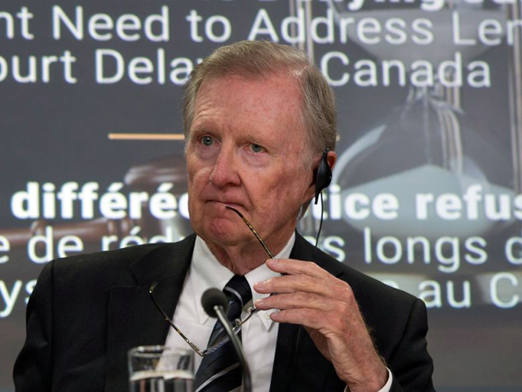 Senator Bob Runciman releases a committee report on court delays in Canada during a news conference in Ottawa, Wednesday June 14, 2017.
In this June 14, 2017 front page story in the National Post, titled “Tens of thousands of criminal trials may be tossed if delays not addressed, Senate report warns”, Post journalist Brian Platt writes …
A damning report from the Senate warns of a loss of public confidence in the justice system due to unreasonable trial delays, and that tens of thousands of criminal cases may be thrown out of court starting next year if action isn’t taken.
The Senate standing committee on legal and constitutional affairs, which toured the country and interviewed 138 witnesses, says the federal government needs to provide judges with other ways to deal with lengthy trial delays beyond a stay of proceedings.
It also says the justice minister (Jody Wilson-Raybould) must address the chronic lag in appointing judges to vacant positions.
The issue of trial delays escalated last summer, when a Supreme Court of Canada ruling known as the Jordan decision, in a ruling read by Chief Justice Beverley McLachlin, established a firm timeframe for when a trial must be completed after a charge is laid: 18 months for a provincial court, and 30 months for a superior court.
“Clearly it hasn’t been approached as an urgent matter,” said Sen. Bob Runciman, the committee’s chair, and former Ontario Solicitor General. He said there were 43 vacancies on the release of their interim report in August 2016; there were 48 on this report’s release.
“We’re almost two years into this government,” he said. “It’s perplexing to us with respect to the snail-like pace.”
A July 6, 2017 CBC story states that, “More than 200 criminal cases across the country have been tossed due to unreasonable delays — including murders, sexual assaults, drug trafficking and child luring, all stayed by judges because the defendant’s constitutional right to a timely trial was infringed” — due to Jody Wilson Raybould’s failure “to speed up Canada’s sluggish courts” by appointing Supreme Court Justices to fill the remaining 48 vacancies across the country.
This Global News story states that, “A shortage of judges … is ‘choking’ Alberta’s court system, a defence lawyer said after a judge threw out a first-degree murder case because it took too long to get to trial.”
Keith Fraser’s December 22, 2017 story in the Vancouver Sun states that, “The shortage of judges on the B.C. Supreme Court remains persistently high, creating ongoing concerns about access to justice.”
For four years, the same story was told over and over again, in every province and territory across Canada, yet Jody Wilson-Raybould didn’t listen, failing to appoint Supreme Court Justices to fill vacancies, bringing the administration of the Canadian justice system into disrepute.
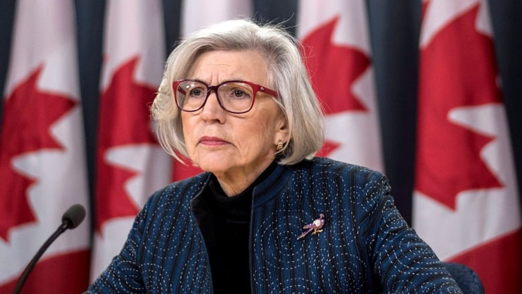 Retired Chief Justice of the Canadian Supreme Court, the Honourable Beverley McLachlin.
During his time in power, Stephen Harper implemented “mandatory minimums legislation,” tying the hands of the courts to rule on a case by case basis. Justices did not look favourably on the legislation.
As part of her mandate, Attorney General Jody Wilson-Raybould was required to introduce legislation that would undo mandatory minimum sentencing, such legislation similar to that recently approved by President Donald Trump, the U.S. Senate and Congress. Readers will not be surprised to learn that the Attorney General failed to introduce such legislation.
We had stated above that the Prime Minister, and members of the PMO, had requested of Jody Wilson-Raybould that she meet with the retired Chief Justice of the Canadian Supreme Court, the Honourable Beverley McLachlin, in order that Ms. McLachlin might explain the relationship between the mandatory minimum legislation, and the reluctance of the courts to rule on cases requiring a mandatory minimum. In fact, in order to avoid having to impose a mandatory minimum sentence, Beverley McLachlin would have told Jody Wilson-Raybould in 98% of cases where a mandatory minimum was involved, those cases were settled out of court, with the remaining 2% finding the defendant not guilty rather than impose an unjust sentence.
The crux of the SNC-Lavalin case was just that — the courts were always going to encourage the parties to settle out of court, resulting in a fine in the billions of dollars and, perhaps, a three-year period when SNC-Lavalin could not bid on contracts let by the federal government.
But Jody Wilson-Raybould thought she knew better, and barreled on ahead.
Tomorrow, VanRamblings will explore in some detail how Ms. Wilson-Raybould injudiciously failed to meet the responsibilities of an Attorney General to seek a variety of opinions, from a broad cross-section of sources, before deciding on a course of action — which, of course, Ms. Wilson-Raybould consistently and insistently failed to do during her tenure.
Kyla Lee | Jody Wilson-Raybould Did A Poor Job As Justice Minister
 Kyla Lee, criminal defence lawyer at Acumen Law Corporation in Vancouver.
Kyla Lee, who you probably recognize from her frequent appearances on the evening news, and for her articles in The Huffington Post, published a recent blog post in the HuffPo, on April 6th, taking Jody Wilson-Raybould to task for failing to properly administer the system of justice during her tenure as Canada’s Attorney General and Minister of Justice …
“Yes, Wilson-Raybould did champion a bill to create a process for medically-assisted dying (ed. note. Although Jane Philpott “didn’t exactly claim credit” for the assisted dying legislation, she did work with Ms. Wilson-Raybould on the drafting of the bill, referencing her work on the legislation — as a correspondent / colleague relates to VanRamblings — as “a point of pride, in her resignation letter.”). However, that legislation is already the subject of challenges before the courts in large part because it arguably doesn’t address the concerns raised by the Supreme Court of Canada in the Carter case. This case found that the ban on physician-assisted death was unconstitutional.
And yes, cannabis was legalized under Wilson-Raybould’s auspices. Or at least, some cannabis was legalized for some people. Meanwhile, medical cannabis was then subject to taxes, sentences increased for certain cannabis-related offences, and access to legal cannabis became very difficult shortly after legalization.
Along with cannabis legalization, Wilson-Raybould brought in legislation that eliminated Charter protections for those accused of impaired driving offences. This, arguably, puts vulnerable people at risk of further interactions with police. It has also been the subject of criticism for the manner in which it will disproportionately affect Indigenous and racialized people.
Other legislation introduced by Wilson-Raybould, such as Bill C-51, reverses the disclosure obligation in criminal trial to an accused person and exposes that person to cross-examination by the complainant. This fundamentally undermines our entire concept of justice in this country.
In Bill C-75, Wilson-Raybould sought to eliminate a right of cross-examination of police witnesses in criminal trials, while also attempting to remove preliminary inquiries from most serious criminal cases and prohibiting peremptory challenges in jury trials.
Remember, too, that while the mandate letter directed Wilson-Raybould to put an end to solitary confinement, under her direction the Department of Justice defended several Charter challenges to the practice of solitary confinement. And when the overuse of this method was struck down by the courts, the Department of Justice filed an appeal and sought a stay of the order permitting them to continue to use solitary confinement while the appeal was pending.
Wilson-Raybould was supposed to oversee the creation and completion of an inquiry into missing and murdered Indigenous women and girls. The inquiry that has occurred has been the subject of numerous scandals, with the resignations of several prominent figures, and timeline extensions well beyond the original two-year deadline. This means that justice and closure for those families, as well as an action plan to prevent further harm to Indigenous women and girls, was significantly delayed under Wilson-Raybould’s watch.
In addition to the above, let us not forget that Jody Wilson-Raybould sought to appoint a conservative justice of Manitoba’s Queen’s Bench into the position of Chief Justice of the Supreme Court of Canada, a justice about whom Mi’kmaq lawyer, professor, activist and politician Dr. Pamela D Palmater stated during a CBC interview … “it is egregious that Canada’s current Minister of Justice would seek to appoint a Chief Justice of the Supreme Court with an appalling record of rulings on reproductive rights, LGBT issues and indigenous issues. What was she thinking?”
Prime Minister Justin Trudeau apparently agreed with Dr. Palmater, when he rejected Wilson-Raybould’s conservative pick for high court.
“Well-placed sources say the former justice minister’s choice for chief justice was a moment of “significant disagreement” with Trudeau, who has touted the Liberals as “the party of the charter” and whose late father, Pierre Trudeau, spearheaded the drive to enshrine the Charter of Rights and Freedoms in the Constitution in 1982.”
Prime Minister Justin Trudeau was well within his rights to seek to move Jody Wilson-Raybould from the position of Minister of Justice and Attorney General, for obvious good reason.
The Prime Minister did offer to make Jody Wilson-Raybould Minister of Indigenous Affairs, asking that she undo the harm of the Indian Act, and fundamentally redefine the relationship of Canada’s indigenous people’s to the state, and the state to our indigenous peoples, working with her friend, the Honourable Jane Philpott to achieve such end.
Ms. Wilson-Raybould emphatically refused such entreaty.
Despite all, Mr. Trudeau wished to keep Ms. Wilson-Raybould in Cabinet, as the only indigenous member of Cabinet, and a woman who he believed was possessed of talent, despite her failings as Attorney General. Mr. Trudeau appointed Ms. Wilson-Raybould as Minister of Veterans Affairs, a position she held for only one week before resigning, one might say in a fit of pique (tinged with a soupçon of arrogance), resigning from the Trudeau Cabinet, while making scurrilous accusations of “interference” by the PMO during her, now truncated, tenure as Minister of Justice and Attorney General.
Tomorrow, on VanRamblings, in Part 3 of this week’s Decision Canada series (there’ll be a fourth part on Thursday) we’ll explore the validity, or lack thereof, of Wilson-Raybould’s untoward contention, as stated above.