Category Archives: #VanPoli Civic Politics

#VanPoli | Meet Vancouver’s Next Mayor | Jody Wilson-Raybould

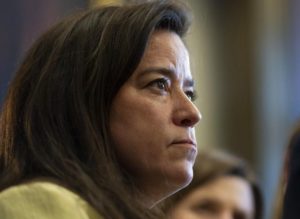
Vancouver’s next Mayor, Jody Wilson-Raybould, principled and a voice for our city, and our nation

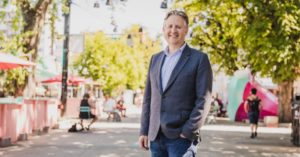
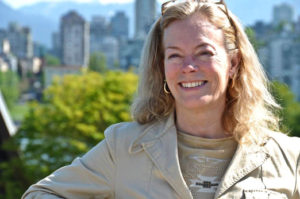
The woman pictured above, former federal Liberal Minister of Justice and Attorney General, Jody Wilson-Raybould — although something of a polarizing political figure, and although she has yet to announce her bid to become Vancouver’s next Mayor — come Saturday, October 15th, 2022 will become Vancouver’s 41st Mayor.

Possessed of great integrity — for which she is justly famous, and highly regarded — incredibly bright, accomplished, articulate and human in a way one rarely finds in the political realm, Jody Wilson-Raybould will likely announce her bid for the Mayor’s chair in early 2022, not out of any cynical calculation, but because Ms. Wilson-Raybould is a protector of our land, our city, and possessed of the kind of integrity that is all too rare in Vancouver politics — which is to say, she’s not involved in politics to enrich her bank account, or find herself beholden to developer interests — but honestly believes that she possesses the innate knowledge on the functioning of government and how best to achieve one’s policy goals, the heart, the humanity and the wit essential to emerge not just as the leader of our city, but a leader across our nation, as Vancouver’s necessary voice on the national stage.

VanRamblings believes that Ms. Wilson-Raybould will announce her candidacy for Mayor in the new year, following a series of meetings with the membership of the Coalition of Progressive Electors — represented by Jean Swanson on Council — and OneCity Vancouver, represented on Council by Christine Boyle.

Given that Ms. Wilson-Raybould is known for doing her homework, and given that affordable housing and human-scale development in Vancouver are key issues of concern for the voting electorate, Ms. Wilson-Raybould will also seek out the learned counsel of Patrick Condon, the James Taylor chair in Landscape and Livable Environments at the University of British Columbia’s School of Architecture and Landscape Architecture, among a host of other academics who care deeply for our city, including Simon Fraser University’s Andy Yan and Josh Gordon, and UBC’s Scot Hein, a highly-regarded former city planner.
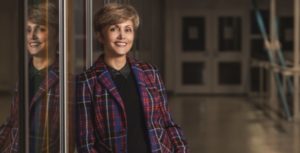
Calgary’s new and first woman Mayor, Jyoti Gondek

Calgary’s new Mayor Jyoti Gondek — the first female Mayor in the city’s history, who on her way to victory, defeated 26 challengers to replace outgoing Mayor Naheed Nenshi; Montréal’s re-elected Mayor Valérie Plante, who defeated incumbent mayor Denis Coderre in 2017, trouncing him again last month.
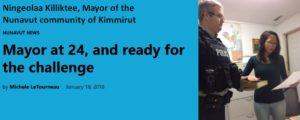
In Nunavut, the Nunavut News stated a new trend had emerged in the territory of young women in politics, as 24-year-old Ningeolaa Killiktee was elected Mayor of Kimmirut, and Pam Gross as Mayor of Cambridge Bay. In the Northwest Territories, one media outlet stated that “Female candidates swept the municipal elections in the NWT,” and the CBC reported the victories of female Mayoral candidates in Hay River, Inuvik, Fort Smith and Yellowknife.
Canadian feminist and Mayor of Ottawa, Charlotte Whitton, was the first woman Mayor of a major city in Canada, serving from 1951 to 1956 and again from 1960 to 1964. Whitton was a Canadian social policy pioneer, leader and commentator, as well as a journalist and writer.

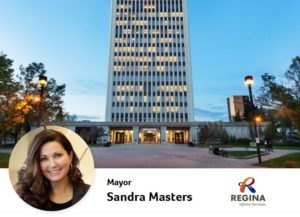
Janice Rhea Reimer became the first female Mayor of Edmonton, Alberta, serving in that capacity from 1989 until 1995. Saskatchewan Mayor Sandra Masters was sworn in as Regina’s 35th Mayor, after having swung to victory as the next year city’s first elected female Mayor, on November 23rd, 2020.
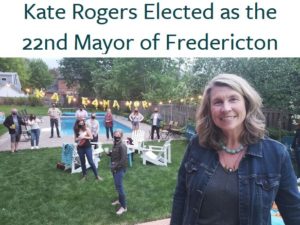
Kate Rogers elected as Mayor of Fredericton in 2020, the first woman to hold the position

Toronto Mayors June Rowland & Barbara Hall, Montréal’s Valérie Plante, Edmonton’s Janice Reimer, Regina’s Sandra Masters, Calgary’s Jyoti Gondek, Ottawa’s Charlotte Whitton, Cambridge Bay’s Pam Gross & Kimmirut’s Ningeolaa Killiktee, Halifax’s Moira Leiper Ducharme (1991-1994), Charlottetown’s M. Dorothy Corrigan, St. John’s Suzanne Duff, and Fredericton, New Brunswick’s current Mayor, Kate Rogers — all duly-elected Mayors of Canadian cities.

Whither Vancouver?

Every Mayor of Vancouver, from Malcolm A. MacLean in 1886, through until Kennedy Stewart today, have been white men of privilege more often than not elected to serve the monied interests of our city. Why is it that in 135 years, the good citizens of Vancouver have never seen fit to elect a woman as Mayor of our city, when almost every other city in Canada has seen fit do do so?

In all likelihood, Vancouver City Councillor Colleen Hardwick will throw her hat into the ring to become Vancouver’s next Mayor.

Rumour has it, too, that former Vision Vancouver Councillor Andrea Reimer is considering a bid to become Vancouver Mayor. VanRamblings’ sources have told us Coalition Vancouver’s Wai Young is set on running for office, as Mayor, in next year’s Vancouver civic election.
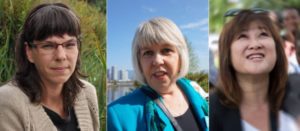
Andrea Reimer, former Vision Councillor (l); Adriane Carr, Green Party; Wai Young, Coalition Vancouver

The Green Party of Vancouver’s Adriane Carr is also reportedly considering a run for Vancouver’s top elected office next year.

And there remains to this day, the persistent rumour that current populist and well-schooled Vancouver City Councillor Sarah Kirby-Yung may also run for office as Mayor in next year’s municipal election.

A surfeit of qualified women candidates for Mayor of Vancouver, any one of whom would well represent our city, should she be elected to the office of Mayor in the 2022 Vancouver civic election, only 321 short days from today.
#VanPoli | The 2022 Mayor’s Race | They’re Off and Running | Part 2

Colleen Hardwick, TEAM Vancouver, running against incumbent Mayor, Independent, Kennedy Stewart

In the next month or so, current and sitting independent Vancouver City Councillor Colleen Hardwick — who is at present seeking the Mayoral nomination with the recently-formed Vancouver municipal political party team … for a livable vancouver — will, in all likelihood, announce at the end of the nascent civic party’s upcoming AGM that she has won the TEAM Mayoral nomination, and will officially announce her bid to become Vancouver’s next Mayor, on Saturday, October 15, 2022.

Colleen Hardwick’s platform?

The platform has occurred as a function of a series of policy meetings TEAM conducted on October 24, 2021. VanRamblings would understand that Ms. Hardwick and the TEAM candidates who will soon be announced will prioritize …

  • A return to neighbourhood democracy, where residents in the 22 neighbourhoods across Vancouver will be empowered to formulate policy affecting their neighbourhood, and will be listened to when decisions are taken at Vancouver City Hall;
  • A move away from podium and high-rise tower-driven plinth construction, in favour of medium-and-low-rise, largely wood frame townhouse, affordable apartment and rowhouse construction, along arterials, and along some residential streets;
  • At Park Board, a re-prioritization of elected Park Board Commissioners as stewards of our parks and recreation system, while working to develop policy to strengthen our community centres, and developing new public pools and parks;
  • A commitment to sustainable fiscal management at City Hall that will reduce annual property tax increases, while prioritizing the delivery of core city services;
  • Arts & culture, transportation, reconciliation, public safety and security, finance and administration, economic development, climate emergency, and School Board policies that were decided on at the October 24, 2021 TEAM Policy Conference, and set to be announced at the upcoming team … for a livable vancouver AGM.

The team … for a livable vancouver AGM will take place either before year’s end, or early in the New Year / first quarter of 2022.

According to a Research Co. poll published in The Vancouver Sun on June 23rd, early pre-election polling has incumbent Mayor Kennedy Stewart with an almost insurmountable lead, and a 49% approval rating among the Vancouver electorate.

Note should be made that the Research Co. poll was commissioned by the Vancouver and District Labour Council , which represents more than 100 Vancouver-based unions. The Labour Council endorsed Kennedy Stewart as their Mayoral candidate in the 2018 election, and has announced their intention to do so again in the lead-up to the 2022 Vancouver municipal election.

Not everyone is thrilled with Kennedy Stewart, though.

Mike Howell, longtime and well-respected Vancouver civic affairs columnist, in a column published in Vancouver is Awesome, posted the question, Why is a former Vancouver councillor bringing developers to meet the mayor?

“Former Vancouver City Councillor Raymond Louie has been advocating for some of the city’s high-profile developers and joining them in a series of private meetings at City Hall with Mayor Kennedy Stewart. Louie participated in seven meetings in February and March in the Mayor’s office, which included Ian Gillespie of Westbank Projects Corp., Bruno and Peter Wall of Wall Financial Corporation, and Brian McCauley of Concert Properties.

Louie, who served 16 years on Council with COPE and Vision Vancouver before retiring (prior to the 2018 election), also met three times by himself with Stewart, according to the mayor’s monthly calendars posted on the city’s website. The frequency of Louie’s visits to City Hall are in contrast to a major plank of Stewart’s election campaign in which he called for new conflict of interest and lobbying rules for elected officials and senior staff members.”

Meanwhile, The Tyee’s Paul Willcocks took Stewart to task last year for his “painfully lame” response to police reform.

“There are 11 municipal police forces in B.C., including Vancouver … Stewart chairs the 9-member Vancouver Police Board, but he’s the only elected and publicly accountable member. The Police Act says Police Boards are responsible for determining the ‘priorities, goals and objectives of the municipal police department.’ But they are also required to “take into account the priorities, goals and objectives of the Council of the municipality.”

If Stewart and Vancouver’s Councillors agreed on measures to combat systemic racism — and shared them publicly — the Police Board would have to respond, or be held to account. That doesn’t take (a provincial government) review, as Kennedy Stewart suggested. No. It just takes leadership.”

VanRamblings believes Kennedy Stewart to be Vancouver’s worst, most inept Mayor since Jack Volrich was elected Mayor in the late 1970s.

Kennedy Stewart has proved throughout his term in office to be a feckless leader, given to whining about a “lack of support” from senior levels of government on the housing file, objectively the worst Mayor of any major Canadian city when it came to responding to the COVID crisis we’ve been living through over the past 20 months, and given to taking positions on issues that rather than serve the public interest, serves the plundering interests of Vancouver’s development community.

Two examples of how Kennedy Stewart serves the development community, rather than interests of all of us who call Vancouver home …

Councillors reject Christine Boyle & Kennedy Stewart’s developer-friendly motion

On May 28th, Vancouver City Councillor Christine Boyle brought forward a controversial motion that would allow projects up to 12 storeys to be built across the city, sans public hearing and community input, a proposal Boyle had worked closely on with Mayor Kennedy Stewart before bringing it before Vancouver City Council.

Boyle and Stewart’s cynical proposal called on the City’s Planning Department to come up with suggestions that would allow 12-storey, so-called ‘social housing’ developments in areas designated for apartments, without the benefit of a public hearing that would allow neighbourhood resident comment. The following Vancouver neighbourhoods would have been impacted were Boyle’s and Stewart’s motion to pass: Fairview, Grandview-Woodland, Hastings-Sunrise, Kensington-Cedar Cottage, Kitsilano, Marpole, and Mount Pleasant.

The Coalition of Vancouver Neighbourhoods posted a statement online on May 16th in opposition to Boyle’s and Stewart’s motion.

“This will increase development pressure, increase rental inflation, gentrification, demovictions, and displacements for existing older more affordable rental buildings,” the coalition said. It noted that existing rents in older buildings “tend to be much lower than new rentals, sometimes even lower than typical subsidized social housing rents, while existing older units are also generally larger”.

The Coalition also reiterated its longstanding objection to the city’s definition of social housing that allows 70% of the units at market-rate rents, but counts entire projects as 100% social housing “when it is mostly market rents”.

“It’s the carrying on of the policies that were established during the Vision administration, and the staff who was in place then is still in place now, and is simply carrying on with these things,” Larry Benge of the Coalition said, “and unfortunately, staff is directing the way this Council is approaching housing policies.”

Boyle and Stewart’s motion offered a cynical sinecure to the development industry that would allow developers to designate an entire building as ‘social housing’, when in fact, 70% of such proposed units within a 12-storey tower would be made available at market rental rates (generally $2150 for a studio, $2575 for a 1-bedroom, $3100 for a 2-bedroom, $3722 for a 3-bedroom), with the remaining 30% of units available at 20% below the going market rates, rather than the much more affordable 20% below CMHC-determined median rental rate — resulting not only in unaffordable housing units for the vast majority of Vancouverites, but creating unnecessary, counter-productive land inflation across the city.

When the motion failed (miserably) — as well it ought to have —  both Mayor Kennedy Stewart and Councillor Christine Boyle’s OneCity Vancouver municipal party sent out withering funding letters to their supporters, derisively calling out those who had voted against this ‘very important equity motion’.

Balderdash.

The bottom line, for the beleaguered citizens of Vancouver: the majority of Vancouver City Councillors saw through Boyle’s and Stewart’s cynical, developer-friendly ruse, voting against the Boyle/Stewart motion, voting in favour of democratic citizen engagement in the planning processes in our city’s neighbourhoods.


REJECTED | City of Vancouver Real Estate Department Plan for False Creek South

When the City of Vancouver’s Real Estate Department put forward a proposal to Vancouver City Council that would have laid waste to False Creek South, and turned this friendly, low-and-medium-rise townhouse and four-and-six storey apartment-style, and largely housing co-operative neighbourhood into a mirror image of the podium and high-rise tower-driven plinth False Creek North neighbourhood, Mayor Kennedy Stewart was first out of the gate to sing the praises of …

“The new False Creek South Plan”, Stewart wrote, “will add more than 4,600 new below-market and market rental, strata, and co-op homes, so thousands of more Vancouver residents can enjoy the benefit of these publicly owned lands. Great cities like ours can never stand still. We must always examine whether our city is meeting our needs, both for today and tomorrow.”

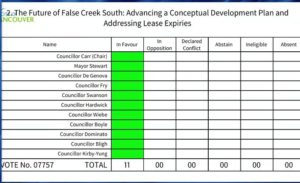
Too bad that the 171 articulate and informed speakers who appeared before Council to denounce the Plan were so moving Council unanimously rejected the Plan, preserving the heart of our city for generations to come. Notice how in the graphic below, Kennedy Stewart has ‘changed his mind’ on the appropriateness and efficacy of the City’s greed-driven plan for False Creek South.

Kennedy Stewart’s last minute change of heart: rejects greedy False Creek South Plan

As might be expected, one of Kennedy Stewart’s main rivals for Mayor of Vancouver in 2022, the very bright and principled Mark Marissen, takes the Mayor to task for re-announcing and re-launching proposals already soundly rejected by Council. “This is not leadership,” writes Mr. Marissen.

Seems that other of Vancouver citizens — you know, the ones that Research Co. didn’t call — are among the many who find Mayor Kennedy Stewart wanting, in the integrity and climate emergency departments …

Make no mistake, Kennedy Stewart retaining power at Vancouver City Hall for a 2nd term will prove no easy task, for reasons other than you’ll find above. That issue, though, will be the topic of Thursday’s VanRamblings column.

#VanPoli | Vancouver’s Woebegone City Council | Election Day Oct. 15, 2022

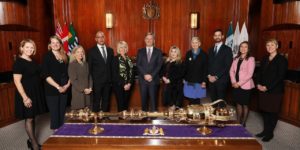
Vancouver City Councillors, l-r, Rebecca Bligh, Christine Boyle, Colleen Hardwick, Pete Fry, Adriane Carr, Mayor Kennedy Stewart, Melissa De Genova, Jean Swanson, Michael Wiebe, Lisa Dominato, and Sarah Kirby-Yung

Only eleven short months — or, 324 days — from today, about 40% of Vancouver’s exorcised voters will go to the polls to elect the candidates for office who will sit as Vancouver City Councillors from November 2022 through until November 2026.

Despite all their hard work, if history proves a predictor, a good portion of the smiling Councillor faces you see above will not be re-elected to Vancouver City Council, a cruel fate for those Councillors who’ve worked so hard to make our city a fairer and a better city, a home within which to reside, and to raise our beloved children.

In 2018 , after ten years in power, Vision Vancouver failed to elect / re-elect any Vancouver City Councillors. In 2014 , Vision Councillor Tony Tang was not re-elected to a second term. In 2011,  COPE City Councillor Ellen Woodsworth lost out to first time candidate, the Green Party of Vancouver’s Adriane Carr, who bested Ms. Woodsworth by a mere  87 votes. In 2008 , incumbent NPA Councillors Kim Capri and Elizabeth Ball were not re-elected to a second term on Council.

In 2005, a year of change, COPE Councillors Dr. Fred Bass, Tim Louis, Anne Roberts and Ellen Woodsworth failed to gain re-election to Council.

COPE sweeps the 2002 Vancouver municipal election, electing 8 of 10 City Councillors, and Mayor Larry Campbell

The Coalition of Progressive Electors (COPE) swept the 2002 Vancouver civic election , winning 8 of 10 Council seats, 7 of 9 School Board seats and 5 of 7 Park Board seats. The Non-Partisan (NPA) was reduced to 2 Council seats, 1 School Board seat and 2 Park Board seats. Vancouver’s Green Party won 1 School Board seat.

Most political observers believe that 2022 will be a year of significant change at Vancouver City Hall, with the likelihood that come late in the evening of Saturday, October 15, 2022 change at Vancouver City will have been wrought.

Political pundits portend that Vancouver will have elected a new Mayor (we’ll write about those prospects on Tuesday and Wednesday), and a more activist Vancouver City Council, the members of which Council will dedicate themselves to serving the majority interests of residents throughout all of Vancouver’s 22 diverse neighbourhoods. Most particularly, renters, and those in search of, or requiring, affordable housing — defined as 20% below the median rate as determined by the Canada Mortgage and Housing Corporation, where a person would spend no more than 30% of their income to keep a roof over their heads. Construction that better and more honestly reflects the incomes of 90% of Vancouver residents, rather than the 10% of high income Vancouver residents,  current condominium, duplex,  and purpose-built rental construction accommodates.

“Come October 2022, I believe we’re going to see a revolution at Vancouver City Hall,” predicts Patrick Condon, the James Taylor chair in Landscape and Livable Environments at the University of British Columbia’s School of Architecture and Landscape Architecture. “Such a new, activist Council will approve sustainable low-rise and mid-rise wood frame buildings built on city-owned land, consisting mostly of housing co-ops that provide security of tenure, where seniors and diverse families will be housed, those individuals or couples earning the median wage of $50,000 – $63,000. Where no one would have to pay more than 30% of their income to live their home.”

Vancouver could very well be facing a major electoral change in 2022, as it did 20 years previous, electing a Mayor and Vancouver City Council of almost entirely newly-elected officials — dedicated to serving all of the diverse communities in neighbourhoods across our city, a Council committed to slow growth and gentle density, dedicated to affordable low-and-medium-rise wood frame buildings over podium and high-rise tower-driven plinth construction, as well as social housing that meets the needs of the many rather than the few, with new parks throughout the city, as well as more new and renewed publicly-owned recreation centres.

#VanPoli | Vancouver 2050 | The City of the Future

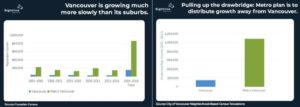
A draft 30-year plan calls for limiting growth in Vancouver, and pushing new residents to the suburbs

All development decisions within the City of Vancouver that are currently being made by senior staff employed within the city’s Planning Department — currently slated to add more than 100,000 new residents to Vancouver, over the course of the next 30 years — is predicated on a rate of population growth that many commentators, and the most recent figures published by Statistics Canada, don’t jibe with population growth projections that are being made at Vancouver City Hall.

In an article published in The Vancouver Sun this past weekend, reporter Douglas Todd writes …

“In recent years about 12,000 more people have been annually moving out of Metro Vancouver for other parts of B.C. than have been moving into the metropolis. The vast majority of new arrivals into Metro Vancouver are foreign-born immigrants.”

Todd goes on to quote former provincial NDP MLA and current two-term Nanaimo Mayor, Leonard Krog.

“We have had lots of people from Alberta and the East cashing out and moving to Nanaimo — to get away from the crush and the smoke,” says Krog. “People are also fleeing Vancouver, and the Lower Mainland. Now it’s more common for people to ask why would you stay in the Lower Mainland when you can cash out on your $2-million house on a crowded Burnaby street, or $3 million Vancouver home and get a great $1 million home in Nanaimo?”

Krog says newcomers are pouring into Nanaimo for several reasons — affordable housing, less density, and a higher-quality lifestyle. “The strong overall shift of residents from other provinces, and from Vancouver or Metro Vancouver, to smaller B.C. cities, which have more young adults, is unsurprising,” writes Douglas Todd.

“Nanaimo’s rapid growth of two per cent a year”, Krog says, “is a result of a ‘perfect storm’ of conditions, including the attractiveness of the region’s oceanfront, university, airport, nearby ski mountains, climate and a lower cost of living.”

“It has all been amplified by the pandemic,” he said. “COVID-19 is helping many across Canada and in other parts of B.C. realize they might be able to permanently work out of their homes. So why not do it in a place that is pleasant and somewhat more affordable?”

If as lawyer, writer, and and community organizer Daniel Oleksiuk writes on the Sightline Institute website that population growth in Metro Vancouver will occur in the Metro Vancouver suburbs, and not in Vancouver, and if Nanaimo Mayor Leonard Krog is correct in his assertion that rather than remain in Vancouver, families are instead opting to move to smaller, more affordable cities such as Nanaimo, how can the Vancouver Planning Department justify a growth strategy, population growth projections, and the consequent tower-driven densification projects they are currently presenting to the members of Vancouver City Council for approval?

At Issue: Form of Development, and the Livability of Vancouver

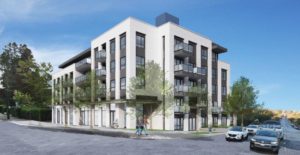
Artistic rendering of the Esso gas station site at 3205 Arbutus, redeveloped into a mixed-use building

A deep issue of concern that has arisen for many, as Vancouver’s  Planning Department presents their plans to City Council, is “form of development”.

For the most part, if you take a look at many of the projects VanRamblings wrote about yesterday, they adhere to the ‘development at all cost’ ethos of the now discredited former Vision Vancouver civic administration, who were roundly and wholly turfed from office in the 2018 Vancouver municipal election: a plethora of greenhouse gas-emitting podium and tower-driven developments — whether they be in the northeast “forest of condos” False Creek neighbourhood, the newly-reimagined Oakridge Centre or nearby Heather Lands development, or in the southern sector of the Grandview Woodland neighbourhood’s ‘Safeway site’.

The question must be asked: whatever happened to the notion of ‘gentle density’?

Why is it that rather than construct high-rise condominum towers all along the Broadway Corridor, from Clark Drive all the way out to UBC, could we not opt instead for the kind of low-rise building illustrated directly above, in the proposed, neighbourhood friendly project located at West 16th Avenue and Arbutus Street?

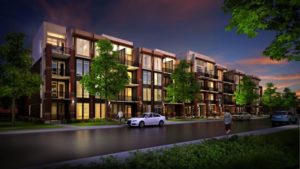
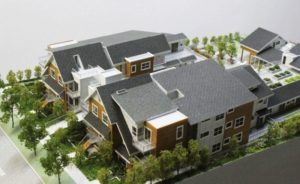
Artistic rendering of a planned, environmentally-friendly wood construction building

Perhaps of even more importance to the stewards of our environment who sit on Vancouver City Council, why not mandate that future home construction be built employing sustainable, carbon-storing cross-laminated timber —  glued at perpendicular angles to make thick beams, and clearly visible in columns, beams, walls and ceilings? Wood construction has proven popular across a broad section of our developer, architect and contractor communities, who see building with wood as a way to increase density at a lower cost, while reducing environmental impact.

Now, that would be an innovation for our Vancouver City Council to truly consider.

Rowhouses such as the ones above are common in many cities around the world, but not in Vancouver

And what of fee-simple row housing , which architect Michael Geller argues for in an interview conducted by Carlito Pablo, in the October 6, 2021 issue of The Straight?

“In a fee-simple rowhouse or townhouse, there’s nothing owned by the association. The owners own their roof, their windows, the land under and around their townhouse. That means the individual owners are responsible for taking care of any lawn, painting the outside, fixing leaks in the roof, and shoveling the snow.”

Whatever happened to the notion of human-scale, gentle density townhouse construction, all the rage 40 & 50 years ago? Why, in recent years, has townhouse construction fallen so out of favour, as podium and high-rise tower-driven plinth construction has become the greenhouse gas-emitting building forme de la journée?

Vancouver Co-Housing, located on 33rd Avenue between Victoria Drive and Knight Street

And what about co-housing in Vancouver, housing that is family-supportive, senior-friendly and energy-efficient? For instance, Vancouver Co-Housing consists of 29 privately owned, fully equipped homes plus 2 rental units, in addition to a large and beautiful common house and outdoor common areas. This vibrant community is located on East 33rd Avenue between Victoria Drive and Knight Street.

The homes range from studios to one-, two-, three- and four-bedroom units – all with their own kitchens. The common house has an area of 6,500 sq ft. and includes a community kitchen, dining room, and lounge; activity rooms for children and teens; office areas; two guest rooms; a yoga studio; and rooftop gardens. As well, there are ground-level gardens, workshops, plus a courtyard and play area that encourage year-round social contact. All parking is underground.

By working together, Vancouver Co-Housing members are able to share amenities common to a traditional home and reduce the size of their private dwelling.


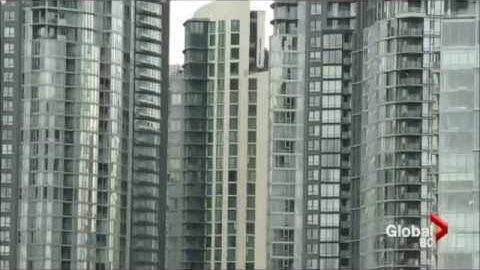
A 2014 Global BC video, identifying Vancouver as one of the high-rise capitals of the world

On July 24, 2014, during the lead up to the Vancouver civic election that year, VanRamblings published a column titled At Issue: Form of Development, and the Livability of Vancouver, which quoted a 2012 study conducted by University of British Columbia Chair of Urban Design and Landscape Architecture, Patrick Condon, addressing the question of how Vancouver might reasonably approach the reduction of energy use and consequent greenhouse gas production in the city by at least 80 per cent by 2050, and how that goal might be accomplished.

The answer: the construction of compact, low-rise structures across the city, along its arterials and throughout its neighbourhoods, as a greener, more workable, more energy-efficient alternative to the present form of high-rise development that so captured the imagination of Vision Vancouver, as seems to be the case with our present Council. That 2014 VanRamblings column is well worth reading.

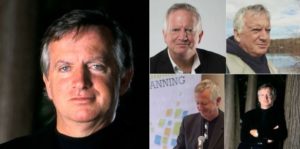
The indefatigable Patrick Condon, future — and absolutely necessary — Vancouver City Councillor

Again today, VanRamblings will leave you with the words of Patrick Condon …

“While it is true that high-rises, when combined in large numbers, create GHG-efficient districts, the buildings themselves are not as efficient as mid-rise buildings.

“High-rises are subject to the effects of too much sun and too much wind on their all-glass skins. And all-glass skins are, despite many improvements to the technology, inherently inefficient. Glass is simply not very good at keeping excessive heat out, or desirable heat in. High-rises, according to BC Hydro data, use almost twice as much energy per square metre as mid-rise structures.”

“High-rise buildings built largely of steel and concrete are less sustainable than low-rise and mid-rise buildings built largely of wood; steel and concrete produce a lot of GHG. Wood traps it. Concrete is 10 times more GHG-intensive than wood.”

Patrick Condon argued with heart and with purpose in 2014, as he does through until today, for the construction of thousands of primarily mid-rise wood frame mixed use commercial / residential buildings on Vancouver’s arterial streets.

And, most importantly, Patrick Condon argues for the retention of existing neighbourhood quality, and the supply of sufficient units to house the burgeoning wave of our elderly population, housing for young families, housing equity, and neighbourhood preservation, through the gentle infill of existing residential streets.