Category Archives: Vancouver

Meeting Courage with Courage: Valuing Women’s Lives in Politics

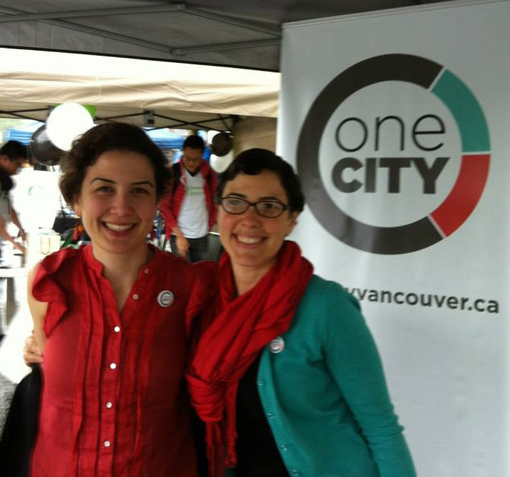
Mia Edbrooke and Kyla Epstein of One City Vancouver, two of the seven women who released the statement 'Meeting Courage with Courage: Valuing Women's Lives in Politics'Mia Edbrooke & Kyla Epstein, co-authors of Courage: Valuing Women’s Lives in Politics

The following statement was issued by One City Vancouver, on July 23rd …
Meeting Courage with Courage: Valuing Women’s Lives in Politics
Of the fifteen One City Organizing Committee members, seven of us are women under the age of forty.
Needless to say, the sudden resignation of Trish Kelly as a Vision Vancouver Park Board candidate has, as they say, hit close to home.
The seven of us are the daughters of women who, since the sixties and seventies, have fought for a seat at the table — and in many cases, won.
We are recognized for our work and are valued for our participation in our communities. Many of us have partners who do their share of the housework, and most of us have or will take maternity leaves and other hard-won benefits. We see people like us in positions of power. We also know that there are fights yet ahead. Women working in and out of politics face judgment based on their appearance, age, family situation, gender identity and sexuality, far more than men do. As younger women, many of us have had to fight harder than men do to legitimize ourselves in the workplace and in our community lives. This struggle broadens our perspective, sharpens our compassion, and brings us together. We simply can not afford to remain silent on this matter. There is too much at stake.
The seven of us know that, should we decide to run for public office one day, we can expect to see any number of things dredged up, especially in the feeding frenzy that is social media. Perhaps it will be over some article we wrote in university; whom we dated, or whom we didn’t date; whether it’s okay for a woman with younger kids to enter into public life; images of us dancing on an art car at Burning Man; private photos that we took with a former partner; our hair, our weight, our clothes, or whether we’re shrill and angry when we assert our position on an issue.
It takes a courageous woman to stand for election, to declare that her voice has worth, in the face of such attacks.
For real social change, institutions need to meet the courage of these women candidates with courage of their own — to stand with women through personal attacks, and to call out the attackers.
At One City, we found it chilling that the decision-makers who hold power at Vision failed to act to affirm their support for Trish Kelly.
Political parties need to say loudly and repeatedly that a woman’s (or anyone’s) appearance, private life, gender identity and sexuality do not diminish their worth as a candidate. In fact, progressive political parties need to fully embrace the diversity and sex-positive activism of women.
We want to build a world where women candidates’ whole lives are valued, where a woman’s history, experiences, and choices are recognized as making her the person she is today.

Alison Atkinson; Anna Chudnovsky; Cara Ng; Christine Boyle; Kyla Epstein; Mia Edbrooke; & Thi Vu. Members of the One City Organizing Committee

VanRamblings Announces Campaign to Buy Vision Vancouver

Buy Vision Vancouver

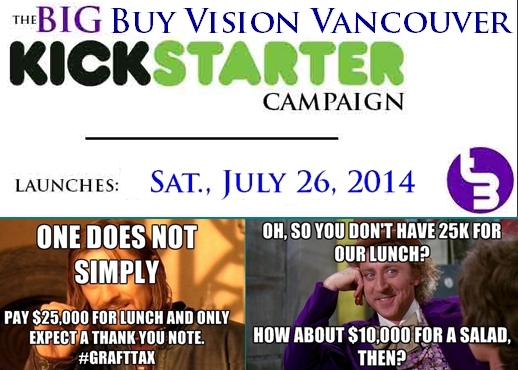
VanRamblings would like to announce today, the creation of a Kickstarter campaign to Buy Vision Vancouver.
As part of VanRamblings’ one billion dollar Kickstarter campaign, at the time of his resignation, on or before November 14th, Mayor Gregor Robertson would receive the sum of $5 million; thereafter, Mr. Robertson would receive the sum of $1 million per year, for a period not to exceed 75 years.
Current Vision Vancouver City Councillors, as well as the new Vision Vancouver Council slate member, and the lone incumbent Vision Park Board Commissioner seeking re-election in 2014, would receive an immediate payment of $1 million at the time of their resignations, plus the sum of $200,000 per annum for a period, again, not exceeding 75 years.
The campaign will also provide $10 million to Trish Kelly — just because.

The offers made above do not extend to the members of the Vision Vancouver Board of Education. Vision Vancouver members of the Board of Education will have to run under a banner other than Vision Vancouver.
At the conclusion of a successful Buy Vision Vancouver Kickstarter campaign to raise one billion dollars, in addition to the payments made to sitting members of the Vision Vancouver caucus, VanRamblings would seek to make available an immediate payment of $1 million to each of the core members of the Vision Vancouver campaign team.
VanRamblings is fully cognizant that such a campaign, and the proposed commitment of monies that is suggested above, would most probably find competition from Joel Solomon, the Tides Foundation, and Vancouver-based developers, including Wall Corp., Westbank, Polygon, Concord Pacific, and others, but we feel well assured that in raising the sum of one billion dollars that we would be fully able to meet any prospective competitive bid for the attention of members of the Vision Vancouver team.
As part of VanRamblings’ Kickstarter campaign to Buy Vision Vancouver, and given that Vision Vancouver would no longer run for elected office in 2014, or in the future, and so as to ensure that come November 15th there is no municipal party that might gain a majority foothold at City Hall, the campaign would make available to each of the Coalition of Progressive Electors and the Green Party of Vancouver, the sum of $6 million, in order that both of these municipal parties would find themselves well-funded and able to compete fairly for the voters’ attention — fair’s fair, after all.
Just go to www.LetsBuyVisionVancouver.ca.
If you want to see this happen, if you want to be rid of Vision, make a pledge for whatever you can afford, $5, $10 — just keep in mind, we need one billion dollars! Gifts for those who donate: for $10,000, you can enjoy a 1-week summer vacation in Stanley Park; for $25,000 you get to spend the day with VanRamblings, which as we all know, is every person’s dream.
With Vision Vancouver having withdrawn from the electoral process, on November 15th we could all look forward to the election of a government of municipal unity, most probably comprised of members of the Coalition of Progressive Electors, the Green Party of Vancouver, and the Non-Partisan Association — with no municipal political party gaining a majority at City Hall, or Park Board. Thereafter, the good citizens of Vancouver may well look forward to the return of good government at City Hall, and Park Board.
Addendum: In the interests of transparency, it is necessary contributors to the Buy Vision Vancouver Kickstarter campaign understand that VanRamblings would receive a small administrator’s fee out of the monies raised from the Buy Vision Vancouver Kickstarter campaign, such monies not to exceed $1 million per year — adjusted for inflation, of course.

kickstarter-support.jpg

star.jpg star.jpg star.jpg

Settle down now. We’re kiddin’. We’re joshin‘. Just havin’ a little fun. There’s no Kickstarter campaign to buy Vision Vancouver. What’s that? Ah, all right, I see (“They’re already bought-and-paid for” — hmmm, if you say so). That’s it. Nothin’ to see here folks, move along now.

At Issue: Form of Development, and the Livability of Vancouver

For VanRamblings the single most important issue that voters will address in the 2014 Vancouver municipal election is: form of development. The key question in this civic election: what kind of city do we want going forward?

Form-based code addresses the issues of land use, urbanism, building structure (i.e. low and mid-rise vs tower), heritage preservation, the scale and types of streets and blocks that we live on, development density, design guidelines and neighbourliness, transportation infrastructure, affordable housing, the development of green space and the accessibility of our community recreation centres, and perhaps most importantly of all, community visioning, neighbourhood consultation, and community planning.

Almost all of the civic issues related to form-based development are addressed by, and are almost solely within the purview of, our city government through the adoption and enforcement of municipal regulation.

The Greening of Our City: Envisioning Vancouver’s Future

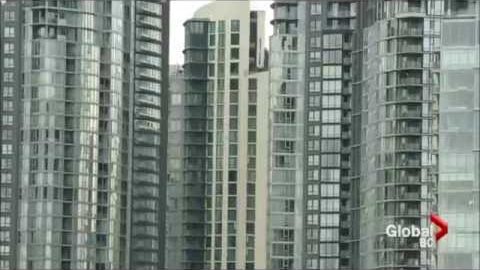
Vancouver ranked 9th for number of towers

At present, with a majority Vision Vancouver government at City Hall, we have a municipal administration that is more strongly tied to the concept and practice of high density, podium and tower high-rise development — as if Vision Vancouver is deep into the pockets of Westbank, Wall Corp., Concord Pacific, Polygon, and a handful of other large development companies — than any Vancouver city government since the woeful days of Terrific Tom Campbell’s ‘development at all costs’ municipal administration.

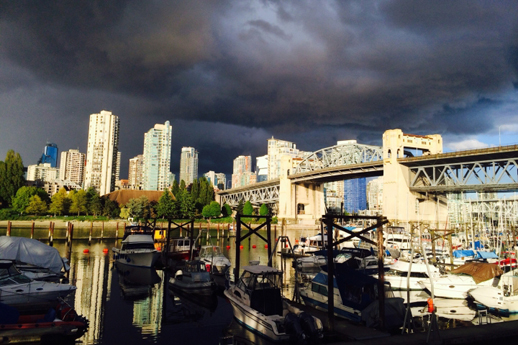
Under a Vision Vancouver civic administration, over the past six years, our city has become almost unrecognizable from the city we have so long loved as the pace, and podium and tower form, of development has cloaked and distorted the concept of the livability of our city, almost beyond imagining.

star.jpg star.jpg star.jpg

Low-Rise Buildings in Vancouver, a Green Alternative to High-Rises

In 2012, working with a group of fourteen landscape architecture and three planning students, Patrick Condon — University of British Columbia Chair of Urban Design and Landscape Architecture — addressed the question of how Vancouver might reasonably approach the reduction of energy use and consequent greenhouse gas production in the city by at least 80 per cent, by 2050, and how that laudatory & necessary goal might be accomplished.

The answer: the construction of compact, low-rise structures across the city, along its arterials and throughout its neighbourhoods, as a greener, more workable, more energy-efficient alternative to the present form of high-rise development that has so captured Vision Vancouver’s imagination.

Dr. Condon and his students wrote that with the expansion of the footprint of the West End and Yaletown towers into neighbourhoods across the city:

First, if you follow that approach you end up with two cities. A city of gleaming glass towers spread like beads on the string of the Skytrain line, disconnected with the surrounding areas they overshadow.”

“Second, it sentences neighbourhoods between stations to a future of slowly aging residents, gradually shrinking populations, more empty classrooms, restricted access for young families, fewer commercial services, and an increased dependence on the car to get around.”

Third, “While it is true that high-rises, when combined in large numbers, create GHG-efficient districts, the buildings themselves are not as efficient as mid-rise buildings. High-rises are subject to the effects of too much sun and too much wind on their all-glass skins. And all-glass skins are, despite many improvements to the technology, inherently inefficient. Glass is simply not very good at keeping excessive heat out, or desirable heat in. High-rises, according to BC Hydro data, use almost twice as much energy per square metre as mid-rise structures.”

Fourth, “While high-rises are an attractive option now, how will they age? And how adaptable are they to changes in family circumstances.”

Fifth, “High-rise buildings built largely of steel and concrete are less sustainable than low-rise and mid-rise buildings built largely of wood; steel and concrete produce a lot of GHG. Wood traps it. Concrete is 10 times more GHG-intensive than wood.”

Sixth and last, our guest lecturers made us painfully aware that people living in single family homes do not appreciate high-rises as neighbours. Politically, it is a nonstarter. So the prospect of supplying the tens of thousands of housing units that our young families and elderly need through the construction of high-rise structures seems naive at best.”

Dr. Condon and his students explored an alternative strategy.

What might happen if the population of the city doubled, and all new residents were placed in areas outside of the downtown core, avoiding wherever possible the problematic high-rise? The outcome?

  • The retention of existing neighbourhood quality, the supply of enough units to house the burgeoning wave of elderly, energy efficiency, housing for young families, housing equity, and neighbourhood preservation through the gentle infill of existing residential streets.

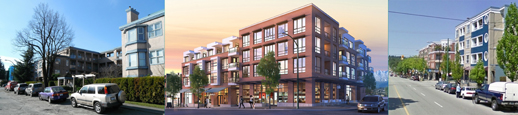
  • The construction of tens of thousands of primarily mid-rise wood frame mixed use commercial / residential buildings on arterial streets.

Typically, four-storey structures replace rudimentary one-storey commercial buildings. When completed, the same or similar commercial enterprises re-occupy the ground floor commercial space. As units are gradually added, neighbourhood commercial services and transit become more viable, as thousands of new potential customers live near bus or streetcar stops, and commercial services. Such a salutary scenario offers particular benefit to (the fastest growing portion of the population) elderly residents, who would have the advantage of walking distance access to transit stops, neighbourhood clinics, inexpensive cafés, and social support facilities.

star.jpg star.jpg star.jpg

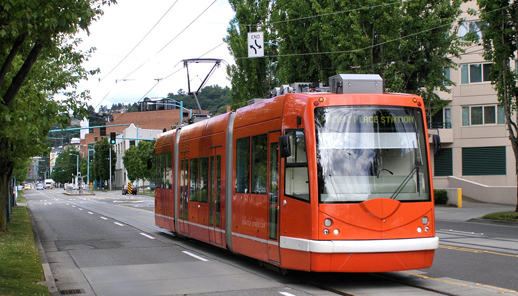
Vote for low-rise, human-scale development. And, streetcars.

VanRamblings has just begun the conversation on form of development.

In the coming months, we will be return to the subject again and again and again, as in the next instalment we set about to explore streetcar development as a workable, human-scale alternative to Vision Vancouver’s ‘too developer-friendly for words’ dark-and-dreary tunnel down Broadway.

Patrick Condon. “For the cost of one Skytrain tunnel along Broadway, the city could build a streetcar infrastructure across the entire region.”

Are you listening, Non-Partisan Association (in particular, you, Mr. LaPointe), Coalition of Progressive Electors, Green Party of Vancouver?
The Greens’ Stuart Mackinnon Blogs on Parks and Recreation

Better Parks, Stuart Mackinnon

July? Must be the silly season in Vancouver politics

Being an election year, this summer is a lot more political than usual. In non-election years the local press often has difficulty finding stories of interest on the civic scene. Not this year. Not a day goes by that there isn’t some sort of story to shake things up.
What seems lost in most of these stories is what I think is most important to voters: Vancouver. Not infidelity, not youthful exuberance, not the internal machinations of giant political machines. Vancouver. The city and its problems. Its future. Its plans.
I hope we can all get back to what is important soon. For me and for this blog that would be parks and recreation. I hope that in this year’s election we can have a real debate about what the Park Board actually does. The Park Board website describes it this way:

“exclusive possession, jurisdiction, and control over more than 230 public parks in Vancouver and a large public recreation system of community centres, pools, rinks, fitness centres, golf courses, street trees, marinas, playing fields, and more.”

I hope in this election this is what we will discuss.
We need to talk about the state of our parks and playing fields. We need to discuss governance and volunteerism at our Community Centres. We need to debate fees and access. We need to talk about future growth and current maintenance. We need the electorate to understand the importance of these public assets.We need candidates that are concerned about the things the Park Board actually does.
So here’s a challenge: From now until the election on November 15th, let’s talk about Parks and Recreation.

Stuart Mackinnon has granted VanRamblings permission to re-publish his Better Parks column.