Category Archives: Politics

#VanPoli | Vancouver City Council To Raise Property Taxes a Whopping 6.35%

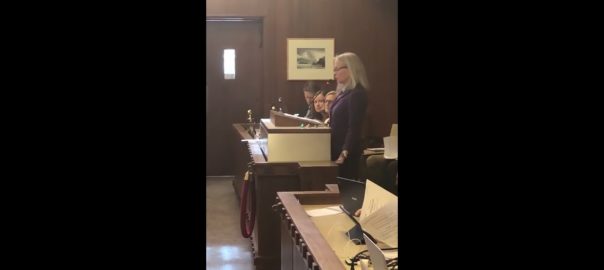
In a contentious, multi-hour meeting of Vancouver City Council, in a split vote along party lines, with COPE’s Jean Swanson, OneCity Vancouver’s Christine Boyle, all three Green Party of Vancouver City Councillors — Pete Fry, Adriane Carr, and Michael Wiebe — voting to raise property taxes in the City of Vancouver in 2022 by a whopping 6.35%, with dissenting votes coming from the former Non-Partisan Association electeds on Council — Sarah Kirby-Yung, Lisa Dominato, Colleen Hardwick, Rebecca Bligh and Melissa De Genova —  arguing that Council should hold the line at a previously promised five per cent increase, at the end of a long and arduous day on Tuesday, reason and fiscal prudence did not win the day.

Next year’s highest in Metro Vancouver property tax increase will see much of the burden borne by small business owners as part of their triple net lease responsibilities, as well as landlords, and the much-put-upon homeowners across the city.

Among the more contentious parts of the debate was an amendment by Councillor Adriane Carr in which she introduced an additional $9 million per year in taxation to fund a variety of the city’s climate emergency goals.

It includes more money for more electric vehicle infrastructure, planting trees, and improving active transportation infrastructure, and comes two months after Council narrowly voted against funding similar measures through a new parking permit system. Councillor Rebecca Bligh said she supported the initiatives, but expressed concern only “some Council members” had been consulted in advance.

“It’s not popular not to support this (climate change measure), we’re likely to be called out on Twitter for not supporting this, and being called climate [change] deniers,” she told the media.

“The people who are going to vote for this, were engaged ahead of this meeting, and the people that likely are not going to vote for this, were not engaged at all.”

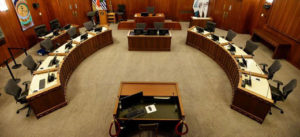
Vancouver City Council budget meeting on Tuesday, December 7 2021. Photo by Jason Payne /PNG

As Vancouver Sun civic affairs reporter Dan Fumano writes today

“Property taxes will rise 6.35% in the city of Vancouver after Council narrowly approved a 2022 budget on Tuesday. After a day of debate, Council passed a $1.747 billion operating budget, with a property tax increase higher than the five per cent proposed in last month’s draft budget. Most of the additional money goes to the police, fire department and climate measures.

On a proposed $9 million fund for the climate emergency measures, the five Councillors elected in 2018 with the Non-Partisan Association — Rebecca Bligh, Melissa De Genova, Lisa Dominato, Colleen Hardwick, and Sarah Kirby-Yung — voted no. It was one of several times Tuesday the five voted together. Four  have long since quit the NPA, citing concerns about its Board of Directors. Only De Genova is still with the NPA.

The other six Councillors, including the three Greens, one from OneCity, one COPE, and the independent mayor voted for the extra climate measures funding, with Stewart accusing the opponents of ignoring the climate emergency so evident in B.C. this year.”

Councillor Sarah Kirby-Yung reflecting on the shenanigans going on at Council’s budget meeting

In the hour prior to the taking of the final vote on the 2022 budget, VanRamblings was afforded the opportunity to speak with Councillor Kirby-Yung.

“All members of Council are dedicated climate change activists, recognize our climate emergency, and to date every member of Council has voted in favour of meaningful climate change policy when it has come before Council,” Kirby-Yung told VanRamblings.

“To, at the last minute, add a $9 million climate measure to a City budget already stretching at the seams — when tens, and over the years working in concert with senior levels of government, hundreds of millions of dollars has been set aside as the City’s response to our climate emergency represents for me, the height of fiscal irresponsibility, and as such emerges as a disservice to the already overtaxed residents of Vancouver.”

Non-Partisan Association City Councillor Melissa De Genova also weighed in.

Late Tuesday evening, Councillor Kirby-Yung tweeted out these thoughts …

Councillor Rebecca Bligh less than pleased with the ‘game playing’ of some of her Council colleagues (Photo courtesy of CBC photographer, Ben Nelms, and CBC civic affairs reporter Justin McElroy)

As CBC civic affairs reporter Justin McElroy writes

“Despite repeated motions in the last two years to try and keep the average property tax increase at five per cent or below, the $1.7 billion budget passed has an increase of 6.3 per cent. That works out to $72 for the average detached condo in the city, or $178 for the average home, not including parts of the property tax bill not under municipal control.”

Councillor Colleen Hardwick looks askance at a Council colleague during budget debate

Mr. McElroy then quotes Vancouver City Councillor Colleen Hardwick …

“The stark reality is we are just going ka-ching, ka-ching, ka-ching, ka-ching, and taking it not out of the one per cent, but of the middle-class people who are trying to afford to continue living in this city.” Hardwick said at one point. “I’m choked as I continue to see us add more and more. It was bad enough that we were looking at five per cent.”

Other than the climate measures included in the 2022 budget, some of the other increases that were not originally included in the draft budget included an extra $3.1 million to Vancouver Fire and Rescue Services for more firefighters, $670,000 for enhanced street cleaning, $1.2 million to fund the newly created Auditor General’s office, and additional funding to the Vancouver Police Department, allowing them to fill current vacancies and fund recent salary arbitration decisions.

#VanPoli | Making Members of the Media Your New Best Friends

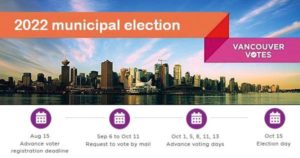
In 314 days, voters go to the polls to elect the next Vancouver civic government.

For which Mayoral candidates will voters cast their ballots, which civic parties and which candidates for office will garner their support? How will Vancouver’s plethora of municipal parties get their ‘Elect Me, Elect Me’ message out to voters?

Social media? Advertising? All candidates meetings? Door knocking? Well-run, well-organized, ‘get out the vote’ civic campaigns for office, staffed by volunteers?

The Globe and Mail’s Frances Bula, the dean of Vancouver’s civic affairs reporters

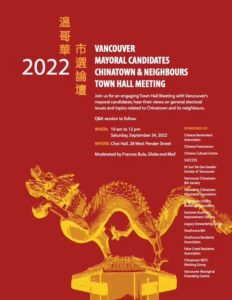
All of the above, and … the media, members of the working press, and more specifically, the hard-working civic affairs reporters who have dedicated their lives to reporting on democratic engagement in Vancouver civic politics: the doyenne of Vancouver civic affairs reporters, Globe and Mail freelancer & Vancouver Magazine columnist, Frances Bula, who has dedicated her working life to reporting on the livable city.

And, the hardest working journalist in civic politics, The Vancouver Sun’s Dan Fumano; former much respected Vancouver Courier, and now much respected Business in Vancouver and Vancouver is Awesome municipal affairs reporter, Mike Howell; the indefatigable Kenneth Chan at Daily Hive Vancouver (how does he accomplish so much — after all, there are only 24 hours in a day?), who is also editor of Vancouver’s première online source for Lotusland news; and the man-of-good-cheer who loves charts, the CBC’s ‘I live to report the news’, the one, the only civic affairs and jack of all journalistic endeavours reporters, Justin McElroy.

And let us not forget, the longtime editor of The Georgia Straight, Charlie Smith — independently-minded, a man of tireless endeavour when it comes to reporting on civic politics, and so very much more, a man possessed of much wit, passion and compassion. And, his civic affairs reporting colleague at The Straight, Carlito Pablo.

Another primary source for coverage of Vancouver’s critically important upcoming municipal election is Bob Mackin’s theBreaker.news. Not familiar with, don’t know about, never visited the curries no favours with politicos, tells it like it is and gives you the straight goods, the source for real reporting on the civic events of the day, and the must-visit muckraking site, in the tradition of I.F. Stone, theBreaker.news is your source for breaking news on Vancouver’s civic affairs scene.

Make no mistake, it is Ms. Bula’s, Mr. Fumano’s, Mr. Howell’s, Mr. Chan’s, Mr. Smith’s, Mr. Pablo’s, Mr. Mackin’s and Mr. McElroy’s reporting, the stories they choose to tell and their interpretation of what they see and what they’re being told, how they feel about the worthiness of the candidates who are offering themselves for service to the residents of Vancouver, who will emerge as the factor of greater importance in the determination as to which party will govern as a majority at Vancouver City Hall — every one of Vancouver’s municipal parties want more than anything else to govern as a majority — as to who will emerge as Vancouver’s next Mayor, and who will sit as Vancouver City Councillors in the 2022 – 2026 term of office.

Current and probable candidates for Vancouver’s next Mayor: Ken Sim, with A Better City; Mark Marissen, with Progress Vancouver; John Coupar, with our city’s oldest and longest governing municipal party, the Non-Partisan Association; Colleen Hardwick, with TEAM … for a livable Vancouver; Wai Young, with Coalition Vancouver; Andrea Reimer, with Vision Vancouver; Patrick Condon, with the Coalition of Progressive Electors; Jody Wilson-Raybould, with OneCity Vancouver; and independent, current Mayor, Kennedy Stewart will all want to garner much attention from Vancouver’s respected, reputable and influence-making municipal affairs reporters, make these good folks of conscience their new best friends.

All the while, the current and probable Mayoral — and their party colleague — candidates will want to convince these all-important civic affairs reporters that they, and they alone, possess the key, the will power, the wit, the acumen, the knowledge of how government works, and the exquisite humanity to make Vancouver the affordable and livable city all Vancouver residents want and need, drawing support from across the political spectrum, across Vancouver’s economic strata and in every one of our city’s 23 diverse neighbourhoods, and across and in every critically-important ethnic community comprising the city we love so very much.

In addition, the CBC’s Early Edition host, Stephen Quinn — no fool, he, and ‘influencer’ of extraordinary proportion. Plus, CKNW’s talented and inquisitive, Simi Sara, who knows how to ask the pointedly unsettling question; Al Jazeera’s lover-of-all-things civic politics, and along with former Vancouver City Councillor (and sometime CKNW host), George Affleck, of The Orca podcast, Jody Vance; former publisher-editor of the much-missed and well-researched political affairs CityCaucus ‘blog’, Mike Klassen (who is VanRamblings’ 17-year-long webmaster), and his Vancouver Overcast podcast; and last but certainly not least, This is VanColour’s tough, yet fair-minded, Mo Amir, now on CHEK-TV, Sundays at 7pm.

The coverage that will be provided to all political candidates offering themselves for service in the municipal arena and asking for your vote — by all those journalists whose names appear above — is called ‘earned media’, and is — and has always been — of exponentially greater importance to candidates running for office — or at the very least, of equivalent importance — than the combined efforts of candidate campaign teams, the donations to political parties from members of the public who will fund the civic party campaigns, and the myriad of all-candidates meetings that will fill civic affairs calendars from the spring of 2022 on, through until Vancouver’s next civic Election Day, to be held on Saturday, October 15th, 2022.

Make no mistake — journalists represent the voice of the people.

Journalists are, and have always been, the information and news conduit between those who govern, or would propose to govern us, and Canadians, be it  provincially or federallyand because, municipally, journalists and candidates are so much closer to the residents of the city whose interests they represent than is true of senior levels of government, journalists should be seen as part of a candidate’s family, as they are members of the families of the 40% of the Vancouver electorate who will cast their ballot at an election polling station, just 314 days from today.

#VanPoli | Team for a Livable Vancouver Holds Its Founding AGM

Architect & charter TEAM for a Livable Vancouver member Brian Palmquist speaks at TEAM’s AGM

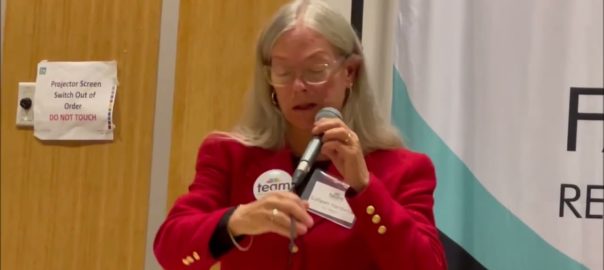
Team for a Livable Vancouver, our town’s newest political party, held it’s first AGM on Sunday evening, an event open only to members of the nascent political party.

Jak King, a longtime Grandview-Woodland and community activist, was one of 12 policy committee speakers addressing Sunday evening’s AGM.

Vancouver City Councillor Colleen Hardwick was the evening’s keynote speaker.

Brian Palmquist, an award-winning architect, provided an Affordability Policy analysis at Sunday evening’s founding event, which took place at the Anza Club on 3 West 8th Avenue. Mr. Palmquist is the author of the substack newsletter, The PATH Project, where he reflects regularly on development in the city of Vancouver, recently emerging — along with UBC’s Patrick Condon — as an increasingly important voice in civic politics, and as a regular speaker at Vancouver City Hall debates.

Unlike the fancy soirées conducted by Ken Sim and his newly-formed A Better City municipal party, or Mark Marissen’s Progress Vancouver event, both of which drew dozens of well-heeled supporters — as well as all the press that matters (no journalist worth her or his salt foregoes a free meal), the founding TEAM AGM was — surprising to many — a members only event, a decidedly déclassé affair, with a solid and upbeat attendance, nonetheless, of those party members who’ve been working with Team for a Livable Vancouver founder, Vancouver City Councillor Colleen Hardwick, to transform Vancouver into a more “livable city” for all.

Sunday evening’s founding TEAM AGM — which, in the early going, would seem to be a no press ‘we don’t want any of those stinkin’ wretches‘ allowed — which for us would seem to comprise an kind of odd, almost stealth campaign for office, a members only ‘ if you don’t love us, we don’t love you’ civic party that somehow possesses definitive plans on sweeping to office at Vancouver City Hall, at Park Board and at School Board, come Saturday, October 15, 2022. Sunday’s AGM follows on the heels of a series of policy workshops organized by Councillor Hardwick in October. VanRamblings was unable to find anyone in Team for a Livable Vancouver to speak on, or off, the record about Sunday’s AGM.

Allow VanRamblings to say that we believe that come the latter part of September 2022, leading up to October 15th Vancouver civic election day, a groundswell of support for Team for a Livable Vancouver will embolden voters to cast their ballot for TEAM — despite whatever jerks like VanRamblings have to say on the matter, in the months leading up to next year’s Vancouver municipal election — and that TEAM will sweep to victory, in the same manner COPE did in 2002, and Vision Vancouver achieved in 2008, surprising many.

TEAM’s October 24th Policy Conference, where 12 groups developed TEAM party policy

VanRamblings was told, simply, to wait for a series of announcements and a new and dynamic party website that will emerge throughout the month of December.

TEAM’s founding Board of Directors, former Green Party civic candidate and architect, David Wong; longtime community activist Sal Robinson; current Vancouver City Councillor Colleen Hardwick; founder of the VanPoli Facebook group, community activist, and Oscar-winning animator (and probable TEAM Park Board candidate), David Fine; and outgoing TEAM Board member, Sean Nardi.

As Sean Nardi wrote in the hours following the TEAM founding AGM …

TEAM elected its first, 9-member Board of Directors, a talented, concerned group who bring a diversity of skills, experience, knowledge and perspectives to guide TEAM’s evolution.”

For the moment, the party is playing its cards close to the vest, and at least for now the party has taken down both of its websites, the initial https://voteforteam.ca/, and more recently, http://www.teamlivablevancouver.ca/.

It would seem that, arising from VanRamblings persnicketyness (there are those who employ harsher language), Team for a Livable Vancouver moved up the début of its audacious and snazzy new website, which may be found at …

https://www.voteteam.ca/ 

VanRamblings had been told that TEAM’s webmaster was something of a perfectionist — you can see for yourself what that means (pretty great, we think).

VanRamblings received a call from a TEAM founding member, this a.m. …

“Ray, I think you’re going to be impressed with who the nine people are who were selected as TEAM’s new Board members. They’re a pretty impressive group, who in the days and weeks to come will play an ever increasingly important role in working to develop policy, and a narrative on what TEAM stands for. Over time, Colleen will play an ever diminishing role in directing the affairs of the civic party she has worked so hard to create. Colleen will turn her focus to becoming Vancouver’s next Mayor on Saturday, October 15, 2022, and carrying her team to office.

The announcement of the new Board members, and the launch of the new website , will occur in short order, perhaps as soon as next week. The launch of Team for a Livable Vancouver bodes well for all of us, and most particularly, for the citizens of Vancouver.”

VanRamblings awaits future Team for a Livable Vancouver announcements.

#GeoPolitics | Autocratic Regimes | A Shift in Power

The rise of right wing populism in the United States brought on by the election of Donald Trump

We live in a troubled and troubling world, with the ravages of climate emergency a danger to us all — most particularly, British Columbians in 2021, living through a heat dome crisis in June, consuming province-wide wildfires this past summer, and now, flooding, economic devastation, and the destruction of roads and bridges that serve to exacerbate an execrable supply chain crisis.

And, then, there’s the politics of the western world, where authoritarianism and autocratic regimes across the globe have become even more brazen in their repression. Many democratic governments are backsliding and are adopting authoritarian tactics by restricting free speech and weakening the rule of law, a trend exacerbated by the COVID-19 pandemic.

“The political flaws and social fault lines revealed by the pandemic will drive more people towards populist and authoritarian leaders that seldom deliver durable solutions for the concerns of citizens”, says International IDEA Secretary-General Kevin Casas-Zamora. “If there is one key message in the Global State of Democracy Report 2021 — Building Resilience in a Pandemic Era”, published by the International Institute for Democracy and Electoral Assistance (International IDEA), an intergovernmental organization based in Stockholm, “it is that now is the time for democracies to be bold, to innovate and revitalize themselves. The Global State of Democracy report is not a wakeup call, it’s an alarm bell. Authoritarianism advances in every corner of the earth. Universal values — the pillars of civilization that protect the most vulnerable — are under threat.”

While many democracies have proved resilient during the pandemic, by expanding democratic innovations and adapting their practices and institutions in record time, in order to preserve our democracies, as Casas-Zamora states, bold action was required by our leaders to innovate and revitalize themselves.

Cuba’s pro democracy protesters take to the streets, to fight rising poverty and high COVID-19 numbers

One of the key findings of the report is the strength of civic activism all over the world. Pro-democracy movements have braved repression in places such as Belarus, Cuba, Eswatini, Myanmar, and Sudan, and global social movements for tackling climate change and fighting racial injustice have thrived.

More than 80 countries have experienced protests and civic action of different kinds during the pandemic despite often harsh government restrictions.

Asia and the Pacific has suffered a wave of growing authoritarianism as crises of various kinds have affected Afghanistan, Hong Kong and Myanmar. Democratic erosion is also widespread, including in India, the Philippines and Sri Lanka with many of them suffering from rising ethno-nationalism and the militarization of politics. China’s influence, coupled with its own deepening autocratization, also puts the legitimacy of the democratic model at risk.

In Africa and the Middle East, while elections remain the norm, the report states the democratic quality of these elections is on the decline and attempts to evade or remove presidential term limits present a risk to democracy.  2021 has seen four military coups: in Chad, Guinea-Conakry, Mali and Sudan.

The Middle East’s tainted track record on protecting civil liberties has been even further strained by the pandemic, with many elections held with the sole aim of keeping existing regimes in power, such as in Algeria, Egypt and Syria.

Moscow gripped with the largest anti-government demonstrations since the winter of 2011-12

The rise of autocracy and of right wing populism, its western democratic cousin, gives rise to understandable concern that liberal political values and the rule of law are heading towards terminal decline.

However, neither autocratic states such as China and Russia nor right wing populist leaders like Donald Trump in the U.S., Italy’s Matteo Salvini and right wing populist leaders in other western countries have had everything go their way. Their mixed fortunes suggest that it is premature to write off the prospects for global governance, even though the rules-based order constructed after 1945 is decomposing and will never return in its old form.

The Chinese and Russian states possess immense resources of violence and intimidation that allow them to suppress dissent with ease. From Tiananmen Square in 1989 on, China has proved that it has an unyielding state of mind, one that augurs poorly for Hong Kong protesters.

However, there is less tolerance for politically related violence in European societies, as demonstrated by the public backlash in Slovakia against the murder of Ján Kuciak, an investigative journalist, and his fiancée Martina Kušnírová.

Should right wing populism fail to make deeper inroads in western political systems, owing to its unrealistic promises and policy confusion when in power, the deliberate disruption of the post-1945 global order would arguably slow down. The growing internal challenges of autocratic systems in countries such as Russia and Turkey might reinforce this trend.

However, the most important long-term trends in international relations over the past 30 years have been the rise of China and the accelerating shift of economic power from the west to the Asia-Pacific region.

That shift ensures that the Washington-designed post-1945 order, built mainly for the benefit of the U.S., Canada, Europe, Japan and their allies, in the years to come will give way to a more dispersed form of global governance.

For the west, the cold reality is not that autocracy will triumph and democracy will fail, but rather that the 500-year-long era of western global supremacy is slowly and inexorably coming to an end.