Category Archives: Politics

Sunday Music | Tracy Chapman | 1988 |
Most Auspicious Début

Arriving with little fanfare in the spring of 1988, Tracy Chapman’s eponymous début album emerged as one of the most important and top-selling records of the late 1980s, providing a touchstone for an entire progressive movement of change, while reviving the singer / songwriter tradition.

As with most promising singer-songwriters, comparisons are prone to discussion, and Tracy Chapman’s début garnered mass amounts of media attention.

Of course, Joan Armatrading’s name is frequently mentioned (Tracy Chapman, however, shares little more than race and gender). Her vocal delivery is reminiscent of Joni Mitchell’s folk period; her sensitivity parallels that of Suzanne Vega. Yet Tracy Chapman is not quite so detached from her listener as these influential forebearers were and are (even today).


Tracy Chapman and Luke Combs playing to a rapturous audience at the 2024 Grammy Awards

Tracy Chapman is a fascinating storyteller, her world unlittered by pretense or façade. Consequently, much of the journey often overwhelms with sheer fidelity.

On June 11th 1988, a concert was held for Nelson Mandela’s 70th birthday who was still imprisoned at the time for his anti-apartheid beliefs and activism.

Tracy Chapman, a largely unknown artist who had just released an album, and prior to playing on the stage at Wembley Stadium had played only clubs holding no more than 40 patrons, or as a street musician had performed in front of crowds of no more than 200 hundred, was asked to play Wembley as a “fill in” artist.

Stevie Wonder was scheduled to perform, too, despite not being officially announced, with the Superstition superstar arriving in London early in the morning of the concert. Heading straight to Wembley Stadium after his plane landed, his band were already rehearsing for his set which was due to take place after UB40 had finished their set. But disaster struck, with Stevie refusing to come on stage, leaving the organizers in panic — Wonder realized a crucial piece of his equipment was missing as he walked up the ramp to take the stage.

Although Tracy Chapman had already performed a brief set earlier in the day to a relatively sparse audience, with concert organizers pleading with her to fill the gap left by Stevie Wonder’s absence, a legend was born.

Behind the Wall was the second of what was supposed to be a three-song set.

As the legend goes, serendipity gave the world another glimpse of this commanding artist when Stevie Wonder’s team took their time to ready the stage for his concert, extending Chapman’s set to include almost the entirety of her début album.

With the crew setting up behind her for Stevie Wonder, alone on the massive stage at Wembley Stadium, guitar in hand, she allowed the echoing mic and the screaming of the initially inattentive crowd to amplify the quiet of the song. At first, a little insecure on the biggest stage of her career, as she sang with magnetic calm she built an atmosphere as intimate as each listener’s childhood bedroom, by the end of her first song, Fast Car, the entire crowd was listening in rapt attention.

The low verses mix bleak recognition with quiet hope before building to a chorus so wistful, so joyfully tender it can transport you to a time in your life when you were younger and maybe a little less scared. Most of the people watching her performance at Wembley did not arrive knowing Chapman’s power, and most likely had never heard of her before. But they experienced in real time her ability to lift hearts into people’s throats. She performed her songs the same way she had on the streets for years: alone and brilliantly exposed.

Not only was the Wembley crowd gobsmacked with Tracy Chapman’s performance — with the noisy crowd quietened by Chapman’s compelling presence on stage, and the strength of the songs she played — but playing two sets on the day offered her far more exposure, with an estimated global audience of 600 million for her second performance watching the concert on their televisions at home.

Over the years, we’ve witnessed the worst this world can throw our way, Chapman suggests on her début, at times through her working-class characters. But her music creates a world where no force exists without a counter. The worst of what we’ve endured, she also offers, makes righteous justice inevitable. It’s a worldview that many could appreciate.

By the end of the summer of 1988, a few months after the Nelson Mandela tribute, Tracy Chapman had a platinum selling album, and the singer was a major star.

Before the Wembley Stadium concert, Chapman had sold roughly 250,000 albums. In the two weeks following her performances, she had sold over two million.

In 1989 at that year’s Grammy Awards, Tracy Chapman won Best New Artist, Best Contemporary Folk Album and Best Female Pop Vocal Performance, and had been nominated — and perhaps should have won — for Album of the Year and Record of the Year for Fast Car, which was nominated as Song of the Year, as well.

In time, Tracy Chapman added a backup band. By then, however, Tracy Chapman was on her way to becoming a global phenomenon. The rest is history.


The wondrous Tracy Chapman and Eric ‘slow hand’ Clapton, 1999, performing Give Me One Reason

#VanPoli | Ken Sim | Swagger | Bullying, Misogyny & Hubris | Pt. 1


ABC Vancouver Mayor, Ken Sim

What is it with men who lack humility, intellectual heft, or have little character and no experience, and their unwholesome mistreatment of women?

In the case of Mayor Ken Sim, perhaps there is a partial answer to the multiple questions above, deriving from Mr. Sim’s use of the word “swagger”.

Social media response to former Park Board Chairperson, Anita Romaniuk

A Definition of Swagger

Pompous, arrogant, boastful. An insolent braggart, and from the definition of insolentdisrespectful, rude, insulting in manner and speech, and deviant.

Swagger. Think: that jerk on the beach in a too small swimsuit who believes he’s God’s gift to women, who moves with a near drunken stagger, on the prowl for a victim of his all-too-visible misogyny and disdain for women, a man who is lacking in fidelity of purpose, and a little man devoid of empathy, and humanity.


Mayor Ken Sim, the next time he uses the word swagger, think: misogynist, arrogant, pompous, lacking in character, intellect and empathy, boastful, braggart, rude, scornful, with no conscience.

Under the current provincial Police Act, the Mayor of Vancouver upon election becomes the de facto Chairperson of the Vancouver Police Board.

Faye Wightman led several high-profile agencies before Solicitor General Mike Farnworth appointed Ms. Wightman, a well-respected and accomplished member of our community, to the Vancouver Police Board, in September 2020.

In past years, dating back to 1990, Ms. Wightman served as CEO of the Vancouver Foundation, CEO of B.C. Children’s Hospital Foundation, vice-president of the University of Victoria, Board Chair of Inspire Health, and interim CEO of the Canadian Cancer Society, appointed as a B.C. Housing Commissioner, and Coast Capital Savings Executive Director.

“The Vancouver Police Board is guided by the values of independence, fairness, objectivity and accountability in all that it does,” Faye Wightman wrote in a statement she issued last week, following her resignation from the Police Board. “I believe Police Board Chair Ken Sim, and certain directors of the Board have lost sight of these key values, and I resigned.”

Faye Wightman’s departure comes less than a year after Police Board member Rachel Roy resigned in June 2023. Stephanie Johanssen also lost her job as Executive Director in November 2022, after serving three years and seven months in the role. Note should be made that Ms. Johanssen’s departure came the same month Mr. Sim and his ABC Vancouver majority Council were sworn into office.


From Mike Howell’s Glacier Media story: “The Vancouver Police Board won’t say why its Executive Director Stephanie Johanssen (far right) is no longer on the job.” File photo Mike Howell.

In a follow-up interview with Glacier Media’s Mike Howell, Ms. Wightman states …

“If the Board is comprised of directors who have a professional reliance on the City of Vancouver for funding, or on maintaining a positive relationship with the Mayor, who also chairs the Police Board, then their objectivity is compromised,” Ms. Wightman said in her statement.

“That is the case with two of our directors at the [police board] and it was becoming clear they were in a position of conflict.”

Ms. Wightman also named Trevor Ford, the Mayor’s Chief of Staff, when asked about her allegation of interference from Mayor Ken Sim’s staff.

“[Trevor Ford] came to an in-camera meeting, he phoned and directed Board members to fire the Executive Director,” Ms. Wightman alleged in the interview.

“He sat in on one-on-one meetings that the Mayor had with individual Board members. If that’s not political interference, I’m not sure what is.”

Vancouver Police Board Executive Director Stephanie Johanssen,  Board member Rachel Roy and now Faye Wightman, who has stated that “Ken Sim, from the outset and throughout our tenure together on the Police Board repeatedly asked for my resignation.”

Gone.

Harassment of Ms. Wightman? Political inference from the Mayor’s Chief  of Staff in the firing of Police Board Executive Director, Stephanie Johannsen?

VanRamblings, in reading Ms. Wightman’s statement, believes so, yes.

Readers. Do you notice a pattern?

Could it be that Mayor Ken Sim demanded the resignation of the three strong women of accomplishment written about above because Vancouver’s current Mayor finds strong women of character, integrity and accomplishment threatening, and as such they must be excised from his circle of influence?

Not to worry, though.

Although B.C. Solicitor General Mike Farnworth has been uncharacteristically silent following the resignation of Ms. Wightman as his chosen appointee to the Vancouver Police Board, fear not …

Premier David Eby in his GlobalBC interview on Police Act reforms, states …

“I understand there’s some concern in Vancouver right now. The reforms (to the Police Act) are clearly needed. We’ll be working with local governments, and with police and the public in terms of the changes that are coming forward. The Solicitor General’s office is working on it right now.”

GlobalBC reporter Catherine Urquhart ends her report, stating …

“Legislation changing the Police Act to remove Mayors from police boards is expected to come as early as the spring session.”


British Columbia Solicitor General Mike Farnworth keeping his powder dry. Buh-bye, Mayor Ken Sim.

Solicitor General Farnworth’s silence thus far = revenge is a dish best served cold.


#VanPoli | The Parlous State of Politics in Our Little Burgh by the Sea


Sam Sullivan, one-term Mayor of Vancouver, 2005 – 2008

On Friday, June 29, 2006, without prior notice, Non-Partisan Association Mayor of Vancouver Sam Sullivan fired all the members of the Board of Variance.

The announcement firing all five members of the Board was made late on the Friday afternoon, in a press release emanating from the Mayor’s office.

The decision to fire the five members of the Board of Variance was contrary to the advice of former Non-Partisan Association Councillor George Puil, who the Mayor and NPA Councillor Peter Ladner had called in to “investigate” the Board, with Mr. Puil reporting back following his exhaustive six month investigation of the Board.

In his report to the Mayor and Councillor Ladner, Mr. Puil told Mayor Sam Sullivan and Councillor Peter Ladner that he had found no wrong-doing on the part of the Board of Variance members and, in fact, in his discussion with dozens of citizens of the community who had appeared before the Board with their appeal of a decision of the City of Vancouver’s Development Services and Planning Departments — citizens ranging from homeowners and members of the community, to developers — they had found the Board to be a fair and thoughftul body, adjudicating the appeals that were brought before the Board with a seriousness of purpose and intent.

Mr. Puil strongly advised Mayor Sullivan and Mr. Ladner against firing the Board.

“Let them finish out their term,” Mr. Puil advised. “The terms of Board members Terry Martin and Jan Pierce will end later this year or early next, with Raymond Tomlin’s term to be completed not too long after, with Quincey Kirschner and Tony Tang’s tenure on the Board to be completed before the next election.

Allow the current members of the Board of Variance to finish out their terms,” Mr. Puil intoned, “and replace them with stalwart members of the NPA to three-year terms on the Board, and should Vision Vancouver gain victory at the polls in 2008, our people will be in place on the Board, which means, we win.


Peter Ladner, Non-Partisan Association Vancouver City Councillor, 2008, NPA Mayoralty candidate

NPA Councillor Peter Ladner maintained the members of the Board were fired because they had “refused to bring legal and administrative spending under control,” to which accusation fired Board Chairperson Terry Martin responded …

“Legal and administrative fees were never discussed with city officials. In fact, the Board had cut its administrative costs by $8,500,” said Mr. Martin, in an interview with CBC Vancouver.

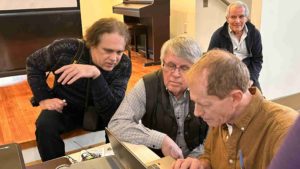
At 6pm on the Friday evening, each of four of the members of the Board of Variance — Terry Martin, Jan Pierce, Raymond Tomlin and Tony Tang — received a hand-delivered letter from the City advising them of the termination of their work on the City’s Board of Variance. Board member Quincey Kirschner (pictured above), 27, had moved recently, and did not receive the letter of termination. Ms. Kirschner was otherwise unavailable on the Friday night. Raymond Tomlin was assigned the task of calling Ms. Kirschner on Saturday morning to advise her of the termination of her work on the Board of Variance.

When contacted on the Saturday morning at 9 a.m., still in bed and groggy, after a night out on the town, Ms. Kirschner was informed by Mr. Tomlin of her “sacking” (as it was referred to in the press).

Ms. Kirschner cried for an extended period of time, and was inconsolable.

Ms. Kirschner had poured her life blood, her passion, her integrity and immense dedication into her work on Vancouver’s Board of Variance, following her appointment as a Board member in late 2005, spending hours each week pouring over the six-inch thick binders Board members received each Thursday or Friday afternoon, and informing herself of the intricacies of development, planning, zoning and community consultation on planning and development and decisions.

Background and history. In the 1950s, by an order of the U.S. and Canadian Supreme Courts, Boards of Variance were created in all communities across the North American continent, communites with 10,000 or more citizens, as independent, lay bodies, protective of and advocates for the community interest, these lay bodies responsible for overseeing all development in the city that did not conform with City zoning bylaws, or in the case of new construction were overheight, lacked the property frontage, where shadowing impinged on a neighbour’s property, or were not otherwise outright approvals of the City’s Planning and Development Services departments — ranging from simple home renovations, to the construction of high-rise towers in their communities, the Board of Variance responsible for hearing appeals from the public on all such related matters.

The arrogance displayed by Mayor Sam Sullivan in his unprecented firing of the members of the Board of Variance, and other matters of misjudgment eventually led to internal dissension in the majority Non-Partisan Association caucus on Vancouver City Council, which in 2008 resulted in Mr. Sullivan being denied the opportunity  to run for re-election that year. Councillor Peter Ladner was chosen as the Non-Partisan Association Mayoral candidate, instead, in 2008.

On November 15, 2008, the Non-Partisan Association was all but wiped out at the polls, losing the Mayor’s chair and four seats on Council, losing to novice Vision Vancouver Mayor Gregor Robertson by nearly 20,000 votes, Vision Vancouver securing seven Council seats, giving the party a “super majority” on Vancouver City Council, allowing them to pass budgets and conduct the affairs of government without input from the three-member (two COPE, David Cadman, and Ellen Woodsworth; one NPA, Suzanne Anton) opposition on Vancouver City Council.


There is a correlation between one-term Non-Partisan Association Mayor Sam Sullivan, and current and certain-to-be one -term ABC Vancouver Mayor Ken Sim, a topic VanRamblings will explore in depth this upcoming Monday, February 12th.

#CdnPoli | Curse of Politics #Cdn Politics Blasphemed

Today, VanRamblings leaves you in the capable hands of …

  • David Herle, host of the Curse of Politics podcast, longtime Liberal strategist and pollster, frequent CBC News commentator, principal in the Gandalf Research Group, and in 2013 Ontario Liberal Party campaign manager in that year’s election, which afforded Kathleen Wynne a come-from-behind victory, electing her as Premier;
  • Scott Reid, Director of Communications for former Prime Minister Paul Martin, and current CTVNews’ political commentator — both Mr. Herle and Mr. Reid proudly successful 40-year veterans of federal (and provincial) Liberal politics;
  • Kory Teneycke, former Director of Communications in Prime Minister Stephen Harper’s office, and 2018 campaign manager for Doug Ford’s Ontario Progressive Conservative Party during that year’s election, which elected Mr.  Ford Premier; and
  • Jordan Leichnitz, an NDP stalwart, longtime progressive political strategist who worked for over a decade in the offices of former federal NDP leader, Jack Layton, and current NDP leader Jagmeet Singh,  and CBC Power & Politics commentator.

The four Curse of Politics panelists discuss the state and nature of federal politics in Canada, providing delightfully profane insight into what the heck is going in Canadian federal politics, the issues of the week, and more, much much more.


The Curse of Politics is also available as an Apple, Android and Spotify podcast.