Category Archives: News

#BC Poli | BC Recovery Benefit Application Day | How to Apply

BC Recovery Benefit eligibility, the application process

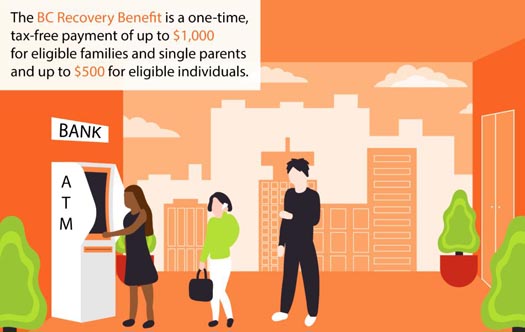
The application for the BC Recovery Benefit that will be made available as a one-time direct deposit payment for eligible families, single parents or individuals opens today. You’ll want to take advantage of this benefit.
The key aspect to be aware of: You must apply to receive the benefit.
Now, the John Horgan could very easily have foregone what will turn out for many to be an arduous application process, if they’re even aware there is a benefit for which they are eligible, and could have held off payment until January 5th, 2021, when they very easily might have included the $500 for eligible individuals, and the $1000 for couples and single parents — as they did in April, when they combined the then Climate Action Credit of $330 — with the issuance of GST cheques to households across the province.
No fuss, no muss, no application process — just a tidy sum of money deposited in every eligible adult’s bank account on the first Tuesday of 2021 — not a bad way to start the new year, don’t you think?

BC Recovery Benefit eligibility, the application process

But in a blunder of immense proportion, not to mention a disingenuous way to commence Mr. Horgan’s first real mandate, our B.C. New Democratic Party provincial government has decided that not only will eligible British Columbians have to jump through the hoops of an online application process, eligibility for the BC Recovery Benefit is dependent on what you earned in the 2019 calendar year — before COVID-19 was on anyone’s radar, before businesses shut down due to the pandemic, causing the loss of hundreds of thousands of jobs across our province — disallowing the full $500 recovery benefit to individuals who in 2019 earned more than $62,500 (with a sliding scale up to a cutoff of $87,500), with households with lower than a $125,000 combined income eligible for the full $1000 recovery benefit, decreasing that amount up to a cutoff point of $175,000.
If you lost you job or your business in 2020, and your income has plunged into the abyss in this very troubling year, you’ll be out of luck when it comes applying for the BC Recovery Benefit.

BC Recovery Benefit eligibility, the application process, covid-19, be grateful

What is that you’re saying? “Don’t look a gift horse in the mouth?”
For those who are unfamiliar with VanRamblings’ modus operandi, well … even with Hanukkah ending yesterday, we nonetheless just love to kvetch.
Okay, enough of this foofaraw, let’s get on with acquiring tax free moolah.

BC Recovery Benefit eligibility, the application process

First off, you going to have to click on this link to be taken to the British Columbia government’s BC Recovery Benefit application website.
Next, you’re going to have to get all your ducks in a row, and make sure you have the following information and documentation available in order to complete the application process …

BC Recovery Benefit eligibility, the application process

Note should be made: persons who are in receipt of the provincial Persons with Disabilities benefits are eligible to apply. The benefit will not be clawed back from existing benefits, as the recovery benefit is non-taxable.

BC Recovery Benefit eligibility, the application process, COVID-19

On Tuesday, December 8th, the BC government introduced legislation to secure funding for the BC Recovery Benefit, projected to help around 3.7 million British Columbians.
BC Recovery Benefit eligibility, the application process, covid-19, students can apply

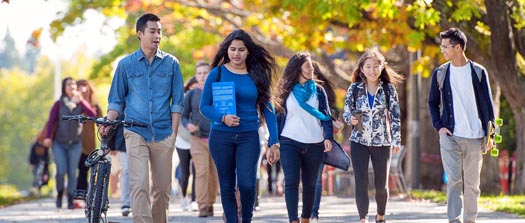
Charlotte Aiden, a writer for The Ubyssey has written this story on student eligibility for the BC Recovery Benefit.

Students who are at least 19 years old and reside in British Columbia on December 18, filed a valid 2019 Canadian personal income tax return and have a social insurance, individual tax or temporary tax number are eligible to apply.

Unlike the Canada Emergency Student Benefit, international students are included in this benefit, given they meet the eligibility requirements.

You’ll need four things to apply on the government website: your net income from your 2019 tax return; your social insurance, individual tax or temporary tax number; your driver’s licence number if you have a BC driver’s licence (but this isn’t necessary); and your direct deposit information.

Unlike past benefits, this benefit will only be issued through direct deposit, so those who apply must have an account with a Canadian financial institution.
BC Recovery Benefit eligibility, the application process, COVID-19, telephone support

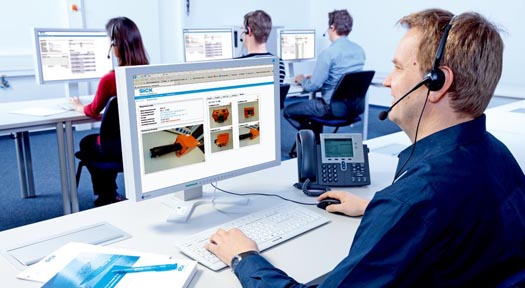
Toll free telephone support is available by phone starting Monday, December 21st, 2020.

  • Call 1-833-882-0020 (within North America);

  • Monday to Friday, 7:30 am to 5:00 pm, excluding statutory holidays;
  • You have until June 30, 2021 to apply.

The COVID-19 BC Recovery Benefit will cost as much as $1.7 billion, up from an estimate of $1.4 billion announced during the election.
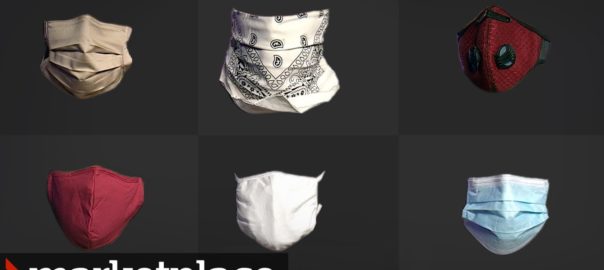
#COVID19 | The Default Mask for Consumers to Buy | Safety First

The best mask for consumer to purchase is a high thread count cotton mask with a polypropylene filter

Wearing a mask is critical to reducing the spread of COVID-19, but rigorous tests conducted on behalf of CBC’s Marketplace found that while some work very well, others offer little protection from the particles that transmit the novel coronavirus. One type of mask even spread those particles to others.

Today on VanRamblings, for those who missed the November 13, 2020 episode of Marketplace, please find below the video of the results of the laboratory tests that were conducted on more than 20 different face masks on the market, revealing the safest, most effective mask for you to wear.

Marketplace put the masks through the rigorous National Institute for Occupational Safety and Health (NIOSH) standard test, conducted at a lower air-flow regimen to reflect normal breathing. The test is usually reserved for N95s and personal protective equipment (PPE) intended for health-care workers. A standard NIOSH test measures filtration efficiency, meaning the particles the mask filters out as the wearer breathes in.

The valve mask is not recommended as a mask to protect you and others from COVID-19

One of the poorest performing masks, not only offering you minimal if any protection but serving to possibly infect others if you are an asymptomatic COVID-19 carrier is the valve mask pictured above — a mask, it should be noted in passing, VanRamblings purchased last spring, and (in retrospect now, stupidly) recommended to friends and acquaintances.

The valve mask is not recommended as a mask to protect you and others from COVID-19

In fact, of the more than 20 masks tested, only the valve mask was designated as a Do Not Use mask by scientists, as the mask risks spreading particles to others.
So, if the valve mask is the worst mask to purchase, what’s the best mask for you to buy? The answer: a 3-layer mask with an inner layer of melt-blown non-woven polypropylene — the only mask you should be wearing.

The best mask for you to wear is a three-layer cotton mask with a polypropylene filter

The best consumer mask Marketplace tested had an inner layer of melt-blown, non-woven polypropylene fabric and outer layers of high quality, 600 – 800 thread count cotton, with filtration efficiency rates as high as an N95. James Scott, a professor from the University of Toronto’s Dalla Lana School of Public Health, who specialiazes in bioaerosols, ran the lab where Marketplace’s tests were run. Scott reported the combination of multiple materials contributed to the strong result for the masks pictured above.

“Even fairly low-efficiency masks are actually quite effective at catching much larger particles. But, it takes a really good mask to catch the small ones as well. And we know that the virus will travel not only on the big ones but the small ones as well,” said Scott.

You can find more information on all the masks tested by Marketplace in the video above, and on the CBC website, in this story.

After watching the COVID-19 face mask episode of Marketplace, VanRamblings purchased our melt-blown, non-woven polypropylene filtered cotton mask from the folks at The People’s Mask, for only $19.99, purchasing a 30-pack of filters (which we change weekly) for $29.99, plus applicable taxes and shipping, both of which products arrived within days.

When we’re out and about now — not a regular occurrence these days, except to go for a walk, a bike ride or shopping for food — we feel safer than previously, and feel good about not possibly infecting others.

Following the research conducted by CBC’s Marketplace, adding a third layer to cotton face masks is now recommended for preventing the spread of COVID-19. Non-woven polypropylene fabric is the material of choice for this third layer. This report out of McMaster University provides detail on what to do, and what not to do if you’re considering making the polypropylene mask at home. Amazon.ca sells a polypropylene filter mask, but delivery of the mask would not be due til late January or early February, so you may want to look elsewhere this particular filtered mask.

Edmonton-based The People’s Mask and Toronto’s Sydney’s both sell three-layer options. If you’re into fashion, there are designs by Amanda Lee Kew and Mayana Geneviere that have a pocket to easily pop a filter into.

The People’s Mask seems like the best, and least expensive, three layer polypropylene filter mask to buy. If you’re making face masks at home you can buy the filters through them, as well.

Merry Christmas & Happy Hanukkah | Holiday Lights Tour 2020

Guide to Christmas Lights in Vancouver over the 2020 holiday season

2020 represents the 50th anniversary of VanRamblings’ annual “Christmas” (holiday) lights tour — a seasonally appropriate and joy-filled tour we’ve conducted with our spouse, children, family and friends dating back to 1970, an utterly free, quietening, joyous and much-look-forwarded to event on the Tomlin household calendar lo these many joyous holiday seasons.

DuPlessis Family Christmas Display, 8222 Burnlake Drive, in Burnaby
DuPlessis Family Christmas Display, 8222 Burnlake Drive, in Burnaby | nightly from 4:30pm til midnight, through until January 10th, 2021

In the 1980s with my two children, Jude and Megan, we’d begin our holiday lights tour in Burnaby, and wend our way back to Vancouver hitting all the spots you’ll find listed on the holiday light display tour, and before heading into Stanley Park for Bright Nights and a ride on the Christmas train, we’d stop in at the (now closed) White Spot on Georgia Street — after which we would continue our tour, alighting at each stop to admire the light display, the children placing monies into the various donation boxes along the way.

During our annual holiday lights tour, in most instances we would forego paid displays — such as the annual Van Dusen Festival of Lights (currently postponed), to which we would dedicate a whole night out at some point during the holiday season — and stick to home-style family light displays.

By the time Megan hit 9 years of age, being the decided personality she is (read: Megan must always get her way … everyone who knows her accepts that as a fact of life), Megan decided that while our annual Christmas Lights Tour would begin in Burnaby, and after completing our tour of Dundarave, West and North Vancouver, and Trinity Street, we would next head out to Coquitlam, and then out to Surrey — which meant that the holiday lights tour wouldn’t end until somewhere around 3 a.m. Then it was home.

Due to COVID-19 many annual Christmas light events have been cancelledThree of the city’s most popular seasonal events — the VanDusen Botanical Garden’s Festival of Lights, the Capilano Suspension Bridge Park’s Canyon Lights, and Stanley Park’s Bright Nights, and the Christmas Train — have all been cancelled this COVID year.

For the purposes of this year’s Holiday Lights Tour column, we are going to limit ourselves to writing about holiday light displays and attractions in Vancouver, and West and North Vancouver — offering you the opportunity to enjoy a socially safe distanced tour that is filled with much light, and even more joy — while linking to posts made by other media that go farther afield. In the main, in 2020, we have relied on the good folks at News1130, and their holiday lights tour guide — although, we organized our tour in a logical manner as if your are driving in a vehicle, and making your way around the Metro Vancouver region.

Now onto the 2020 Holiday Lights Tour

Continue reading Merry Christmas & Happy Hanukkah | Holiday Lights Tour 2020

#COVID19 | As The Pandemic Wends Its Glorious Way to A Close

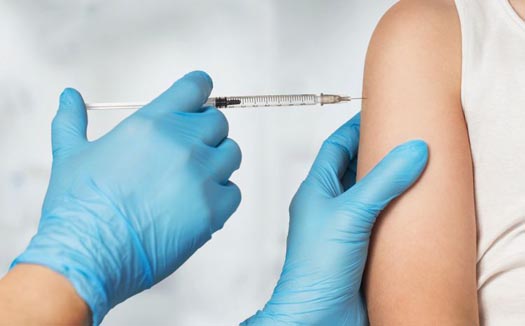
COVID-19 vaccines are on their way, hopefully bringing to an end our current pandemic

Hope for an expeditious end to our current pandemic circumstance appears to be relatively close, with vaccines from at least four — and more probably, six — companies appear well on their way to receiving approval in the next short while, with the two-injection Pfizer vaccine appearing set for approval by Health Canada as early as this Thursday, December 10th, with Moderna, AstraZenica and Johnson & Johnson not far behind in the pipeline. Update: Health Canada approved the Pfizer/BioNTech on December 9th.

A number of announcements have been made in recent days involving the roll-out of the vaccines that will, eventually, keep us all safe …

On November 27th, Prime Minister Justin Trudeau announced the appointment of former NATO commander Maj.-Gen. Dany Fortin to lead the national vaccine distribution effort, with a target of immunizing half of all Canadians — that’s 19 million of us — or more, by September, 2021;

Just yesterday, the Prime Minister told Canadians that Canada has secured an agreement to receive its first batch of Pfizer’s coronavirus vaccine before the end of the year — up to 249,000 doses. Pending Health Canada approval, “Canadians will be getting vaccinated starting next week,” Trudeau said at a news conference in Ottawa. Shipments will continue to arrive in 2021; the second batch will be reserved for the same people vaccinated in the first batch — which is to say, the elderly in long term care facilities across Canada. “We’re facing the largest immunization in the history of our country,” Trudeau said.

Canada’s National Advisory Committee on Immunization (NACI) this past Friday released its final directive addressing the prioritization of who should receive the vaccines first, and which groups would be next, right through until the late spring. By the end of March, NACI scientists said they expect 3 million Canadians will have been vaccinated with one of the three (soon to be four, or more) approved COVID-19 vaccines, that number doubling by late June, and doubling yet again by early to mid-autumn of 2021.

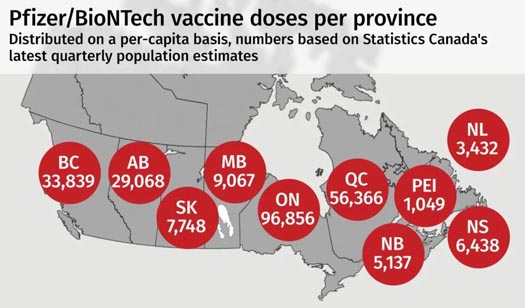
Pfizer/BioNTech roll-out of their COVID-19 vaccine to Canadian provincesThe initial batch of Pfizer/BioNTech vaccines will roll out to 249,000, or more, Canadians

NACI scientists advise the roll-out of vaccines will occur, as follows …

  • (a) Long-term care and assisted living facility residents, as well as residents in retirement homes and chronic care hospitals, who face “severe outcomes” and a much greater chance of dying from the disease than the population as a whole;

  • (b) NACI scientists said the next priority group would be “adults 80 years of age and older;”
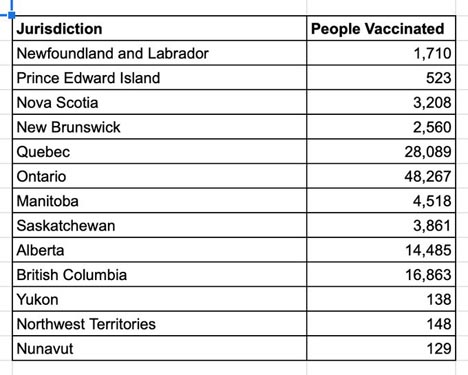
    Initial Pfizer/BioNTech vaccine roll-out in early 2021. Expected number of people in each province to be vaccinated.Number of Canadians, by province, expected to receive the initial batch of Pfizer/BioNTech vaccine in the early part of 2021, beginning in January.

    (c) NACI scientists expressed concern about Indigenous adults living in communities “where infection can have disproportionate consequences, such as those living in remote or isolated areas.” Indigenous persons will be the third group of Canadians to be vaccinated;

    Initial Pfizer/BioNTech vaccine roll-out in early 2021. Expected number of people in each province to be vaccinated.

  • (d) Adults aged 75 – 79 would be next to receive vaccinations, followed by adults aged 70 – 74 years of age.

These four groups — long-term care residents and staff, the elderly, front line health care workers and some Indigenous adults — are expected to consume all of the six million doses (the Pfizer vaccine requires two doses) to be delivered in the first three months of 2021.

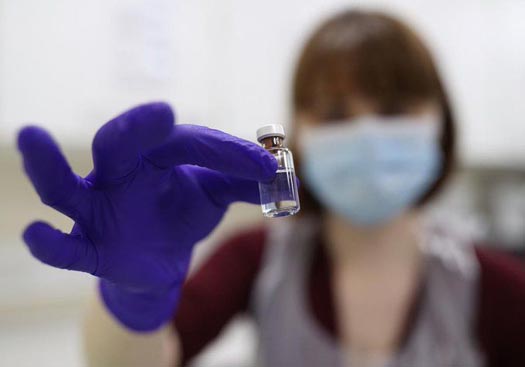
Nurse holding a small bottle containing a COVID-19 vaccine

In the second phase of the vaccine roll-out, which would begin in April 2021, as more supply comes online, other essential workers will have access. The NACI advisory committee said first responders — such as police officers, firefighters and health care workers not included in the initial rollout — would be next in line, followed by residents and staff in other “congregate settings” — such as migrant workers, prisoners in correctional facilities and people in homeless shelters.
At the end of the day, though, it is the provincial Premiers, their Health Ministers and Public Health Officers who will determine prioritization of vaccine roll-out in their jurisdictions. By late summer / early autumn, Prime Minister Trudeau has said he expects half of all Canadians would be vaccinated — that’s 19 million Canadians.
The vaccine roll-out will continue through the end of 2021, and beyond.