
Category Archives: canadian politics

#BCPoli | Polarization A Defining Feature in B.C.’s Upcoming Election


B.C. Premier David Eby has attacked the B.C. Conservatives over abortion, race and gender identity. B.C. Conservative Leader John Rustad has been critical of Eby and the ‘radical NDP.’ | Photo: CBC.

On Tuesday evening, those who tuned into the contentious Kamala Harris-Donald Trump debate on ABC-TV witnessed the division and polarization that has come to frame realpolitik in the United States, and an ever more impactful defining feature of American politics over the past eight years, since Donald Trump first came down the elevator at New York City’s Trump Tower in 2015 to announce his Presidential bid to secure the Republican Party nomination.

If polarization and division have become a defining feature of American politics, in the 2024 British Columbia provincial election, with an alt-right / far right, climate change skeptical Conservative Party of British Columbia emerging as a serious contender for government over the current centre-left B.C. New Democratic Party government led by Premier David Eby, this year’s provincial election is poised to be one of the most contentious in the province’s history.
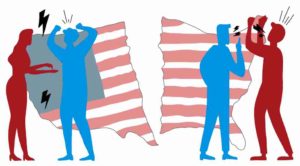
The deep polarization between the B.C. New Democrats and the B.C. Conservatives reflects a broader national and global trend, with political forces on the left and far right dominating the discourse.

The NDP is often seen as a left-leaning, socialist party, while the B.C. Conservatives, as we say above, have gained a reputation for being alt-right or far right, especially on social issues.

As both parties position themselves on opposite ends of the political spectrum, the rhetoric, contentious statements, and ideological battles between them have intensified, creating an atmosphere of division.

Polarization in British Columbia Politics

British Columbia has long been a politically diverse province, with both urban and rural areas reflecting distinct priorities and values.

Traditionally, the province has seen competition between the NDP, representing progressive, labour-oriented interests, and the B.C. Liberals, a more centrist / centre-right party. However, the resurgence of the B.C. Conservatives the last couple of years, combined with the decline of the B.C. Liberals / B.C. United, has created a new dynamic.

The NDP has consolidated its hold on progressive voters, while the Conservatives have catered to socially conservative and populist sentiments, giving rise to a polarized political landscape.

The B.C. NDP, under Premier David Eby, champions policies focused on climate action, the construction of affordable housing for various economic stratas, public transportation, social welfare programmes, and expanding public services.


A B.C. Conservative Party government would walk away from the province’s commitment to protect 30% of British Columbia’s wilderness land base by 2030, says party leader John Rustad .

These priorities resonate with urban voters, particularly in Vancouver and other metropolitan areas.

The NDP’s approach to addressing issues like affordable housing, health care, and environmental sustainability has been lauded by progressives but criticized by opponents as being overly ambitious and fiscally irresponsible.

On the other side, the B.C. Conservatives have positioned themselves as defenders of traditional values — for instance, the province’s SOGI 123 programme, which protects the interests of LGBTQ students — and individual freedoms.

The B.C. Conservative Party has gained traction among rural voters and those disillusioned with the political establishment.

With rhetoric that often borders on populism, the B.C. Conservatives, under the leadership of John Rustad, have campaigned on issues like opposing carbon taxes, promoting resource extraction, and resisting what they view as “woke” progressive policies, including LGBTQ+ rights and climate change initiatives.

This sharp ideological division has made co-operation and compromise between the two parties seem increasingly unlikely.

Contentious Statements from the B.C. NDP and B.C. Conservatives

Both current British Columbia political parties have made highly charged statements about one another, fueling the perception that this election is about more than just policy — it’s a battle over the future direction of the province.

The following was tweeted out by a retiring B.C. United MLA …

The B.C. NDP has painted the B.C. Conservatives as being out of touch with modern British Columbia, accusing them of aligning with far-right extremism.

Premier Eby and his colleagues have criticized the B.C. Conservatives for their stance on climate change, with NDP officials often labeling them as “climate change deniers” and suggesting that their policies would set the province back decades in the fight against global warming.

Furthermore, the B.C. NDP has accused the B.C. Conservatives of being hostile to diversity and inclusion, particularly regarding LGBTQ+ rights, with some NDP members framing the B.C. Conservative agenda as “regressive” and “intolerant.”

In response, the B.C. Conservatives have launched attacks on the NDP, framing the ruling party as being out of step with the needs of ordinary British Columbians.

B.C. Conservatives have characterized the NDP’s policies as “socialist overreach,” arguing the government is infringing on individual freedoms and burdening taxpayers with excessive regulations and taxes.

The B.C. Conservatives have taken aim at the NDP’s environmental policies, particularly the implementation of carbon taxes and clean energy initiatives, which they argue hurt the economy and disproportionately affect rural communities dependent on resource industries.

The B.C. Conservative Party leadership has also criticized the NDP for what they see as pandering to special interest groups, claiming the government is more focused on identity politics than on addressing inflation, crime, and economic growth.

As such, the B.C. Conservatives have taken a page out of Donald Trump’s MAGA Republican playbook, which has proved successful in the United States. We’ll have to wait until the evening of Saturday, October 19th to see whether the Trump-like B.C. Conservative electoral strategy bears fruit at the polls, and allows them to form government.

The 2024 B.C. Election May Become The Most Contentious On Record

Several factors make the upcoming election in British Columbia particularly contentious. First, the ideological gulf between the B.C. NDP and the B.C. Conservatives is wider than ever.

While previous elections in the province have often involved debates over centrist policies, this election is shaping up to be a choice between two starkly different visions for the future. On one side is the NDP’s progressive, environmentally conscious, and socially inclusive platform, and on the other is the B.C. Conservatives’ economically libertarian, socially conservative, and resource-focused agenda.

Second, the stakes are high for both parties.

The B.C. NDP is seeking a mandate to continue its transformative policies, particularly around climate action and social justice, while the B.C. Conservatives are eager to capitalize on voter discontent.

For many voters, the upcoming election is about more than just political leadership — it’s about the soul of British Columbia itself.

Urban voters, particularly in Vancouver and Victoria, may see the election as a referendum on progressive policies, while rural voters view it as a chance to push back against what they perceive as an out-of-touch government.

Broader national & global trends are influencing B.C.’s upcoming election

Across Canada and other Western democracies, political polarization has increased, with far-right and far-left parties gaining ground as centrist parties struggle to maintain relevance.

In British Columbia, this trend is magnified by the province’s unique political landscape, where environmental concerns and social issues intersect with a resource-based economy.

With the B.C. Liberals / B.C. United Party having abandoned its bid for government, the resulting fight between the B.C. NDP and the B.C. Conservatives represents a new era in provincial politics, one where compromise seems unlikely, with the stakes being higher than ever.

As the election approaches — the Writ will be dropped on Saturday, September 21st, at which time the election will be officially underway — the rhetoric between the two parties is intensifying, with each accusing the other of being out of touch with the province’s needs.

With so much at stake — climate action, housing, economic development, social justice, and the future direction of British Columbia — B.C.’s upcoming election is likely to prove to be a pivotal moment in the province’s social and economic history, setting the stage for B.C.’s political trajectory for years to come.

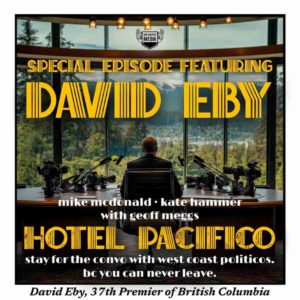
#BCPoli | An Alternative Perspective on Election ’24 | The Hotel Pacifico

Today on VanRamblings, a departure from our usual ramblings, and instead an interview with Premier David Eby, conducted by the folks at Air Quotes Media’s Hotel Pacifico podcast, the inimitable and skilled purveyors of all things British Columbia politics: former 2013 Christy Clark B.C. Liberal campaign manager, Mike McDonald; former Globe and Mail B.C. Legislative reporter, Kate Hammer; and Geoff Meggs, the former Chief of Staff to BC NDP Premier, John Horgan.

On their most recent edition of Hotel Pacifico, the co-hosts of British Columbia’s most informed political podcast hold Premier David Eby’s feet to the fire, for a good half hour, the remainder of the hour-long podcast dedicated to informed punditry on all of the issues that will impact on the 2024 B.C. provincial election.

Next week, the derring pundit trio introduce B.C. Conservative Party leader John Rustad to their listeners, and all of us folks with a passing interest in politics.


Hotel Pacifico podcast hosts / pundits extraordinaire: Mike McDonald, Kate Hammer and Geoff Meggs

Note should be made before we get to Hotel Pacifico’s David Eby interview that Mr. Macdonald, Ms. Hammer and Mr. Meggs will broadcast daily, Monday to Friday, for 18 consecutive weekdays beginning Monday, September 23rd (two days after the Writ is dropped) in the lead up to the October 19th election, on the machinations of the 28-day B.C. campaign for government, a must-watch, must-listen-to (the podcast available on YouTube, and your favourite Apple or other podcast app, as well as on Spotify and other media platforms) endeavour.


The Hotel Pacifico hosts’ podcast interview with B.C. New Democratic Party Premier, David Eby.

#BCPoli | Election 2024 Kindness as a Core Value in the Political Realm

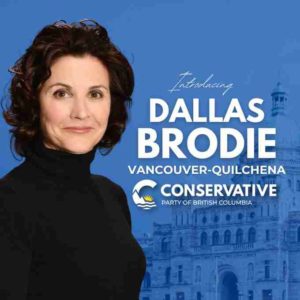
Recently, VanRamblings was afforded the opportunity to meet Dallas Brodie, the B.C. Conservative Party candidate in the riding of Vancouver-Quilchena.

Ms. Brodie, when she approached VanRamblings, told us that one of her campaign workers had made mention to her that we had recently written about her on our blog. Ms. Brodie followed up her initial comment to us by saying, “I read several articles on your blog. You’re a very good writer. Thank you for what you do!”

Now, did Ms. Brodie have to be kind, greet us with a warmth of character and a disarming and engaging complimentary élan?

Nope, she didn’t — particularly given that we’re an opinionated sort of fella, and chances are that Ms. Brodie read some VanRamblings commentary or other with which she was not necessarily in agreement (apparently, Ms. Brodie and VanRamblings, we are told, do not share a “political philosophy” .. alas).

Nonetheless, Dallas Brodie was invariably kind during the few minutes we spoke with one another — in an often too contentious world defined by an unwholesome divisiveness, VanRamblings came away from our encounter hopeful and heartened.

VanRamblings takes this opportunity to congratulate Dallas Brodie on her pending win in the Vancouver-Quilchena riding, where we feel quite assured that she will more than ably represent the concerns and interests of her grateful constituents.

The Role of Kindness as a Core Value in Politics

In an era where political discourse is often dominated by divisiveness, hostility, and polarization, the concept of kindness might seem quaint or naïve.

When we examine the foundational purpose of politics — the organization of society for the common good — kindness emerges as a practical and necessary value.

At its core, kindness represents empathy, respect, and a genuine concern for others. When woven into the fabric of political practices, kindness fosters collaboration, promotes inclusivity, and enables the pursuit of justice and equality.

Kindness must be viewed not as a weakness, but as an essential guiding principle in the development of government policy, and political conduct.


Premier David Eby, one of the kindest, most empathetic persons VanRamblings has ever known, a man  committed to social and economic justice, and a robust full employment economy.

In the 17 years we have enjoyed a political alliance with David Eby, we have always found him to be kind, not just to VanRamblings, but to everyone who comes into his orbit. David Eby is one of the kindest, most empathetic and entirely decent persons we have ever known, possessed of a beneficent social conscience, and as you may have noticed since he became Premier, a grassroots, democratic pragmatism that reflects the best interests of those he serves.

VanRamblings very much believes in the concept of “dancing with the one that brung ya.” As such, we’ll work diligently on David’s upcoming campaign.

Kindness as a Tool for Justice and Equity

Kindness in politics also has a powerful role in advancing justice and equity.

At its core, political decision-making is about determining how resources, rights, and opportunities are distributed within society. When kindness is embedded in this process, it ensures decisions are made with empathy for our most vulnerable populations.

In practical terms, policies that reflect kindness take into account the well-being of all citizens. The commitment to social and environmental justice is not an act of charity but an acknowledgment of our shared humanity.

The importance of kindness in addressing issues like climate change cannot be overstated. Climate change disproportionately affects the poorest and most vulnerable communities.

A kind approach to environmental policy prioritizes the well-being of future generations and ensures that those who are least responsible for climate change are not left to bear its worst consequences. By fostering and promoting a sense of responsibility, political leaders who prioritize personal and social kindness (and equity) can guide the world toward more sustainable and just solutions.


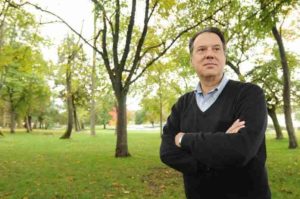
John Coupar, a candidate for the B.C. Conservative Party, in the Vancouver-Little Mountain riding.

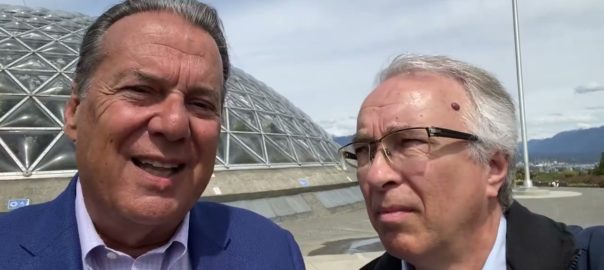
We had written on VanRamblings last week that we’ll be endorsing John Coupar — a past Vancouver Park Board Chairperson, and current Conservative Party of British Columbia candidate — in his bid to win the newly-created Vancouver-Little Mountain riding in the upcoming provincial election.

For maximum exposure, VanRamblings’ plan will be to publish our formal endorsement of Mr. Coupar early next month, a couple of weeks away from British Columbia’s October 19th provincial election date.

As we have written on social media, at least in part (and for us, an important part) of our endorsement of John Coupar arises from the fact Mr. Coupar, in the time we have known him, has always been one of the kindest, most open and most welcoming human beings we have ever encountered.

Which is not to say that John Coupar isn’t a take no guff, tough but fair-minded man of conscience, a man possessed of integrity and great character, a man who while not suffering fools gladly will stand up always for and behind what he believes is right and just, and serves the best interests of the community, and those he has been elected to serve and represent (which means, of course, all of us).

Kindness as a core value in politics is not just an idealistic aspiration; it is a pragmatic approach to creating a more just, equitable, and functional society.

By humanizing political dialogue, building trust, and promoting co-operation, kindness can repair the fractures in our political systems and enable leaders to address the pressing issues of our time with empathy and clarity.

Kindness in politics is a reflection of strength — the strength to listen, to compromise, and to fight for a society where all individuals are treated with dignity.

#BCPoli | BC Election 2024 Vancouver-Little Mountain May the Best Wo/Man Win

On Friday, May 3rd, the Conservative Party of British Columbia announced former Vancouver Park Board Chairperson John Coupar as their candidate in the newly-created riding of Vancouver-Little Mountain, in the upcoming provincial election.


John Coupar announced as BC Conservative Party candidate in the riding of Vancouver-Little Mountain

John Coupar is best known for his role in saving and restoring the iconic and much beloved Bloedel Conservatory atop Queen Elizabeth Park, located at the geographic centre of Vancouver and the Little Mountain riding.

Public safety is issue number one. Residents deserve to walk down the street without worrying about being assaulted or robbed,” says Coupar. “I know this riding and the people who reside in it. I’ve lived in Olympic Village for over a decade.”

Upon accepting the Conservative Party of B.C. nomination, John Coupar had this to say about Christine Boyle, his BC NDP opponent in Vancouver-Little Mountain.

“The current NDP candidate, Christine Boyle, has not represented the concerns of this community. She doesn’t even live in the riding. She promoted the ‘defund the police’ movement, and supports reckless policies on illicit drug use. Quite simply, Christine Boyle is out of touch with the concerns of the community. The residents of Vancouver-Little Mountain require a common-sense approach to governance that will restore public safety, make life affordable, and a responsible MLA in the B.C. Legislature who will represent the best interests of the community,” concludes John Coupar.


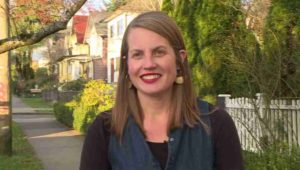
BC NDP candidate, Vancouver City Councillor Christine Boyle, seeks office in Vancouver-Little Mountain

After a hard fought nomination race, on April 4th of this year, two-term Vancouver City Councillor Christine Boyle secured the British Columbia New Democratic Party nomination in the newly-created riding of Vancouver-Little Mountain.

“It’s an incredible honour to be your BC NDP candidate in Vancouver-Little Mountain in the upcoming B.C. election,” Ms. Boyle posted on the X social media platform upon securing the nomination. “Thank you for your support, for your encouragement and for your passion as together we work towards building a fairer, healthier and more affordable British Columbia for all.”

BC NDP candidate Christine Boyle for Vancouver-Little Mountain, with media after winning nomination

David Eby weighed in when Ms. Boyle secured the Vancouver-Little Mountain nomination.

“As a Vancouver City Councillor, Christine Boyle is a tireless champion for everyday people and the social good,” Eby said.

“I know she’ll bring that same energy and compassion to her work for people as a BC NDP MLA. Christine will be a strong addition to our team, and a great representative for people in Vancouver-Little Mountain and the issues they care about.”

Christine Boyle is a strong advocate for rental, co-op and non-market housing.

Since first being elected to Vancouver City Council in 2018, and re-elected to a second term on Council in 2022, Christine Boyle has only served to strengthen her environmental and climate advocacy bona fides — including, leading the development of Vancouver’s Climate Emergency Action Plan — which, when you consider that BC Conservative party leader John Rustad believes climate change to be a hoax, makes Ms. Boyle’s election to Victoria all that much more important.

Sources within both the BC NDP and the BC Conservative Party tell VanRamblings that Christine Boyle currently enjoys a five-point lead over John Coupar in the race to become the Member of the Legislature representing Vancouver-Little Mountain.

In the interest of full disclosure, as we wrote on social media yesterday, VanRamblings will formally endorse John Coupar in the lead up to British Columbia’s October 19th provincial election, when we will express why we believe it is critical to the interests of B.C. citizens that John Coupar becomes a member of the BC Conservative Party caucus, a goal that could be achieved should the residents of Vancouver-Little Mountain in all their wisdom elect John Coupar to represent them in the British Columbia Legislature over the next four years.

Here’s what we wrote yesterday on social media in support of John Coupar’s candidacy for elected office under the Conservative Party of B.C. banner.

“I am supporting John Coupar, who I’ve know well since 2011, someone I speak and meet with regularly, someone who saw me through my cancer journey, one of the best men I have ever known, a compassionate and caring man of character who doesn’t suffer fools gladly and stands up for the guiding principles that have defined his life of service and contribution, a champion of the gender variant community, and a person of character who I believe it is critical to have sitting in the BC Conservative caucus.

In the case of John Coupar, it is the privilege of my life to count John among my friends.

My endorsement of John is not meant to suggest that Christine Boyle — his NDP opponent — is not a worthy candidate, or that she wouldn’t make a fine member of the British Columbia Legislature.

The above said, my support for the re-election of British Columbia’s New Democratic Party government could not be stronger, as will be evidenced in my writing in the weeks to come.”

Make no mistake, this will be a close election, with either the NDP eking out a win to form government over the next four years, or the Conservative Party of B.C. — with the wind at their back, riding the coattails of popular federal Conservative Party leader Pierre Poilievre, who is currently polling at 50% support among the B.C. electorate — forming government, from late 2024 through the fall of 2028.

We’ll know the outcome of the provincial election on Saturday, October 19th.

Whoever secures government on the evening of October 19th, VanRamblings implores you to not allow yourself the destructive indulgence of division.

When you awake on a peaceful October 20th morning, those who love you will still love you, and as we head into the holiday season in November and December know that there will be much to be thankful for in all aspects of your life.

Yes, elections are important, and we all — well, at least those diminishing few of us who are engaged in the conditions that impact on our lives, and give a good galldarn about politics, and know how important the role of government is in determining the livability and economic and social viability of our province — will continue on with our lives as we always have, experiencing occasional peripatetic joy, while appreciating the natural beauty of our province, and the love of all those who play a critically important role in the stability and the livability of our lives.