 The rise of right wing populism in the United States brought on by the election of Donald Trump
We live in a troubled and troubling world, with the ravages of climate emergency a danger to us all — most particularly, British Columbians in 2021, living through a heat dome crisis in June, consuming province-wide wildfires this past summer, and now, flooding, economic devastation, and the destruction of roads and bridges that serve to exacerbate an execrable supply chain crisis.
And, then, there’s the politics of the western world, where authoritarianism and autocratic regimes across the globe have become even more brazen in their repression. Many democratic governments are backsliding and are adopting authoritarian tactics by restricting free speech and weakening the rule of law, a trend exacerbated by the COVID-19 pandemic.
“The political flaws and social fault lines revealed by the pandemic will drive more people towards populist and authoritarian leaders that seldom deliver durable solutions for the concerns of citizens”, says International IDEA Secretary-General Kevin Casas-Zamora. “If there is one key message in the Global State of Democracy Report 2021 — Building Resilience in a Pandemic Era”, published by the International Institute for Democracy and Electoral Assistance (International IDEA), an intergovernmental organization based in Stockholm, “it is that now is the time for democracies to be bold, to innovate and revitalize themselves. The Global State of Democracy report is not a wakeup call, it’s an alarm bell. Authoritarianism advances in every corner of the earth. Universal values — the pillars of civilization that protect the most vulnerable — are under threat.”
While many democracies have proved resilient during the pandemic, by expanding democratic innovations and adapting their practices and institutions in record time, in order to preserve our democracies, as Casas-Zamora states, bold action was required by our leaders to innovate and revitalize themselves.
 Cuba’s pro democracy protesters take to the streets, to fight rising poverty and high COVID-19 numbers
One of the key findings of the report is the strength of civic activism all over the world. Pro-democracy movements have braved repression in places such as Belarus, Cuba, Eswatini, Myanmar, and Sudan, and global social movements for tackling climate change and fighting racial injustice have thrived.
More than 80 countries have experienced protests and civic action of different kinds during the pandemic despite often harsh government restrictions.
Asia and the Pacific has suffered a wave of growing authoritarianism as crises of various kinds have affected Afghanistan, Hong Kong and Myanmar. Democratic erosion is also widespread, including in India, the Philippines and Sri Lanka with many of them suffering from rising ethno-nationalism and the militarization of politics. China’s influence, coupled with its own deepening autocratization, also puts the legitimacy of the democratic model at risk.
In Africa and the Middle East, while elections remain the norm, the report states the democratic quality of these elections is on the decline and attempts to evade or remove presidential term limits present a risk to democracy. 2021 has seen four military coups: in Chad, Guinea-Conakry, Mali and Sudan.
The Middle East’s tainted track record on protecting civil liberties has been even further strained by the pandemic, with many elections held with the sole aim of keeping existing regimes in power, such as in Algeria, Egypt and Syria.
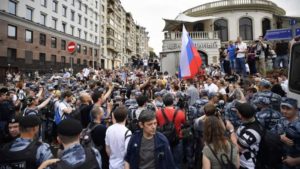 Moscow gripped with the largest anti-government demonstrations since the winter of 2011-12
The rise of autocracy and of right wing populism, its western democratic cousin, gives rise to understandable concern that liberal political values and the rule of law are heading towards terminal decline.
However, neither autocratic states such as China and Russia nor right wing populist leaders like Donald Trump in the U.S., Italy’s Matteo Salvini and right wing populist leaders in other western countries have had everything go their way. Their mixed fortunes suggest that it is premature to write off the prospects for global governance, even though the rules-based order constructed after 1945 is decomposing and will never return in its old form.
The Chinese and Russian states possess immense resources of violence and intimidation that allow them to suppress dissent with ease. From Tiananmen Square in 1989 on, China has proved that it has an unyielding state of mind, one that augurs poorly for Hong Kong protesters.
However, there is less tolerance for politically related violence in European societies, as demonstrated by the public backlash in Slovakia against the murder of Ján Kuciak, an investigative journalist, and his fiancée Martina Kušnírová.
Should right wing populism fail to make deeper inroads in western political systems, owing to its unrealistic promises and policy confusion when in power, the deliberate disruption of the post-1945 global order would arguably slow down. The growing internal challenges of autocratic systems in countries such as Russia and Turkey might reinforce this trend.
However, the most important long-term trends in international relations over the past 30 years have been the rise of China and the accelerating shift of economic power from the west to the Asia-Pacific region.
That shift ensures that the Washington-designed post-1945 order, built mainly for the benefit of the U.S., Canada, Europe, Japan and their allies, in the years to come will give way to a more dispersed form of global governance.
For the west, the cold reality is not that autocracy will triumph and democracy will fail, but rather that the 500-year-long era of western global supremacy is slowly and inexorably coming to an end.