Investigative Journalism | Why We All Must Subscribe to Media

subscribe.jpg

The future of journalism will increasingly depend on you paying for the news directly. Subscribing to newspapers, magazines and online journals represents nothing less than your essential duty to your fellow citizens, a necessary act of good citizenship, particularly when the algorithms developed by social media feeds like Facebook knowingly publish what can only be considered as “fake news”, and a true diminishment of knowledge.
The genesis of today’s VanRamblings derives from this tweet by longtime, respected Globe and Mail labour reporter, Rod Mickleburgh …


For those who don’t know: I love short form writing, have for almost 60 years now. As this is my blog, and in some sense an expression of what I care about, it is also (increasingly) about who I am, and how I have arrived at where I am in my life, psychologically, spiritually, philosophically and intellectually at the age of 70 years, and a few more COVID-19 months on.
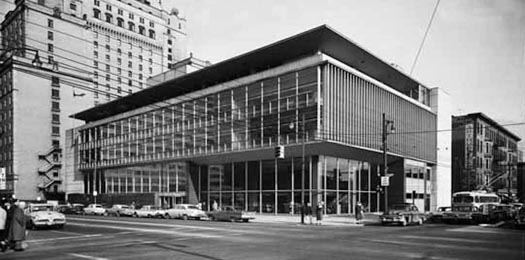
Vancouver Public Library, at Burrard and Robson, circa 1963

As I’ve written previously, from age 6 on, I pretty much raised myself — my father worked the afternoon shift til 1 a.m. at the post office, and my mother worked evenings at Canada Packers / Swift Meats on Lulu Island. After making myself some dinner, or eating some stew that was bubbling away in the slow cooker, I was left to my own devices. Sometimes that involved going to the movies, sometimes in the 1960s that meant rehearsing for a play at Templeton Secondary school, but mostly it meant spending evenings at the Vancouver Public Library, at Robson and Burrard (pictured above). In some measure, librarians helped to raise me.
The library opened up previously unimaginable possibilities about what the future held, not only introducing me to the great works of literature, but providing me with insight into history, politics, development, and the arts.
Amidst the many tens of thousands of books, there was a newspaper and magazine room, where I would spend the better part of an hour each evening, reading through Time magazine, the London Times, the New York Times, the Manchester Guardian, the Toronto Star, and in time, the “gang of activists” folks who began publishing This Magazine, Canadian Forum and Canadian Dimension. I read newspapers from across the globe, and consumed magazines as if I was starved for information about the beauty and breadth of the world around me. I carried on that tradition of magazine and world newspaper reading while attending school at Simon Fraser University in the 1970s, and carry on that tradition thru until this very day.
At present, I subscribe to the following newspapers, magazines and …

News subscriptions

The Globe and Mail sets me back $29.36 each month, by far my most expensive subscription, I subscribe to the news channels through TELUS Optik TV. The annual subscription to the LA Times is $71.01 (or $5.92 a month), the Washington Post, $76.08 ($6.34 monthly), Slate Plus is $35.86 annually, while Vulture / New York magazine comes in at $27.36 for the year. The New York Times is $8.40 per month, and The Guardian is an even $5. The total monthly subscription to the news channels, and all the magazines above comes in at a whopping, easy-to-digest $67.28 a month.
Each morning when I arise to Stephen Quinn and The Early Edition, sometimes at 7 a.m., sometimes at 5 a.m., I immediately flip open the iPad Mini beside my bed, and click on the morning digest of news on my Flipboard app, a free and indispensable source of news.

Next, I surf through the New York and Los Angeles Times, then Slate, The Guardian, the Washington Post, and Vulture. Then, it’s up to make some breakfast while listening to the New York Times’ Michael Barbaro podcast, The Daily. Over breakfast I catch up on the news on CBC Network, the CTV News channel, CNN and MSNBC. After breakfast, it’s to my computer to continue with an hour of reading of the Globe, and the NY Times, the Washington Post and LA Times in depth, with a gander at Slate, and checking out Vulture / the New York magazine — and whatever I’ve found on Flipboard that I found interesting, in The Atlantic, Esquire, Vanity Fair, after which it’s off to Twitter and Facebook.
And then, after all that, I’m ready to begin my day.
Okay, okay, I can hear you say, “It’s alright for you to read and subscribe to so many news outlets, but not all of us have money to spend burning a hole in our pocket,” which will now lead to the following graph of my total income for 2019. I have an extra $75 in tax taken off, so I’ve got a bit of money, usually $900 in a tax return, each spring — thanks to my good friend (who knows how he puts up with me?) and accountant for nigh on 30 years, the spectacularly kind Patrick Mokrane, who’s kept me afloat financially thru his on the up-and-up derring do on my annual tax return.
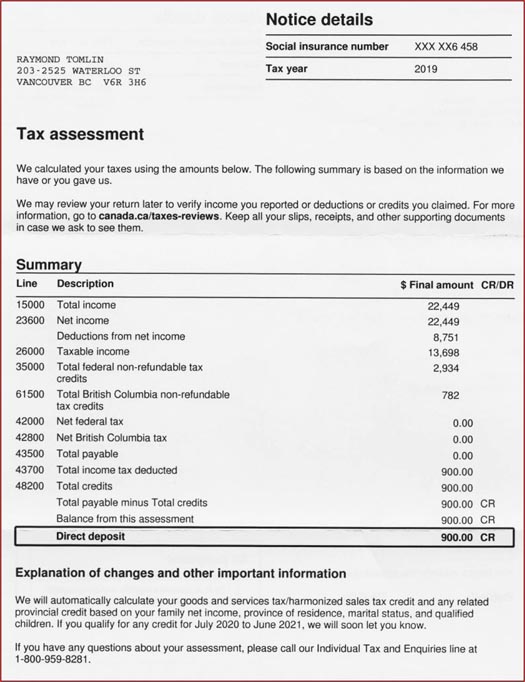
Raymond Tomlin's 2019 tax return

A friend of mine tells me that he believes I live better on $1870.75 a month than anyone he knows. I have created an Excel spreadsheet that tracks every penny I spend, so that helps keeps me focused. My housing co-op monthly charge comes in at around $600, my bills (Internet, TV, mobility, home phone and Hydro, Netflix, Prime, etc.) comes in at around $245 — which leaves me with $67 for my subscriptions, $350 for food and household products, $75 a month on dining out or ordering in, another $75 a month for clothes and shoes — which, ordinarily, would leave me $400 each month left over to pay for dental, books, tech, insurance, hair cuts, donations to various causes (oh yes, I forgot, I donate $100 each month to the NDP provincially and federally, as well as to a faith organization, and various “causes”). Unfortunately, when in 2018 I came into a windfall arising from a 30-year-old union grievance I filed and won (for me, and hundreds of others locally), Canada Pension deducted that windfall from my annual income (economics - the dismal science), but in 2019 I had no such windfall, so in July Canada Pension cut my pension by $172.50 a month!
All of the above is by way of saying, if I can live relatively well on $1698 a month, or so, and can still prioritize subscriptions to various online news organizations, and donate monies to political parties I support, so can you.

digital-subscribe.jpg

As all of us are aware, it costs money to create content, and it costs a lot of money to fund good investigative journalism, as the nonprofit-run Mother Jones pointed out this year during a fundraising effort.
These past few years, we’ve also become aware of the controversy surrounding Mark Zuckerberg; the indifferent Facebook CEO claimed it was “crazy” that fake news on Facebook could have influenced the recent U.S. election results, or that his social media site has anything to do with aiding the repression of citizens across the globe. Sadly, that’s far from the truth.
Awhile back, Facebook eliminated the human editors who curated trending news; now an algorithm handles this — but the algorithm often gets it wrong, as stories from Russian bot sites present themselves as credible news organizations, make the rounds and trend on Facebook, feeding conspiracy theories and misinformation. Little wonder that, at last count, Facebook remains the world’s #1 purveyor of false or inaccurate news.
All of which is to say that you have an obligation to yourself, to those around you, and to society in general to keep yourself well-informed, and read credible news sites that are, in actuality, truly “fair and balanced.”
If you believe the newspapers and magazines above are a little too “conservative” for your liking, in Canada, there’s always rabble.ca, the public affairs journalism of richochet.ca, This Magazine, and Canadian Dimension, as well as down south, In These Times, Mother Jones, Crooks and Liars, and so many other left-of-centre journals and magazines that may be found online. There are places online where you can get credible, well-thought-out and researched, witty & engagingly written truthful news.
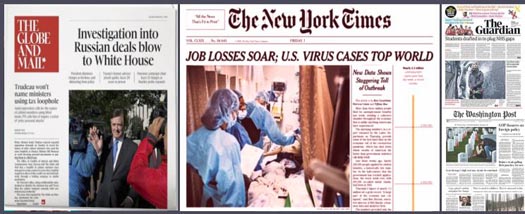
newspapers-magazines.jpg

Do yourself a favour today: subscribe to one or more online, or home delivery, newspaper, journal or magazine. You’ll feel better for it. Honest.


#USElection2020 | So Long Donald Trump, You F%&?#! Maniac

Trump's loser portrait

In 65 days from today, the monstrous narcissist that is Donald Trump will no longer be President of the United States, a position he never should have ascended to in the first place, and despite the 73 million wrong-headed, Mussolini-lovin’, cult-like votes he managed to secure earlier this month from the American electorate, Donald Trump remains a blight on the social and political landscape of the U.S., and everywhere across the globe.
No one, ten years from now, will ever admit to having voted for this sociopathic, hate-filled traitor — any support for him will have long been repudiated by the vast majority of Republicans, and the U.S. electorate.

In the meantime, Donald Trump refuses to concede, to conduct himself as a responsible citizen, and to co-operate with an orderly transition of power — thereby causing the United States, and all of us, to find ourselves in a precarious state of a lack of security to fight those who would do us harm. No surprise there, of course — it’s just par for the course for Donald Trump, apt phraseology given Trump’s love for spending time on the golf course.
For months before the election, political analysts and worried members of the public wondered what would happen if Donald Trump refused to concede after losing to Joe Biden. With Trump’s fetish for autocratic power, inability to accept negative consequences, and lack of apparent tether to democratic norms, the prospect of his outright ignoring an election defeat seemed all but certain. No one who’s been watching Trump in horror for the past four years should be surprised by his unhinged obfuscatory tactics.

While it’s true that no modern U.S. presidential candidate has refused to concede, and while American history’s most contentious presidential races have also ended in admissions of defeat, if not an expressed concession outright, and there are no legal consequences should Trump continue to refuse to concede, the transition team President-elect Joseph R. Biden has put in place has already addressed the matter of concession, issuing a statement that reads, in part, “the U.S. government is perfectly capable of escorting trespassers out of the White House, if such becomes necessary.”
John R. Vile, dean of political science at Middle Tennessee State University, who has written about the history of concession speeches, argues that it matters for presidential candidates to concede even if it doesn’t have legal consequences, because words matter.

“Adherence to established electoral norms has helped shore up U.S. democracy even in the midst of its most chaotic and divisive elections,” Vile has written. “When it comes down to it, it’s not the Army or the Navy that keeps the United States together. It’s the notion that we are bound together by certain great principles and that our similarities are more binding than our differences are.”

On Monday, December 14th, the U.S. College of Electors will meet to acknowledge that having won 306 electoral college votes, Joseph R. Biden will become the 46th President of the United States, a fact that will be further amplified by a meeting of the U.S. Congress on Wednesday, January 6th, creating the conditions for the Inauguration of President-elect Joseph R. Biden and Vice President-elect Kamala Harris to be sworn into office, and officially become the President and Vice President of the United States.

Donald Trump's post presidency

In an article in Politico, David A. Bell, a professor of history at Princeton University and author, most recently, of Men on Horseback: The Power of Charisma in the Age of Revolution argues that whether or not Trump concedes, come January 20, he will be looking for a new job.

“Trump is undoubtedly tempted to remain as much as possible in the public eye, rage-tweeting against the Biden administration,” Bell writes, “and possibly starting up a new cable TV network. But he also has to worry about criminal investigations, and about defaulting on his considerable debt now that he can no longer use the presidency to drive business to his hotels and resort properties.”

Which is to say, Trump’s post-presidency will hardly be a bed of roses.
VanRamblings would argue that unless, as has been rumoured, tough guy New York Governor Andrew Cuomo becomes the next U.S. Attorney General and orders the prosecutors in the southern district of New York state to cease all investigatory work pertaining to Trump, the 24 credible cases of sexual assault that have been lodged against Trump will move forward through the courts, in all probability leading to a conviction on most, if not all, of the allegations — leaving Donald Trump to experience a penury not dissimilar to that of Harvey Weinstein, and a multiple year prison sentence.

And that’s not all. Trump faces incoming fire from three different directions in his native New York, his odds of escaping unscathed long indeed. New York Attorney General Letitia James has filed motions revealing that her office too is on Trump’s trail, arising from a long-standing civil investigation into whether the Trump Organization improperly inflated its assets to get loans and obtain tax benefits, a practice that former Trump attorney Michael Cohen told Congress was routine. The release of Trump’s eight years of unreleased tax records could very well trigger action by Manhattan District Attorney Cyrus Vance Jr. to file criminal charges.
If Trump were to issue himself a pardon, or resign his office in January and have a lame duck Mike Pence as president for 10 days issue a pardon of Trump, such a pardon would preempt federal prosecution, but it would not stand in the way of state-initiated action by James and Vance in New York.

Slate Political Gabest co-hosts David Plotz, Emily Bazelon & John Dickerson weigh in on Trump’s failure to concede, transition planning by the incoming Biden administration, and the upcoming U.S. Supreme Court decision on the Affordable Care Act aka Obamacare.

Trump has proved himself a prolific escape artist during his presidency, using delay, subterfuge and political muscle to push back against any number of potentially mortal lies, gaffes and legal threats. But his very success in doing so has inspired many powerful actors in the legal profession to want to hold him, finally, to account after he leaves office.

Coronavirus cases, and deaths, in the United States, as of 10:35pm, November 15, 2020

As VanRamblings writes this, more than 251 million Americans have lost their lives to COVID-19. As is the case in Canada, many American children have lost months of school. Soon, a huge part of America will lose any semblance of Thanksgiving, the most important of American holidays.
Because of the Trump administration’s barbaric family separation policy, 545 children may be lost to their parents forever. America has lost its status as a leading democracy. More people have lost their jobs under Trump than under any president since World War II.
A perpetual state of emergency proved so unhealthy for many Americans, and so unsustainable that a record 78,764,266 Democratic voters made it to the polls, even amidst a pandemic, to reclaim their country and end the tenure of the panic-inducing Trump administration that blocked out the sun and all but eradicated hope in a United States that became near unrecognizable to many citizens of conscience living across our Earth.

But soon, a new day will dawn. Only when Donald Trump has gone will all of us come to see how much we’ve been missing these past four years.
Bill Maher | Farewell to the Douchebags in the Trump Administration

Music Sundays | Rickie Lee Jones | The Girl at Her Volcano

Rickie Lee Jones, The Girl at Her Volcano

At age 15, a young Rickie Lee Jones dropped out of school and ran away from her Pacific Northwest home in search of her father, an itinerant jazz musician, who had abandoned her family when she was 10 years of age. After spending time living in a barrio in Los Angeles, once on the road again, Rickie Lee finally located her father in Kansas City, Missouri — but didn’t end up staying very long, instead returning to her Puget Sound home, writing her GED, enrolling first at a small college in Tacoma, and afterward, at age 18, moving south to Huntington Beach, California.

Tom Waits’ interpretation of the classic Bernstein/Sondheim song, Somewhere, from the 1961 musical West Side Story, the song on the 1978 Tom Waits album, Blue Valentine.

While in L.A., Rickie Lee played in bars and coffee houses in L.A., and at the age of 21 she began to play in clubs in Venice, sitting in with various jazz bands. Soon after Rickie Lee moved to Venice, where she met local piano player and songwriter Alfred Johnson, the two of them in time setting about to compose the songs Weasel and the White Boys, and Company, both songs later included in Rickie Lee’s eponymous début album.

By 1977, Rickie Lee was playing original material at Hollywood’s Ala Carte Club, when she came to the attention of Tom Waits, who was particularly impressed with her interpretation of a song her father had written, The Moon is Made of Gold. By early 1978, Rickie Lee found herself in the studio where Tom Waits was recording his latest album, Blue Valentine.

Towards the end of the Warner Bros. Blue Valentine recording session, with all the musicians in the room, Rickie was asked if she wanted to record some tracks on the master tape, whereupon she laid down four tracks: Weasel and the White Boys, Company, Easy Money, and The Last Chance Texaco — and thought nothing more of it, until Warner Bros. executive and producer Lenny Waronker was listening to the master tape in his office one day, and was floored when he heard Rickie Lee Jones for the first time.

A year later, in March 1979, Rickie Lee Jones was released and became a hit, buoyed by the chart success of the jazz-flavoured single Chuck E.’s In Love, which hit No. 4 on the Billboard Hot 100. Rickie Lee became an overnight sensation, touring the album across North America and Europe.
I saw Rickie Lee in Vancouver, at The Orpheum, in the summer of 1979.
Rickie Lee followed up her début album with Pirates, considered by many to be her masterpiece, the album returning her to the upper echelons of the charts, along the way garnering a rave five-star review in Rolling Stone.

Long story short, success proved a challenge for Rickie Lee. Behind the scenes, by late 1982 Rickie Lee was struggling with intense addictions, ranging from alcohol, to heroin and cocaine. The authorities were aware of her drug usage, as a Reagan administration set about to make an example of her, and charge and jail her. An oft told tale in the music industry.
Prior to her being charged, Warner Bros. made arrangements to spirit Rickie Lee out of the country, to the south of France — but before leaving, Rickie Lee insisted on recording a 10″ EP, 1983’s jazz-infused Girl At Her Volcano, a virtually unknown album in Rickie Lee’s vast discography, but by far my favourite Rickie Lee recording, and the music which became the soundtrack of my children’s lives in their early, and most formative years.

Lush Life (Girl at Her Volcano), recorded live at L.A.’s Perkins Palace, April 16, 1982

Cobbling together a recording as best they could before spiriting a troubled Rickie Lee out of the country and to safety, the Girl At Her Volcano EP, while highlighting Rickie Lee’s propensity for jazz material, given that the recording is evenly split between classic pop studio and live jazz material actually reveals itself to be a surprisingly cohesive recording.

The studio material, arrangement and production-wise, balances the atmospherics of 1981’s Pirates with the impressionistic, airy tone of The Magazine, which also was to display a return to a more upbeat, joyous jazz-pop style. The lone original is the beautiful two-minute Hey Bub, which, as the liner notes reveal, was the first song written for Pirates in September 1979 but was left off the LP. It’s similar to those lonely, sad, forlorn ballads from the album like Skeletons or The Returns, and similarly gorgeous.

The brief, electric piano-fuelled So Long is a Girl At Her Volcano highlight.

The real highlights of Girl At Her Volcano, though, have to be her sublime live renditions of some notable jazz standards. Rickie Lee’s interpretations of Lush Life and My Funny Valentine breathe new life into familiar material; her emotive vocals and inventive phrasing completely rejuvenate and revitalize the songs. She puts in a passionate vocal performance, certainly, but also a technically superb performance — with dazzling range, precision, and control. Rickie Lee’s voice is not especially big but she wows with her incredible feeling and ability. Those two recordings are from consecutive nights in Pasadena’s Perkins Palace and the LA’s Roxy on April 17-18, 1982, and, along with a September 1979 recording of Something Cool from Amsterdam’s Theater Carre, represent three of Rickie Lee Jones’ career best vocal performances, simply moving and spine-chilling in their intensity.
All of six years of age, when Megan first heard Girl At Her Volcano, and Rickie Lee’s interpretation of Richard Rodgers’ My Funny Valentine — Jude and Megan and I were on our way back home from Seattle, where we’d spent the weekend, as we did once a month throughout the 1980s, and where I’d pick up a cassette of the as-yet-unreleased-in-Canada Girl At Her Volcano EP, late in the day, the night sky dark, clear and purple, Megan sitting nestled in the passenger seat, Jude sound asleep in the back seat, she turned to me and quietly asked, “Daddy, how can someone say …

Your looks are laughable
Unphotographable.

Is your figure less than Greek?
Is your mouth a little weak?
When you open it to speak
Are you smart?

“… isn’t Rickie Lee being cruel when she sings those lyrics? Are those the words you use to say to someone you love, that you really love them?”
From that chill 1983 autumn night until this pandemic-infused mid-autumn November, My Funny Valentine remains a Rickie Lee Jones unfavourite song for Megan, however much she loves everything else that Rickie Lee has recorded over the years, the soundtrack of a young girl’s life growing up, and now the mother of three children, living over on Vancouver’s east side.
Have a listen, and see what you think of Rickie Lee’s My Funny Valentine.

Stories of a Life | Summer Travels to Nova Scotia, But No More

A photo of the east coast Nova Scotia community of Annapolis Royal

In the mid-1980s a friend of mine with whom I’d gone to school at Templeton Secondary on Vancouver’s east side, and someone with whom I’d worked in radio — his achievements in radio were far greater than mine — met a woman, fell in love, and in 1988 the two were married, in Nova Scotia, her home since the late 1970s, where she worked as a librarian.
Now, this woman had in the 1960s, while in her teens and early twenties, had a very successful career as a model, and on the advice of her financial advisor invested in property in Nova Scotia — which to this day remains undervalued — and specifically in the community where her parents visited each summer when she was a child, the east coast township of Annapolis Royal, a beautiful waterfront community nestled in the Annapolis Valley.
Both my friend and his new bride — who had moved to British Columbia with her new husband and taken on a job as a librarian in a rural, waterfront community just outside of Metro Vancouver — were people I spoke with regularly and visited often. We were close, and whenever they were in town, we would go for dinner at a comforting restaurant where the food was good, somewhere in the city of Vancouver. For seven years, the two of them were a regular fixture within my social circle, and good friends.
In early March of 1995, when I called over to their home one Wednesday evening, quite surprisingly my friend Corinne did not answer the phone — Donald answered the phone. “Where is Corinne?” I asked. “Oh, she’s at a library Board meeting,” he answered. And so it went, twice a week, every week through near the end of June — Corinne never available, at a meeting or out with friends, or a walk, in town, or otherwise unavailable. Until …
One day in late June, I got a call from Corinne; she was back in Nova Scotia, had returned there from her home in British Columbia, had filed for divorce from Donald, and was as lonely as lonely could be, she told me. “Raymond, come visit me in Annapolis Royal. I miss you, and I need to see you. Come stay with me this summer, and I promise that the two of us will have a good time together, and that you’ll just love Nova Scotia.”

And thus began, the first of 15 consecutive summer visits I made to Annapolis Royal, Nova Scotia and environs, a lovely community, where I met everyone in town, during the summer months becoming something of a fixture in the community, where people pleaded with me to move back east, where I was repeatedly offered the job as general manager of the King’s Theatre, where I could purchase a house on 10 acres for $40,000, where I helped run NDP campaigns on three occasions (and where I met a callow young fellow by the name of Stephen McNeil who, as I predicted when speaking with him, would be Premier of the province one day — a prediction, quite obviously, which came to pass), where I fell in love with the community and all the wonderful people I met over the years, recovering from the hurly burly of my west coast life, over the weeks I spent each summer in the tranquil community on the Annapolis River.

All was well in each of the summers, until 2010, when I travelled back east to Annapolis Royal to celebrate my 60th birthday. Corinne, a decided personality, had over the years become increasingly dissatisfied with her life, both in Annapolis Royal, and with life in general.
As the years passed, she made it clear that my visit was to be shorter, more truncated, no longer than 10 days, after which I must leave. On my birthday in 2010, which we celebrated at a wonderful waterfront restaurant, Corinne insisted I pay for the two of us, a bill which far exceeded $150 — which for me was a lot of money, when added to the now $1000 airfare, my stay in Halifax on the way to Annapolis Royal, and on the way back, and Corinne’s insistence that I pay for all expenses for the two of us during my stay in her home, which was strange given that Corinne owned two large, revenue-generating apartment buildings in town, as well as thriving storefront properties, and her own, nicely-situated waterfront home.
In the summer of 2010, with Stephen McNeil finally having fulfilled his commitment to bring high-speed internet to his rural Annapolis Royal constituency, I also helped Corinne establish a stable Wi-Fi connection, set up her new laptop computer, got her on the world wide web, and placed a couple of thousand mp3s of her favourite music — like me, she’s a big fan of progressive country music — onto her newly acquired computer.
All was right with the world, as four of the nights I was in Annapolis Royal, the two of us were invited out for dinner at the homes of various mutual friends, enjoyed an incredibly bountiful church dinner on the Friday nights, visiting at the farmer’s market on Wednesday & Saturday, where I picked up a handful of hand-sewn wash cloths and nautically-themed cotton coasters, as well as a beautiful and a small, lovingly hand-sewn quilt, paying only $10 for the latter — all of which items I enjoy to this day!

The Kings Theatre, Annapolis Royal

All was well until the Saturday evening, when Corinne and I repaired to the King’s Theatre, to attend a student concert of a choir, musicians, and individual singers hailing from Annapolis Royal, a beautiful night of music and song celebrated with the townspeople, and visitors from across the Maritimes and the U.S. northeast — and me, of course.
On that evening, Corinne was working the front of the house prior to the concert starting, supervising the volunteer staff, making sure tickets were taken, the concession was working well & efficiently, and persons taken to their seats in readiness for the concert that was about to begin. One of the volunteers was a 17-year-old young woman, recently graduated with first class honours from Annapolis Royal Secondary and enrolled for the fall session at Dalhousie University, as becoming as could be, all primly dressed (as Corinne insisted) in a black skirt with a hem no more than two inches above the knee, and a starched white blouse, hair neatly kept, and all freshly scrubbed and presentable, a picture of innocence and sophistication.
As it happens, I first met this young woman when she was just a toddler, when Corinne and I visited at her parent’s home, which we both did each of the 15 years I travelled back east. So, I had watched this young girl grow into a woman of substance and no little élan, the apple of her parent’s eye and I’m sure they thought, a tribute to their superior parenting skills — which is to say, they loved her, brought her up with the values of service to the community, teaching her to express kindness and consideration for all.
Now, I hadn’t noticed it, but Corinne did, and as she was standing next to me, called the young woman over to angrily express her disdain at the …

“… entirely inappropriate nose ring you are wearing, which I will simply not have. You know the dress code, and have failed to meet that dress code. In consequence, I am suspending your participation as a volunteer, sending you home immediately, with an instruction that you may not return until I have spoken with your parents, and ensured that you have removed that damnable ring from your nose.”

The above said in a bitterly critical voice designed to embarrass this young woman, who by the time Corinne finished was in tears, the front of her blouse soaked, her nose running (I offered her a freshly-pressed cotton handkerchief, which I always have on my person), shaking, inconsolable.
The young woman left the theatre, people now seated, the concert began.
During the concert, I got up from my seat to repair to the lobby, during which time I called the parents of the young woman, both to check on their daughter’s emotional state, and to gain an understanding as to their position on their daughter’s nose ring, as to whether they approved or not.
They told me that although they were not necessarily thrilled with the nose ring, they saw the ring as an acceptable form of rebellion, and respected their daughter’s body autonomy, that as long as she was not engaged in an activity that would bring her harm, the two of them were just fine with her choice, and nothing as inconsequential as a nose ring would interfere with their love for their daughter, or her love for them. That said, it being a small town, neither would speak with Corinne about “the incident.”
Later that evening as we prepared for our overnight slumber, with warming herbal tea in hand, I addressed “the incident”, doing so quietly and respectfully, that had occurred earlier that evening in respect of the young woman and the “inappropriate” nose ring, asking Corinne, perhaps, if there might have been a better venue than the front of a packed house to address her concerns with a young woman she’d known since birth, and who had been brought to tears resultant from Corinne’s “intervention” to protect the heritage of the King’s Theatre.
Corinne was having none of it …

“Julienne came to the theatre dressed inappropriately knowing full well what the terms and conditions that have been set by me respecting matters of dress, she ignored the guidelines respecting her presentation, a slap in the face to me, and to the King’s Theatre. I could care less as to whether she is brought to tears — she ignored the rules, and if she wants to feel sorry for herself by crying, that’s her business not mine.”

No more was said that evening, but that was not the end of the matter.
The next day, I told Corinne that I wished to be heard on the matter of the young woman, and what had occurred the previous evening.

“I feel that what occurred last evening and your interaction with Julienne, Corinne, was entirely inappropriate and uncalled for,” I said. “You have, and had, no right to interfere with the bodily autonomy of Julienne, particularly when the item of her dress that so offended you was a barely perceptible nose ring, a bit of rebellion her parents told me last evening of which they both approve. Whether or not Julienne — appropriately dressed in a black skirt and starched blouse, wearing appropriate footwear, and as presentable as could be, the apple of her parents’ eyes, and a young woman, as you well know, who is celebrated for her many contributions to this community — meets the stringent requirements of a dress code you have established, a set of regulations for volunteers that I would suggest to you have been made by you arbitrarily and, as I understand, unilaterally implemented, to speak to this young woman as you did in a crowded theatre, causing her embarrassment, and for her to break down in tears, causes my heart to break, and offends every notion I possess on how those in our lives, and others, should be treated.”

Corinne did not respond, but simply got up and left the room. Later that day she approached me and said, “I’d like you to leave, first thing tomorrow morning.” Which I did, neither of us conversing again.
Upon arriving back in Vancouver, I received a terse, pointed e-mail from Corinne, which read, “You are no longer welcome in my home. Should I never see you again, it will be too soon. Please stay away from Annapolis Royal; it is my home, not yours.”
And thus my summer forays to Nova Scotia came to a close — although, annually over the December holiday season, I do post to Corinne my favourite progressive country music albums of the year, with a video of a song accompanying why it is I find the country artist to be deserving of both her time and my time, and the music transporting.
In 10 years, Corinne has not responded.