Vancouver Votes 2018 | The Rise and Fall of the Rage-Filled Voter

2018 Vancouver Municipal Election IssuesGraphic courtesy of Christina Gower’s Municipal Elections October 2018 Facebook group

Vancouver Municipal Election | Transcendence & the Holy Trinity
Part 2: The Way of Out of the Misery of Our Town’s 2018 Civic Election Political Porn
In 2008, at the end of a contentious, strike-and-lockout prone Mayor Sam Sullivan Vancouver Non-Partisan Association civic administration, where his own party rejected him, before voters got a chance to do so, running Councillor Peter Ladner instead as the NPA Mayoral candidate in 2008, so dispirited was the electorate that on election day only 30.79% of eligible voters came out to the polls to cast a ballot, while 69.21% yawned.
Three years later, in 2011, a whopping 34.57% of Vancouver’s voters made it to the polls, while 65.43% of Vancouver’s eligible just stayed at home or spent the day lollygagging around on voting day, effectively saying to the candidates “to hell with you.” No one ever said life in civic politics is easy.
Things were really looking up when it came time to head to the polls in 2014 to re-elect a majority Vision Vancouver municipal government, an easy-to-follow and hard-fought campaign, that pitted the bike-riding, Happy Planet drinking voters against those dastardly bike-lane hating degenerates (but not really) in the Vancouver Non-Partisan Association. Oh woe is us. All neat and tidy, good vs evil, making it incredibly easy for voters to cast their ballot. And they did, in record numbers: of the 411,741 registered Vancouver voters, there were a record 181,707 ballots cast, putting the voter turnout in 2014 at 44.13%! Hallelujah, and love a duck.
What do the voting figures above mean for the 2018 Vancouver civic election? In the era of Trump, it’s hard to know. The rightist backlash we wrote about yesterday … had our friend Dave Pasin weighing in, who posted the following on Twitter …

“You miss the point. It’s not about nimbyism or the fear of a hyperbolic hell hole. The real issue is that citizenry don’t feel they have a real say in how the city is evolving. They feel used, abused and taken advantage of by supposed morally superior leaders.”

And here we thought that’s what we were writing. Meanwhile, Dave Pasin isn’t done, adding the following Twitter comment …

“Raymond, as one who travels to the U.S. on a regular basis, the U.S. is far from the hell hole you portray. The reality of what’s actually happening is far and away from politics and hyperbolic cable shows. I have found the country to be in a good place economically, and even socially.”

Hyperbole, thy name is VanRamblings. And it will be forever thus. Since recovering from cancer, we’ve given up a lot of things — fear, anger, hubris, being mean, not appreciating Vision Vancouver — but hyperbole? Nope, we’re wed to hyperbole, like we’re kinda wed to writing in the third person (keeps an ironic distance, don’tcha know) … well, mostly, anyway.

In 2018's Vancouver municipal election, voters will go to the polls on Saturday, October 20th

In 2018, then, we’ve got a spitting angry electorate, or as Bill says, a voting public who “feel used, abused and taken advantage of by supposed morally superior leaders” — you know, as we wrote yesterday, the types that have helped to make Vancouver a city that has focused on …

Reconciliation with our indigenous peoples, promoting the interests of women in the workplace, making Vancouver a racism-free zone, a nuclear-free zone, a city focused on the interests of our LGBTQ and gender variant communities, which has created Vancouver as a non-gendered bathroom zone, a city concerned with the interests of vulnerable citizens, a city that — working with our federal and provincial governments — is committed to building 6,000 units of co-op housing; 4000 truly affordable rental housing units; 2,000 social housing units; while supporting the construction of 2,000 co-housing units, all over the next ten years …

Where the used and abused part that Dave writes about arises, is from a lack of consultation with residents in all 23 of Vancouver’s neighbourhoods when it comes to the decision-making by Vancouver City Council, which riles up folks like the Grandview-Woodland residents who came out to express their opposition to a new detox and treatment centre, or the 680 units of transitional modular housing, where Marpole residents came out in droves to protest the construction of transitional modular housing units in their neighbourhood, which neighbours feared would introduce vulnerable drug dependent citizens into their neighborhood, creating a safety concern.
Over the course of the past 10 years, the majority Vision Vancouver civic administration has focused its governance on social issues, and making Vancouver an environmentally forward city (which Georgia Straight editor Charlie Smith, in a Twitter response to yesterday’s VanRamblings column, identified as a critical issue to our city and our planet’s future).
For the record, be it environmental initiatives or the bike lane construction programme undertaken by our Vision Vancouver civic government, the focus on active transportation, the construction of 680 transitional modular housing units, and all and more of the social justice initiatives that Vision has championed while in power at City Hall: we think they’re important social justice and environmental initiatives — and just like 65,844,954, or 48.2% of the American population, voted for Hillary Clinton to continue along the path Barack Obama had embarked on, while only 62,979,879, or 46.1% of the American population voted for Donald Trump — call them the deplorables, as Hillary Clinton did in a fit of pique (or candour), or the “I love the under-and-uneducated voters”, as Trump referred to his barely literate followers (who wore Trump’s words like a badge of honour). Still.
No matter what Dave Pasin has written above, life has not gotten better for African American men and women, nor for any segment of the immigrant or refugee communities, nor the Dreamers, the farmers, children in under-financed schools, nor the poor, the opioid drug-addicted & the vulnerable.
In the era of Trump, license has been given to mouth and give vent to the worst inclinations and intolerant beliefs of huge segments of our population, in the U.S. and in Canada, those who feel disenfranchised and locked out, and who are bereft of hope — the battle is on, then, for the hearts and minds of this portion of the electorate, who need hope, and a sense that there is justice for them, that they’re being heard, that they’re loved

Vancouver City Council, circa 1961, at a dogwood tree planting ceremony.1961. Vancouver aldermen A.E. Sprott, Dr. W.B. McKechnie, F. Fredrickson, H.D. Wilson, Angus Maclnnis & former Vancouver aldermen, at a dogwood tree planting ceremony.

As progressives, as the literate and well-educated in our population, if we’re not very careful, in 2018 — for all of our good intentions — the ground that the 2018 election could be fought on is one of intolerance, hatred of the other, preservation of self-interest, and a return to a meaner time, when our majority population … well, old white men, anyway, ruled the day, and if you were a person of colour, an indigenous person, an immigrant or a refugee escaping misery, or a barely tolerated, vulnerable member of our population, you were locked out of the decision-making.
In 2016, 65,844,954 good-hearted Americans didn’t want to see a return to the days of intolerance, hatred and fear — but it didn’t quite work out for them, who now find themselves living in the intolerant world of Trump.
The Holy Trinity of Vancouver Civic Politics. Christine Boyle: Saviour

The Holy Trinity of Vancouver civic politics: Sarah Kirby-Yung, Christine Boyle and Anne RobertsVancouver’s civic election Holy Trinity | Sarah Kirby-Yung, Christine Boyle, Anne Roberts

The palliative in the coming civic election campaign, quite literally our non-hectoring saviour, and a charismatic voice of reason — although, at the moment, she doesn’t think she is and probably finds the notion and the writing of such to be an engagement in just a bit of hyperbole, being the humble person she is, but whether or not Ms. Boyle is ready for it, by the time late summer rolls around, it will become abundantly clear that 2018’s Vancouver civic election will become the Christine Boyle election, whether she is yet able to acknowledge it early on in her campaign for a seat on City Council, as a OneCity Vancouver candidate for office, or not.
Christine Boyle’s campaign for office offers a message of hope that speaks to the best of us, much in the same way as Barack Obama in 2008.
One of the traits we most admire in Christine Boyle — an inherent feature of her personality and how she brings herself to the world, and a trait that will serve her well on the campaign trail, in the months to come — is her humility, because hers is a voice not just of sympathy, but of empathy for every one of us, a spiritual empathy that voters will feel deep within them, and which will inform the 2018 Vancouver municipal election.
Humility, empathy in civic politics in the city of Vancouver. Unusual that. But also good, as well as engaging and transformative traits for a budding civic politician, traits that will serve her (and us) well — because it means that for even the angriest voter, for those who feel disenfranchised, abused and used, as Bill McCreery writes above, across every neighbourhood in our city, who feel unheard, have come to feel ignored and disrespected, in Christine Boyle — a United Church minister of heartening and consoling countenance — she will come to represent what can be for all of us …

Christine Boyle. OneCity Vancouver. You MUST save a vote for Christine this October.

Christine Boyle not only does not represent a threat to anyone, as a figure of humility, grace and compassion, she is also the embodiment of hope, her voice one of sympathy and generosity, and a preternatural wisdom.
Christine Boyle’s candidacy and the acknowledgment of the transformational role she will play in the 2018 Vancouver civic election — well, it’s a little ways off yet, for her, for the voters of Vancouver, and for her political opponents, as well. Maybe recognition will come as late as the third or fourth all-candidates meeting she attends in September, when it will become clear to Ms. Boyle, as it will to the rest of us, that she is the leader we need, hers a candidacy for office that seeks to appeal and speaks to the best of us, for all of us, Christine Boyle as the hope of our future.

Justin Trudeau and his wife Sophie Gregoire, October 19th 2015, the night he became Prime Minister

Looking back at the 2015 federal election, in the early part of the federal campaign, Justin Trudeau struggled, he did not find his voice, did not say what people most needed him to say — that he was his father’s son, whose legacy for which, as he stated, he was “incredibly proud,” on that September 26th Monk debate night when Justin Trudeau first knew that he would become Canada’s 23rd Prime Minister; soon after, and within days, so did everyone else, as in the final three weeks of the 2015 federal election campaign, Justin Trudeau & the Liberal Party of Canada’s fortunes catapulted into the stratosphere, rising from 27% in the polls in the days prior to the Monk Debate, to an astounding 39.47% on election day.
Soon, very soon, Christine Boyle will find herself on that same trajectory.

For Christine Boyle is the leader we need, hers the voice of generosity of the human spirit, circumspect wisdom and prudent understanding, a candidacy for office which appeals to the best in us — a distaff and soon-to-be-beloved Tommy Douglas for the 21st century, hers a once in a lifetime candidacy that is certain to emerge in this currently nettlesome civic election season, as the hope of our future, the person who speaks for and to the rage-filled, reactive and fear-filled neighbours we see on our TV screens at night — whose concerns she will address, whose voices she will hear, and most important, on whose wishes she will act, to make ours a city for everyone, whether you live in Dunbar, the Downtown Eastside, Kitsilano or Shaughnessy, Hastings Sunrise, Grandview Woodland or the West End, Fraserview, Riley Park, Killarney, along Cambie, or in Mount Pleasant, False Creek, Marpole or West Point Grey, in any neighbourhood in our city.
As you might imagine, though, Christine Boyle will not achieve for us that which needs to be done, the affordable housing that must be built, the property taxes that need lowering, the child care centers that need to open, the children in our city who must no longer go to school hungry, the homeless and the indigent who through no fault of their own live in poverty and wont, the hollowing out of our neighbourhoods that have made some once thriving parts of our city virtual ghost communities — no, Christine Boyle is going to need help, she is going to need a comrade in arms, another transformative political figure in our city, a planner …
Sarah Kirby-Yung. A person of conscience, an idea person who knows how to think outside the box, a generational candidate, political figure and comrade, who possesses a way of speaking to the people, while not as practiced and charismatic as Ms. Boyle’s, nonetheless speaks to the heart — and much to her credit, and the good fortune of those who live in Vancouver — and to the mind, who in her tenure at Park Board achieved the near impossible in having cetaceans in captivity banned in Stanley Park — in the process thwarting Non-Partisan Association policy, and reversing a key plank in the 2014 civic election Vancouver Non-Partisan Association platform, who is wily and smart and knows how to get things done, and who will become best friends with Christine — and, no, at this point they have not met one another — and even though, supposedly, they are on the opposite sides of the political spectrum, Sarah Kirby-Yung set to become British Columbia’s Premier in the next mid-decade, while her friend-yet-still-to-be resides as Mayor in Vancouver, as one of the most beloved political figures to ever emerge in the history of Vancouver civic politics.
Anne Roberts. And then there is the Coalition of Progressive Electors (COPE) candidate for City Council, past head of the journalism programme at Langara College — where she transformed the life of one of the people I most love in this world, a social justice warrior from the first time we met when she was just nine years of age, Justine Davidson (who just yesterday, gave me a hug — which oughta keep me going for some time now) — a former and most beloved Vancouver City Councillor, making a difference for the better in all our lives during her 2002 – 2005 tenure on Council, the parliamentarian in Vancouver civic politics’ holy trinity, who will get along with Sarah Kirby-Yung, and who Sarah will come to love, each moment Sarah and Anne spend together meant to be cherished, and who together will get things done, get those things accomplished that Christine Boyle has promised on the campaign trail, who will mentor Christine in the ways of civic governance and accomplishment, these three women about to become best friends, soon, and long, long, long into the future.
In 2018, we like NPA Mayoral nominee John Coupar just fine, and we’re pretty sure that Vision Vancouver mayoral candidates Ian Campbell and Taleeb Noormohamed are pretty good guys, and we’re downright impressed with Ben Bolliger, Brandon Yan and R.J. Aquino, candidates for Council all with OneCity Vancouver. Pretty much across the board, we’re grateful when candidates come forward to offer themselves for service in the public weal.

Fierce, accomplished women possessed of wisdom and grit will lead us into the futureFierce, accomplished women possessed of wisdom and grit will lead us into the future

But in 2018, a new era has dawned, an era where it is time for tough, psychologically healthy, exceptionally bright, capable and principled women to lead us, women who know how to work with others, know how to bring about change, and bring people — all people — along with them.
But, y’know what — just in case you haven’t been reading the news, or haven’t been following the #MeToo and #TimesUp movements as closely as you oughta have been, or maybe you were one of three or four folks across the North American continent who didn’t see that it was Patti Jenkins who made the zillion dollar grossing Wonder Woman last year. You did, you’re aware, you follow the news, you’re informed? Then tell you what, let us remind you of something you already know, in your heart & in your mind …
2018 is the year of the woman, in Hollywood at the box office, and at the voting booth in the U.S. — where at last count, 43 women of conscience defeated troglodyte white men in American by-elections over the course of the past eight months, and in our home in Vancouver in 2018, women rule, and women will rule, and come Saturday, October 20th, Vancouver’s holy trinity of women city councillors will assume control at Vancouver City Hall.
Vancouver Votes 2018 | Trump’s Impact On Our Election Outcome

2018 Vancouver civic election results will be announced in the evening of Saturday, October 20th

The Grounds the 2018 Vancouver Civic Election May be Fought On Part 1, Backlash: Rightist Vancouver Residents Rise Up to Fight City Hall
The 2018 Vancouver civic election is less than five months away, with election results available late in the evening of Saturday, October 20th.
As the six main Vancouver political parties ramp up their election strategy, the issues emerging are affordable & social housing, transit, property taxes, street cleanliness and service to the public, renewal of our community centre system, and civic government expenditure. But are these the issues, the ground that 2018’s Vancouver civic election will actually be fought on?
VanRamblings would suggest to you the core issue for some residents in the coming Vancouver civic election only tangentially relate to the platform issues on which Vancouver’s six civic parties will run their 2018 campaigns.
Rather, VanRamblings would present to you that the core issue of the coming civic election is … heart, or the lack thereof, and the willingness of Vancouver voters to place self-interest second to that of poverty reduction, and the construction of transitional, social and affordable housing in neighbourhoods across our city, over the course of the next four years.

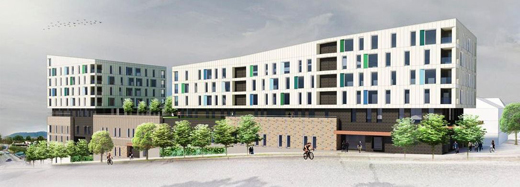
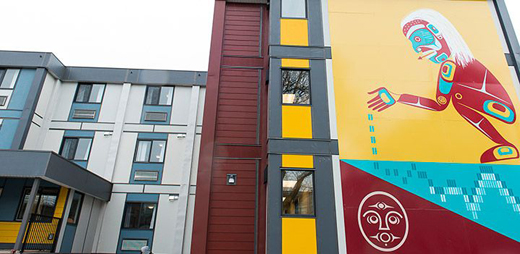
The City of Vancouver will open 680 modular units by mid-2019

Funded by the province and being built in the City of Vancouver, by this time next year 680 transitional modular housing units will have opened on ten or more supervised sites across the city, located in as many Vancouver neighbourhoods, the modular housing meant to house Vancouver’s most vulnerable population. The experience of the City following an announcement of modular housing construction has found that each and every time a new modular housing project site is announced, be it at …

  • Little Mountain, at 37th and Main;
  • 650 West 67th Avenue, at Heather Street;
  • 595 and 599 West 2nd Avenue, near the Vancouver Police Department headquarters, and nearby the Olympic Village Canada Line station;
  • 4480 Kaslo Street, just south of the 29th Avenue Skytrain station;
  • 1131 Franklin Street, over by the B.C. Sugar Refinery, just off Powell Street; and
  • 525 Powell Street, at Jackson Street.

Fearful, socially regressive neighbours driven by self-interest, safety and the potential for lower property values come out in droves, well-organized and sometimes numbering in the hundreds, carrying signs and yelling at passersby, while vehemently protesting modular housing construction in their neighbourhood, each time the City announces a new construction site.

A new, larger Vancouver Detox Centre and social and affordable housing project proposed in the Grandview-Woodland neighbourhood, to be located at First Avenue and Clark DriveVancouver Coastal Health has proposed an affordable housing facility and detox treatment centre on East 1st Avenue at Clark Drive, the project a divisive one for some Grandview-Woodland neighbourhood residents. One group of locals, though, worries such divisive behaviour will teach their children to be afraid of those who most need assistance and empathy, this latter group coming out in favour of the project.

OneCity Vancouver candidate for City Council, Christine Boyle, had an unhappy experience at a May 2nd Grandview-Woodland neighbourhood — the neighbourhood where her family and friends live — information session on a proposed affordable housing facility and treatment centre to be located on East 1st Avenue at Clark Drive, with the treatment centre controversially, for some residents, taking over the duties for the current, smaller detox centre located on East 2nd Avenue, near Main.
Ms. Boyle said such opposition to the treatment centre was disappointing.

“I don’t want my kids to learn that they should be fearful of people who are homeless or struggling,” Boyle told StarMetro Vancouver reporter, Perrin Grauer. “I worry that’s the lesson coming out of this.”

And there you have it: NIMBY residents opposing modular housing construction in their neighbourhood, or construction of an under lock and key detox and treatment centre — and even the provision of affordable housing in their neighbourhood, that might lower their property values.
Heart, social conscience, empathy for our most vulnerable citizens vs naked, socially maladroit, near-heartless self-interest. That my friends, is the battle ground on which 2018’s Vancouver civic election may be fought.
The 2018 Vancouver civic election is a “throw the bums out” election, and by that many Vancouver residents mean — we’ll see how many, come the evening of Saturday, October 20th — that they’re “sick-and-tired” of the social engineering that has gone on at City Hall”, the focus on reconciliation with our indigenous peoples, promoting the interests of women in the workplace, making our city a racism-free zone, a nuclear-free zone, catering to the interests of our LGBTQ and gender variant communities, Vancouver as a non-gendered bathroom zone, a catering to the interests of vulnerable citizens zone — all at the expense of “tax paying” NIMBY citizens — a city where progressivism has been the order of the day, all much to the chagrin of Vancouver’s meaner, more socially regressive “hey, it’s all about me, my interests, maintaining the value of my property” citizens.
In the 2016 U.S. presidential election, progressives were convinced that Democratic nominee Hillary Clinton had a presidential win and four years in the White House in the bag, that under no circumstance would a sexist and misogynist, barely literate and totally uninformed man-child buffoon go on to win the White House. Well, you know how that one turned out.
In the 2018 Vancouver election, a lowest common denominator Mayoral candidate, and candidates for Council will emerge — the Wai Young Coalition Party and Hector Bremner campaigns — will emerge from the primordial muck quite soon, well-financed and hungry for power, and ready to turn the clock back to a meaner time, a “people’s movement” that could snatch victory from both the progressive party coalition, and the socially progressive, nominally right-of-centre Vancouver Non-Partisan Association.

SmartBrew 5-Cup Coffee Maker | Singles | Couples | On the Cheap

Black & Decker SmartBrew 5-Cup Coffee Maker, only $18.99 at Canadian Tire

Ah, VanRamblings harkens for the carefree days when we were earning in excess of $100,000 a year, with nary a worry about the cost of things.
Halcyon days, those.
As a senior living on a fixed income (although we live in a housing co-op — even if they do think we’re a commie pinko who wishes them ill cuz we kinda think that having a social conscience goes hand-in-hand with living in a co-op, or whereas a neighbour said to us the other day, “We’re not social workers, y’know” — if nothing else, if the co-op’s finances are in order, one’s housing charge amounts to only 30% of one’s income. Whatever the politics, that’s an argument in favour of housing co-ops, all by itself.
Living in a co-op gives VanRamblings a break on our housing charge when all is said and done. As a retired person out of the economy, we’ve become pretty darn frugal. Can’t tell you how much we love putting every cent we spend into an Excel household expenses spread sheet we created, divided into categories, and under each category, sorted by expenditure item.

Enjoying the first cup of coffee in the day

As is the case with most North Americans, we enjoy our first cup of coffee in the morning. But no Nespresso for us, though, no sirree, bob.
The last time we were in the market for a coffee maker (the carafe on our previous coffee maker, the one you see at the top of this post, got a crack in it after six years of daily use), we went looking for a new coffee maker at London Drugs — but prices ranged from $39.99 all the way up to a dear $219.99. Hey, we want a coffee maker, not a new car with fancy gadgets!
What to do, what to do? We loved our reliable old Black & Decker SmartBrew 5-Cup Coffee Maker — but who sells ’em anymore? We looked high and low, and finally we found what we’d been searching for at Canadian Tire, the only retail outlet in town that carries the Black & Decker SmartBrew, and for only $18.99, too, with can’t live without features like …

  • A compact footprint, great for condos and apartments;
  • A personal size 5-cup capacity, with an easy to clean one piece cover, and water level indicator for easy filling;
  • A Duralife Glass Carafe, with sturdy handle & reinforced glass; and
  • A removable filter basket for easy cleaning, and a retractable cord for easy storage;

Remember how we were mentioning the Nespresso awhile back?
VanRamblings may be a pauper, but we’re no piker. We like our coffee fancy like everybody else. Yep, we sure as the dickens like to see that foam, and make believe that we can afford one of dem dere fancy coffees when they’re not on sale at McDonald’s. “Ma, pick up some kindlin’, would ya?”
So, how to get foam in your coffee, and not have to rob a bank?

The Aerolatte milk frother, makes foam for your coffee like the dickens

The Aerolatte frother, makes foam for your coffee like the dickens

Yep, we recommend the Aerolatte milk frother, only $29.99 at Bed Bath and Beyond, reliable, hard-working, makes foam for your coffee like you wouldn’t believe, and although it takes batteries, you can always employ an inexpensive battery charger. If you’re gonna go to Bed Bath and Beyond, we recommend you sign up with them (which one of the staff will do for you), and use one of those 20% off coupons that they give away on the spot, and every couple of weeks. If you sign up with five e-mail accounts, you get five 20% of coupons. Parsimony, thy name is Raymond Tomlin.
Hallelujah!
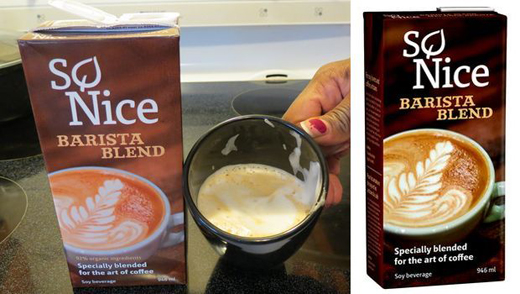
Not to end today’s post on a downer note — which we would never do, cuz we’re just about the happiest and most joy-filled guy on the planet; a miraculous recovery from cancer will do that for you, y’know? — but it seems that we’re lactose intolerant (we’re sorta intolerant, too, of folks who lack the milk of human kindness in the way they choose to lead their lives). No milk for us. Oh, we could drink milk, eat yogurt, cheese, etc. but then we’d get an upset tummy; not worth it, we say. So, it’s no dairy for us, although we’ve found a great foaming alternative for our coffee (almond milk doesn’t do the trick, you really need So Nice Barista Blend).

So Nice Barista Blend, an organic soy milk product that proves to be a perfect milk alternative for frothing for your morning coffee

So Nice Barista Blend is a 92% organic soy beverage, foams to beat the band, and seems to be exclusively available at Choices Market, only $2.49 for a 946ml carton. We love it in our morning coffee, an utter joy for us!

2018 Vancouver civic election

Monday to Friday, ever week, VanRamblings publishes content related to the upcoming 2018 Vancouver civic election, the link in VanRamblings’ header above, in the rectangular box, containing the words Vancouver Votes 2018. Tell your friends, let ’em know that some pretty skookum election coverage may be found on VanRamblings. Oh sure, we know — ”Election coverage, what’s that?” your friends will say. Yes, you get to roll your eyes when they say that — just don’t be too obvious about it, cuz we don’t want to hurt anyone’s feelings. Still, it’d be nice if more folks got involved in attempting to influence the conditions of their lives, and the lives all of the folks around them who share this planet.
Fridays on VanRamblings, we present arts coverage. Saturdays, it’s time for the VanRamblings “Raymond reveals it all” Stories of a Life feature, where you will learn more than you could ever want to learn about the fellow who publishes this blog. Sundays? It’s catch-as-catch-can, although we seem to be focusing on food & health-related items.
VanRamblings expects to see you back here every day. You wouldn’t want to hurt our feelings, would you? Didn’t think you would.
See ya back here tomorrow.

Stories of a Life | Love at First Sight | September & October 2012

World cinema promotes understanding, peace, harmony and humanity.

Anyone who knows me, knows that I live for film, and for the past 37 years have attended the annual Vancouver International Film Festival each spring (in the early years) and autumn since the inception of VIFF in 1981.
For me, VIFF has provided a sense of connection to the larger world around me, and occurs as a humanizing event in my life, helping me to remember that no matter where we live across our planet – be it in Kenya, Kazakhstan, Lebanon, Chile, Italy, Sweden, Vietnam, Guatemala or Iran – the issues we all confront in our daily lives are the same: wont and need, reconciliation with family and the need for understanding, pending environmental collapse, housing as a human right, love, tragedy, personal disaster, rage, injustice and how over time it becomes clearer and clearer how necessary it is that we all work together for change to improve the conditions of our lives, our family’s life and the lives of those around us, to make ours a more inclusive and more socially just world for all, no matter where we live, no matter our ethnicity or sexual orientation, or our economic circumstance, we are all one, and must learn to work together.

The Vancity Theatre ... early morning lineups for the early September advance screenings for 2012's 31st annual The Vancouver International Film FestivalThe Vancity Theatre … early morning lineups for the early September advance screenings, at 2012’s 31st annual Vancouver International Film Festival (VIFF)

In the first week of each September dating back to 2005 — when the Vancity Theatre opened — VIFF administrators have held an early morning press conference mid-week at the Vancity Theatre. Some 365 films are introduced, programmers talk excitedly about the films that will be coming to that particular year’s festival, a teaser trailer is shown, Festival Director Alan Franey — if you beg and plead — will provide insight into his favourite films that will screen during the Festival, after which about 120 folks, including actors, directors and producers of Canadian films that will screen at the Festival, repair to the reception area to consume delicious noshing canapés (“hey, we’re indigent writers & actors, it’s our meal for the day!”).
And then the fun really begins …
The very next day — on Thursday — starting at 10am, VIFF commences advance screenings of films where directors, actors and producers for the advance screening films will be present during the Festival. About 30 members of the press, complemented by about 80 festival pass-holders line up outside the Vancity, and after we’ve done our waiting in line, scurry in to find the seats where we’ll remain for the next six hours, losing ourselves in the cinema of the world, the cinema of despair, the cinema of hope.
2012. Noon. Break between films. Vancity Theatre. Sitting in the back row is Len, a Richmond-based filmmaker, and veteran Vancouver Film Festival attendee. As we rise together — I’m sitting in the fourth row from the front of the theatre in the middle of the row, Len is sitting in the back row near the south exit. Except this year for the first time, there is a woman nudging beside him as he stands — would it be fair to say, a beautiful woman, a goddess with an aura around her, an entirely angelic beneficent presence, for she is all of that, a young Botticelli madonna brought to life.
Love, at first sight. Kismet. Magnificent, life-changing, transcendent love.
As I make my way to the south stairway to rise toward Len, looking at me he says, “This is my friend, Julienne. We’re making a film together, a documentary. This is Raymond — he writes about the Festival.”
Julienne is grace in human form, polite verging on deferential. The three of us engage in a repartee, on which subjects I cannot recall.
Julienne looks at me. Clearly, she sees that I cannot move. I am awestruck in her seraphic presence — which I hope against hope she has not sensed, but who am I kidding .. of course she has. But Julienne does not let on, as she sets about to create a protective space, so that my heart will not break.
Each day for the next three weeks, it proves much the same — three, as many as five films screening in advance each day Monday through Thursday, polite conversation between films, talk about the documentary Julienne and Len were making. And I behaved myself — which is unusual for me, because most years I am utterly out of control for the duration of the film festival period, so alive, so lacking in sleep, moved to tears by so many films, in so much despair yet feeling so much hope, falling in love every minute with the women on the screen, with the young, socially gifted women VIFF volunteers — joy verging on madness. But 2012? I was calm.

A line-up outside the Granville 7 cinema, home to the 2012 Vancouver International Film Festival

As is the case with a great many film festival devotees, in the week before the festival is officially to get underway, I create a daily schedule for the 16-day duration of the festival — usually five films, sometimes six or even seven films — that I will see each day, the film schedule based on input from Alan Franey or other festival staff, buzz from film-goers, awards from a dozen other film festivals, and reviews in the New York and Los Angeles Times, Variety, The Hollywood Reporter, Screen Daily, Britain’s The Guardian and The Telegraph, and a retinue of other print & online sources.

j-b-shayne-and-ray-tomlin-at-the-festival-oct-6-09.jpgShowbiz Shayne, and the ineffable Mr. Know-It-All

My friend, J.B. Shayne, for two decades and more accompanied me to the Vancouver International Film Festival, giving me the nickname, Mr. Know-It-All (J.B. billed himself as Showbiz Shayne). One doesn’t know the meaning of the word insufferable until you’ve encountered me pontificating on one film or other, or what to see that day, or some inside festival scoop, while waiting endlessly in line to gain entrance to one venue or another.
The first day of the 2012 Vancouver International Film Festival, J.B. and I were a little blurry-eyed, lined up outside the Granville 7 cinema waiting to pick up our entrance tickets for the day’s screenings, the first one of which would unspool at 10am. As per usual, in a state of near madness, personalized festival schedule in hand, 100 hundred films lovingly and carefully chosen for both J.B.’s and my viewing pleasure (although we don’t attend all screenings together), me in an excited state of near derangement, dogmatic about the films, “You just must see, take my word for it …” offering my opinion on the work of a particular European director or other, her or his oeuvre and body of work, a crowd gathering around me, present for this early morning devolution into insanity … when …
Julienne, standing in line some ways in front of me, unseen by me, approached. Approached to correct me.
What followed was a professorial treatise on the history of film made ‘live’, and where this particular director fell into the timeline of the history of film and the arts, whose work he was drawing from, the lighting technique innovative and all his own, lambent always with just a touch of sheen, his use of time and space, how he moves the actors around on screen … making it quite plain to everyone standing around that I was but a mere novice on the history of film, a charlatan, an imposter, a pretender, perhaps even a buffoon. And for the first time in 20 years, I was truly in love.
Julienne was angelic in her presentation of information, her love and respect for me infusing her every word of criticism, each word a hug, a kiss, a warm embrace. Here was someone who truly loved me, cared for me, wished to make her presence known and felt, her words a devotion to me, fealty made extant, as real and palpable, as moving and transcendently lovely as anything I have ever experienced in my life, every word uttered by her one of utter respect, and true love and appreciation.
After Julienne completed her discourse on cinematic history, those around us turned away, as it was clear that for Julienne and I there was only the two of us, Julienne and I now standing close, standing side by side, almost touching, Julienne asking to see the schedule of films I had in my right hand. Turning over my personalized VIFF schedule to her, Julienne did the same for me. As she perused my VIFF schedule, I looked at her film schedule — barely recognizing any of the films on her filmgoing agenda, all of the films on my schedule vetted through weeks of painstaking research.
Without hesitation, looking at her list of scheduled VIFF films, I made a decision: for me, this would be the Julienne festival. I threw away my film schedule, knowing that it was essential that I attend at a screening of every film on Julienne’s list. And so it was. We attended every one of her chosen films together, well more than 80 films over the course of sixteen days, never sitting even remotely close to one another at any one of the screenings, for as it is me for me, it is for Julienne: the Vancouver International Film Festival represents the church of cinema

” … the church and the cinema create a sense of sacred space with their high ceilings, long aisles running the length of the darkened rooms inside, the use of dim lighting, the sweeping curvature of the walls, and the use of curtains to enhance the sacredness of the experience.

The seating, and the opening introduction by a VIFF manager constituting a liturgy for one and all, not dissimilar to the welcoming ritual that occurs in a church service prior to the sermon.

There is, too, the notion that as the film limns your unconscious mind you are being transported, elevated in some meaningful way, left in awe in the presence of a work of film art.

At the Vancouver International Film Festival, there is the vague, unshakable notion that the eternal and invisible world is all around us, transporting us as we sit in rapt attention. We experience the progress and acceleration of time, as we see life begin, progress, and find redemption. All within two hours. The films at the Vancouver International Film Festival constituting much more than entertainment; each film a thoughtful meditation on our place in society and our purpose in life.

Cinema emerging as that place where we might experience life in the form of parable, within a safe and welcoming environment, that place where we are able to become vulnerable and open, hungry to make sense of our lives. Cinema delivers for Julienne and I, as it does for many, access to the new spiritualism, the place where we experience not merely film, but language, memory, art, love, death and, perhaps even, spiritual transcendence.”

And so it went, from early morning til late at night, until one morning while the two of us were in line, a friend came up to Julienne and I, saying …

“What the two of you are doing is disgusting. Raymond, Julienne is 30 years younger than you. She’s a married woman, yet the two of you carry on like you are lovers. Leave her alone. The two of you have no business spending any time together. Stop it. Stop it now!”

Even before Diana finished her denunciation of the two of us, Julienne was crying, tears trickling, then cascading down her cheeks, unable to catch her breath, unable to reply. I wanted to hold Julienne, tell her that all would be fine. But I had not touched Julienne, nor had we or did we intend to have any sort of physical contact, ever. Ours was a love that existed on another plane, our relationship — by which I mean to say, that we related as friends and colleagues, our respect for one another based on an intellectual and spiritual rapport. But physical love? Never would that occur, Never, ever would we together disrespect Julienne’s lovely and generous husband, Bill.
Julienne, finally gathering herself together, her voice catching, was able to utter the words …

“I am so, so sorry, Diana. Raymond and I are friends, that’s all. He has a keen intelligence. I have two PhDs, one in economics and one in medicine. I have taught economics at the Sorbonne, and worked at the Mayo Clinic, yet most days I am unable to keep up with Raymond, his mind is so vibrant, his vast knowledge on the broadest range of academia — save the sciences, where I am wont to point out to him, his knowledge is quite lacking — our rapport entirely intellectual, the joy we experience in one another’s company based solely on an intellectual plane of curiosity, and the desire to learn more, to know more, to be challenged. Somehow the two of us have found one another in time and space, perhaps knowing one another in another life, kismet as Raymond has called it. I would say that is all it is — but all that it is is so great, and so very much appreciated by the two of us that I am taken aback, and profoundly hurt that you would judge me, that you would judge the two of us, that you would think for even one moment that we would ever wish to cause harm, to cause anyone harm. You have referred to Raymond as your friend, in past conversations with me. Diana, a friend does not speak or use the language of judgment you employed in setting about to destroy what is for Raymond and I beauty in our lives, a meeting across the universe.”

And with that, Julienne turned and walked away, the two of us not spending one more moment together for the remaining nine days of the festival.
Then ten minutes following Diana’s denunciation of Julienne, in particular, and me only by association, Diana and her companion, Graham, J.B. and I foregoing the 10am screening found ourselves at the Granville & Smithe Starbucks looking for a coffee, certainly not to calm our jangled nerves, silence between the four us, until we were all seated, me now rising

“What the fuck did you think you were doing, Diana? You made Julienne cry, Julienne who is as close to an angel on Earth as I have ever encountered. Julienne the personification of loveliness and grace, who would never hurt anyone, nor cause anyone a moment’s concern.

What the fuck were you thinking confronting the two of us on the street? And what business is it of yours, anyway, what I do or don’t do with any person of my acquaintance, particularly when it is as clear to you as it would be to anyone with eyes and a heart, that there is — now was, I fear — a joy that was passing between the two of us, when joy is a commodity in rare possession these days. What in hell would cause you to interfere? Did you, perhaps, think that you were defending Bill’s honour, Bill with whom Julienne and I attend evening screenings together, with me sitting on the other side of the cinema, as per usual, from where Bill and Julienne are sitting. Do you think so little of me, do you think me so lacking in honour and integrity and human compassion, so self-serving and unconscious of the love that Bill and Julienne have for one another that I would, or that Julienne would, engage in behaviour that would be ruinous and contrary to both our natures? Diana — fuck off, never pull that shit around me again. Keep your sick and twisted thoughts to yourself, and never ever speak to me again in the way you did on the street just minutes ago. And one more thing — stay the fuck away from Julienne, don’t ever hurt her again.”

And with that said, I left the Starbucks.
Julienne and I did see one another at the annual Saturday morning, post-festival brunch at The Bellagio, on Hornby at Robson, across from the Vancouver Art Gallery, where 20 or so diehard festival-goes gather each year to debrief on all that has occurred at VIFF over the course of the past month and more, the food and service great, the company — almost everyone present more accomplished than myself, healthy of body and mind and intellect, and inveterate life long lovers of cinema, particularly world cinema — Julienne sitting on the other side and at the end of the table, distant from me. The two of us did not speak. Nor did our eyes meet.
Bill and Julienne and I did get together three more times in the weeks after the festival had ended, for dinner, for a coffee, and for a dessert one late evening. We all got along famously, but it wasn’t too difficult to discern that what had transpired between Julienne and I from early September to early October 2012 could, and would, no longer occur. And, of course, there was the Diana incident. Julienne took a job that required much of her time, and although we communicated from time to time, sometimes in a phone call, more often — but only sporadically — by e-mail, never initiated by me. And then, barely noticing it, the two of us drifted apart … until …

Baguette & Co., 3273 West Broadway, in Vancouver

In mid-summer of 2016, I contracted hilar cholangeocarcinoma, a terminal, inoperable form of cancer that was most assuredly going to kill me, sooner than later. Do you recall reading earlier in this story that Julienne had acquired a PhD from the Mayo Clinic?
Turns out that Julienne had trained at the Mayo Clinic under Dr. Gerald Klatskin, best known for his work on the biochemical and biological abnormalities and the clinical features of the diseased liver, but who was also the doctor to first identify and develop a treatment — an operative intervention actually, a rebuilding of the entire bile duct and intestinal system, and replacement of the liver — for hilar cholangeocarcinoma.
Hilar cholangeocarcinoma is often called Klatskin’s tumour, where the bile duct system — a series of tubes or tracts, sometimes called the biliary tract — connects all the elements of the intestinal system to the liver in order that the body’s proteins and materials the body can’t use are eliminated.

Now, I already had a scientist friend — another of the great loves of my life, Alison Fitch, who for the past 10 years has run a multi-billion dollar biotech lab in Seattle, and wouldn’t you know that one of the projects her lab was working on was a cellular intervention to mitigate the growth of cancer cells in the intestinal system, and in the biliary tract and bile duct system, in particular. You wonder why I’m still alive when I was supposed to be dead, at the very latest, a year ago today?
Both Julienne and Alison played key roles in my recovery — one can have great doctors and surgeons, and I did, but it is quite another thing to have women who love you, women who are skilled and are scientists and who love you, who are committed to finding treatments to prolong your life, and working on a “cure”, or at least an intervention that will allow you to live in good health for the next 30 years, while keeping the cancer at bay, women who are on your side, adamant that as long as they’re around, you will be.
In February 2017, when it still appeared that I was a goner — not that Alison or Julienne were going to let that stand — Julienne asked if we might go to lunch at Baguette and Co. on West Broadway, near my home, that she wanted to introduce me to David, whom she and Bill had adopted in Chile, where Julienne was born, and where she and Bill had spent the better part of a year working through the adoption process (why and how it was that Julienne and I had lost contact, she and Bill needing months to help David adjust to his new home in Canada).
David, 2½ years of age, when we were at lunch together — a lunch that lasted some three hours, Julienne and I having much catching up to do in this leisurely setting — focused only on ourselves and David, with no talk of cancer, but only of joy, a joy that was clearly evident in David’s demeanour, a joy his parents shared with him, David an angel on Earth as much as is the case with his mother, Julienne. Julienne told me that Bill and she had attempted to, and believed they were successful in helping to, create a sense of safety and love for David, that since his arrival in Canada the year previous, he had not cried, nor experienced any emotion other than joy, his life so full of love and goodness and warmth and the love of his parents — to see Bill together with David is to witness the same love that Julienne has for her son, the most hopeful love it has been my privilege to witness.
David’s record of no tears was about to come to a bitter — and, really, there’s no other way of saying it, tragic — end, a part of one of ugliest incidents I have ever been party to, and all arising from an unforgivably heinous, revolting and extremely ugly intervention by my daughter, Megan.
With whom I had spoken at some length over the summer, she telling me, “Dad, I’m raising my sons (my two grandsons, Sasha and Leo) the same way you raised me,” about which she went into some detail, and with then Vancouver School Board trustee Christopher Richardson by my side at the opening of the new General Gordon elementary school — where my two grandsons are enrolled — with Megan, her engineer husband, Maz and Leo nearby, Megan saying my two favourite words, “Hi, daddy,” then putting her arms around me, and then her arm in mine, Maz standing opposite, Leo playing, Christopher standing off to the side, as pleasant and as warm & loving an interaction as any father would wish to have with the daughter he loves with all his heart, who he has known since birth to be the toughest, brightest, most heart-filled person I’ve ever encountered (in all the years I raised her, Megan was the most transcendently lovely and intellectually acute person of whose life I had ever been a part — but tough, omigawd tough, as well as the most socially skilled person I’ve ever known).
When I was diagnosed with hilar cholangeocarcinoma in the late summer of 2016, I spoke with my son, Jude — who was supportive and loving through my months long cancer journey — leaving a message for Megan that I wished to speak with her, calling her mother, Cathy afterwards to ask if she might intervene to mitigate any pain Megan might feel in hearing of my terminal, inoperable cancer diagnosis.
I have yet to write about my cancer journey, and will likely set about to do so once the current Vancouver civic election is over, but for the purposes of this Story of a Life, suffice to say that subsequent to the call I made to Megan in September, and the half dozen or so calls I made to her in succeeding months, when the news about my cancer was getting worse and worse and worse, me needing to hear her voice on voicemail, that Megan had no contact with me, did not as I suggested to her visit with our family physician, Dr. Brad Fritz, or in any other way intervene throughout the eight months I was told my cancer was terminal, my death imminent.
About 2:45pm on that early February afternoon Julienne, David and I were meeting, on this unseasonably warm and sunny February day, after our lunch Julienne asked if I might walk with her and David to Macdonald Street, in order that she and David might catch the bus home. While we were walking up 7th Avenue toward Macdonald, Julienne asked if there was a school nearby, and I said there was, General Gordon, where my grandsons were enrolled. Julienne told me that she and Bill were looking at moving into the neighbourhood, in order to find a good school for David to attend kindergarten — Julienne thought she might drop into the school to speak briefly with the principal, to set up a meeting for a future date.
But that did not happen.
Instead, shortly after 3pm when Julienne, David and I were near to General Gordon school, David spotted the playground and the playground equipment, and ran over to play on the slide and teeter-totter, round-about and other playscape items on the school’s grounds. While David played, a number of kindergarten age and younger children playing nearby, David was full of smiles, as was his mother, the moment one of joy, until …
Megan — my 41-year-old daughter, who I held in my arms for the first 10 minutes of her life, as Cathy was still under anaesthetic, who I raised from the time she was a baby, through her years at UBC — walked up to Julienne and I, her face twisted and unforgiving — something I’d never seen before with Megan, a monstrous look — looking at me, saying in a bare whisper, “I love you,” after which she turned to Julienne, not introducing herself so Julienne had no indication as to who was speaking with her, and said …

“He’s probably told you that he’s going to die. That’s bullshit. He’s only looking for sympathy. Look at him. He looks the same way he always has. There’s nothing wrong with him. You’re being a fool if you believe that there’s anything wrong with him, other than he’s sick in the head …”

At which point David looked over — Julienne’s attention consumed by Megan’s vicious diatribe, Julienne now in tears — a look of alarm on David’s face, a crestfallen look of fear. I immediately went over to David, who was the priority in this circumstance. David wanted his mother.
Megan was still yelling at Julienne, Megan an out of control madwoman, Julienne in response now subject to heaving sobs, David running towards his mother, David now crying, too, inconsolably, both mother and son so emotionally flooded that even in her state of madness, with one adult and one child before her crying in pain, Megan left, yelling some epithet or other at Julienne.
Julienne looked at me, and through tears and sobbing, said, “Raymond, you didn’t say anything.” I took Julienne and David over to sit down, to calm Julienne, David now wailing and inconsolable, David wrapped tightly in Julienne’s arms. I was able to calm Julienne, which took a good five minutes. With Julienne now calm and no longer crying, with David still crying and inconsolable, but quieter now, his face buried in his mother’s chest, I responded to the statement Julienne had made only minutes earlier …

“Julienne, this past six months has brought one piece of tragic news after another. I decided early on that if I was going to live, I would need to establish an equilibrium in my life, and never react to any situation, never give up any control in my life over which I have jurisdiction. If I reacted to all the news I’ve heard on almost a daily basis these past six months, I’d be dead, from fear. I decided a long time ago I would not allow fear to rule my life through my cancer journey, and afterwards should I find myself subject to a miracle. I will not relinquish what little control I have over my life, I will not react, as I did not react this afternoon. If I were to do so, I feel quite assured that I would be sounding the death knell for my life.”

At which point, Julienne — David in her arms, arose saying, “We should go, Raymond. I have to get David home. I’ve got to put some dinner on.”

In Vancouver, West 7th Avenue, just west of Macdonald Street, east of General Gordon school

But it took another 15 minutes to make it the one block to Macdonald, Julienne and David stopping along West 7th Avenue, she concentrating on David’s recovery, his sobs still prominent, his demeanour inconsolable. Finally, David released his tight hold on his mother, putting his feet on the ground, putting one step in front of the other, his body still heaving.
The three of us did make it Macdonald Street, now back in the sun, the time close to 4pm, Julienne now saying that she wanted to walk with David and I over to West 4th Avenue to catch the Macdonald bus — which she did, but not before turning to me, for the first and what would assuredly be the last time, placing her arms around me in an embrace, a tight hug that said, “Raymond, I need assurance that all will be well.”
And then, Julienne and David were gone.
I have told you that I love Julienne. And I do with all my heart — but as I told Bill the next day …

“It seems fated that Julienne and I cannot ever have a relationship. It’s just too dangerous for her. I wish it wasn’t so, because as you know, I love your wife, and there exists between us a rapport of kindness and connection, and an intellectual curiosity that is challenging and rewarding for the two of us. But I will never see Julienne again, nor you or David. I am so very, very sorry for what happened to your wife yesterday. I wish I knew what to say. I simply can’t find the words.”

After walking with Julienne to the bus that tragic afternoon, while slowly making my way home, I called my son to tell him what had happened. Jude was generous, kind and supportive, saying to me by way of explanation …

“That wasn’t Megan speaking today. That was mom speaking. Mom has filled Megan’s head so full of lies and hate, Megan is so conflicted, the entire circumstance of the dysfunction of our lives arising from Cathy’s morbidity, that I don’t know what can be done to repair a family situation so rent that there seems no way of putting the pieces back to make us whole again. I love you. Megan loves you. Maybe some day Megan will get away from Cathy’s influence, maybe some day Megan will make her way back to you in a healthy and whole way — but first she’s going to have to get away from the influence of mom, who will just keep on buying Megan off with trips and the promise of purchasing a new home for her, and as she has always set about to do, buying Megan’s affection, but surely not her love, because although mom is many things, one of those things is certainly not lovable. Forget about what happened today. Concentrate on getting better, or if you’re not going to get better, if your time on this Earth is fated to end soon, then enjoy every day you have left.”

No Julienne in my life, a woman I love. A caring and loving son, though. A conflicted daughter. And, an ex-wife who seemingly wants to destroy me.
And, another story of a life.