Sunday Reflection | Save Your Life | EWG’s Dirty Dozen Foods

EWG, the Environmental Working Group's 2018 most and least pesticide-ridden foods | Eat Organic
EWG: The Environmental Working Group’s Dirty Dozen & Clean 15 Foods | Eat Organic

From August 2016 through the end of October of that year, from the initial diagnosis of my terminal, inoperable Stage 4 hilar cholangeocarcinoma, I simply stopped eating. No appetite, simply wasn’t hungry. Didn’t feel well.

Not only did I have no appetite, but my entire intestinal system was in an uproar and in the early stages of shutdown, with my kidneys, gallbladder, biliary tract and bile duct, pancreas and liver pretty much shot and so cancer-ridden as to dramatically compromise my tenure on this Earth, my being kept alive a function of my Vancouver General Hospital gastro-intestinal surgeon, Dr. Fergal Donnellan, placing stents into my bile duct to keep things functioning, alleviating the jaundice that was serving to compromise my immune system, my bilirubin count up in the 200 range (normal bilirubin count: 17), my liver shot, my jaundiced body (but not spirit) causing me to glow yellow — not that I could see any difference between how I look normally, and the apparent way I looked to friends in this three month span of 2016 — keeping me bed-ridden, or in the hospital.
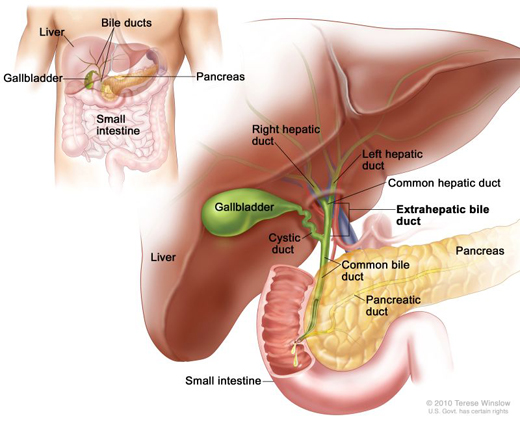
The bile duct system in the intestines, the organs and ducts that make and store bile (a fluid made by the liver that helps digest fat), and release it into the small intestine. The biliary tract includes the gallbladder and bile ducts inside and outside
The bile duct system in the intestines, the organs and ducts that make and store bile (a fluid made by the liver that helps digest fat), and release it into the small intestine. The biliary tract includes the gallbladder and bile ducts inside and outside.

Of course, aside from writhing around in my bed or finding myself in meu banheiro for hours on end, there was an upside to all the pain and misery that was now consuming my life: I was losing weight like mad, and I wasn’t spending any money! Now, anyone who knows me — as my daughter Megan is wont to point out — knows that I tend to be tubby. Dropping 70 pounds & not spending any money — what a great programme, I tell ya.

I didn’t announce my hilar cholangeocarcinoma to the world until October 7th, 2016, doing so only after arriving home from Vancouver General Hospital after a day of surgery, still a little fuzzy and discombobulated from the anaesthetic, but ready to reveal to the world that my time on this Earth was seemingly and abruptly, not to mention, painfully, coming to an end.

Not really oh woe is me, I thought, nor did I relay the information of my cancer diagnosis in an attempt to gain sympathy (or, empathy for that matter — as came to be my experience in the next months, though, as one person after another revealed their own cancer diagnoses to me), but more as a matter-of-fact “this is what’s happening to me, it’s been good knowing you, thank you for your support, and for indulging my idiosyncrasies all these years” message to friends on Facebook, and a whole lot of good-natured folks I had no idea had been following me on Facebook, among them friends I’d not communicated with in years, sometimes decades.

Now, my friend (and as it turned out, personal saviour), author and mom and lover of Alan Bayless, the incredible and talented — and “make no mistake, I would not be here today were it not for Maureen’s intervention on my behalf, consistently the only person and the right person to see me through the scarifying experience of my cancer journey, and the only person who knows the whole story” — Maureen Bayless, about whom I will write, and dedicate more than one VanRamblings column in the future, in the story of my cancer journey, which will commence publishing in the aftermath of the current and hopeful 2018 Vancouver municipal election.

Marlie Oden, with whom I had worked as an arts journalist with the Lower Mainland community newspapers, as Director of Special Projects at Vancouver Magazine, and later publisher-editor of Festival magazine, published in support of Leonard Schein’s Festival Cinemas, upon reading in early October of my cancer diagnosis, got on the phone with me, texted and messaged me, told me of her own arduous cancer journey, a cancer with which she was still living, and set about to make arrangements to arrive at my now dark, dank and utterly messy home in mid-October, laden with an organic chicken from Whole Foods, as well as soups and prepared breakfast items from Whole Foods, salads and more, she and her husband leaving me a store of food that took me more than a month to eat, Marlie insisting, “Okay, Raymond. You’re going to eat well. You’re going to eat organically. You may not have much of an appetite, but you’re going to find a way to eat this food, whether you want to or not, because you need nutrition to keep up your strength, and to fight your cancer.” Hallelujah!

And with that, Marlie and her husband were gone.

I should probably say that I’d had no communication with Marlie in 20 years! Yet, there she was in my home, placing food into my refrigerator, giving me much needed instruction, showing a caring that was so heartening and spiritually uplifting that — as dire as everything looked, and would for months to come — for the first time in two months, Marlie gave me hope. You’re reading this, so you know I’m still around. When you run across Marlie and Maureen thank them for me, will ya — please.

I managed to consume the chicken over a one-week period, the soups over the month and into November, and most of the breakfasts over the course of the next month. So, thanks to Marlie and her husband, I was eating again, my weight loss slowed, and my strength began to return.

Anyone who knows me knows that I like (maybe that should read, love) strong, emotionally healthy, and spiritually sound women — any part of me that is at all recommendable comes in consequence to the women in my life, women who have cared for me against all reason, I have often thought to myself, but who have taken on the task of helping to make me a better, a healthier and more spiritually-centered person, women who have given me life and a sense of purpose. Marlie Oden and Maureen Bayless certainly are members of the cadre of compassion who have contributed to creating the best parts of me, and of how I daily bring myself to the world.

EWG, the Environmental Working Group's 2018 most and least pesticide-ridden foods | Eat Organic
Read through the entire Dirty Dozen list of foods that the Environmental Working Group insists you should never eat, unless they’re organically-grown.

Marlie says, “Eat organic,” I eat organic. Of course, I already knew that — but I’d bought into the myth that eating organically would cost a fortune, and living like a pauper like I do, I thought, “Well, I oughta be eating organically, but can I really afford it?” Turned out, though, that eating organically doesn’t cost any more money than eating pesticide-ridden, corporate-farmed agri-business foods. For instance, if you look at the graphic above, you’ll notice that strawberries are first on the list of foods that if you’re not eating them organically, and you’re consuming pesticide-ridden agri-business strawberries, as I wrote on Facebook the other day …

“Strawberries contain residue from up to 22 pesticides — eating ‘regularly grown’ strawberries is like eating little bits of death, as yummy as they may look and taste. UNLESS, unless, unless the strawberries are ORGANIC — in which case, you may enjoy this life-giving food to your heart’s content. A couple of weeks ago, Whole Foods Market had 3 pounds of organic strawberries for only $9.99 (regular price, $6.98 a pound). This week, Choices Market has stepped up to plate, offering 3 pounds of organic strawberries for only $9.94!”

If you’re a Trump / Alex Jones conspiracy theorist, and you believe that there’s no difference between organic foods and agri-business grown foods, have at it, believe what you will. Me, I’m going to eat organic, especially when organic foods are often cheaper, much cheaper, than agri-business grown foods you’ll find at your local grocer. For instance, organic celery at Safeway — which is #10 on the Dirty Dozen list of foods you should stay away from, or as the folks at the Environmental Working Group write, “More than 95% of conventional celery samples tested positive for pesticides. A maximum of 13 pesticides were detected on a sample of conventional celery.” Oh gosh, I want to have some conventional celery right now … not — is consistently cheaper, often much cheaper, than the agri-business celery that you’re probably buying regularly, or periodically.

EWG, the Environmental Working Group's 2018 Clean 15 Foods, the least pesticide-ridden foods
Read through the entire Clean Fifteen list of foods that the Environmental Working Group suggests you can eat, even if the foods are not organically-grown.

The Environmental Working Group also publishes a Clean Fifteen list of foods you can consume without having to be too concerned as to whether they’re organic or not, including as above, avocadoes, corn on the cob, pineapples, cabbages, onions, frozen peas, papayas, mangoes, eggplant, honeydew melons, canteloupe, cauliflower and broccoli — because these foods have thick, impenetrable “skins”, or the Environmental Working Group found that these foods had no detectable pesticide residues.

You’ll notice, too, that on both lists, at the bottom of the linked pages there’s an expanded list of foods under each category, so you’ll want to take a look at the expanded lists, in order to know what you should, or should not, be eating.

If you’re a parent of young children, as is the case with OneCity Vancouver’s Alison Atkinson, Cara Ng, Anna Chudnovsky and Christine Boyle (and their respective partners), or if you’re a good BC NDP supporting parent of a young child, like Kurt Heinrich and Theodora Lamb (should I have reversed the order of names? hmmm), Stepan Vdovine and Mira Oreck, or physician-to-be Cailey Lynch who’s co-habiting with some guy named David Eby (isn’t he British Columbia’s Minister of Justice and Attorney General, and maybe they’re, like I dunno, married? … who knows, it’s so beyond me …) — and, how in heck did I manage to miss mentioning Vancouver City Councillor Melissa De Genova again? … ew, she’s not going to like that, and what about new mom, and great and democratic Park Board Commissioner, Erin Shum, or mom-to-Grade One student and fiscally prudent and dedicated and hard-working Vancouver School Board trustee, Lisa Dominato? — or even if you’re not a died-in-the-wool progressive — or, maybe you’re the hope of our future, COPE candidate for City Council, Derrick O’Keefe, and his partner, Andrea Pinochet-Escudero, who have a great young son — it’s probably in the best interests of your family, and your family’s health, to take a look at both EWG lists, and act according to your conscience & as I say above, in yours and your family’s best interests.
Stories of a Life | 1972 – 73 Movements | The Douchebag Story

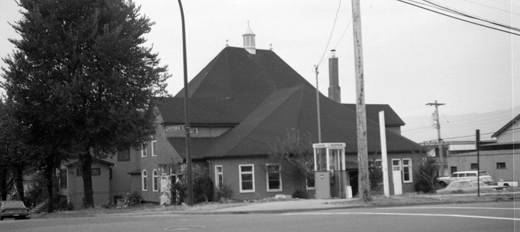
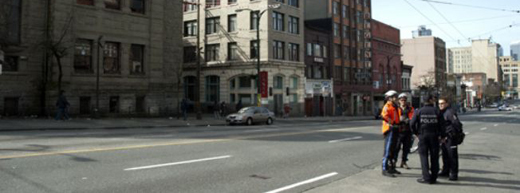
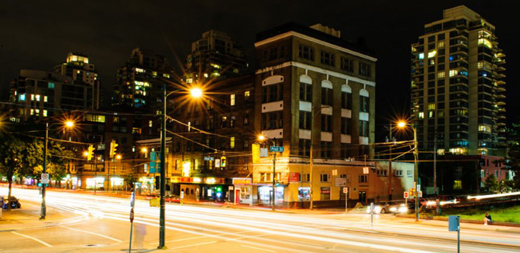
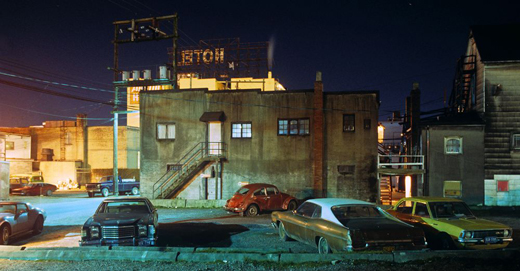
Vancouver in the 1970s, a picture taken on the eastside just off Hastings, at night

In 1972, upon returning from our two month sojourn to Mexico, Cathy and I became vegetarians. While traveling through Mexico, we were uncertain about the provenance of much of the food we ate, but were certain that far too much of what we consumed as “meat” was not meat from a cow.
Once back in Vancouver, Cathy and I were made aware of a “buying group” that had been formed by a friend of a friend, a sweet-natured, calm and centered, energetic and idea-filled fellow by the name of Murray Head. Murray had put together a group of 10 couples who would order food each week collectively, mostly produce, top quality from the best suppliers, as well as cheeses and a vast array of food staples of the very highest quality.
Cathy and I joined up with Murray and his wife, and eight other couples in May 1972 into this new, largely vegetarian collective buying group.
As word spread throughout the community about our newly-formed “buying group”, friends, neighbours, dope-smoking Cosmic League baseball players, and activists wanted in, and joined with us to create a much larger buying group, which by mid-July had become the Tillicum Food Co-operative.
With the support of Dave Barrett’s groundbreaking and leftist provincial government — a grassroots-based government if there ever was one, in Canada or elsewhere — $300,000 was granted by the government to the nascent group of activists who were organizing for change around food.
Norm Levi, British Columbia’s first Minister of Human Resources, was assigned the task of liasing with the members of the now burgeoning Tillicum Food Co-operative. A warehouse on Vancouver’s eastside was secured, two blocks north of the Waldorf Hotel, just off Hastings Street.
As the new Tillicum Food Co-op was realized, the food-buying club was re-organized into neighbourhood collectives, organized, run and operated by family groups with friends and neighbours in each of Vancouver’s 23 neighbourhoods, each collective run autonomously, but coming into the Tillicum Co-op warehouse each week to pick up their weekly food order.
Initially, collectives collated and submitted their orders for bulk pre-ordering with the other collectives. Responsibility for ordering and sorting the food for the whole club rotated among the various collectives.
As it happened, and quite fortuitously, the founders’ experiences with activism and community organization brought forward a skill-set that proved useful to starting a co-operative. Together, our collective experience brought communication, group decision-making, and leadership qualities.
Through trial and error, good-naturedly we learned how to start, manage and operate as a truly democratic, grassroots, member-run co-operative.
By September 1972, though, with dozens of collectives now spread across Vancouver, and beyond, moving into all of the cities across Metro Vancouver and into the Fraser Valley, a decision was taken to hire a “co-ordinator,” someone who would oversee the growth of the burgeoning grassroots co-operative movement in Vancouver. The “Co-ordinator” would be the de facto Chief Executive Officer, responsible for liaising with suppliers, organizing the collectives, overseeing the distribution of food, publishing a magazine, and working with all levels of government to grow the movement into a much larger social-environmental justice movement.
The individual who was chosen as the Tillicum Food Co-operative’s first co-ordinator was a 22-year-old Simon Fraser University student, a fellow by the name of Raymond Tomlin. From the time of his hire and over the course of the next year, Tillicum grew into a province and nationwide co-operative movement, with collectives in every town, village, community and city across the province, into the prairies, as well as into Washington state.
The thousand dollar a week buying club that had begun in May 1972, by September 1973 had become a thriving, two million dollar a month business, working with government to create British Columbia’s first co-operative child care centres, securing funding for our province’s first recycling depot, creating the Wild West Organic Co-operative (western Canada’s first organic food distributor), going on to purchase farms, setting up furniture building, tool and automotive co-operatives, and working with the provincial, and more, the federal government, to create a made-in-Canada solution for the provision of member-run affordable housing.
And thus by 1977, Canada saw the approval of our nation’s first housing co-operative, the Amor de Cosmos co-op in Vancouver’s Champlain Heights neighbourhood, followed by the creation of the Kitsun Co-op on West Broadway in Vancouver, Canada’s first solar-powered housing co-operative.
Halcyon days those, when all you had to do was come up with an idea, and with the support of Premier Dave Barrett’s and Prime Minister Pierre Elliott Trudeau’s governments — federally, Mr. Trudeau initiating virtually all of the policies of David Lewis’ federal New Democratic Party — there were jobs aplenty, significant funding for federal job creation programmes for activists, federally administered job programmes like the Local Initiatives Programme (LIP) that gave priority to “funding non-profit organizations that would provide useful services or facilities to the community,” and the longer term Local Employment Assistance Programme (LEAP) that not only created hundreds of thousands of jobs for activists across Canada, but in Vancouver funded almost all of the jobs at the Tillicum Food Co-operative.

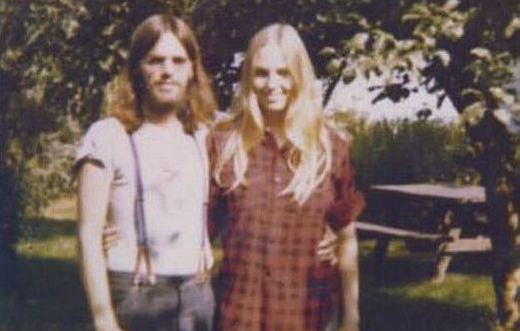
Raymond Tomlin and Cathy McLean circa 1972, in the days of the Tillicum Food Co-operative1972: A fuzzy picture of a long-haired Raymond Tomlin, and exquisite Cathy McLean

Note should be made that the always brilliant and phenomenally talented Cathy McLean (my spouse and love of my life) wrote all of the grant applications — of which there were hundreds — every single one of the grant applications she submitted approved by the federal government.

In 1973, the Grandview United Church at 1895 Venables Street, just off Victoria Drive, became the Vancouver Free University1973: Grandview United Church, Venables & Victoria, became Vancouver Free University

The LIP and LEAP programmes were also responsible for helping to acquire a closed and forlorn church at Venables and Victoria Drive, which first became an open university, and soon after became known as the Vancouver East Cultural Centre, and then simply, in recent years as, “The Cultch.”

Paul Phillips, one of the founders of Vancouver's Fed-Up Food Co-operative WholesalerPaul Phillips, one of the founders of Vancouver’s Fed-Up Food Co-operative Wholesaler

A group of activists lead by Dana Weber, Ros Breckner and Paul Phillips left the now thriving Tillicum Food Co-operative to form the Fed-Up Food Co-op Wholesaler, importing food stuffs from across the globe, and acting as a supplier to the Tillicum Co-op. Fed Up was the first North American wholesaler to sign a contract that would bring sultana raisins from Australia onto this continent. Where Tillicum remained responsible for distributing food throughout the Metro Vancouver region, Fed Up took on the job of distributing food across the province, western Canada and down into the United States, and growing the food co-operative movement globally.

Simon Fraser University's Louis Riel House, a student family one-and-two-bedroom apartmentSimon Fraser University’s Louis Riel House, student family 1 + 2 bedroom residence

Meanwhile, there was nascent women’s and LGBTQ movements that were just getting underway. Throughout the 1970s, I recall that each Wednesday evening that Cathy would leave our apartment to meet with almost every woman who lived in Louis Riel House — the 148 one-bedroom and 61 two-bedroom student apartment residence located at Simon Fraser University’s Burnaby Mountain campus — for what was termed consciousness-raising.
The “consciousness-raising” of the day was not limited to white, cis-gendered women, however. No, as I wrote above, there was along with the women’s movement, a burgeoning & activist LGBTQ movement in our city.
And thus, finally on VanRamblings, the raison d’être as to why I am writing today’s Story of a Life, because today’s story is one that has remained deep within me all of my adult life, and helped to define my involvement over the past near 50 years in both the feminist & LGBTQ social justice movements.

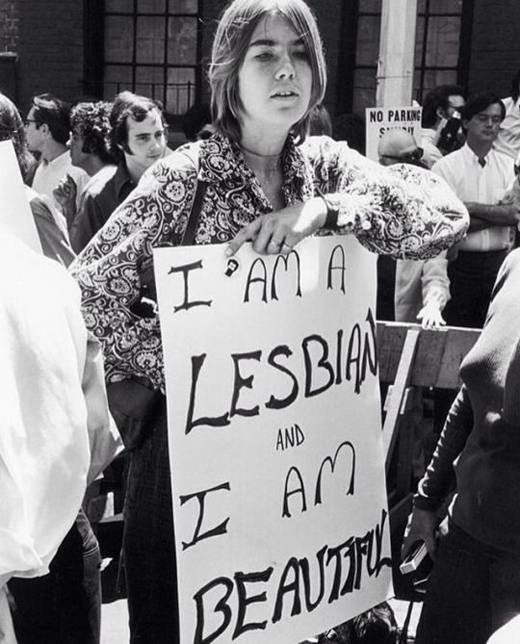
The 1970s Women's Liberation Social Justice Movement, "I am a lesbian, and I am beautiful"

In the autumn of 1972 I made the acquaintance of a group of activist women who had formed their own collective in the Tillicum Food Co-op.
Young, bright, passionate, articulate, as I am wont to do, I fell in love with each of these women who supported me in my various endeavours, tough, strong, take no guff women who were surprisingly gentle and supportive of me, giving instruction to me as it was necessary (which was probably more often than I would admit even now). The group of us became fast friends, as we worked together to build a fairer, more just and inclusive society.
Now, each of these women, average age about 22, were strikingly attractive in the most usual sense, and drew a great deal of unwanted attention from men. To say that the early 70s were the days of rampant sexism is to understate the matter. These were antediluvian times in the history of the women’s movement, and in our collective history. The women in the Women’s Collective were able to handle whatever situation came their way, though, and nothing too untoward ever occurred, until …
The Women’s Collective was an overtly political collective. Not only were they progenitors of the women’s movement in Vancouver, they also wished to be progenitors of the LGBTQ movement, although all the women were white, educated and decidedly heterosexual.
The Women’s Collective, though, still took on the goal of championing LGBTQ issues, and lesbianism in particular, by adopting lesbianism as a personal and political endeavour. To thwart any interest by men, a decision was taken by each woman, who when I first met them weighed in at about 110 pounds sopping wet, to gain 60 pounds apiece — and they did.
By February 1973, each woman weighed in at about 185 pounds.
In addition to gaining weight, and becoming an overt, in-your-face lesbian collective, the Women’s Collective undertook a military-style training regimen, a three-month long boot camp that even though the women were now of hefty frame, they were also as strong, in actuality much stronger, than any man involved with either Tillicum or Fed Up Food Co-operative.
From autumn 1972 to winter 1973 I saw the transformation, and it was something to behold, a form of experiential personal theatre made live that was amazing to watch unfold. The women continued to be kind, tending to a quiet and less boisterous nature — although fun to be around, and at the monthly drunk-a-thon dances we had in the Tillicum warehouse, great dancers each and every one of them, lithe despite their new bulkiness.
Still, as I say, these were sexist and regressive times in the early 1970s.
Women were undermined as a matter of daily intercourse in the life of our society, tended to have what they said readily dismissed, and were regarded by most men of the time as little more than sexual playthings.
Not so for the politically active lesbian women in the Women’s Collective.

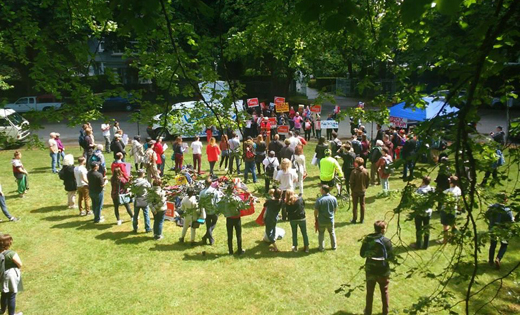
Team Jean Campaign Launch photos, taken at The Crescent, in Vancouver's wealthy Shaughnessy neighbourhood, on Saturday afternoon, June 9th, 2018

In Vancouver this past year, a new movement of change has emerged, the sort of revolutionary change many of us felt and lived in the late 1960s and early 1970s, this new Vancouver-based movement identifying themselves as TeamJean, a cadre of activists who have organized around Order of Canada recipient and veteran community and anti-poverty activist, Jean Swanson. What I find so becoming and hopeful about the, mostly, young people involved with TeamJean is not just their revolutionary fervor and their work towards creating substantive change in our society, and change now, but in how much fun they’re having in organizing for change, how each of them see the necessity of theatre as a necessary communications tool to get their ideas across in a humanist and non-threatening manner.
There is an excitement within TeamJean that is wholly inspiring, an excitement I haven’t seen, felt and experienced in more than 40 years.
In the 2018 Vancouver municipal election, I have been writing that Derrick O’Keefe, working with organizers within TeamJean like Sara Sg, Chanel Ly, Fiona York, Maddie Andrews, Duncan Martin, Selina Crammond, Riaz Behra, Luis Porte Petit, Ngaire Leach (the graphic designer behind the Jean Swanson logo, and all of TeamJean’s visual design), Shawn Vulliez, Aiden Sisler, Darlene Alice Bertholet, Beverly Ho, Devin Gillan, Alex Kennedy, Ishman Bhuiyan, Jorj Tempul and Qara Maristella believe not just in activism and activism with a conscience, but in the transformative power of theatre, art, song, dance and plain good fun towards changing and helping minds grow, to bringing people along with them into a new era of peace, social justice and inclusion, that aims to serve the many over the few.

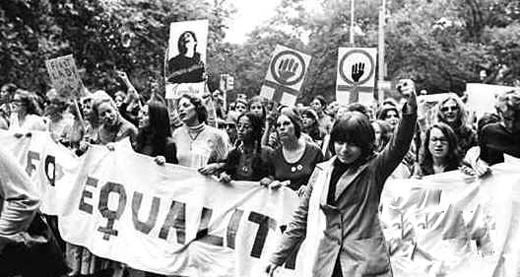
Women march for equality in the 1970s, as part of the Women's Liberation Movement

In February 1973, a meeting of the collectives involved in the Tillicum Food Co-operative movement was called, the meeting taking place in a workshop space on 2nd Avenue just west of Main. These meetings were held monthly, chaired by me, where we shared ideas on how to grow the co-op movement, not just the food co-op movement, but movements in general.
Of course, a cadre of my favourite women in the Women’s Collective were present, all bulky and fine and in good spirits, on their home turf in their workshop space, and ready with a plethora of ideas on a panoply of activist fronts. The Women’s Collective had proven central to the success of the Tillicum Food Co-op, and the soon-to-be Fed Up Co-operative — without their support, counsel and energy, I’m not entirely sure that the Tillicum Food Co-op would have grown as it did in the first year, and beyond.
So, there we were on this chilly Tuesday evening in early February 1973, in a dimly lit workshop space, approximately 75 chairs set out, me at the front, collective members from across the Lower Mainland settled into their chairs, the women in the Women’s Collective “patrolling” the meeting, none of them seated, almost a security force, in case such was needed.
There was talk of forming a camping and adventure equipment co-operative, which eventually became the Mountain Equipment Co-op. There was talk about working with the provincial government on creating child care in our province, which occurred in 1974, when Norm Levi assigned $100 million to the creation of child care centres throughout the province. As usual, the meeting was positive and directed, orderly and respectful.
Except …
There was one man, sitting off to my left, in the second row who, when one of the women in the Women’s Collective offered up an idea that met with support, but debate from some of those present, that when it came time for this man to speak, he looked directly at the woman who had made the suggestion, and started off his address to her, saying, “Hey, douchebag …
In a millisecond, a woman in the Women’s Collective who’d been standing behind him, pulled his chair back on its back legs, his feet now dangling, while another woman in the collective approached him, pulling down his pants and his underwear, and when this was accomplished, yet another woman in the collective grabbed his flaccid penis, pulling it taut while also pulling up his scrotum, and then placing the tip of a knife under his scrotum in the perineal region midway between his anus and his genitals, the woman who had pulled down his pants and underwear now looking directly at this now formerly recalcitrant man, and asked, “Did you want to repeat yourself? Did you want to address my friend using the pejorative you employed just a moment ago? You called my friend what? I’m waiting …
All of the above had occurred in much under 60 seconds.
The formerly surly man of intransigent nature was mute, not frightened exactly but more contemplative than anything else. He shook his head, and finally uttered, “No, I have nothing to say other than, I’m sorry. It’ll never happen again. I promise.” And, in all the time to come it never did.
As quickly as the errant man had been approached, the women withdrew, his chair let down, aid given to pull up his pants, those 75 Tillicum members in attendance acknowledging what had occurred between the Women’s Collective and the disagreeable man, for what it was: theatre.
Of course, change doesn’t happen in a day, it is long and arduous and hard fought for — but occurs most often with action and a degree of humour.
Some year later, I recall working in the offices at the Fed Up Food Co-op on Scotia Street, and walking down into the warehouse, where 80 pound sacks of oatmeal were being carried from one end of the warehouse to the other. On one memorable occasion, I saw a young, petite woman quite easily carrying an 80-pound oatmeal sack on her back, as a man came up to her and, gallantly I’m sure he thought, looking at the woman, saying to her, “I can do that for you. I’ll take the sack, if you’ll let me.” And she did.
The man took the cumbersome 80-pound oatmeal sack, and struggled to carry it across the warehouse. Meanwhile, the woman who had given up the oatmeal sack had gone back to pick up a 100-pound sack of wholegrain flour, and as the man continued his struggle with the heavy oatmeal sack, the woman sailed on past the man with a light as a feather 100-pound flour sack on her back, glancing back at the struggling man saying, “Thank you,” and then proceeding to the other end of the warehouse with her burden that was not a burden at all, but a metaphor for change and growth, and the doctrine of a necessary and revolutionary change of consciousness.

Arts Friday | Illicit | Revealing The Lives of Illicit Drug Users

Illicit: Stories from Vancouver’s harm reduction movement is a community-engaged arts-based project developed and led by residents of our region brought together by the harm reduction movement, and the ongoing opioid crisis impacting on our region’s most vulnerable citizens.

Illicit: Stories from a harm reduction movement, a site-specific installation and performance created in response to the 2016 closing, by Vancouver Coastal Health, of the harm-reduction facility DURC (Drug Users Resource Centre)

Please listen to the audio above of the interview conducted last evening by VanRamblings with Illicit Artistic Director Kelty McKerracher, for full background on the development of the Illicit community-developed performance piece, what it’s all about, who developed and is involved in the project, the rationale behind Illicit, upcoming performances, and more.

Illicit: Stories from a harm reduction movement, a site-specific installation and performance created in response to the 2016 closing, by Vancouver Coastal Health, of the harm-reduction facility DURC (Drug Users Resource Centre)

Created in response to the 2016 closing by Vancouver Coastal Health of the Downtown Eastside harm reduction facility DURC (Drug Users Resource Centre), Illicit explores the lived realities of the opioid overdose crisis, the effects of Canada’s drug policy, the stigma faced by those who use illicit drugs, and the courage of community to act in the face of continuing loss.

Illicit: Stories from a harm reduction movement, a site-specific installation and performance created in response to the 2016 closing, by Vancouver Coastal Health, of the harm-reduction facility DURC (Drug Users Resource Centre)

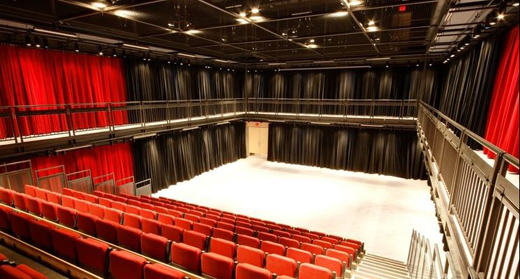
On July 3rd and 4th, the creators of Illicit invite you to witness the next step in the evolution of their work-in-progress — by entering an immersive world of shadow, music and story that celebrates the heart of a movement. The July 3rd and 4th performances of Illicit will take place at the Orpheum Annex, at 823 Seymour Street, in the artistic heart of Vancouver.

Illicit: Stories from a harm reduction movement, a site-specific installation and performance created in response to the 2016 closing, by Vancouver Coastal Health, of the harm-reduction facility DURC (Drug Users Resource Centre)

At 1pm on July 3rd, there’ll be a ‘pay what you can’ matinée performance of Illicit, for community members and anyone who wishes to attend, with ticketed performances in the evening, at 7pm, on both July 3rd and 4th.

Illicit: Stories from a harm reduction movement, a site-specific installation and performance created in response to the 2016 closing, by Vancouver Coastal Health, of the harm-reduction facility DURC (Drug Users Resource Centre)

Towards the end of the month, or very early in July, VanRamblings will re-publish today’s post. Tickets for the upcoming performances of Illicit will be available here, at some point in the next 24 hours, for the July 3rd and 4th performances of Illicit with information, as well, on how you might contribute to the Illicit project, as well as where and when performances of Illicit will take place in Victoria and Kamloops.

“In both places,” says Ms. McKerracher, “we’re working with wonderful teams of people, to set up not only a theatrical venue but an environment where we can have a productive dialogue. Illicit isn’t just about a performance, it’s about opening a space for a conversation that needs to be happening across the board in our society.

Harm reduction and the opioid crisis is not just a Downtown Eastside issue, this is affecting people across the province and across the country. We’re hoping that by taking it outside of Vancouver we’re going to reach audiences who don’t have access to this kind of conversation, and this kind of cultural shift.”

Illicit: Stories from a harm reduction movement, a site-specific installation and performance created in response to the 2016 closing, by Vancouver Coastal Health, of the harm-reduction facility DURC (Drug Users Resource Centre)

Illicit, a site-specific installation and performance uses theatre, monologues, shadow puppetry and marionettes to tell personal stories that nurture dignity and hope. The artistic team behind the project: current Artistic Director and producer Kelty McKerracher, director Renae Morriseau, musical director and Juno award-winning artist, Devon Martin, and shadow marionette and puppeteer David Mendes, who collaborate with an active and intimately involved group of co-researcher performers — including Alanna Abrosimoff, Tyler Bigchild, Steve Cardinal, Nicolas Leech-Crier, Shawn Giroux, Jim McLeod, and Tina Shaw — to create Illicit.

Illicit: Stories from a harm reduction movement, a site-specific installation and performance created in response to the 2016 closing, by Vancouver Coastal Health, of the harm-reduction facility DURC (Drug Users Resource Centre)Tina Shaw, who works in overdose response in the Downtown Eastside, is involved in the upcoming production about Vancouver’s opioid crisis.

Presented in partnership with PHS Community Services Society, Hives for Humanity, and SFU ‘s Office of Community Engagement. And with support from Canada Council for the Arts, Community Action Initiative, and Canadian Institute for Substance Use Research. As Ms. McKerracher related to VanRamblings last evening …

“The show will be educational and anecdotal, about what’s going on in our community and how people feel, the performance of Illicit hopefully ending with a discussion. It’s about truth and understanding and about acknowledging the uncertainty, the loss, and the tragic unfairness of the current opioid crisis.”

For more information on the Illicit project, please visit the Illicit blog.

Vancouver Votes 2018 | Compassion Will Be Wedded to Power

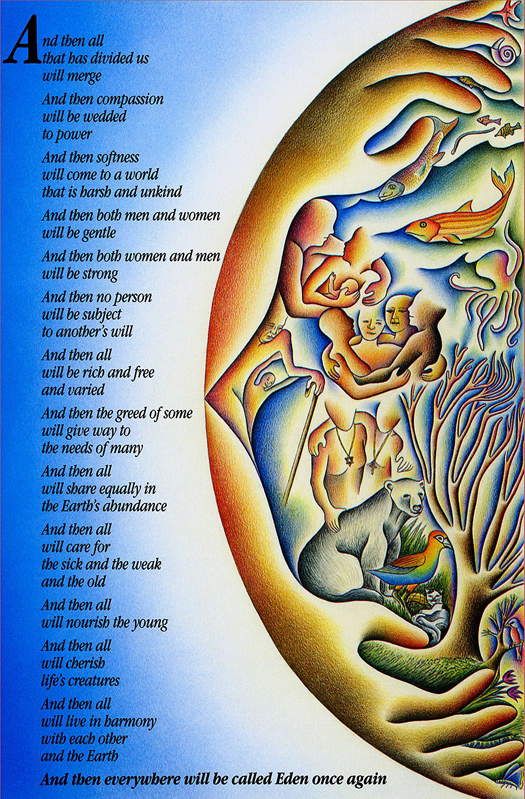
Judy Chicago 'Merger Poem', a Jewish Ritual That Should Serve as Instruction in Vancouver's 2018 civic election

As the grounds on which the 2018 Vancouver municipal election will be fought come into clearer focus, as the five municipal parties in Vancouver set about to nominate their candidates — with COPE having chosen its candidates this past Sunday, and OneCity Vancouver set to nominate its candidates this upcoming Sunday, the Green Party of Vancouver planning to hold their nominating meeting on June 27th, and Vision Vancouver doing the same thing on July 8th, with the nominally right-of-centre Vancouver Non-Partisan Association set to announce their Council, School Board and Park Board candidates at an as yet undetermined date, but no later than early July for sure — Vancouver’s 2018 civic election is about to get underway in full force, beguiling the public with promises, and change.

Five term Vancouver City Councillor Raymond Louie announces his retirement | June 13 2018Five-term City Councillor Raymond Louie announces his retirement from political life

VanRamblings was saddened to learn yesterday that five-term Vancouver City Councillor, Raymond Louie, has chosen not to seek another term in office. During his celebrated career of service on behalf of the citizens of Vancouver, Councillor Louie’s contributions have been innumerable, and the positions he has held on local and national governmental bodies of significant importance to the best interests of our democracy, including …

  • Current Vice-Chair of the Metro Vancouver Board, a position he has held since December 2011;

  • Metro Vancouver Board Chairman of the Intergovernmental Relations and Finance Committee, since December 2011;
  • Chairman of the Board of Directors of the Pacific National Exhibition Board, since July 2009;
  • President of the Canadian Federation of Canadian Municipalities, June 2015 – June 2016, and …
  • Chairman of the City Finance and Services Committee, November 2008 to December 2014.

Councillor Raymond Louie’s presence in the governmental structure of our city, our region and our nation will be greatly missed. We trust that there is much good in store for this titan of governance in our city, and as will all the citizens of conscience in Vancouver who give a good galldarn about how we are governed, we wish him well in his future endeavours, and thank him from the bottom of our heart, and the depth of our soul, for his unrivaled contribution to improving life in Vancouver for all of its grateful citizens.

Metro Vancouver Alliance, faith groups and union members organizing for a better, fairer and more just Vancouver Metro region, and province

The story of the non-partisan community action group, the Metro Vancouver Alliance

VanRamblings is a delegate to the Metro Vancouver Alliance, a broad-based alliance of community groups, labour, faith and educational institutions working together and organizing for the common good.
Founded in 2009, at present more than 50 organizations hold membership in the alliance, as this critically important social justice institution continues to grow its membership each and every week.

Metro Vancouver Alliance organized to reduce fares for transit riders, as a social justice initiative

Recently, the good folks involved in the Metro Vancouver Alliance brought forward a proposal to the British Columbia government, recommending the elimination of transit fares for children 12 years of age and under, reducing the current cost of the $45 monthly student bus pass to $22.50 for students aged 12 to 18, and reducing fares and the cost of monthly bus passes, to as little as half, for persons who earn less than $35,000 annually.
Not surprisingly and much to the satisfaction of MVA delegates, British Columbia Minister Responsible for Poverty Reduction, Shane Simpson — at a May meeting of the Alliance that he attended — looked favourably on the MVA proposal, telling delegates he would recommend implementation of the MVA plan to his governmental colleagues, and Cabinet.
At this past Tuesday evening’s Annual General Meeting of the Metro Vancouver Alliance, one of the delegates read out a poem by Judy Chicago, an artist, author, feminist and educator whose career spans five decades, and who in 1989 wrote the Merger Poem, a Jewish Ritual, that has particular resonance in our current Vancouver municipal election.
VanRamblings would like to dedicate Ms. Chicago’s moving Merger Poem to all the candidates seeking office in the 2018 Vancouver municipal election, and to those affiliated and working on the various civic election campaigns, most particularly OneCity Vancouver City Council candidate Christine Boyle, who we believe embodies the soul and purpose of Ms. Chicago’s poem and lives it daily, and to Peter Armstrong, the veteran Vancouver Non-Partisan Association organizer and past President who we believe, as well, will work with his party’s candidates for office to realize the goals set out in Ms. Chicago’s stirring instruction to all the good and kind citizens of Vancouver.

Judy Chicago's 'Merger Poem', a Jewish Ritual That Should Serve as Instruction in Vancouver's 2018 civic election