Arts Friday | Best Cinema of 2018 | VanCity Theatre

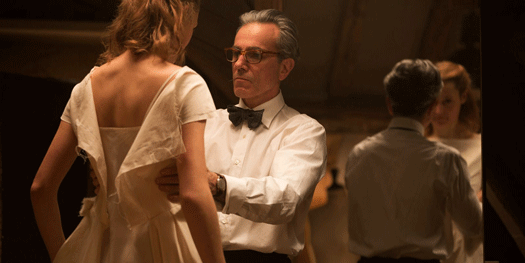
Paul Thomas Anderson's Phantom Thread, starring Daniel Day Lewis

As occurs each December, Tom Charity — one of the kindest, most thoughtful and erudite men of our acquaintance, a great lover of film and who, as it happens, has long acted as the absolutely superb programmer of the Vancouver International Film Festival’s year-round Festival cinema venue, the Vancity Theatre, once again, this year, for your edification, enjoyment and just plain delight presents the Best of 2018, one time only, year-end, must-see screenings of the very best 2018 cinema had on offer.

Paul Thomas Anderson’s Phantom Thread, Thursday, Dec. 27th, 8pm, Vancity Theatre.

Moira Macdonald, Seattle Times arts critic, writes, “Paul Thomas Anderson’s “Phantom Thread” casts a remarkable spell; it wraps around you, like a delicately scented cashmere shawl woven from music and color and astonishing faces.” Absurdly pleasurable to watch and to listen to, with its effortless display of poise, as Chicago Sun-Times film critic Richard Roeper writes, “Anderson shoots and paces Phantom Thread almost like a 1950s mystery, and there ARE some dark elements of intrigue in the story — but this is not a Hitchcockian tale of lust and betrayal and murder. It’s a fascinating examination of an obsessive-compulsive, maddeningly self-centered, magnificently talented man.” Captivating, unsettling, entrancing.

Debra Granik’s Leave No Trace, Friday, December 28th, 8pm, at the Vancity Theatre.

Here’s what we wrote about Debra Granik’s Leave No Trace last Friday …

Far and away the strongest and most affecting independent film of 2018, director Debra Granik’s first outing since 2010’s multiple Oscar award nominee, Winter’s Bone (in which Jennifer Lawrence made her début, gaining a Best Actress Oscar nomination), Leave No Trace tracks a father and daughter living precariously off the grid, introducing us to an incandescent 17-year-old Thomasin Harcourt McKenzie, who lives a tranquil life sheltered with her loving, PTSD suffering father, Ben Foster, in an urban Oregon woodland, in perfect harmony with one another, despite all. Uncompromising, authentic, raw, heartbreaking, brilliant, haunting, full of grace, and riveting throughout, Leave No Trace is a multiple Gotham & Indie Spirit Award nominee — including Best Actor, Supporting Actress, Director and Feature — and a must-see Best of 2018 film screening.

This past week, Thomasin Harcourt McKenzie was designated as the National Board of Review’s Breakthrough Performance award winner!

Make sure you catch The Death of Stalin on Saturday, Dec. 29th, 8pm, Vancity Theatre.

This past spring, recently-elected Vancouver City Councillor Colleen Hardwick and her husband, renowned actor Garry Chalk, caught a screening of Armando Iannucci’s The Death of Stalin at the Fifth Avenue Cinema, and came out of the theatre raving about the film to all who would listen. High praise, indeed, from persons of conscience in our community who cherish film as the critically important art form of our age.
Says New York Times film critic Manohla Dargis, “The Death of Stalin is by turns entertaining and unsettling, with laughs that morph into gasps and uneasy gasps that erupt into queasy, choking laughs,” Iannucci’s take-no-prisoners directorial style perfect for this blackest of farces, political satire of the first order, and a farcical, frightening and a timely reminder that things could always be worse — which in the time of Trump is going some.

Part of a double bill, Mandy on Saturday, December 29th, 10:10pm, Vancity Theatre.

Says CineVue’s Tom Duggins, “Mandy is not just hideous, hilarious and thrilling — although, it’s all of those and then some — it’s also a meditation on personal grief which loses no poignancy for all its blood-soaked insanity and eye-melting psychedelia.” Not enough praise?
Try this, from the Austin Chronicle’s Marc Savlov, “Mandy, though, is flat-out orders of magnitude a more emotionally adept and shockingly powerful film in virtually every department, from the dazzlingly insane cinematography and lysergically-inclined production design to what I can only believe is Nicolas Cage’s single best performance to date.”

Multiple award winner, Foxtrot, on Sunday, December 30th, 8pm, at the Vancity Theatre.

Winner of the Grand Jury Prize at the 74th annual Venice Film Festival, says the Washington Post’s Ann Hornaday, “Samuel Maoz’s award-winning Israeli film is graced by superb performances, especially from Lior Ashkenazi and Sarah Adler, this gentle, dreamlike but admirably process film offers a devastating portrait that bursts with integrity and tough honesty, even in its most lighthearted moments,” and as the Los Angeles Times’ lead film critic Kenneth Turan writes in his review of Foxtrot, “An intricate, dazzling cinematic dance, Foxtrot goes both deeper in and further out than standard-issue cinema. It’s profound and moving and wild and crazy at the same time, simultaneously telling a specific story and offering an emotional snapshot of a country whose very soul seems to be at risk.”

Paddington 2, on Monday, December 31st at noon (New Year’s Eve!), Vancity Theatre.

Probably the most enthusiastically reviewed film of 2018 — and this from a usually cynical crowd of film critics — here’s just a bit of what’s been written about Paddington 2: “An exquisite reminder of the wondrous things that can happen when a storyteller of boundless imagination avails himself of some rigorous discipline (Justin Chang, L.A. Times); and from Time Out London film critic, Helen O’Hara, “It’s a family adventure that’s the right sort of heartwarming, delivering real human emotion through the medium of a small bear.” Others have written about Paddington 2: exemplary, beguiling, enchanting, whimsical, heartfelt, humane, delightful, heartwarming, and “a sequel that surpasses the superb original.”

First Reformed, on Tuesday, January 1st at 7:45pm (New Year’s Day!), Vancity Theatre.

Perhaps the best reviewed art film of 2018, a comeback film for Paul Schrader (Taxi Driver), winner of the prestigious New York Film Critics Circle & Gotham Awards for Best Actor for Ethan Hawke — the prohibitive favourite for a Best Actor Oscar — as well as Best Screenplay for Schrader with both critics’ organizations, critic Godfrey Chesire writing, “A stunning, enrapturing film, a crowning work by one of the American cinema’s most essential artists,” while Roger Moore in Movie Nation writes, “A powerful, disturbing crisis of faith drama that takes on the raiments of a thriller, and a tour de force for the understated acting of Ethan Hawke.” Not to be missed.

Edge of the Knife (Sgaawaay K’uuna), on Tuesday, January 1st at 10pm, Vancity Theatre.

The first feature film to be spoken entirely in the Haida language, Sgaawaay K’uuna is based on a popular Haida legend, Gaagiid/Gaagiixiid (Wildman), the 19th century set film relating the tale of two families who gather together for their annual Haida Gwaii fishing camp.
A man, Adiits’ii (Tyler York), flees into a forest and transforms into a Gaagiid/Gaagiixiid (Wildman) after experiencing a tragedy. Throughout, Sgaawaay K’uuna offers mythic, human scale storytelling, where every life is sacred and no one is beyond redemption, as riveting a tale of survival and forgiveness as you’ll see this year, or any other year.
Sgaaway K’uuna, or Edge of the Knife is derived from the Haida saying: ‘The world is as sharp as the edge of a knife; as you go along, you have to be careful or you will fall off one side or the other.’

Sorry to Bother You, on Wednesday, January 2nd at 8:25pm, at the Vancity Theatre.

One the best reviewed comedies of the summer of 2018, Sorry to Bother You offers a roiling mix of wry race comedy, economy-grade dystopian speculative fiction, and inspired/demented midnight-movie Silicon Valley satire — it’s also as funny and as caustic as hell. Oh, and did we say that Boots Riley’s début feature film is also a welcome hand grenade of subversive power that is all at once incendiary, hilarious, alarming, anti-capitalist, infectious, absurdist and provocative? Gosh, I think we just did.

Support the Girls, on Thursday, January 3rd at 8:25pm, at the Vancity Theatre.

Saving the best for last, writer-director Andrew Bujalski’s heart-of-gold film offers a fresh perspective on the lives of marginalized people, in a story about sex, race, class, and age, all without ever coming off as preachy or lecturing, even given its winking/earnest double entendre of a title.
Here’s what respected film critic John Anderson had to say in the Wall Street Journal

The unlikely, bittersweet, bristling comedy Support the Girls is easily one of the best films of the year, and the most sympathetic to women, despite having been made by a man. How can this be? Luckily, Andrew Bujalski’s remarkable movie — with its killer performance by Regina Hall (who just won the New York Film Critics Circle Award for Best Actress, and is a lock for a Best Actress Oscar nod) is not just about women. It’s about men being idiots. And no one is arguing ownership of that narrative.

Humble, restrained, breezy, heartwarming, never hectoring, delicate, cogent, tender, tough, empathetic, controlled, victorious, tumultuous, brilliant, bracing & utterly phenomenal, you need to see Support the Girls.

The Music & The Stories of One’s Life | A Horse With No Name

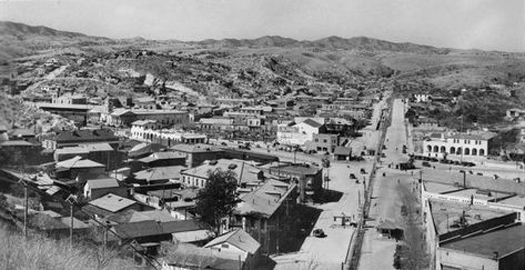
Nogales, Sonora Mexico, circa 1972

When Cathy and I left for Mexico in February 1972, we crossed the border at Tijuana, and took a bus to Mexicali, where we boarded a train for Guadalajara. On the way home, though, we crossed the border at Nogales, Mexico, approximately 600 kilometres east of Mexicali — which meant that when we entered into the United States, we landed in Nogales, Arizona rather than San Ysidro, California.
Whatever the case, we were happy to be heading home.

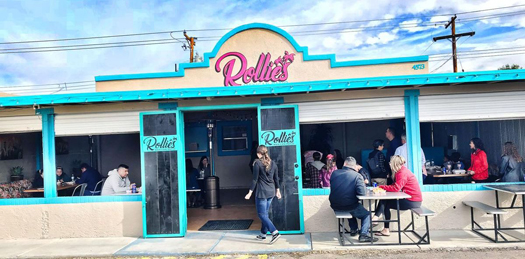
Rollies Diner in Nogales, Arizona

Once in Nogales, Arizona, we stopped in at a popular local diner for breakfast (it was approximately 8 a.m.), after which we headed over to the highway, where we stuck our thumbs out, hoping for an 85-mile ride to Tuscon, Arizona, all dusty and laden with backpacks, of course.
A kind young man picked Cathy and I up just outside of Nogales, and as luck would have it, he was on his way to Tuscon. Once we’d loaded our backpacks into the back seat, and were comfortably ensconced in his late model Ford sedan, as we barrelled down the I-91 highway heading north, he turned the radio on. After two months away, the song that follows just below is the first song we heard on American radio, a song that would soon rise to #1 on the charts, and which Cathy and I remember to this day as signalling the first jaunt of our journey home, to Los Angeles initially, and then to our home atop Burnaby Mountain, at SFU’s Louis Riel House.

Somehow a song about the desert as we trundled our way through southern Arizona on a warm, breezy, dusty sun dappled Tuesday morning seemed entirely fitting — Cathy and I just looked at one another & smiled.
Once in Tuscon, we once again put our thumbs out at the side of the highway, and soon found ourselves on the second, 113-mile leg of our journey home, this time to Phoenix, and afterwards on the last leg of our route back to our friend’s home in East LA, a 372-mile ride to from Phoenix to Los Angeles. We made it back to Los Angeles around 8:30 p.m.
In fact, we arrived in the Westwood neighbourhood of Los Angeles, where our friend Bachi (Manuel Vittorio Esquivel) was kind enough take the 22-minute drive from East L.A. to pick us up, and bring us back to his home. We stayed a couple of days, and then jumped into our Datsun 510 — a wedding present, as it happens, and a vehicle that Bachi had serviced in our absence, all in prep for our 1277-mile leisurely sojourn to Vancouver.

Holiday Season | VanRamblings Will Reduce Posting This Month

The 2018 holiday season, and VanRamblings reduces our incidence of posting

The holiday season is upon us. For VanRamblings that means spending time with friends and family (as I suspect is the case with most of us), and a level of busyness that is unusual for us — given that much of our life is given over to the creative endeavour of writing on VanRamblings, which entails a dozen hours or more each day sitting in front of our computer composing the posts that you read from time to time, on this blog of ours.
From April 20th on of this year — six months out from the 2018 Vancouver municipal election —&#32there was a raison d’être for VanRamblings: to introduce you to the candidates we felt were worthy and deserving of your vote. To that end, we wrote as many as 2500 words each day about the 2018 Vancouver municipal election, the issues we felt were important for candidates to address, and who we felt best were most capable of creating the city we need, a fairer and more just city for all.
While it remains our intention to continue our coverage of Vancouver City Council, School Board and Park Board, we are not quite so obsessed with civic governance and all that occurs each day with the process of decision-making that will lead to creating a city for all of us. In Vancouver, we’ve elected our Mayor, Kennedy Stewart, and a pretty darn fine group of City Councillors, School Board trustees and Park Board Commissioners — we’re prepared to let them get on with the job sans the obsessive coverage that has come to define VanRamblings these past almost eight months.

Damara, our new kittyamara-new-kitty.gifDamara, our new 3-year-old kitty, soon to be our companion as we write each day.

Here’s our plan for VanRamblings, then, going forward, which, of course, is subject to change — we’re planning on writing about politics once or twice a week this month. We have a column on Janet Fraser, Chairperson of the Vancouver School Board, that we’re intending to write, with likely publication this upcoming week (for the record, we consider Dr. Fraser to be a transformative political figure, and believe we should all be grateful for the gift of her presence on Vancouver’s political scene). We’ve also got a column on Vancouver International Film Festival programmer Tom Charity’s Best of 2018, which it is our current intention to publish next Friday.
In fact, VanRamblings will publish a great many columns on film this month — because we love film, considering it to be the art of our age, and during the April through October period we forfeited our love of film in favour of covering the election — where the majority of candidates we endorsed were elected to office, as well as a few we failed to endorse, but should have.
As far as is possible, in addition to our once or twice a week political coverage, we’ll keep up our Arts Friday coverage — which will be given over to film for the foreseeable future, but within which we plan to expand our coverage into other facets of Vancouver’s arts scene. We’ll continue our Stories of a Life feature — no such posting this week, or last, but next week we promise — and our Music Sunday feature, which tomorrow oughta emerge as a sort of Story of a Life when, and if, it actually comes to fruition. Tuesdays and Thursdays may be fallow days, or given over to tech coverage — we have a column for Apple iPhone SE, 6, 6 Plus, 6s, 6s Plus, 7, 7 Plus, 8, 8 Plus, and X users we’ll publish this upcoming Tuesday.
In the new year, VanRamblings will finally write about our cancer journey — which “story” will begin 10 months prior to our official cancer diagnosis. We’ll introduce you to those who made a difference in our life, and who are — we believe — the reason we are here today, enabling you to read those words on the screen in front of you (there’ll be a great many political folks who will find their way into our reporting out, as our “life savers”).
Thank you for hanging in with us.
Going forward, it is our intention to remain relentlessly positive about pretty much darn near everyone and everything, while focusing on change for the better, and a better life for everyone in all aspects of our lives.

#VanPoli | Planning | How Did We Get Ourselves into This Pickle?

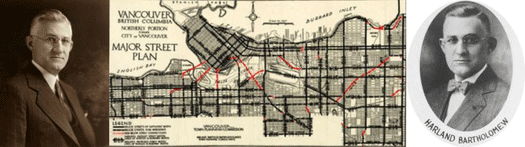
Harland Bartholomew, author of the 1930 Vancouver Plan

Harland Bartholomew (September 14, 1889 – December 2, 1989) was an American urban planner. Although a civil engineer by training & disposition, from 1911 through until the mid-1950s, Mr. Bartholomew emerged as the most influential urban planner of the first half of the 20th century, his considerable influence now thought to have had a profoundly negative impact on city development, administrative evil masked as “moral good”.
During the course of his lifetime, Mr. Bartholomew created comprehensive city plans for urban centres across North America, including …

  • 1911-1915 Newark, New Jersey;

  • 1916-1920 St.Louis, Missouri;
  • 1920 Memphis, Tennessee;
  • 1920-1921 Lansing, Michigan;
  • 1921-1922 Wichita, Kansas;
  • 1926-1930 Vancouver, BC;
  • 1930 San Antonio, Texas;
  • 1930-1934 St.Louis, Missouri;
  • 1932 Louisville, Kentucky The Negro Housing Problem;
  • 1953-1959 Washington, DC.

Before, during and after WWII, Mr. Bartholomew was appointed to the United States’ Federal Planning Committee by three Presidents, Herbert Hoover, Franklin D. Roosevelt and Dwight D. Eisenhower. In 1952, President Eisenhower appointed Mr. Bartholomew chairman of the National Capital Planning Commission, a position he held for seven years.
Mr. Bartholomew was an early advocate of slum clearance & city planning, serving on the U.S. Slum Clearance Advisory Committee. His ideas helped shape the Housing Act of 1937 & the Housing Act of 1949, and had a profound effect on the segregation of city neighbourhoods, ensuring that immigrants and the urban poor would be designated to one blighted city neighbourhood — including in Vancouver, skid row (now called the Downtown Eastside), the urban planning handiwork of Mr. Bartholomew.

Harland Bartholomew, author of A Plan for the City of Vancouver, 1930

In his June 17, 2017 essay on Vancouver’s Abundant Housing website, urbanist Reilly Wood records the following …

“When Bartholomew asked what abuses he should consider in the interim zoning by-law of 1927 he was preparing, the chairman replied that ‘the only serious abuse… is the intrusion of undesirable apartment houses into residential districts'” (Zoning and the Single-Family Landscape, p. 60)

Recently, at the November 13th meeting of Vancouver City Council, newly-elected OneCity Vancouver Councillor Christine Boyle moved an amendment to a motion calling for an updated City Plan that would have included in its mandate “a city for all, such that all neighbourhoods in Vancouver would include all types of housing, rental, co-and-co-op housing, and social housing.” Councillor Boyle’s amendment was supported only by Mayor Kennedy Stewart and COPE City Councillor Jean Swanson.
Old ideas die hard, it would seem, and the legacy of Harland Bartholomew looms large in the planning process within the City of Vancouver.
Nonetheless, VanRamblings believes that as a new, inclusive and neighbourhood sensitive City Plan is developed, the intent of Councillor Boyle’s heartening and necessary amendment will carry the day, with the near unanimous consent of the Mayor & her fellow City Councillors, persons of conscience, grit & integrity to their core, who mean well for our city, not just over the course of the next four years, but for generations to come.
How did Harland Bartholomew’s Ideas Shape Vancouver?

“Few cities possess such a combination of nearby natural resources, a splendid harbour, a terrain ideally suited for urban use, an equable climate and a setting of great natural beauty.

Vancouver is the most important Pacific port of a great country. Here, if anywhere, should develop a great city. Circumstances of such character call for a city plan of substantial scale.”

A Plan for the City of Vancouver, Harland Bartholomew & Associates, 1928, p. 10

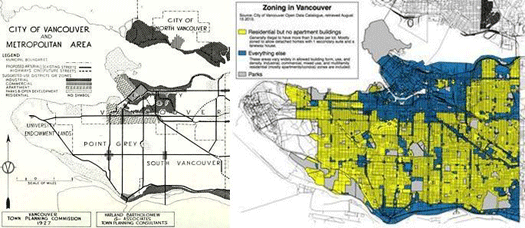
From the outset, Harland Bartholomew was clear in stating his preference for single-family homes throughout the city, with Vancouver Town Planning Commission chairman Arthur Smith setting the tone by praising Point Grey’s early bylaw, explicitly segregating Vancouver by class, and noting the retention of single-family homes as a major goal …

“The wise foresight which Point Grey has used in planning at an early stage of its growth should provide Vancouver with one of the most desirable residential districts possessed by any city on the Continent, and those who have to gain their livelihood by manual labor should find in Hastings Townsite, and in a replanned South Vancouver, a place where they can build up modest homes which should differ only in size from that of the more opulent employers. The retention of Vancouver as a city of single family homes has always been close to the heart of those engaged in the preparation of this plan.” (A Plan for the City of Vancouver, p. 26)

Bartholomew further clarified his preference for single-family homes …

“As has been mentioned, Vancouver is largely a city of one-family homes and is surrounded by similar development in the adjoining municipalities. Large areas are now available for such development, though a considerable proportion has yet to be served by utilities. That the one-family dwelling is the desirable unit for happy living is the general concensus (sic) of opinion of all authorities. (A Plan for the City of Vancouver, p. 233-234)

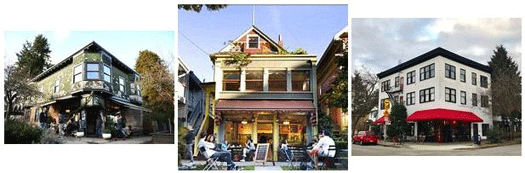
Neighbourhood stores in the City of Vancouver

Bartholomew was keen to keep stores out of residential neighbourhoods …

“The scattering of stores promiscuously throughout residence districts has done considerable damage to the city’s appearance. The nearly universal custom of building stores out to the street line has hurt the appearance of a good many residence streets and at the same time has injured adjoining lots by making them less desirable for living purposes and reducing their saleable value. The zoning by-law will remedy this condition and tend to prevent residence districts from becoming blighted.” (A Plan for the City of Vancouver, p. 247)

As Reilly Wood writes in his Abundant Housing essay …

“The contrast with modern-day Vancouver is remarkable, given that neighbourhood stores built before Bartholomew’s Plan are now many neighbourhoods’ most cherished jewels. Who would prefer the East Side without the Marché St. George, or the West Side without Arbutus Coffee? Bartholomew sought to completely eradicate small-scale retailers and meeting places from residential neighbourhoods, without questioning whether people might want to live near such amenities.”

Bartholomew advocated for and succeeded in creating exclusionary neighbourhoods, imposing extravagantly large minimum lot sizes and yards, and as Wood writes could “be more accurately described as a suburban plan, designed by a man with a profoundly anti-urban bias. It would be laughable if we weren’t still living in its shadow.”

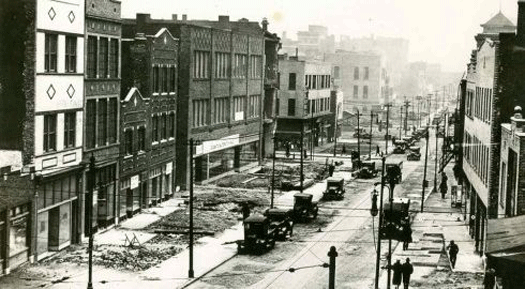
Urban planner Harland Bartholomew's plan for St. Louis, Missouri created a blighted cityFranklin Avenue looking East from 9th, 1928. Landmarks Association of St Louis.

Bartholomew’s urban plan for St. Louis, Missouri, is particularly instructive:

“City planner Harland Bartholomew rose in prominence along with the popularity of scientific city-efficient planning during the early to mid-twentieth century. In the pursuit of solutions to urban problems, Bartholomew concluded that the most efficient way to revitalize St. Louis, Missouri, was through the clearing of slums. In an attempt to solve the city’s economic and demographic problems, slum clearance destroyed and displaced Black neighborhoods whose 70,000 residents were seen as detrimental to the city’s success.”

In fact, as Dan Chapman of The Atlanta Journal-Constitution, writes

“The region’s psychic scars run deeper. St. Louis once was the nation’s fourth most populated city, a manufacturing and transportation colossus. It was the proud Gateway to the West, idealized by the soaring steel Arch along the banks of the Mississippi River.

A century ago, city fathers realized that blight, traffic, poverty, and fragmented government threatened St. Louis’ success. They hired a city planner in 1916 who, a year later, published the “Problems of St. Louis.” The city was at a critical juncture, an inflection point where long-term success might be guaranteed if the right civic decisions were made.

Harland Bartholomew, the planner, hoped that his report would “ultimately result in some action and action is St. Louis’ greatest need.” Action ensued, but not always the right kind.

St. Louis today ranks 27th in population and 45th in job growth among the top 50 metro areas. In hindsight, few imagined that the year 1916 would figure so prominently. Bartholomew’s embrace of urban renewal and highways-to-the-suburbs fueled the exodus from St. Louis as well as the region’s fragmentation and racism.

A residential segregation law passed that year established an ongoing pattern of racial separateness. The law was overturned, but the scars remain. Ferguson, for example, is two-thirds black, yet at the time of the shooting the mayor and five of six council members were white.

Ferguson affirms that we in St. Louis are in the geographic and cultural heart of America with all its issues and foibles,” said the Rev. Starsky Wilson, pastor of St. John’s United Church of Christ in St. Louis. “These are American problems.”

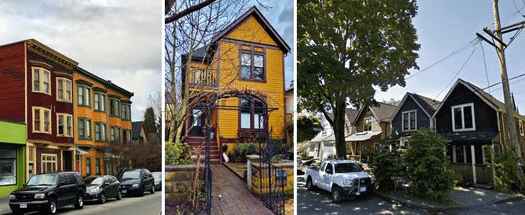
The Strathcona neighbourhood in Vancouver, the only neighbourhood zones for narrow lotsVancouver’s Strathcona neighbourhood was developed with narrow lots before Harland Bartholomew’s ideas were adopted. UBC urban geography professor Patrick Condon wants it known that in the 1960s, consequent of a state-sponsored urban renewal initiative, government sought to declare Strathcona a “slum”. David Gibson wants it known that “Strathcona was saved by the Strathcona Property Owners and Tenants’ Association (SPOTA), The Electors’ Action Movement (T.E.A.M.) Council of the early 1970s, supplemented by federal Opportunities for Youth (OFY) & Local Initiatives Projects (LIP) grants, “such that Strathcona continues to thrive to this day.

Blatantly racist development policy, intolerance, exclusive neighbourhoods where the working poor, persons with disabilities, seniors, those on social assistance, immigrants and refugees are all but forbidden from residence, and a blighted downtown neighbourhood riven with crime, hopelessness and an opioid crisis that is killing our city’s residents by the thousands — these are the critical challenges faced by our new Mayor and City Council.
A good place to start?
Undo and reverse the legacy of Harland Bartholomew, and begin anew.