Arts Friday | Are Things Getting Better For Women In Hollywood?

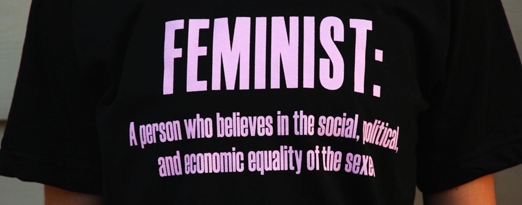
Feminist | A person who believes in the social, political, and economic equality of the sexes

From the earliest days of Hollywood, women were stage managed and manipulated by older men in powerful positions. And it remains clear that, although Harvey Weinstein, Les Moonves, John Lasseter, Luc Besson, among a host of other male predatory Hollywood executives who have been outed, little good has been achieved still for women in the film industry.
In the Hollywood dream factory, trauma surfaces as light entertainment.
In 2013, introducing the list of best supporting actress nominees during the Oscar ceremony, actor and comedian Seth MacFarlane quipped: “Congratulations, you five ladies no longer have to pretend to be attracted to Harvey Weinstein.” What was chilling was that no one got the joke. The idea that female stars and aspiring, often young, female stars are required to accept the attentions, at the very least, of older male studio executives, producers and prominent male stars, is as old as the Hollywood hills.
Given the profile that the #MeToo movement has brought to sex discrimination, why does sexism continue to prevail in Hollywood?
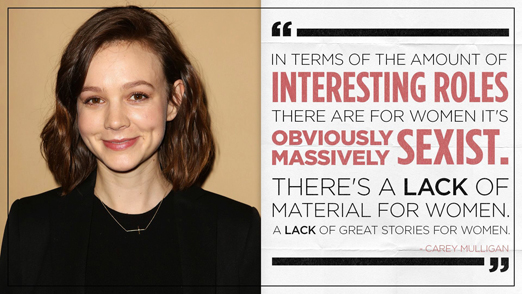
Actress Carey Mulligan on sexism in the film industry

According to San Diego State’s Center for the Study of Women in Television and Film, women made up only 7 per cent of directors on the top 250 films of 2018, which was actually a 2 per cent decline from 2017. The same study found that while women made up higher percentages of other fields in the industry — 24% of producers, or 17 per cent of editors, for example — they only accounted for 17 per cent of the workforce of all the jobs surveyed. And that too, was a 2 per cent decline from the year before.
The University of Southern California’s Viterbi School of Engineering’s Signal Analysis and Interpretation Lab (SAIL) revealed how sexism is embodied by characters on the silver screen. If female characters are taken out of the plot, it often makes no difference to the story the study found.
Analyzing 1000 scripts, the study found that there were seven times more male than female writers & twelve times more male directors than women.
The biggest impact in counteracting the gender imbalance was if female writers were present at script meetings. If this was the case, female characters on screen was around 50% greater.
Inherent in these observations of the film industry are powerful messages about what it means to be female.
In our “post-feminist” era, where we are frequently told the problems of girls are yesterday’s news — that girls are awash in the largesse of civil rights, and it is boys who really require our attention — it is worthwhile to consider the conduct of male Hollywood writers and executives.

Actress Geena Davis, founder of the Geena Davis Institute on Gender in MediaActress Geena Davis, founder of the Geena Davis Institute on Gender in Media

The problem is so glaring that in 2005, the actress Geena Davis, who would go on to start her own gender institute, commissioned Stacy Smith, a researcher at the University of Southern California, to study the issue and help push the studios beyond the staid male-centred film industry.
From 2007 through 2017, according to Smith’s research, women made up only 30.2% of speaking or named characters in the 100 top-grossing fictional films.
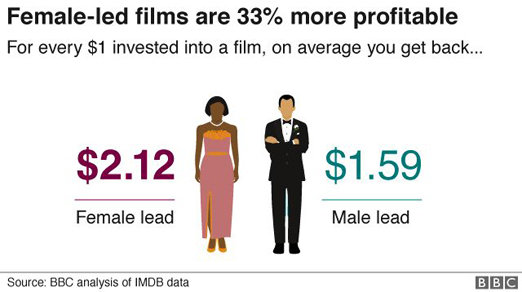
Female lead films make more money than films led by males.

The Geena Davis Institute on Gender in Media reports that films featuring women are financially profitable. “Guess what, Hollywood? Female-led films consistently make more money, year over year,” Madeline Di Nonno, the Institutes chief executive has reported to the heads of Hollywood studios.
Hollywood actor Charlize Theron has criticized the movie industry for gender bias. Promoting her film Atomic Blonde, she told feminist Bustle magazine: “Fifteen, ten years ago, it was almost impossible to produce female-driven films, in any genre, just because nobody wanted to make it.”

The Bechdel Test, the role of women in film

A quiz that was designed to find out how sexist a film might be was developed by Alison Bechdel and Liz Wallace in 1985. To pass, the film needed three positive answers to these questions: Does it have more than two named female characters? Do those two talk to each other? Is that conversation about something other than a man?
The Hollywood Reporter applied the Bechdel-Wallace test to the top-selling movies of 2018, finding that only around half of the films passed the test.

Actress-writer-director Lena Dunham, creator of the HBO series, "Girls"Actress-writer-director Lena Dunham, creator of the HBO series, "Girls"

Female directors are in what “Girls” creator Lena Dunham calls “a dark loop.” If they don’t have experience, they can’t get hired, and if they can’t get hired, they can’t get experience. “Without Googling it,” Dunham asked a recent Sundance panel, “Ask anybody to name more than five female filmmakers who’ve made more than three films. It’s shockingly hard.”
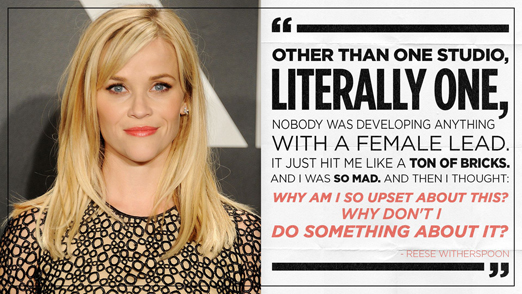
Actress Reese Witherspoon confronting sexism in the film industry

The sheer scale of rampant Hollywood sexism is daunting, the stories of what actresses have to put up with disturbing, the tales of pay inequity and pushing for more female-led stories are instructive.

Actress-writer-producer Zoe KazanActress-writer-producer Zoe Kazan, star of the Oscar-nominated film Big Sick, and writer and executive producer of the films, Ruby Sparks and Wildlife (the latter now on Netflix)

Actress Zoe Kazan (The Big Sick) told IndieWire reporter, Kate Erbland, “There’s so much sexual harassment on set. And there’s no HR department, right? We don’t have a redress. We have our union, but no one ever resorts to that, because you don’t want to get a reputation for being difficult.”
The Oscar winner and star of The Favourite, Rachel Weisz, told Out Magazine that a number of her male co-stars have taken lower salaries in order to match her own. “In my career so far, I’ve needed my male co-stars to take a pay cut so that I may have parity with them,” she said.
Actress Emmy Rossum sounded off during a recent Hollywood Reporter roundtable about her experience with overt sexism in the industry.

“I’ve never been in a situation where somebody asked me to do something really obviously physical in exchange for a job, but even as recently as a year ago, my agent called me and was like, ‘I’m so embarrassed to make this call, but there’s a big movie and they’re going to offer it to you. They really love your work on Shameless. But the director wants you to come into his office in a bikini. There’s no audition. That’s all you have to do.'”

If the dynamic of older men and younger, submissive women greases the wheels of Hollywood production offices repeats itself on screen, it is not an accident, but the desires of the producers and directors who create these films played out on the biggest stage of all: Hollywood cinema, the world’s most effective propaganda machine. Who is Hollywood trying to kid?


#VanPoli Civic Politics | Faith Groups + Affordable Housing | Part 4

City of Vancouver affordable housing graphic

Joming Lau, a City of Vancouver Planning Analyst and member of Vancouver city’s Community Serving Spaces Team, and his colleague James O’Neill, a Cultural Planner with the city, working in the Cultural Spaces and Infrastructure Division of the Planning Department — and also a member the city’s Community Serving Spaces Team — have been kind in posting to VanRamblings the core document informing the conduct of the Tuesday, May 7th, 2019 affordable housing forum held at CityLab, at Cambie and West Broadway, the document in question, the Community Serving Spaces Place of Worship [pdf] presentation paper on the development of affordable housing and community service spaces on the sites of places of worship.

In an April 1, 2019 article in the Vancouver Sun / Province / PostMedia, migration, diversity and religion writer Douglas Todd asked the question, “Can Metro Vancouver churches plug the dire housing gap?”, going on to ask a second, related question, “How big a dent will re-developing scores of places of worship into housing make in a metropolis that ranks as one of the most unaffordable in the world?”, quoting Andy Yan, director of Simon Fraser University’s city programme as saying …

“Hopefully, the redevelopment (of places of worship) is one of the steps of creating a stairway to housing nirvana in Metro Vancouver. But the scale of trying to house those on local incomes affordably is almost biblical.”

Mr. Todd goes on to report that Christian and Jewish religious groups are together adding hundreds of units each year to the region’s rental and housing market, their annual contribution sometimes exceeding 1,000 new homes, a relatively small portion of the roughly 20,000 to 28,000 homes being constructed each year across Metro Vancouver, but still an invaluable contribution of low cost, affordable housing across our region.

BOSA affordable housing development at 1155 Thurlow Street, with 45 social housing and 168 secure rental units
Approved by Vancouver City Council in 2014, completed in 2018, a partnership between Central Presbyterian Church and Bosa Properties.

In collaboration with the city, Bosa Properties and Central Presbyterian Church, at 1155 Thurlow in downtown Vancouver, set about to provide 45 social housing homes that would be owned by the church, allowing Bosa Properties to build 168 secured rental homes that would be owned by Bosa, the project including the construction of a new church (and child care centre) built for the church by Bosa — at no expense to the church — and still owned by the church, the very much needed social housing homes and the child care centre creating an ongoing revenue stream for the Central Presbyterian Church. A win-win for all concerned: city, developer & church.


Don't Miss Any of VanRamblings Must-Read Content. Click On This Graphic for More

The role of the city? To collaborate with the places of worship to secure funding — from private sources, from the federal or provincial governments through their affordable housing programmes, or in some cases through access to the city’s Community Amenity Contribution programme, which secures in-kind or cash contributions from property developers in exchange for re-zoning of the property — which pays for the entire cost of construction, the city liaising with the place of worship to establish a relationship with a non-profit or for-profit property developer / builder.

Further, the city expedites the development permit process.

From first contact with a place of worship to final completion & occupancy, an average of three years transpire, with the end result: the creation of affordable rental housing, low cost social housing, and much needed community serving spaces, such as the aforementioned child care centre.

Catalyst Community Development Society, Vancouver

The most common phrase enunciated at the Community Serving Spaces for Places of Worship forum last week was, “Robert Brown can’t do it all.”


Don't Miss Any of VanRamblings Must-Read Content. Click On This Graphic for More

Mr. Brown, the founder of the Catalyst Housing Development Society is the President of our province’s largest non-profit real estate developer, he and his team responsible for the development of more affordable rental homes on the Lower Mainland and across our province than any other British Columbia developer, allowing faith groups to unlock the value of their real estate assets, while reinvesting that value back into communities for the benefit of families, and a revenue creation stream for places of worship.


Don't Miss Any of VanRamblings Must-Read Content. Click On This Graphic for More

A key piece of altruistic advice Mr. Brown provided to faith groups at last week’s affordable housing forum: retain ownership of your property.

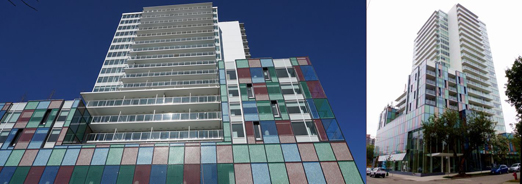
Catalyst Community Development located at 2221 Main Street, in the city of Vancouver

Here’s the bottom line: there are 364 land rich, cash poor places of worship across the Vancouver landscape. The City of Vancouver, as part of the city’s Healthy City Strategy, has set about to work with faith groups to create the conditions necessary that would result in the construction of much needed low cost, affordable housing on the under developed properties owned by faith group congregations, providing a no cost renovation or reconstruction of the aging church, synagogue or other place of worship infrastructure, while also creating a revenue stream for the faith group membership, to ensure that our city’s places of worship will continue to thrive, while serving the social and community interests of neighbourhoods across our city.

#VanPoli Civic Politics | Faith Groups + Affordable Housing | Part 3

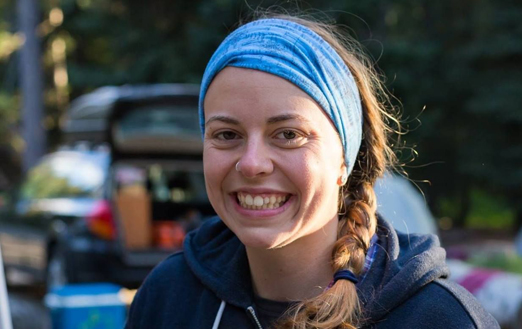
Audrey Anne Guay, Vancouver power broker, SFU Urban Studies Masters student, Chairperson of MVA Housing Leadership TeamAudrey Anne Guay, powerbroker, Simon Fraser University Masters student in Urban Studies, Chairperson of the Metro Vancouver Alliance Affordable Housing Action Team, community activist, organizer, an inspiration to all who know her & hope of our future.

THE ROLE OF THE METRO VANCOUVER ALLIANCE IN WORKING WITH FAITH GROUPS TOWARDS THE PROVISION OF AFFORDABLE HOUSING ACROSS THE METRO VANCOUVER REGION

Audrey Anne Guay, 26, arising from a research grant bestowed by Simon Fraser University for the past eight months to spearhead the Metro Vancouver Alliance’s (MVA) Affordable Housing Action Team has, this past year, emerged as one of the key figures in the continuing discussion on the provision of affordable, low cost housing in the Metro Vancouver region.

The Metro Vancouver Alliance (MVA) is a broad-based alliance of 75 civil society institutions who work together for the common good, comprised of members of 60 faith groups across our region, and representatives from 15 labour unions, including the British Columbia Government and Service Employees’ Union (BCGEU), and the Canadian Union of Public Employees.

In fact, democratic, activist grassroots MVA members (and sponsoring) organizations together represent more than 200,000 citizens across the Metro Vancouver region, and over 700,000 citizens across our province.

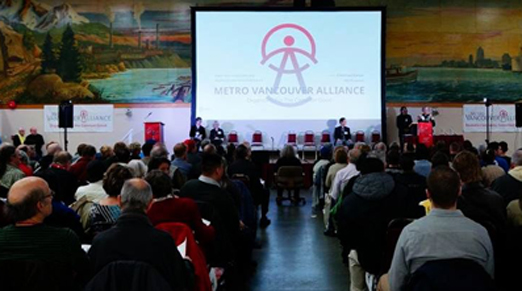
Metro Vancouver Alliance meeting on the role of faith groups who, together, are creating the conditions that will lead to the construction of affordable housing

Here is the erudite, socially conscious and, often, emotionally trenchant Ms. Guay, in her own words, on her work with MVA and faith groups across our region who, together, are creating the conditions that will lead to the construction of affordable housing across our region …

“There’s a great deal of energy in the faith-led sector to develop land owned by places of worship across the Metro Vancouver region, for the provision of low cost, affordable housing. The research conducted by MVA has provided insight into both the motivations of the faith groups, and the challenges they face.

A secondary, but still important, focus of MVA’s Housing Team revolves around the role of Community Land Trusts, arising from the successes of MVA’s sister organization in London where as just one small but significant component of the work they’ve successfully completed, involved the construction of 23 affordable homes in one of the most expensive neighbourhoods in London. The Land Trust model, going strong in Vancouver (1500 affordable homes are now under construction in Vancouver!), is of particular interest to MVA, in that it involves community leadership in developing affordable housing solutions.”

Much of Audrey Guay’s work has involved speaking with faith leaders, who may or may not be members of the Metro Vancouver Alliance, who have indicated an interest and begun a discussion on making their sites available for the building of much needed low cost housing.

In addition, over the past year, Ms. Guay has met and had in-depth discussions with city planning staffs in municipalities across the region, City Councillors, affordable housing development staff at the Pacific regional office of Canada Mortgage and Housing Corporation, various non-profit associations across the region, and community-oriented developers like Robert Brown’s Catalyst Community Developments Society, and Stuart Thomas, Simon Davie and Jim O’Dea, among other development staff, at Terra Housing.

Audrey Anne Guay is a name you will hear for years and years to come — a critical and necessary voice of change in a society in flux, and a splendidly energized and energizing difference maker, an undeniable presence in all of our lives, whether you are aware of her or not (and you should be!).

star.jpg star.jpg star.jpg

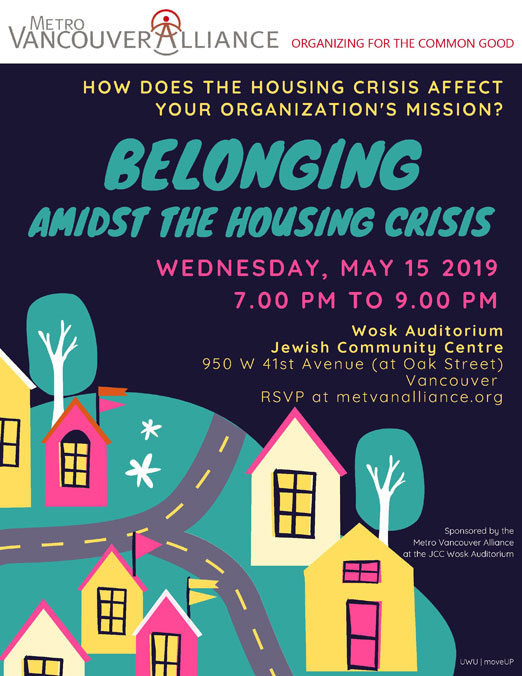
Want to gain an understanding of what’s going on in the faith-based and non-profit affordable housing development front? Well, then, your attendance at tonight’s Metro Vancouver Alliance Housing Forum is absolutely mandatory (and, it will be fun and informative!). Organized by MVA Executive Director Tracey Maynard and MVA Housing Leadership team leader, Audrey Anne Guay, information on the where and when of tonight’s critically important housing event may be found in the poster below.

The Metro Vancouver Alliance Housing Forum, at the Wosk Auditorium, Jewish Cultural Centre, May 15 2019

#VanPoli Civic Politics | Faith Groups + Affordable Housing | Part 2

St. Mark's Anglican / Trinity United Church, at 2nd & Larch in Vancouver, set to become the site of affordable housingSt. Mark’s Anglican / Trinity United Church, located at 2nd & Larch in Vancouver, is set to become the site of 63 units of ‘affordable’ rental housing, 13 units of which will adhere to the accessible and much more affordable median market / ‘moderate’ rental rate.

Places of worship in Vancouver are having a hard go of it.

Land rich but cash poor, burdened by ongoing maintenance that members can ill afford — don’t even mention seismic upgrading … it’s not as if the provincial government is going to step in and fund renovations or replacement of aging infrastructure — an ongoing, decades-long decline in membership, such that the membership lists of many places of worship hovers around 10% of the membership and attendance figures of places of worship in their heyday, way back in the spiritual 1950.

Most of the 364 places of worship in Vancouver, identified by the B.C. Assessment Authority at the request of the Community Services Division of Vancouver City Hall’s Planning Department, face a plethora of dilemmas — how to maintain the physical structure of their place of worship with the dearth of funds available to them to afford necessary renovations and upkeep, while seeking out and encouraging new and younger members to join in their aging worship community, where the average age is near 65.

The role of the modern place of worship in the life of the 21st-century citizen is critical as a place of succour and sanctuary, as a place to fill our spiritual void. If a car needs fixing, it is brought to the mechanic shop. If you’re feeling ill, your local critical care centre or hospital is where you seek medical attention. A place of worship is the place where you go to feel whole, to feel supported, to sing and join with others in spiritual endeavour.

With all the weight and pressures of the world weighing down on our minds and on our bodies, we can rightfully expect a nearby place of worship to help furnish answers to life’s questions no other institution can provide.

The title for this week’s VanRamblings affordable housing series is Faith Groups + Affordable Housing. The City of Vancouver, and the Metro Vancouver Alliance (MVA) — the latter which we will write about tomorrow — have identified a solution to the financial crunch most places of worship in our city face: with the assistance and support of the city and the fine folks involved with the MVA, and with the expertise community housing developers like Robert Brown’s Catalyst Community Developments Society are able to provide to places of worship to develop affordable housing and community services, the potential exists for places of worship to develop a stable revenue stream from the affordable housing built on their site — the cost of construction borne by the provincial and / or federal governments — while creating necessary community services for their own membership, as well as the surrounding neighbourhood community where they are situated.

A case in point is the initiative undertaken by the United Church in 2018 that will see the construction of up to 414 units of low cost, affordable homes on United Church properties across the Metro Vancouver region.

One of the United Church sites set for construction is the Lakeview United Church on Semlin Drive (just east of Victoria Drive) on Vancouver’s eastside, which upon completion will provide 100 new moderate cost rental apartments to citizens in the surrounding community, with rental rates from $700 per month and up, according to information released by the John Horgan government at an announcement ceremony in April 2018, when a commitment was made by the provincial government to spend $12.4 million to assist the B.C. Conference of the United Church of Canada in the redevelopment of church site lands located in Vancouver, Coquitlam, and Richmond (and Nanaimo), just one of many such announcements in 2018.

The affordable housing projects are part of the provincial government’s newly created “HousingHub,” which aims to broker agreements with non-profits, developers, faith groups, property owners, local and federal governments and Indigenous organizations to locate, use or redevelop land in communities where affordability is an issue.

In November of last year, the provincial government announced 72 additional affordable housing rental projects, at a cost of about $492 million, which will see the provision of 4,900 new mixed-income rental homes, set to begin construction in 2020 as part of the government’s new Building BC: Community Housing Fund, one constituent component of a current $1.9-billion provincial investment by the John Horgan government.

The provincial government has committed to building 114,000 new units of affordable “rental” housing over 10 years, in the form of co-op, rental, not-for-profit and market-based housing, the housing geared toward low – and middle-income earners, families & seniors located in 42 communities across the province. A list posted by the province in 2018 showed 29 affordable rental projects — many of which will be built on the sites of places of worship — planned for Metro Vancouver and the Fraser Valley, which will supply a total of 2,877 new homes for citizens living in these regions.

Another 20 developments are planned for Vancouver Island and the Gulf Islands, 17 for the Interior and six in the northern part of the province, many of which will be built on sites owned by places of worship. Individual buildings will contain units aimed at a mix of income levels, the province announced, and will include deeply subsidized rentals for those on fixed incomes. The housing complexes will include non-profit and co-op options.

“Years of inaction on the B.C. housing crisis left families struggling to get by and unable to get ahead,” Premier John Horgan told those present for the affordable housing announcement. “These new, affordable rental homes are an important step toward addressing the housing crisis and giving families in every part of the province a break from skyrocketing housing costs.”

Please find below a full list of the 72 affordable rental projects set to begin construction this year or next.

72 affordable housing proje… by on Scribd

In Wednesday’s instalment of this week’s faith group / affordable housing / community services series, VanRamblings will explore the role of the Metro Vancouver Alliance, which has partnered with city staff and faith groups across our region — as well as with members of Metro Vancouver’s development community — towards the provision of affordable housing.

In addition, VanRamblings will seek to provide insight into why Vancouver’s underutilized places of worship may very well emerge as a critical component in our city’s plan to build community, to address income inequality and the attendant issues of access & succour encompassing the vast majority of our city’s socially and economically beleaguered residents.