Category Archives: Vancouver Votes 2026

Kareem Allam on the Vancouver Park Board, Preserve the Elected Board

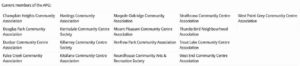
The Association Presidents Group (APG) representing 17 community centre associations across the City of Vancouver, released a statement in 2024 strongly urging Premier David Eby to “reconsider his commitment to proceeding with the elimination of the Vancouver Park Board.”

The APG says Vancouver Mayor Ken Sim’s decision is “undemocratic.”

“We do not believe 8 City Councillors can decide to abolish the Park Board elected by thousands of Vancouver citizens in October 2022,” it said, in the press release, which may be found below.

“We believe the Park Board can only be removed after a civic election in October 2026, and only if Vancouver citizens have made that choice. Neither the City nor the Province have a mandate to remove the Park Board.”

The Association Presidents Group (APG) says ABC Vancouver Mayor Ken Sim’s motion to eliminate the Vancouver Park Board was announced and passed in a week without any engagement with the APG organization and other key stakeholders.

“There was no transition plan to demonstrate the alleged benefits of such a decision. The reasons announced have been questioned by many stakeholders including dozens of former Park Board Commissioners and Community Centre Associations,” said representatives with the Association Presidents Group.

Vancouver’s independent and elected Board of Parks and Recreation has served Vancouver for over 135 years. Vancouver is the only city in Canada with an elected Park Board and is the only city in North America other than Minneapolis to place its focus on growing a vibrant parks and recreation system as a constituent element to the citizens served by the municipal governments in both cities — up until the untoward December 13, 2023 decision by Vancouver Mayor Ken Sim and his super majority team of ABC Vancouver City Councillors.

VanRamblings reader Mara writes to correct some of the information above …

MANY cities in the United States have elected park boards including: Tacoma (Washington State), Bainbridge Island (Washington state), Bend (Oregon), Willamalane (Oregon), Simi Valley (California), Three Rivers Park District (Minnesota), and over 350 cities in Illinois (Naperville, Joliet, Rockford, Springfield are the big ones, but there are 350 others), and nearly every city in North Dakota (Fargo, Bismarck, Minot, Williston, others). There are also elected park districts in northern California, Montana, Colorado, Florida, West Virginia, New York state, and Massachusetts.

In Canada, Cultus Lake in British Columbia has an elected park board.

I say this because Vancouver IS NOT an outlier. It needs to keep its independently-elected park board, but people need to realize it’s one of many. If you keep repeating Ken Sim’s lie about Vancouver being an oddity, it feeds into his narrative.”

Thank you, Mara. At the moment, for some, the Contact VanRamblings function on the site is not working. We are working on resolving that issue.


Preservation of an Elected, Independent, Responsive Vancouver Park Board 

Here’s the Association Presidents Group Press Release 

The Association Presidents Group (APG) believes Vancouver Mayor Ken Sim’s attempt to abolish the elected Vancouver Park Board is undemocratic.

We do not believe 8 City Councillors can decide to abolish the Park Board elected by thousands of Vancouver citizens in October 2022. We believe the Park Board can only be removed after a civic election in October 2026, and only if Vancouver citizens have made that choice.

Neither the City nor the Province have a mandate to remove the Park Board.

Mayor Sim’s motion was announced and then passed within one week without any engagement with the Community Centre Associations and other key stakeholders. There was no transition plan to demonstrate the alleged benefits of such a decision. The reasons announced have been questioned by many stakeholders, including dozens of former Park Board Commissioners and Community Centre Associations.

The elected Park Board has served Vancouver well for over 135 years.

Voters created an elected Park Board because they wanted parks and recreation to be a high-profile priority in Vancouver. Commissioners run for office because they are passionate about protecting and expanding our parks and recreation programmes. It is their priority concern and responsibility.

The Mayor’s proposal would have Commissioners replaced by City Councillors who have a multitude of responsibilities resulting in a less responsive and effective working relationship for community stakeholders. City parks and recreation will not be the first priority for City Councillors.
The APG rejects the Mayor’s claim that the Park Board is broken.

We believe it has been critically underfunded by City Council for several decades.

Many of the examples cited by the Mayor for the elimination of the Park Board are in fact already the City of Vancouver’s responsibility. They own and maintain the buildings and infrastructure in the Park Board system.

For example, Park Board frequently recommends renewal and expansion of Community Centres for additional space to accommodate children’s programmes but it is City Councillors who decide on the funding. Parents complain that programme spaces for their children are inadequate. Those concerns should be directed to City Hall.

A decision to eliminate the elected Park Board must be determined democratically in the next municipal election if it remains part of the ABC platform. Let the voters of Vancouver make such an important decision.

Sign the APG Petition asking the Premier not to eliminate Park Board.


For more information please contact either of the following APG members:

(copy and paste either or both of the following e-mail addresses into your e-mail programme)

Jerry Fast <jerryfast@shaw.ca>

Kathleen Bigsby <kmbigsby@gmail.com>


The Auditor General’s Report released yesterday on his audit of recreation facility asset management at the Vancouver Board of Parks and Recreation (Park Board) and City of Vancouver (City).

The Report, as submitted by Mike Macdonell, Auditor General reads in part …

“The Park Board manages 24 community centres, 14 pools and eight indoor rinks, which are owned by the City, with responsibility for maintenance shared between the Park Board and City departments. The audit determined that these facilities were not effectively managed to align with strategic goals, meet service level priorities and optimize asset lifecycles.

The 46 recreation facilities included in the audit have an estimated infrastructure funding deficit of $33 million per year, which is part of the City’s significant overall infrastructure deficit of $500 million per year.

Many of the Park Board facilities’ building systems have been extended well beyond their intended useful life. As of 2022, the City’s data showed that 72% of recreation facilities were in poor or very poor condition, from an asset management perspective, based on the cost of required repairs and maintenance relative to the facility’s replacement value. Although the lower rating does not mean that facilities are unsafe, these assets generally cost more to maintain, repair or improve and are closer to requiring renewal.

The Park Board and the City aimed to improve the condition of recreation facilities so that 70-80% were in good or fair condition by 2050. However, there were no agreed-upon facility asset management investment plans to fund such a significant increase in condition.

The audit found that the City did not have a Council-approved policy or strategy, or a formalized capital asset management framework, to guide asset management planning for recreation facilities and ensure consistent alignment between community expectations, service delivery targets, and the maintenance strategies needed to support them.

The City provided building maintenance services to the Park Board guided by an agreement created in 2014, but the audit found there was no operating level agreement that defined respective Park Board and City staff responsibilities.

The agreement also did not define accountability or reporting requirements from the City to the Park Board for its provision of asset management services. The audit found that Park Board Commissioners did not receive consolidated information on asset-related service levels, performance indicators and funding scenarios to support their responsibility to oversee recreation asset management.”

VanRamblings believes that preserving our elected Park Board is critical for the livability of our city, to continue to prioritize the high quality of service provided to us by our community centres, pools and hockey rinks, and the maintenance of Vancouver’s more than 400 parks for the ongoing enjoyment of Vancouver citizens.
Crypto, The Scam Currency Championed by Vancouver Mayor Ken Sim

Cryptocurrency promised a democratized financial future.

In practice, it functions like a casino wrapped in techno-mystique — ideal for laundering money and enriching insiders.

The Financial Action Task Force (FATF), the world’s Anti-Money Laundering standard-setter, warns that without strong rules, “virtual assets … risk becoming a safe haven for the financial transactions of criminals and terrorists.”

FATF Chainanalysis traces tens of billions in tainted money each year — its 2025 report estimates illicit crypto addresses received about $40.9 billion in 2024 (likely nearer $51 billion once all is identified). FATF Chainalysis has issued red-flag indicators and repeated calls for tougher global action precisely because criminals employ crypto to launder funds.

Crypto’s core economic claim — “value” — is equally shaky, fraudulent even.

The Bank for International Settlements writes bluntly that crypto assets “have no intrinsic value and lack a backing authority,” making prices prone to sudden swings. Bank for International Settlements reviewers have long argued they are “akin to a commodity money (although without any intrinsic value in use).” That hollowness fuels boom-and-bust cycles in which sophisticated players harvest gains while latecomers eat losses, the ultimate Ponzi scheme.

Who actually wins?

Not the many, but the whales (the very very wealthy, the 1%). Academic work and regulators document extreme concentration: the top 10,000 Bitcoin holders controlled a massive share of supply, revealing “participation … still very skewed toward a few top players, which is to say, the wealthy one per cent.” Such concentration means market moves are often dictated by a tiny cohort of the very wealthy, who can move liquidity and sentiment at will — hardly a people’s money.

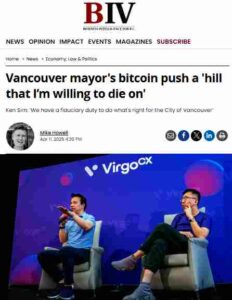
Against this backdrop, Vancouver’s Mayor Ken Sim has championed making the city “Bitcoin-friendly,” even floating paying municipal property taxes and holding reserves in Bitcoin — “a hill I am willing to die on,” he told Business in Vancouver’s Mike Howell this spring while awaiting a staff report.

BIV reporting in December 2024 detailed his motion to explore accepting Bitcoin for taxes / fees and investing a portion of city reserves. Tying essential public revenues to an asset class that lacks any intrinsic value is fiscal brinkmanship, not innovation. (Bank for International Settlements)

Crypto currency certainly doesn’t serve the interests of the citizens of Vancouver.

The pattern is clear: a system tailor-made for obfuscation — bafflement, bewilderment, mystification, puzzlement — celebrated by a wealthy minority that profits from volatility, and promoted as “the future” despite watchdogs’ alarms.

When the smoke clears, crypto looks less like finance for the many and more like a high-risk conduit for the few — plus a convenient money laundering tool for the criminal underworld.

And this is the fraudulent “currency” Mayor Ken Sim champions?

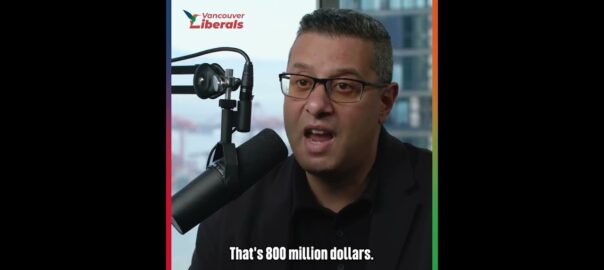
Vancouver’s Next Mayor | Kareem Allam | Priorities | Cancel Ken Sim’s $800 Million City Hall Campus

A Note from Kareem Allam, Vancouver’s Next Mayor

I am seeking the nomination of the Vancouver Liberal Party to be the next Mayor because I think I can do a better job.

As I prepare to launch, I am reaching out to my friends to donate to ensure my campaign has the best launch possible.

I’m running because we need to fix the mess at City Hall.

Vancouver should be a place young people flock to — for great careers and to raise their families. It needs to be more affordable with great public services that just work for people.

And on great services … this week I announced on Day One the Vancouver Liberals would requisition 400 more frontline workers, and we will pay for it by ending the practice of hiring management consultants and managers … who do nothing more than manage other managers.

I want a new rule at City Hall: if it doesn’t help bring young people back, make life more affordable, improve city services, or keep people safe, we’re not doing it.

Period.

So many people have stepped forward to offer their help, to volunteer to run for office, to offer smart ideas to make our city better. You’re one of them — and so I’m writing to ask for your help:

  • Donate as much as you’re able today. You can give as much as $1,402.40 – but whatever you can contribute today will help.
  • Get involved. You can sign up at VancouverLiberals.com — let us know you want to be a part of this project.

Thank you so much — more to come.

— Kareem

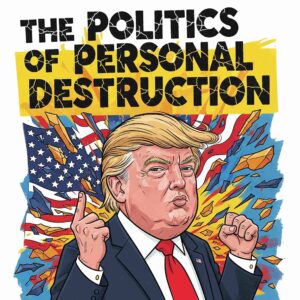
The Politics of Personal Destruction in Vancouver

In Vancouver, the politics of personal destruction has long been stock and trade for those running for office. In a city where political competition is fierce and civic identity is fragmented across 23 neighbourhoods, campaigns often take the shape of contests not about ideas, but about the destruction of personalities.

For instance, on March 20th, 2020, when Mayor Kennedy Stewart called for a cessation of in-person meetings in Vancouver City Hall’s Council chambers, due to the outbreak of COVID-19, Councillor Pete Fry allegedly tweeted out an untoward comment about a fellow Councillor. This alleged tweet was allegedly directed at then City Councillor Colleen Hardwick.

When VanRamblings’ friend Joseph Jones filed a formal complaint with the office of the City Manager respecting Councillor Fry’s alleged injudicious “mean” tweet, the City replied in an e-mail that, as a third party, he did not have any standing, and therefore his complaint could not be accepted, nor acted upon.

Vancouverites know well the stories of politicians torn apart not by their policies or their vision, but by narratives manufactured and circulated for the purpose of ensuring their defeat. Former Vancouver City Councillor Colleen Hardwick is the candidate for office most often subject to personal attacks by her political opponents. In these latter days of his time as Mayor, Ken Sim runs a close second.

The politics of personal destruction is not new. Its roots can be traced back through centuries of democratic life, from pamphleteers in the 18th century to the tabloids of the 20th. Yet in recent years, the vitriol has intensified.

Donald Trump’s entrance into politics a decade ago supercharged a cultural shift: insult, ridicule, and character assassination became normalized as the central tools of political combat. What began as spectacle in the United States has since migrated north, settling into Canada’s civic politics with troubling force.

Vancouver, far from immune, has absorbed this toxin into its bloodstream.

The dynamic plays out in every election cycle. Local media, amplified by social media platforms, frame candidates in terms of their weakest or most controversial qualities. What might once have been a gaffe becomes a defining feature. A poorly worded sentence becomes a character flaw. A photo from decades past resurfaces as proof of hypocrisy or malice. The candidate’s ideas are eclipsed; the person becomes the story. And in a political environment as fragmented as Vancouver’s, where candidates often win office with a fraction of the vote, tearing down opponents is more effective than inspiring broad-based support.

The consequences are corrosive. At the civic level, Vancouver faces enormous challenges: a housing affordability crisis, an opioid epidemic, climate pressures, and deepening inequality. Addressing these issues requires serious debate, collaboration, and — above all— public trust in political leadership.

Yet when the political arena becomes consumed by personal attacks, trust evaporates. Politicians no longer seem like public servants but more like caricatures, defined only by the accusations lodged against them. Voters, in turn, grow cynical and disengaged. Democracy shrinks when citizens come to see politics not as a space for collective problem-solving but as a blood sport where the only winners are those most adept at tearing others down.

This dynamic does more than corrode public trust; it also drives away talent.

Who, knowing the ferocity of political campaigns, would willingly step forward?

For every candidate who accepts the risks, there are others who quietly decline.

Community leaders, business people, academics, and activists who might bring fresh perspectives to City Hall weigh the costs of public humiliation against the potential rewards of civic leadership — and they walk away.

The result is a narrowing of the pool of candidates, leaving the field to those willing to endure or even to participate in destructive politics. In this way, the politics of personal destruction perpetuates itself.

The media plays an undeniable role. The incentive structures of journalism reward conflict, scandal, and controversy. A headline about a candidate’s vision for neighbourhood development rarely generates as much attention as one about a candidate’s personal misstep. Social media amplifies the dynamic, rewarding the sharpest, most caustic takes with likes, retweets, and viral circulation.

In Vancouver’s polarized civic politics, with factions aligned around housing, development, and ideological identity, these attacks are not just tolerated but often celebrated by supporters eager to see opponents discredited.

Yet the responsibility does not lie solely with media or candidates. Citizens, too, play a role in perpetuating the culture of personal destruction. By consuming, sharing, and rewarding negative content, voters enable the very dynamics that undermine our democracy. It is easier, in some ways, to join the pile-on than to engage thoughtfully with the complexities of policy.

The digital age has made outrage a form of social currency, and too often Vancouverites spend it freely.

But the politics of personal destruction is not inevitable.

Cities like Vancouver thrive not when they are divided, but when they are connected — when residents and leaders alike focus on building bridges rather than tearing one another down. The challenges Vancouver faces are collective ones, and they demand collective solutions.

The housing crisis will not be solved by discrediting the character of those who hold office; it will be solved by debate, compromise, and innovative policy. The overdose crisis will not be solved by mocking the missteps of political leaders; it will be solved by compassion, evidence-based strategy, and political will.

Towards building a better society, our job as citizens, as political candidates, and as journalists ought to be to resist the destructive instincts that have come to plague politics. We must choose instead to elevate the conversation. That means expecting better of our leaders, but also of ourselves. It means seeking common ground in our city’s diverse neighbourhoods, acknowledging difference without demonizing those who hold it. It means holding candidates accountable for their ideas and actions, not for caricatures drawn by their opponents.

If Vancouver is to be a city worthy of its promise, it must move beyond the politics of personal destruction. It must embrace politics as an act of community-building, not community-breaking.

Each of the 23 neighbourhoods that make up our city deserves leadership that is respected, even when it is contested. Each citizen deserves a politics that invites them to participate, not one that drives them away in disgust.

The politics of personal destruction has been with us for too long, but it need not define our future. In Vancouver, a city of breathtaking landscapes and vibrant communities, our city by the sea, we can and must choose a different path: one of conscience, common ground, and collective purpose.