
br>Starting on the top left: The Cinematic Orchestra, Brooke Fraser, Azure Ray, Love, Allison Moorer (in the middle), Andy Gibb, Bebel Gilberto, Crash Test Dummies, and Billie Eilish.
Today on Music Sunday, a chill 9-song Spotify playlist of some of my favourite laid-back songs, spanning the years from 1967 (that’d be the American group Love’s Alone Again Or, written by band member Bryan MacLean) right up until present day, with Billie Eilish’s, I Love You.
The various artists span the globe, from New Zealand singer-songwriter Brooke Fraser — with whom I became acquainted one autumn day in 1997 when walking into a neighbourhood consignment clothing store — where, of course, I purchased a great new sweater, the young woman behind the counter a recent Kiwi emigré, who was more than happy to share her love of Ms. Fraser’s music with me; Brazil’s Bebel Gilberto, singing a song originally recorded by her then 24-year-old step-mother Astrud, in 1965; plus a lo-fi jazz song from Britain’s The Cinematic Orchestra, featuring Québéçois singer-songwriter Patrick Watson on vocals; a song by Australia’s Andy Gibb; and music from Alison Moorer, raised in the southern U.S., which is where Azure Ray’s Orenda Fink and Maria Taylor hail from; and, from Canada, the Winnipeg-based Crash Test Dummies, Brad Roberts on vocals; and last but not least, the incomparable chanteuse, Billie Eilish.
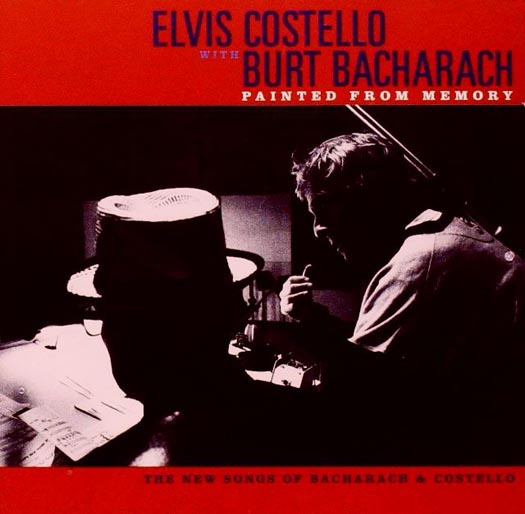
The perfectly matched, heartbreaking, heavenly collaboration between Elvis Costello and Burt Bacharach, Painted from Memory, the pop-music masterpiece, was released on the 29th of September 1998 — slightly old-fashioned, yet insistently clear and capable of flooding the heart with all the awful beauty of love’s highs and lows … mostly lows … “In the darkest place,” it all begins, “I know that is where you’ll find me” — remains to this day one of my favourite albums ever, one I go back to again and again.
The people we meet on the album who move through these 12 perfect pop songs aren’t teenagers tasting first-love tears.
They’re grownups who know what they’ve done to themselves, their hearts broken, who are now enveloped in a realm we’ve all visited from time to time, a dimension where time ticks away just a bit more slowly and the world passes by at a remove. They are displaced and disconnected, seen only in fine silver frames, distant cities or watching from afar. They live in empty houses, waiting for sleep to come to take them somewhere else, and all this they do to music meticulously crafted by two experts of the form.
Neither producer Burt Bacharach nor composer Elvis Costello is a stranger to collaboration, but together they are a singular pairing, as Costello brings discipline and edge to Bacharach’s lush melodic outpourings, while Bacharach returns the favour by setting Costello’s exacting progressions and taut wordplay in soundscapes that are both intricate and silky smooth.
Take, as a spectacular example, the gorgeous ballad What’s Her Name Today?, a Costellian pondering on the ruin brought about by those in pain that’s not so much backed by Bacharach’s purposeful grand piano as admonished — you’re a fool it declares, before sweeping up the whole affair into a whirlwind of strings and human wreckage.
Other times, they’re more sympathetic, deploying Bacharach’s famous mellow trumpet to harmonize with the vocals on the tricky tale of infidelity Toledo, or winking at the conceit of The Sweetest Punch by threading the tune with chimes, a lovely instrument you have to hit, with mallets.
In the song above, the horns say a little prayer, below … the bells chime.
The sum of this artistic one + one is more than strictly musical. By coming together when they did, each man underwent a kind of recalibration whereby the sheen of kitsch acquired by Bacharach’s body of work since his ’60s heyday was stripped away, and Costello, then in his mid-40s, shed the last lingering remnants of his image as an angry young man.
In turn, Painted from Memory itself became a bridge, connecting classic works of love and loss — think Frank Sinatra’s ninth studio release, 1955’s concept album, In the Wee Small Hours — to the wave of pop-jazz new schoolers (Norah Jones, Michael Bublé) that followed closely in its wake.
Costello and Bacharach know that opening yourself up to the sentimental side of life exposes you to its cruelties as well; it takes courage, so Painted from Memory concludes with a plea for fortitude and grace. God Give Me Strength — which they wrote over the phone lines — is the first of the pair’s dual efforts and it remains one of the best, an achingly gorgeous last-stand waltz through the end stages of grief. “That song is sung out,” it concedes, “this bell is rung out.” Except that it isn’t, because there’s something in all of us, the part Painted from Memory renders so well, that will always wait for the bell to ring. That damned, beautiful bell.
All animation, whether it depicts a whistling mouse, a walking dinosaur, or a leaping superhero, is a kind of magic trick. It’s right there in the name of one of the earliest devices used to project slides: the magic lantern.
If you take an image of an open hand and an image of a fist and project the two in sequence, you’ll convey the illusion of a clench.
“What happens between each frame is more important than what happens on each frame,” Scottish-Canadian experimental animator, the late Norman McLaren — a director and producer with the National Film Board of Canada (NFB), and a respected pioneer of hand-drawn animation and drawn-on-film animation — once explained, stating that ‘Animation is the art of manipulating the invisible interstices between frames.”
Arising from VanRamblings’ coverage this week of the meaning behind the majority BC NDP win in the recent provincial election, we failed to make mention of International Animation Day — which occurred this past Wednesday, October 28th — celebrated by the National Film Board of Canada through the streaming of 12 films, all of which are permanently available now – for free viewing – on the National Film Board website.
As Mercedes Milligan wrote this past Tuesday in Animation Magazine …
Now in its 14th year, this annual NFB event gives Canadian audiences the opportunity to explore a host of new works by Canadian and European filmmakers working in the National Film Board’s cutting-edge, internationally renowned studios. The rich 2020 selection puts women in the spotlight — both female directors and strong female characters — and features a wealth of different animation techniques.
</ br>Vancouver-based animator Ann Marie Fleming’s new animated short, Old Dog
Made by world-renowned animators, the outstanding animated films in this year’s International Animation Day programme have won prestigious awards and screened throughout the global festival circuit.
Long one of VanRamblings’ favourite arts and culture writers, Katja De Bock is now a publicist with the NFB (lucky, lucky them!). Here’s what she wrote to VanRamblings earlier in the week on one particular film she cherishes …
Old Dog, the latest film by Vancouver’s Ann Marie Fleming, started off as a way of talking about aging, inspired by Ms. Fleming’s namesake, Ann-Marie Fleming, whom she often gets mixed up with in Internet searches.
Ann-Marie has a company in 100 Mile House, B.C., that makes technologies for aging dogs, and also for their humans. Animator Ann Marie was struck by the compassion her namesake has for these vulnerable animals, as she helped them to navigate the latter stages of their lives, and by how much dogs have to teach human beings.
The COVID-19 pandemic made Ms. Fleming (the animator), whose elderly parents live overseas, reflect on how we take care of our elders and how our global values are being put to the test.
According to Ann Marie, animation is the perfect medium to tell this story. It makes the experience of the human and the dog more universal and helps us understand the unbearable lightness of being.
Now, as it happens Ms. De Bock informs us — and now, you — Old Dog is also featured at this year’s SPARK Animation Festival in Vancouver — which, by the way, began yesterday, and is set to run through Sunday, November 8th, and in addition to films will feature workshops, panels and talks by the world’s most talented artists, directors, and studio luminaries.
This year’s SPARK Animation Festival pass is only $25 — which will give you access to the dozens of films SPARK has on offer in 2020.
Guess what VanRamblings is going to be doing for the next nine days!
On Arts Friday, VanRamblings will leave you with this special treat …
On this post election Sunday, a needed and necessary break from politics.
Last Sunday, October 18th, would have been beloved American singer-songwriter Laura Nyro’s 73rd birthday, born Laura Nigro on that date in The Bronx, New York. Ms. Nyro passed far too early on Tuesday, April 8, 1997.
Years ago, for me, one of the great joys of my life was playing the breadth of Laura Nyro’s music library during my regular afternoon shift on Simon Fraser University’s CKSF radio, when I was in love with her music, and simply couldn’t get enough of the albums she released, and I softly spun.
br>Laura Nyro, the song Up on the Roof, from her 1970 LP Christmas & The Beads Of Sweat
A bit of background on Ms. Nyro: As a child, she spent summers in the Catskills with her family, where her father played trumpet at various resorts. She credited the Sunday school at the New York Society for Ethical Culture with providing the basis of her education; she also attended Manhattan’s High School of Music & Art. While in high school, she sang with a group of friends in subway stations and on street corners.
Her father Louis Nigro’s work brought him into contact with record company executive Artie Mogull, and his partner Paul Barry, who in 1966 auditioned a young Laura Lyro, then all of 20 years of age, subsequently going on to become her first manager. Mogull then set about to negotiate a recording and management contract for his young protégé. On November 29, 1966, Laura Nyro released her début album, More Than a New Discovery, for the Verve Folkways label. A song from the album, Wedding Bell Blues / Stoney’s End became a minor hit for Nyro, especially on the west coast.
Later, other songs from the album became hits for The 5th Dimension, Blood, Sweat & Tears, and Barbra Streisand.
On Saturday, June 17, 1967, Laura Nyro appeared at the Monterey Pop Festival. Soon afterwards, impresario David Geffen approached Mogull about taking over as Nyro’s agent. Geffen became her manager, and together the two established a publishing company, Tuna Fish Music, under which the proceeds from her future compositions would be divided equally.
Geffen also arranged Nyro’s new recording contract with Clive Davis’ Columbia Records, and purchased the publishing rights to her early songs.
The new contract allowed Nyro more artistic freedom and control. In 1968, Columbia released Eli and the Thirteenth Confession. Eli was followed in 1969 by New York Tendaberry, another highly acclaimed work which cemented Nyro’s artistic credibility. Nyro’s fourth album, Christmas and the Beads of Sweat, was released at the end of 1970. The set contained Upstairs By a Chinese Lamp and Been on a Train (one of my all time favourites), and featured Duane Allman and other Muscle Shoals musicians.
In the early 70s, there was no greater reflection to be had on a rainy autumn afternoon up on the fog-bound hill at Simon Fraser University than to be snugly sequestered, and warm inside the tiny broadcast studio at CKSF, lights down, experiencing Laura Nyro’s melancholy Been on a Train.
The following year’s album release, Gonna Take a Miracle was a collection of Nyro’s favourite “teenage heartbeat songs”, and was recorded with the blues vocal group Labelle (Patti Labelle, Nona Hendryx, and Sarah Dash).
In 1976, Ms. Nyro released an album of new material, Smile, after which she embarked on a four-month tour with a full band, which resulted in the 1977 live album Season of Lights. After the 1978 album Nested, recorded when she was pregnant with her only child, she again took a break from recording, this time until 1984’s Mother’s Spiritual.
Between 1968 and 1970, a number of artists had hits with her songs: The 5th Dimension with Blowing Away, Wedding Bell Blues, Stoned Soul Picnic, Sweet Blindness, and Save the Country; Blood, Sweat & Tears and Peter, Paul and Mary, with And When I Die; Three Dog Night and Maynard Ferguson, with Eli’s Comin’; and Barbra Streisand with Stoney End, Time and Love, and Hands off the Man (Flim Flam Man). Nyro’s best-selling single was her recording of Carole King’s and Gerry Goffin’s Up on the Roof.
Laura Nyro’s final album release, Walk the Dog and Light the Light came in the late summer of 1993, with the song, Oh Yeah Maybe Baby. I remember going down to Zulu Records, when it was located at the corner of 4th and Burrard, with my friend J.B. Shayne, who all but took my hand as he led me into the store, and to the bin where Walk the Dog and Light the Light lay, the album becoming the soundtrack of my life in 1993.
Nyro passed away April 8, 1997, at the age of 49.
She was posthumously inducted into the Songwriters Hall of Fame in 2010, and into the Rock and Roll Hall of Fame in 2012.