Category Archives: Politics

American Dream Heads Overseas
People are Talking About A Job-Loss Recovery

KERRY
Democratic presidential candidate John Kerry speaks to United Auto Workers
members during a campaign stop where he received the UAW endorsement


John Kerry, the U.S. Democratic presidential candidate, took dead aim at President George W. Bush’s economic record yesterday, as he unveiled his first major policy proposal since winning his party’s nomination last week.
The senator from Massachusetts told a partisan crowd in Detroit that if he is elected President he would enact changes to the tax laws aimed at reversing the trend of U.S. companies shipping jobs to other countries — commonly referred to as “outsourcing” — telling those assembled that he would “end the tax policy allowing companies to defer U.S. taxes on profits made in other countries.”
The Democratic nominee said his tax reform plan would help him create 10 million jobs over four years.

Continue reading American Dream Heads Overseas
People are Talking About A Job-Loss Recovery

Hear and Read the Full Testimonies at the 9-11 Commission Hearings

911

Audible.com has thankfully seen fit to offer free audio of the 9-11 Hearings, currently being held in Washington, D.C.
The testimonies of U.S. Secretary of State Colin L. Powell; Secretary of Defense Donald H. Rumsfeld; Clinton administration representative to the United Nations and then, in late 1996, Secretary of State Madeleine K. Albright; counterrorism director in White House administrations from Reagan through George W. Bush, Richard A. Clarke; national security adviser to the Clinton administration Samuel L. Berger; and former Secretary of Defense William S. Cohen, among others, have been made available.
Thanks, again, to Debra Galant for pointing us to Audible.com.

God Created The World In Seven Days
A Few Days Later, the Corporation Came To Be

nafta_gassing.jpg
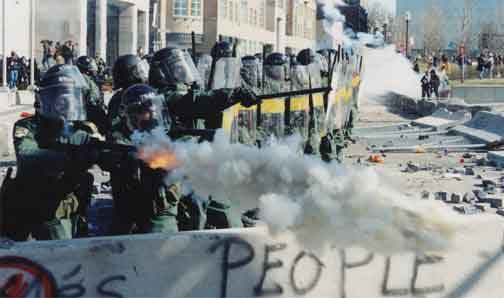
Anti-NAFTA protestors are gassed at a WTO rally in Montréal

A decade ago the North American Free Trade Agreement (NAFTA) burst onto the scene in North and Central America. The complex trade pact between Canada, the United States and Mexico has become a perennial issue of quite heated debate during, and between elections, in all three countries, and its initial ratification ignited vocal dialectical deliberation.
But amid the din of voices fighting to be heard in the struggle something was missed. Overlooked by NAFTA opponents and proponents alike, and something virtually ignored in deliberations on the agreement, was one inconspicuous provision: Chapter 11. In essence, Chapter 11 spells out the terms under which multinational corporations can be compensated (with our tax monies) for losses incurred by government expropriation.
If a government wants to build a highway or sports arena and your home happens to be in the way, the government can force you out but they have to compensate you for your loss. Chapter 11 recognizes this precedent and goes much further.
Under Chapter 11, the signatory nations are prevented from “directly or indirectly nationaliz[ing] an investment” or taking measures “tantamount to nationalization or expropriation”, and therein lies the distinction. By expanding government responsibility for compensation beyond direct takings, the architects of Chapter 11 enabled foreign corporations doing business in Mexico, Canada, or the U.S. to seek reimbursement for any government law, rule, or regulation that impinges upon the company’s profits. This represents a significant departure from past practice.
Dan Seligman, director of the Sierra Club’s Trade Programme, argues that Chapter 11 may lead to a “fundamentally different world in the degree of power corporations hold on democratic governments.”
Ontario attorney Todd Weiler has created a web site where you can obtain information about NAFTA investor-state dispute settlement, obtain copies of recent NAFTA Claim documents, and contact an appropriate person in order to learn more about bringing a NAFTA investor-state claim.
For more background, read Justin Gerdes’ article on the Environmental News Network web site, and for an even more detailed understanding of NAFTA, have a look at the full text of the NAFTA agreement.

Condoleezza Rice’s bad week

RICE
National Security Advisor Condoleezza Rice sits across from President Bush, meeting with his Cabinet and advisors, on Sept. 15, 2001, at Camp David, Md.

Bush’s national security advisor dodged the 9/11 commission, but she can’t evade its judgement. In an article written by Martin Sieff for Salon magazine, he reports that the Bush administration’s former counterterrorism chief, Richard A. Clarke, told the commission investigating the 9/11 terrorist attacks that only a week before the attacks he had sent Condoleezza Rice a powerful and prophetic letter warning of the danger that hundreds of Americans could die in a terrorist strike.

“You urge policymakers to imagine a day after hundreds of Americans lay dead at home and abroad after a terrorist attack and ask themselves what else they could have done. You write this, seven days before 9/11?” former Democratic Rep. Tim Roemer asked Clarke in a nationally televised open session of the commission.
Clarke tersely confirmed he had sent the letter with a single word, “Yes.”

The New York Times reports in tomorrow’s paper that “under mounting pressure from Democrats about its response to the investigation into the Sept. 11, 2001, attacks, the White House offered Thursday to have Condoleezza Rice, the national security adviser, answer more questions from the Sept. 11 panel,” while Times’ columnist Bob Herbert takes the Bush White House to task for their failure to respond appropriately to 9/11, stating that “the U.S. never pursued Al Qaeda with the focus, tenacity and resources it would expend — and continues to expend — on Iraq.”