Category Archives: Politics

20 Things About Condie That You Probably Didn’t Know


RICE


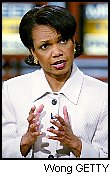
Condoleezza Rice is having a very bad week. Not only did she have to place herself in the role of Bush apologist, for failing to act to stem the terrorist threat prior to 9-11, as well as have to respond before the 9-11 Commission to former counterterrorism director Richard A. Clarke’s allegation that he had warned Rice about an “imminent threat” of a catastrophic attack months prior to 9-11, this week former Senator Gary Hart and co-chair of the U.S. Commission on National Security told the Commission that on January 31, 2001, he had handed Bush and Rice a report, from his bi-partisan panel, which warned of a “devastating terrorist attack on America.”
But, according to Hart, the Bush administration never followed up on the commission’s urgent recommendations, even after he repeated them in a private White House meeting with Rice just days before 9/11.
VanRamblings asks: Connie, oh, Connie, where did you go wrong in your just shy of 50 years of life on this planet? In an effort to humanize the embattled Bush administration National Security advisor, reader Daryl Magnuson sends along this set of interesting “facts” about Rice.
Read ’em and weep.
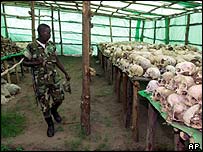
Ten Years On, Rwanda Seeks Lessons From Genocide


RWANDA


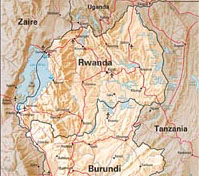
an item posted below on the upcoming 10th anniversary remembrance of the death of Nirvana lead singer Kurt Cobain — Michael wonders why it is that the almost exclusive media focus on the history of a decade ago centres on the death of a rock musician, to the exclusion of a remembrance and reflection on the mass genocide which took place in the tiny Central African country of Rwanda, around the same time of Cobain’s passing.


RWANDA800


800,000 people were killed
in the Rwandan holocaust

In 1994, one of the most appallingly intensive killing campaigns in human history — possibly the most intensive — took place in 100 days of genocide that the outside world did little to prevent. Many of the majority Hutu (about 85% of the population) turned on the Tutsi (about 12% of the population) and moderate Hutu, killing an estimated 800,000 people.
Gendercide provides this case study on the Rwandan holocaust, while BBC News publishes this report on the more than 100,000 genocide suspects who remain in Rwandan jails awaiting trial.
Update: Sent in by reader Alison Fitch, this story from the Globe and Mail, a feature on how the Hutus tortured Athanasie Mukarwego’s husband to death and then told her: “You, we will kill with rape.” For the three horrific months that followed, literally hundreds of them tried to do just that. As Rwanda prepares to mark the genocide’s 10th anniversary, she can’t forget but “I have to forgive, so things are different for my children.”
Also, in production, The Guardian reports that filmmaker Raoul Peck’s Sometimes in April has set out to “recreate the killing zones to reach beyond cliche of ‘never again’.”

White House Knew About Pending Al-Qa’ida Attack on U.S.

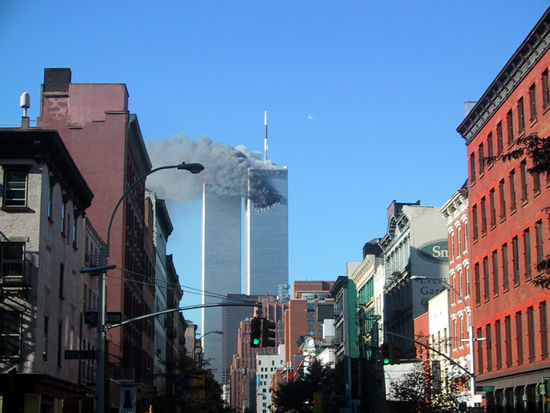
9-11STREETSCAPE
The aftermath of 9-11 still felt today, as Bush White House attempts to thwart investigation

“I saw papers that show the U.S. knew al-Qa’ida would attack cities with aeroplanes.” — Sibel Edmond, employee of the FBI

A former translator for the FBI with top-secret security clearance says she has provided information to the panel investigating the September 11 attacks which proves senior officials knew of al-Qa’ida’s plans to attack the U.S. with aircraft months before the strikes happened.
Sibel Edmond said the claim by U.S. National Security Adviser, Condoleezza Rice, that there was no such information was “an outrageous lie”.
In a report filed by The Independent’s Washington-based reporter Andrew Buncombe, Ms. Edmond goes on to say …

“I gave [the commission] details of specific investigation files, the specific dates, specific target information, specific managers in charge of the investigation. I gave them everything so that they could go back and follow up. This is not hearsay. These are things that are documented. These things can be established very easily … There was general information about the time-frame, about methods to be used … about people being in place and who was ordering these sorts of terror attacks … on major cities with skyscrapers.”

In a separate report filed by New York Times reporters Philip Shenon and David E. Sanger, the commission investigating the Septenber 11 attacks said that it was pressing the White House to explain why the Bush administration had blocked thousands of pages of classified foreign policy and counterterrorism documents from former President Bill Clinton’s White House files from being turned over to the panel’s investigators.

“We need to be satisfied that we have everything we have asked to see,” Al Felzenberg, a spokesman for the bipartisan 10-member commission, said. “We have voiced the concern to the White House that not all of the material the Clinton library has made available to us has made its way to the commission.”

Meanwhile, Daniel N. Nelson writing in Common Dreams addresses the issue of the U.S. defeat on Iraq, measured not simply by the number of dead and wounded, the incomplete destruction of enemy forces or infrastructure, or any single military disaster.
“Defeats don’t happen,” he writes. “They develop.”

Bush puts a ‘cancer on the presidency’


WATERGATE


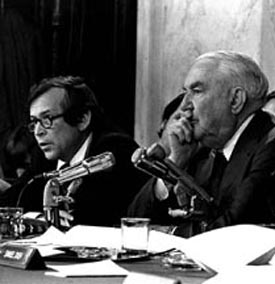
Watergate Committee Chair Sam Ervin (right)
and Vice-chair Howard Baker

In a piece written by Robert Scheer and published in the Los Angeles Times, Scheer reviews the book Worse Than Watergate: The Secret Presidency of George W. Bush, written by Richard Nixon’s White House counsel, John Dean, and sets out to draw parallels between the dark sides of the Nixon and Bush administrations.
As the Los Angeles Times is available only by subscription, if you’re interested in reading Scheer’s full article, click on the link at the end of this item.
First, though, have a look at this Quicktime video, a trailer for the documentary Uncovered: The Whole Truth About the War in Iraq, and read this essay published in Newsday — written by journalist and playwright Nicholas von Hoffman, author of the forthcoming book, Hoax: How We Were Taken In.
Von Hoffman writes …

“The Watergate hearings were the recipient of saturation, gavel-to-gavel TV coverage. You could not turn on a set without tuning in on them. There was nothing else on. None of the major networks covered last week’s 9/11 hearings and nobody objected. Indifference was universal.
The Watergate hearings, filled with drama, suspense, humor and surprise, made for weeks of hypnotic viewing and led directly to chasing Nixon from the White House into his own personal diaspora. The two-day, public 9/11 hearings will have no such effect on George W. Bush’s career. With the exception of Richard Clarke, the witnesses at this hearing were a dreary line of undistinguished officeholders, past and present, engaged in covering their behinds, and the polling reflects it. It shows that the majority of the potential electorate will cast its votes for reasons unconnected to 9/11.”

As a commentator on the article writes, “The most telling difference between the two hearings is the lack of major television coverage, which only serves to provide further evidence of how deeply the media are in bed with the Bush Administration.”

Continue reading Bush puts a ‘cancer on the presidency’