Category Archives: Politics

The Bush Administration’s Continuing Denial of Human Rights
The Iraqi Prison Abuse Scandal: Reaping What It Has Sown


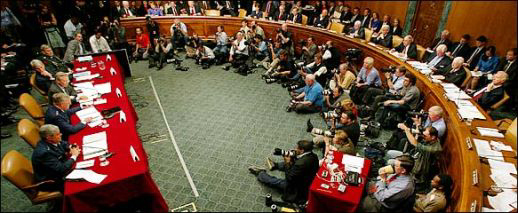
RUMSFELD-SENATE-HEARING


The Senate hearing into the abuse of Iraqi prisoners; click on photo for story


The fallout from the abuse, by American soldiers, of prisoners detained at Iraq’s Abu Ghraib prison continues.
Joe Conason, in Salon, provides insight into a report by human rights lawyers which found that the Abu Ghraib abuse was not only lawless — it was sanctioned by Pentagon political appointees.
Chicago Sun-Times columnist Neil Sternberg, in a compelling and readable column, suggests that President Bush is wrong to say prison abuse is inconsistent with the nature and temperment of Americans. Read why.
The New York Times reports on the life and current status of Pfc. Lynndie England, the female national guardsman featured so prominently in the Iraqi abuse photos.
The Times also presents a timeline, titled “Prison Abuses: Military Actions Taken and When Top Officials Knew.”
Update: ITV reports allegations of a “girl as young as 12 (who) was stripped and beaten by military personnel.” National Public Radio in the U.S. offers this audio report, by Jackie Northam, providing detail and insight into the report issued yesterday by the International Committee of the Red Cross on the coalition forces’ treatment of persons held in Iraq.
And, finally in this update on the scandal that is rocking the Bush White House …
Yale law professor Jack Balkin writes that the Bush “administration wanted secrecy. It wanted to be free of legal constraint. It wanted to do whatever it wanted whenever it wanted without ever having to be called to account for it.” Balkin goes on to suggest that in denying the prisoners in Iraq (as well as Afghanistan and Guantanamo Bay) the usual protections of the Bill of Rights — including the presumption of innocence, the right to counsel, the right to know the charges against them, and the writ of habeas corpus to test the legality of their detention if they are placed in jail — the Bush administration is now “reaping what it has sown.”
Dark Days: U.S. Soldiers Accused of Abusing Elderly Iraqi Woman


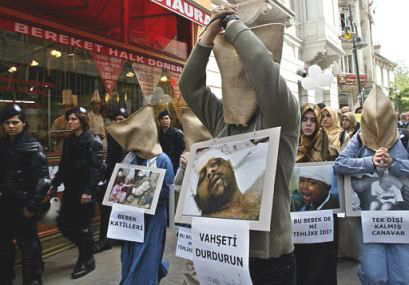
TURKISHPROTEST


Hooded Turkish protestors hold pictures of Iraqi detainees and anti U.S.
posters, during a demonstration in Istanbul, yesterday. The protest,
organized by Mazlumder, a pro-Islamic human rights group, condemned
the abuse of Iraqi prisoners by U.S. and British soldiers in Iraq

U.S. soldiers who detained an elderly Iraqi woman last year placed a harness on her, made her crawl on all fours and rode her like a donkey, Prime Minister Tony Blair’s human rights envoy to Iraq said on Wednesday. The envoy, veteran Labour MP Ann Clwyd, said she had investigated the claims of the woman in her 70s and believed them to be true.
In related news, the Washington Post has obtained 1,000 digital ‘travelogue’ photos taken recently by U.S. soldiers, including …

“photographs of naked men, apparently prisoners, sprawled on top of one another while soldiers stand around them … another of a naked man with a dark hood over his head, handcuffed to a cell door … and another of a naked man handcuffed to a bunk bed, his arms splayed so wide that his back is arched. A pair of women’s underwear covers his head and face.”

The full Washington Post story is available here. One distressing new photo shows Pfc. Lynndie England of the 372nd Military Police Company holding a leash tied around a naked man’s neck at Abu Ghraib prison.
Reuters has made available 227 Iraq-related photos in a captioned slide show presentation tracking the events in Iraq in the past week.

Questions of War: How Far Up Does The Responsibility Go?
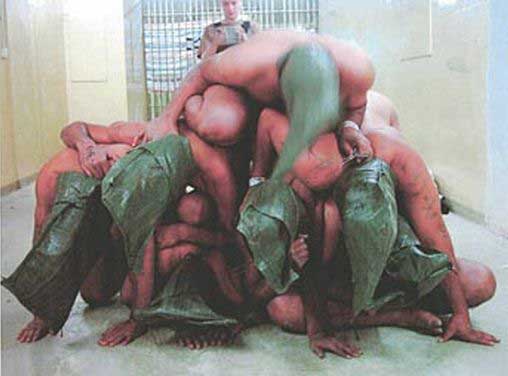
Torture At Abu Ghraib: American Soldiers Brutalized Iraqis


A pyramid of naked, hooded Iraqi prisoners, tortured at Abu Ghraib prison by U.S. troops

“In the era of Saddam Hussein, Abu Ghraib, twenty miles west of Baghdad, was one of the world’s most notorious prisons, with torture, weekly executions, and vile living conditions,” writes Seymour Hersh, in the latest edition of The New Yorker.
“As many as fifty thousand men and women — no accurate count is possible — were jammed into Abu Ghraib at one time, in twelve-by-twelve-foot cells that were little more than human holding pits.”
When the United States assumed responsibility for Abu Ghraib prison more than a year ago, conditions for prisoners were to have improved — the mandate of the U.S. troops to hold human rights as paramount — as preparations were made by the Bush administration to turn over responsibility for the prison to Iraqi authorities this June.
Earlier this year, when reports began to leak out that unsavoury practices within the prison had continued under U.S. command, the senior U.S. Army commander in Iraq authorized an investigation into the Iraqi prison system. The 53-page report that resulted, which was written by Major General Antonio M. Taguba and was not meant for public release, was devastating.
Taguba found numerous instances of “sadistic, blatant, and wanton criminal abuses” of Iraqis by American soldiers at the Abu Ghraib prison.
This systematic and illegal abuse, Taguba reported, was perpetrated by members of the 320th Military Police Battalion, and also by members of the American intelligence community. There was considerable evidence to support the allegations, Taguba added, including “detailed witness statements and the discovery of extremely graphic photographic evidence”; the photographs, which were taken by American soldiers while the abuse was going on, were not included in the report, Taguba said, because of their “extremely sensitive nature.”
This week, 10 of those photographs made their way into the hands of the American media. Some graphic details have been digitally obscured.
Today, the New York Times published their own investigative update on the “virtual collapse of the command structure in prisons” throughout Iraq.
Over in Britain, at the same time General Taguba’s confidential report was being made public in America, The Daily Mirror published its own graphic report of the gross abuse and torture of Iraqi prisoners — this time by British troops — along with horrific photos of that abuse.
Although a story in The Guardian reports that some quarters within the British Armed Forces have expressed doubts as to the authenticity of the photos, Piers Morgan, editor of The Daily Mirror, said his newspaper stands by the authenticity of the photos.

Ideologically Incorrect? An Exploration of The Starbucks Paradox

The favourite target of WTO protesters is actually far more diverse than the anti-globalization movement. Kim Fellner looks into the contradictions of coffee, class, and race.


STARBUCKS


In an article published in Colorlines magazine, reporter Kim Fellner ponders the ‘Starbucks Paradox’ — is the coffee behemoth inherently evil just because it’s a big corporation? Or, is Starbucks actually a diverse company that offers viable career opportunities for those of all races and classes?
The knock on Starbucks? WTO protesters accuse Starbucks of buying coffee at prices that won’t sustain farmers’ livelihoods; purchasing from farms that degrade the environment; causing neighbourhoods to gentrify and small cafés to wither; and representing the mega-branding that’s killing small businesses and homogenizing the world.
Ms. Fellner’s response to the concerns raised above encompasses Starbucks’ record on race, class, politics, human rights and the environment; as well as employees’ working conditions and benefits.
In the Colorlines article, Jef Keighley, a national representative for the Canadian Automobile Workers, describes his experiences organizing Starbucks in British Columbia, where the union is in a drawn-out contract negotiation covering 10 Vancouver stores. “We used to have 12 stores,” he says, “but the company has had a hand in organizing decertifications at two of those stores, even selecting and paying for the lawyer. We’ve been at the Labour Board for a year and a half.”
Is Starbucks equivalent to Wal-Mart, given its hyper-aggressive expansion, especially abroad, and a marketing plan which has positioned the company as a symbol of the ‘Americanization of the world’? Read Ms. Fellner’s article for an expansive and thoughtful answer to that, and other, questions.