Category Archives: Politics

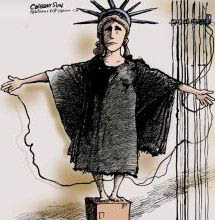
Abu Ghraib: The Rule, Not The Exception
Prisoner Abuse Began at Home, and Elsewhere


PRISONER-ABUSE


VanRamblings can’t keep track of all the articles and commentary coming out about prisoner abuse in the U.S. since the Abu Ghraib photos were first published.
In an article published yesterday in The Globe and Mail, torture expert Miles Schuman writes that “Americans are no novices to inflicting pain and humiliation;” that, in fact, “U.S.-sanctioned torment has a long and diverse pedigree.”
Talk Left points to this story in the Los Angeles Times, about conditions in the L.A. County jail, where five inmates have been murdered since October.
This L.A. Times editorial calls jail security an oxymoron.
Update: America. Prison Nation. That’s what many Americans believe the U.S. has become. Don’t miss this editorial in the Monday, May 17th, New York Times, ‘The Dark Side of America’. The abuses within the United States are at least as bad, and probably worse, than those abroad.

A Kerry Landslide?
Why the next U.S. election won’t be close


AMERICAN-PRESIDENTS


Conventional wisdom has it that the 2004 U.S. Presidential election will be extremely tight. But history shows that an election with an incumbent president tends to function as a referendum, which could mean a big win — or a big loss — for Democratic hopeful, Massachusett’s Senator John Kerry.
In a column written for The Washington Monthly, editor-in-chief of the National Journal’s Hotline, Chuck Todd, suggests the race for President may not be as close as most pundits believe. In fact, writes Todd …

“2004 could be a decisive victory for Kerry. The reason to think so is historical. Elections that feature a sitting president tend to be referendums on the incumbent — and in recent elections, the incumbent has either won or lost by large electoral margins. If you look at key indicators beyond the neck-and-neck support for the two candidates in the polls — such as high turnout in the early Democratic primaries and the likelihood of a high turnout in November — it seems improbable that Bush will win big. More likely, it’s going to be Kerry in a rout.”

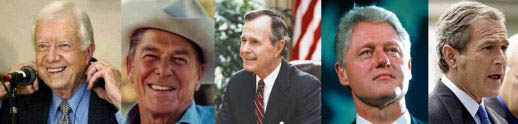
In a prescient BBC article, published in December 2002, correspondent Paul Reynolds compares the presidencies of Jimmy Carter and George W. Bush, offering an analysis of what brought Carter down.
Although Reynolds suggests that George W. Bush intended not to be burdened by the same problems — the economy and foreign policy — that defeated Carter, in fact, given the events of the past few months, if you contrast the problems that plagued the Carter administration with those of the Bush White House, the current president’s tenure would seem uncertain, indeed, based on recent U.S. political history.

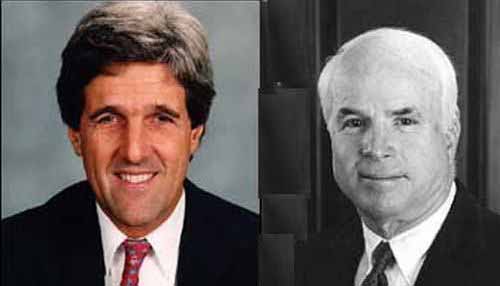
Kerry and McCain: The Winning Ticket Against Bush/Cheney?


Presidential hopeful John Kerry, and Senator John McCain for the Democratic ticket this November?

Word out of Washington, D.C. this morning has Democratic party Presidential hopeful considering five candidates for the Vice-President’s slot on the ticket: John Edwards, retired General Wesley Clark, Richard Gephardt of St. Louis, Senator Bob Graham from Florida, and Iowa Governor Tom Vilsack.
All and all, a pretty lacklustre group of potential running mates for a Kerry campaign already dogged by allegations of unutterable dullness.
Although there’s been some blue sky speculation / hopeful thinking about a John Kerry / John McCain Democratic ticket come November, The New Republic’s senior editor, Andrew Sullivan, goes a bit further than previous commentators.

In office, McCain could be given real authority as a war-manager, providing a counterweight to Kerry’s penchant for U.N.-style non-solutions … Domestically, a Kerry-McCain ticket would also go a long way toward healing the Vietnam wound, now rubbed raw again by recent events in Iraq … The next president, whomever he is, may well have to encounter seismic shocks from new terrorist atrocities in America and the world. Under those circumstances, America cannot afford more polarization, partisan division, and acrimony. In parliamentary democracies, such crises sometimes provoke the formation of a ‘national government’ in which both major parties serve together.

A United States government of national reconciliation? With each passing day, and as the position of the United States only continues to worsen — with the continued publishing and broadcast of horrendous pictures and video from Iraq, with the Bush administration’s failed policies on the environment, with the potential for a privatized education system, and a thousand other issues of concern to working Americans — VanRamblings joins the call for the Kerry campaign to implore John McCain to run on the Democratic ticket, to heal the wounds of division that have torn Americans apart, so that order might once again be re-established in the U.S., and the lives of each and every one of us will not be imperiled to the degree that has become the case under Bush.
Horror Show: Nightmarish Images Emerge From Iraq
Soldiers Armed With Digital Cameras Bring The Warm Home


NICK-BERG-FAMILY


On Tuesday, Michael Berg, center, hugs his daughter, Sara, as his son David stands
nearby, after learning the details of the killing in Iraq of his other son, Nick.


Farhad Manjoo, writing for Salon (free day pass available) theorizes as to why 26-year-old freelance contractor Nick Berg did not become a media story until video of his horrible decapitation was played on an Arab website.
From a government which has, for years, held sway with the American press, when spin control from the White House, since 9/11, has all but guaranteed favourable press for the Bush administration across the United States, times have certainly changed. The brutal realities of war have been brought home in a new and horrendous way, as digital age ‘travelogue’ pictures and videos are transmitted back home from the war front, sent by e-mail, or posted on websites.
And the senior ranks of the Bush administration reels with each new revelation.

“The video of Berg’s beheading that so dominated the news on Tuesday is just the latest example of how gruesome digital images are forcing us, and forcing the government, to confront the awful reality of war,” writes Manjoo.

We were never supposed to see the pictures that are now pouring out of Iraq. If the U.S. government had its way, ‘embedded journalists’ would have reported only on what the American administration wanted us to see and read. There would be no pictures of dead soldiers returning, of Iraqi prisoner abuse, or of Canadian and American civilians held at the mercy of the shadowy enemy.
That amateurs — American soldiers employing new technology — have emerged as the journalists who have created the iconic images of the Iraq war represents a watershed change in the way we receive news, and a shattering and revolutionary new way of documenting the world around us.