Category Archives: Politics

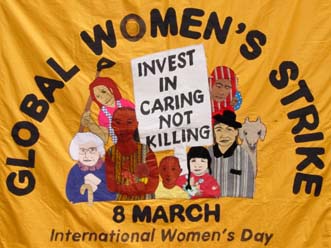
6th Annual Global Women’s Strike: Invest in Caring, Not Killing


GLOBAL-WOMENS-STRIKE


Seeking to end poverty and to put an end to war, fighting for a living wage for all of our work, and continuing the struggle to achieve pay equity in the global market, each March 8th, on every International Women’s Day since 2000 — and again in 2005 — women in over 60 countries will, and have, engaged in grassroots organizing activities to demand together that society invest in caring not killing, that the money squandered on wars across the globe instead be directed to the needs of our communities.
The demands of the global women’s strike — a day when women do neither paid, nor unpaid work — include …

  • Payment for all caring work — in wages, pensions, land and other resources.
  • Pay equity for all — women and men — in the global market.
  • Food security for breastfeeding mothers, paid maternity leave and maternity breaks.
  • Accessible clean water, healthcare, housing, transport and literacy.
  • Non-polluting energy and technology.
  • Protection and asylum from all violence and persecution, including by family members and those in positions of authority.
  • Freedom of movement.


A-WOMANS-PLACE


Nothing in life is to be feared.
It is only to be understood.
Marie Curie

From Ghana, where women and girls have taken to the street of Anum to demand an end to war, and support for issues of importance to women; in Guyana, where multi-racial demonstrations have protested against the country’s 25-year history of racial segregation and violence; in India, where mass rallies and workshops of Tribal and Dalit women have demanded an end to the wage discrimination of the caste system, and an end to rape by individual men, employers and the police; in Uganda, where rural women have won free and accessible healthcare, the right to clean water close to their homes, and the respect of their husbands; to Peru, where domestic workers’ organizations in Lima took over a community radio station to press the government to implement legislation to provide benefits and rights to domestic workers — strike action has brought about needed change and empowered women, children and men to take more, and increasingly effective, action to create a more caring, just and equitable world.
Change comes slowly, but change comes only through action and struggle.
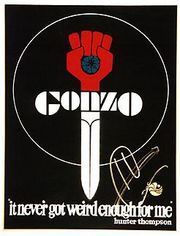
Depraved and Decadent: The Life and Death of Hunter S Thompson


HUNTER-S-THOMPSON

Hunter S. Thompson is dead. Long live the king.
Amid the guns, drugs and enormous expenses claims, Hunter Stockton Thompson created a new style of writing — gonzo journalism — and a generation of adherents. In the days after Thompson’s suicide, journalists from across the globe have weighed in on the importance of Thompson’s contribution to the canon of late twentieth century political discourse.
From Eric Homberger’s chronicling of Thompson’s life, published in The Guardian, to Tom Wolfe’s historical merry prankster retrospective, through to the perspective offered by author and political commentator Williams Rivers Pitt, to the voice of the man himself (audio via What Really Happened), when all is said and done all that is left to declaim is that Thompson will be sorely missed.
Thompson took pride in being the wild man of American journalism.

“As a journalist, I somehow managed to break most of the rules and still succeed,” he told biographer William McKeen. “It’s a hard thing for most of today’s journeymen journalists to understand, but only because they can’t do it.”


There is no more cogent evocation of what Thompson meant to political discourse than his writing on the passing of Richard Milhous Nixon, He Was A Crook. As Alexander Cockburn writes in counterpunch, “How Thompson said goodbye to Richard Nixon is as good a way to remember the high priest of gonzo as any …”

Richard Nixon is gone now and I am poorer for it. He was the real thing — a political monster straight out of Grendel and a very dangerous enemy. He could shake your hand and stab you in the back at the same time. He lied to his friends and betrayed the trust of his family.
It was Richard Nixon who got me into politics, and now that he’s gone, I feel lonely. He was a giant in his way. As long as Nixon was politically alive — and he was, all the way to the end — we could always be sure of finding the enemy on the Low Road. There was no need to look anywhere else for the evil bastard. He had the fighting instincts of a badger trapped by hounds. The badger will roll over on its back and emit a smell of death, which confuses the dogs and lures them in for the traditional ripping and tearing action. But it is usually the badger who does the ripping and tearing. It is a beast that fights best on its back: rolling under the throat of the enemy and seizing it by the head with all four claws. That was Nixon’s style — and if you forgot, he would kill you as a lesson to the others. Badgers don’t fight fair, bubba. That’s why God made dachshunds.


The remainder of Thompson’s Nixon retrospective is available here.

Something Evil This Way Comes


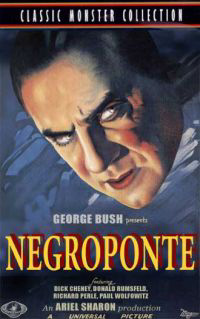
NEGROPONTE

From 1971 to 1973, John Negroponte — confirmed by the Bush administration this past week as the first U.S. National Intelligence director — was the officer-in charge for Vietnam at the National Security Council under Henry Kissinger. During that period, former Drug Enforcement Administration agent Michael Levine was conducting undercover operations in Saigon, Thailand, and Cambodia where the U.S. government was smuggling heroin into the U.S. The government was utilizing caskets and body bags of those “Killed In Action” to smuggled the heroin.
From 1981-1985, Negroponte was assigned as U.S. Ambassador to Honduras, where he illegally assisted the Contra war, aiding the Reagan administration in ‘disappearing’ close to 300 political opponents in classic death squad fashion. He supervised the creation of the El Aguacate air base, which the Contras used as a secret detention and torture centre. From 1989 to September 1993, Negroponte was ambassador to Mexico where he directed U. S. intelligence services in assisting the war against the Zapatista rebels in Chiapas.
According to the New York Times, under the diplomatic cover of his role as ‘ambassador’, Negroponte organized right wing death squads in Central America, leaving tens of thousands of people dead in El Salvador, Honduras and Nicaragua as they murdered to prop up pro-U.S. dictatorships under President Ronald Reagan. The Times credits Negroponte with ‘carrying out the covert strategy of the Reagan administration to crush the Sandinista government in Nicaragua’ during his tenure as U.S. ambassador to Honduras from 1981 to 1985.
In an article titled, Former death squad man to run Iraq, Kevin Ovenden writes in IndyMedia UK that …

  • Negroponte could give lessons to the most brutal dictatorships in the world on how to organise death squads, assassinate opponents and terrorise popular movements into submission
  • Negroponte, during his term as ‘ambassador’, oversaw the growth of military aid to Honduras from $4 million to $77.4 million a year. Much of that money was funnelled to the death squads in neighbouring Nicaragua and El Salvador
  • Negroponte concealed murder, kidnapping and torture by a CIA equipped and trained Honduran military unit, Battalion 3-16
    Negroponte, while at the U.S. embassy in Vietnam, coordinated pro-U.S. death squads from 1964 to 1968


Dave Lindorff, writing in Counterpunch, calls the nomination by President George Bush of John Negroponte both ‘obscene and predictable’.

Jon Stewart in a Dust Up on CNN’s Crossfire


JON-STEWART-DUST-UP


Seems that Jon Stewart is mad as hell and he just ain’t gonna take it any more.
Appearing on CNN’s Crossfire, the Daily Show’s acerbic host took Crossfire hosts Paul Begala and Tucker Carlson to task for “hurting America,” by failing to take journalism as a serious endeavour, by failing to hold politician’s feet to the fire, and by turning their show into nothing more than Spin Alley. “Now don’t you think that for people watching at home, that’s kind of a drag? That you’re literally walking to a place called Deception Lane?”
Both Dave Cullen and Salon magazine’s Charles Taylor weigh in on what Stewart accomplished by demanding that Crossfire “confront tough issues, instead of being the political equivalent of pro wrestling.”
Video of Stewart’s appearance on Crossfire is made available by The Free Speech Zone.