Category Archives: Jude and Megan

Stories of a Life | How Can You Locomote Yourself from A to B?

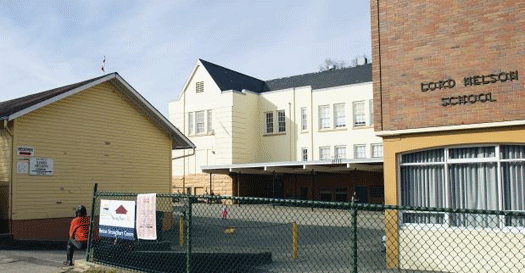
Lord Nelson Elementary School in Vancouver

Lord Nelson Elementary School, on Vancouver’s eastside, where I attended Grades 1 thru 3. The portable on the left is where I experienced a happy and rewarding Grade 2, in Mrs. Goloff’s class (I liked her, I thought there was a solid goodness about her and a genuine affection, as well as a deep respect, for students) from September 1957 thru June 1958.

In the summer of 1959, after I’d completed Grade 3 at Lord Nelson Elementary School in Vancouver (my memory of Grade 3 only slight), in August of ’59, my parents moved from Vancouver to Edmonton to be closer to family — on both my mother’s and father’s sides of the family.
In Alberta at the time, the provincial government had adopted what they called an “Enterprise Programme,” a focused academic programme meant to engage students intellectually while providing them with the tools they would require to compete successfully at post-secondary university. While all other Canadian provinces had adopted a two stream programme, one academic (university bound), the other vocational (meant to prepare students to work in the trades), Alberta was having none of that — educational achievement at the highest possible level was Alberta’s goal, the curriculum requirements rigorous, demanding and challenging, and consistently above grade level. The Enterprise Programme was defined by competition and the striving to become the best possible student — failure was never an option, doing your best was expected and required, academically and socially. Future leaders were being trained in Alberta.

“The provincial government meant to produce the best and the brightest, informed by a progressive educational ideology that Alberta was the first Canadian province to adopt in the 1950s, an educational philosophy that was child-centred, subject-integrated, with an activity-based approach, known in Alberta as the Enterprise Programme, focused on content centered courses in History, Geography, and Civics integrated into a new course: Social Studies, which was taught across all grade levels, this new subject emphasizing the development of democratic, co-operative behaviour, and inquisitiveness through experiential learning.”

Lynn Speer Lemisko & Kurt W. Clausen, Connections, Contrarities and Convolutions: Curriculum and Pedagogic Reform in Alberta; Faculty of Education, SFU, March 1, 2017

In the summer of 1962, my parents made the decision to return to Vancouver — the reasons are unclear to me, but whatever the case, in the summer of 1962, living at 2136 Venables Street, I found myself enrolled at Templeton Secondary School, then the toughest school in Vancouver (that mantle would soon be claimed by VanTech — but in 1962, Templeton was the school where all the toughest “juvenile delinquents” were enrolled, although truth to tell, many of the tougher students found themselves behind lock and key at the Brannen Lake Juvenile Correctional Facility).
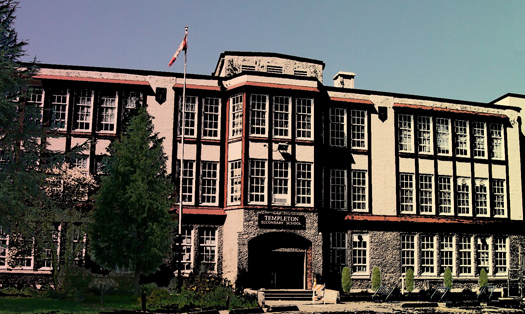
Templeton Secondary School in Vancouver circa 1963

From Grades 7 through Grade 12, I attended Templeton Secondary. Based on my experience in Alberta, I was enrolled in the academic programme at Templeton, whereas every person I’d attended Grades 1 thru 3 with at Lord Nelson found themselves enrolled in the vocational stream. Odd, I thought to myself at the time. Another odd thing I found: from the spring of 1963 on, my grades never soared about a C-average — whereas in Alberta, I’d been a straight A student. Unlike most others enrolled in the academic programme, I was required to take vocational classes — and from Grade 8, I was enrolled in typing and secretarial classes, unlike any other student in the academic stream. Although a typing speed of 160wpm would serve me well later in life, I still found it odd, and just a bit concerning, that I was required to take three clerical classes each year through to graduation.
From Grade 8 on, I was also concerned that when I submitted an essay in Social Studies or one of my English classes, it either came back to me with a C, a D or a fail — with a comment from my teacher that someone other than me had written the essay, or I had either plagiarized or copied directly the work of someone else. By the time I reached Grade 12, where I had achieved an A- average in French, was taking the lead in the school plays, and editing the student newspaper, I was surprised and disappointed to receive a D in English, and a fail in History and Geography.
I recall one spring afternoon in 1968, the teacher having turned down the lights, with soft music playing in the background, the teacher asking the students in my Grade 12 English class to write a stream of consciousness essay, which I was only too happy to do. When I submitted the essay to the teacher, she took a glance at the essay and tore it up, saying to me, “You didn’t write this. You either copied it from someone else or had the essay prepared in advance (note. there had been no notice of a stream of consciousness essay taking place in class that day). You receive a fail for the essay. I’m disgusted with you.”
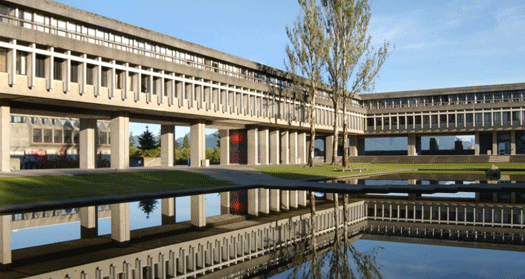
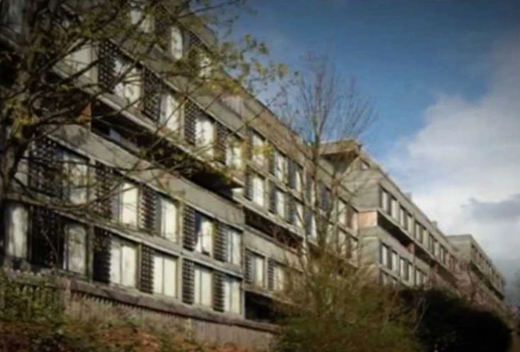
Simon Fraser University, Burnaby Mountain campus

A dozen years later, I was the Assistant Director of Teacher Training, PDP 401-402 at Simon Fraser University (a position I held while working on my Master’s degree). The English teacher referred to above had taken a seconded position as a PDP Faculty Associate — in essence I was her boss. When we first connected, in September, at the outset of the 1980 academic school year, almost the first words out of her mouth were, “I had a student with your name at Templeton Secondary. How odd that you should both have the same name,” at which point I informed her that the Raymond Tomlin she had taught, and the person standing in front of her was one and the same person. She looked aghast, stammering, “But how?”
I told her I had a 3.8 grade point average and two undergraduate degrees, and was currently enrolled in a Master’s programme at the university, letting her in on what I am about to write and record for posterity now …
In June of 1968, when I was about to graduate, as was the case with all of the other graduating students, I met with Ken Waites, the patrician, white-haired Principal at Templeton Secondary School, in his office with the door closed, and this is what he said to me …

“Well, Raymond, even though you’re a couple of courses short of graduation, given your failing grades in History and Geography, I am nonetheless going to graduate you anyway — because any kind of academic future is clearly not in the cards for you. I want to tell you something that we’ve kept from you for the past five years: for each of those years, you were recorded as having the lowest IQ of any student enrolled in the Vancouver school district, not just at Templeton, but city wide. Your teachers and I had often wondered, given your low IQ, how it is that you locomoted yourself from point A to point B. Someone with as low an IQ as you shouldn’t even be able to speak — but here you are.

You’ve probably wondered to yourself, why you were required to take three clerical courses each of the past five years. The answer is easy: you spell well, and it was clear early on that you had an aptitude for secretarial work, your typing speed and accuracy superior. Your guidance counsellor and I determined a long time ago that the best course in life for you would be to enter the clerical field, to be a secretary — because, clearly, you are possessed of no academic skill whatsoever, although you seem to have done well in French.

I have had these meetings with all graduating students, providing what I believe to be sound advice on how each student should proceed with his life following graduation. In your case, your best — and I would say, your only — hope is as a secretary. Thank you for meeting with me this afternoon, Raymond. All the best in your future.”

In 1970, my new wife insisted I enroll at Simon Fraser University, where students with an inferior academic record were being accepted, in order to build the student body. In my first semester at SFU, I achieved 3 C’s and two B’s. In my second semester, 3 B’s and 2 A’s — and every semester after that, straight A’s (not that I ever cared about grades, as did many of my fellow students — I was just hungry for knowledge, and curious about the world, eager to learn as much as I could, at one point early on not leaving SFU’s Burnaby campus over an 18-month period). I loved to read, I loved to write, I loved to learn, I was curious about everything — being at Simon Fraser University and hanging out with and being challenged by the best and the brightest was like a dream come true for me.
My curiosity about life, about all aspects of our existence on Earth remains to this day — I want to read all of the papers of record every day (and I do!), to engage with nation builders and city builders, to work with persons of conscience, to work towards better, fairer, more just. And I am afforded that opportunity each and every day, surrounded (outside of my plangent housing co-op life) by strong-willed persons of conscience who mean to build a better and more just world. As such, my life is near filled with joy!

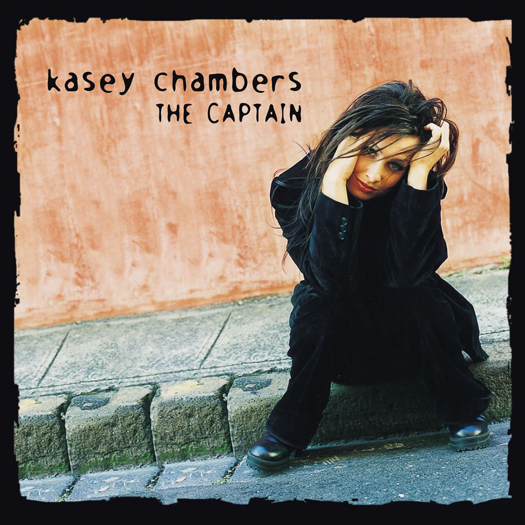
The Music of One’s Life | Kasey Chambers | The Captain

Kasey Chambers, The Captain

As the year draws to a close, the thoughts of music lovers everywhere is the anticipation of the discovery of new music made extant through the publication of the various year-end lists by respected music critics of the best new, under-the-radar music releases of the previous 11 months.
Such was the case during the holiday season in 2000, when the then not-discredited Charlie Rose had on the then not-discredited longtime New Yorker music critic Sasha Frere-Jones on his show to discuss the best albums of 2000. Mr. Frere-Jones found himself able to talk about one artist and one artist alone: Kasey Chambers, a then 23-year-old woman raised in the southern Australian outback who, he insisted, had released the best album of the year, the best country album he’d heard in years. Mr. Frere-Jones could not help himself from extolling Ms. Chambers’ many virtues as a singer-songwriter, going on to insist that Mr. Rose, and his other guests around the table that evening — and everyone tuned into PBS’ The Charlie Rose Show first thing the next morning repair to their local record store to secure, or order, Kasey Chambers’ début album release, The Captain.
Enthusiasm exhibited by a usually taciturn critic is a rare commodity at the best of times — critics being a cynical lot, by nature — leaving the viewer of that evening’s episode of The Charlie Rose Show no option other than to purchase The Captain first thing the next day — which, of course, I did.
Kasey Chambers’ music is timeless, as is the case with every song on The Captain. If you’ve not heard The Captain prior to this, you can listen to each of the songs on the album through YouTube, after which I assure you, you’ll want to download the entire album, and make it a part of your music library, and the soundtrack of your life, going forward. Important, really.

Click or tap on this link to listen to & savour Kasey Chambers’ The Captain in its entirety

Kasey Chambers was born in Mount Gambier, the second most populated city in South Australia (urban population: 28,684) early on the Friday afternoon of June 4th, 1976, the younger sister of brother Nash, who was born in 1974. Kasey’s parents, Diane and Bill, were musicians, itinerant farmers and hunters, who wanted nothing to do with big city life.

Mount Gambier's Blue Lake, in southern Australia

Mount Gambier’s crystalline Blue Lake

As money was often tight, on the few occasions when the family came to town, given that all members of the family were fine, well-respected musicians, arrangements were made for the family to play a series of concerts, the monies earned enough to pay for supplies until the next time the Chambers family came to town. By 1986, when Kasey was only 10, the family had formed a band called the Dead Ringer Band, so-named because Nash and Kasey looked like younger versions of their parents.
From the outset, it was clear to anyone that heard Kasey Chambers that she was a preternatural talent, Kasey Jo Chambers providing vocals and writing songs for a series of albums released by her parents between 1987 and 1993. When interviewed by the press — word of Kasey’s talent spread quickly across Australia, almost from the outset — she often cited Emmylou Harris as one of her primary influences, recalling that Harris’ music was frequently played by her parents, ever since she was a child.
Kasey Chambers recorded her début solo album, The Captain in July and August of 1998, with her brother Nash producing, and her father Bill on guitar (her parents were in the throes of divorce, so mother Diane played no role in the recording of the album). Joining the family on the recording were American country musicians, Buddy Miller and Julie Miller, who added guitars and vocals to four tracks. The Captain was released in Australia in May 1999, and worldwide, in June 2000 by Asylum Records.
And, as is often said, the rest is transcendent & salutary musical history.
Cry Like a Baby went on to win the country music Song of the Year award in 2000, The Captain winning the same award the following year. The next year, Kasey Chambers toured across the globe as the supporting and opening act for Lucinda Williams, who was touring to support her breakthrough, multi-award winning album, Car Wheels on a Gravel Road.
At my insistence, my friend J.B. Shayne (not a fan of country music) and I attended the Lucinda Williams concert at The Vogue in late 2001 — a three-hour concert that blew the roof of the venue — J.B. commenting to me afterwards, “That was like attending a Doors concert. I don’t think I’ve ever heard better musicianship. Lucinda Williams and her band (two drummers / percussionists, two lead guitarists, a rhythm guitarist, a slide guitarist, an organist, and a pianist) are probably the finest band I’ve heard in years. It’s maybe the most stoned concert I’ve ever attended.” And so it was.
Kasey Chambers, of course, was the opening act — and proved to be everything and more that I’d promised J.B. Within minutes, she had the audience in the palm of her hand, clapping, cheering, shouting, and head over heels in love with this Aussie girl who just knocked their socks off, not only performing most of the songs off The Captain, but previewing songs from her new album, Barricades & Brickwalls, produced by her brother Nash, the song Not Pretty Enough going on to win CMA Song of the Year.

Stories of a Life | Is Raymond Jewish? | Yep, Certainly by Blood

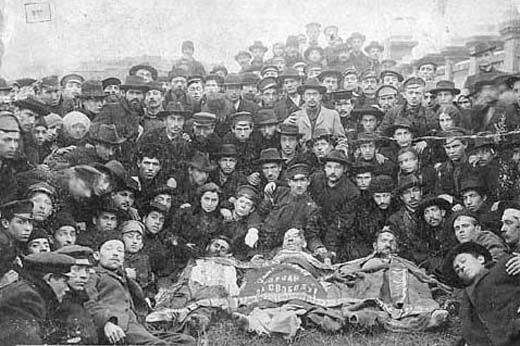
In the early part of the 20th century, my grandfather escaped the Ukrainian pogroms, an ethnic cleansing of the Jewish population that was taking place across eastern Europe1903: In the early part of the 20th century, my grandfather escaped the Ukrainian pogroms, an ethnic cleansing of the Jewish population that was taking place across eastern Europe that resulted in the murder of tens of thousands of Jews.

Whether it be the 11 congregants at Pittsburgh’s Tree of Life synagogue who were wantonly murdered only two short weeks ago, or Jews being targeted in the alt-right rally in Charlottesville on August 11th and 12th of 2017, or the 907 Jewish refugees escaping Hitler’s Germany in 1939 who were refused safe harbour in both Canada and the United States, most of the 907 returning to their deaths in Europe, where six million more Jews were slaughtered during the course of WWII, or the fact that since 2015 hate crimes in Canada against people of the Jewish faith has risen by an astonishing 30%, the fact of the Jewish diaspora and the murder over the centuries of hundreds of thousands of Jews as “the other” in countries across the globe is a devastating and unjust historical fact for the ages.

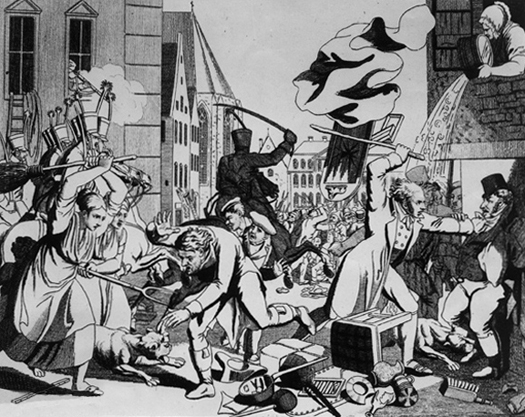
Pogrom of 1819 in Frankfurt, GermanyThe Hep-Hep riots in Frankfurt, Germany in 1819 that occurred amidst a climate of anti-Semitism fueled by various anti-Jewish publications. Participants in these riots rallied to the cry, “Hepp Hepp”, which may have been an acronym for “Hierosolyma est perdita”, meaning “Jerusalem is lost”. On the left, two peasant women are assaulting a Jewish man with pitchfork and broom. On the right, a man wearing spectacles, tails and a six-button waistcoat, “perhaps a pharmacist or a schoolteacher,” holds another Jewish man by the throat and is about to club him with a truncheon. The houses are being looted.

First recorded in 1882, the Russian word pogrom is derived from the common prefix po- and the verb gromit’ meaning “to destroy, to wreak havoc, to demolish violently” — apparently a word borrowed from Yiddish, the term first used to describe the anti-Semitic excesses in the Russian Empire from 1881 — 1883. Antisemitism in the Ukraine has been a historical issue, as well, but became more widespread in the 20th century.
Pogroms were a generational fact of life in the Ukraine, in 1821, 1859, 1871, 1881, 1903 and 1905, across the whole of the Ukraine.
In 1903, when my grandfather was but a young Jewish teenage boy, he managed to escape the Odessa pogroms that killed thousands that year, making his way by foot to Sweden, where he hoped to find passage to Canada. Word had filtered into Europe at the turn of the last century that the Canadian government was offering tracts of land to European settlers, and it was with this fact in mind that my grandfather set about to make his way to Canada, fully aware that Jews were not included in the Canadian government’s offer of land in exchange for breadbasket farming development, in the hope of settling the Prairie provinces, and making Alberta, Saskatchewan and Manitoba part of the new country of Canada.

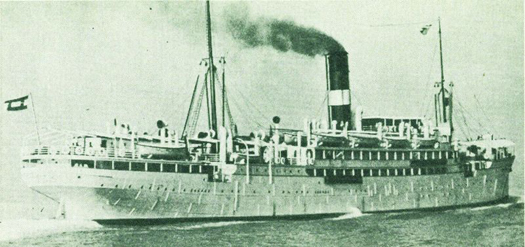
Ship transporting Jews from Europe to Canada at the turn of the last century

While in Sweden, my grandfather married a young Jewish woman he met while awaiting passage, and not many months later the two were boarded onto a ship sailing out of Sweden for Canada, arriving in our burgeoning new country in the spring of 1905. Irrespective of the laws of the time, and because the new province of Alberta was desperate to have their land settled, my grandparents were provided a densely treed tract, a full section of land just outside of what we now know as High River, Alberta. Over the years, one section of land grew into many, 10 children were born, five boys and five girls, the last of whom was my mother, born on March 28th, 1924.
The life was hardscrabble, even more so upon the death of my grandmother in the early winter of 1927, when my mother was but three years of age. All the children pitched in, though, creating a thriving farm — up until the Great Depression of the 1930s. By the time my mother was twelve years of age, she had struck out on her own, making a life for herself as a waitress in Drumheller, Alberta, a job she held off and on for the next fourteen years. World War II saw her moving to Vancouver to work first in the shipyards, and then in the factories making armaments — factory work a staple of her life for the next 35 years.
In 1946, my mother Mary met my father Jack, the two were married, and in 1947 my brother Robert was born, a sickly child who died three months after his birth. Escaping grief, my parents moved to Drumheller, where my mother had friends, and where her old waitress job awaited her, my father picking up what work he could. On August 9th, 1950, my mother went into labour, and had my father drive the both of them back over the deadly Rocky Mountain pass, the two arriving in Vancouver and driving directly to Vancouver General Hospital, where I was born at 2:26pm on Friday, August 11th, 1950. My sister Linda was born a bit less than two years later at St. Paul’s Hospital, on May 29th, 1952. My mother had insisted that both her children be born in Vancouver — to know my mother is to know that no one ever refused her. To this day, I am attracted only, and have found myself in loving relationships with tough, take no guff, opinionated (and, dare I say, “crazy” and just a tad, or more than a tad, mentally unstable — and, yes, I realize that’s sorta like the pot calling the kettle black … even so) women.

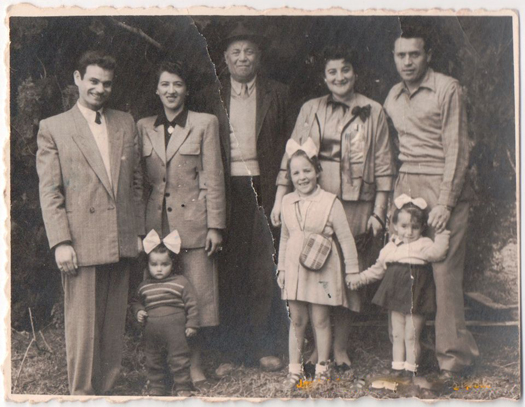
Jewish family, early 1950s

For the first 20 years of my life, the fact of my Jewishness was never raised with either my sister or me, not by my parents, not by my “spinster” aunt Freda (Blackerman, my mother’s maiden name), nor my aunt Anne and Uncle Dave, my uncle Joe nor any of my mother’s Jewish brothers and sisters — the quid pro quo in my family was that if my aunts, uncles and cousins wanted me to be a part of their lives, there was to be no talk of my Jewish heritage — this edict by my mother extended as well to my tall oak of a grandfather, who was every bit the sophisticated patrician Jew.
Every Sunday of our youth, my sister and I were picked up by a small school bus and transported to Sunday school, spending the rest of the day being taken to lunch, swimming, out to Stanley Park, or otherwise engaged by the members of the church. Every week I memorized and recited verses from the New Testament at Sunday school.
Now, there were some “hints” given that I might be Jewish — my mother, when she wasn’t working at one of her three jobs, loved to bake, and I grew up on a steady diet of Jewish pastries, my favourite the jam-infused hamantaschen, and jam, nut and raisin-infused rugelach, which latter small pastries I could consume by the dozen.
Growing up there was a great deal of arguing that went on between my parents, epithets thrown at my mother by my father, with the words “dirty Jew” heard on the other side of the door inside of my parent’s bedroom, words raged at my mother by my father. Otherwise, although I suspected I was Jewish, the fact was never confirmed for me growing up.

Simon Fraser University's Louis Riel House, a student family one-and-two-bedroom apartmentSimon Fraser University’s Louis Riel House, student family 1 + 2 bedroom residence

At around 10am one summer’s morning in July, 1972, while we were resident at Louis Riel House, Cathy and I received a telephone call from a woman identifying herself as my “Aunt Sally.” I took pains to explain to her that she must have the wrong number, that I had no “Aunt Sally”, to which she replied …

“I am your Aunt Sally. Your mother is Mary, who is my youngest sister. Your Aunt Freda — who all but raised you — is my second youngest sister. Summer’s you went to stay with your Auntie Anne, my sister, and your Uncle Dave, in Lethbridge. When you were younger, you stayed on my father’s farm in High River, Alberta. You know my older brother, Joe — who, when you lived in Edmonton for Grades 4, 5 and 6, helped to raise you when your mother was working three jobs, and your father was working evenings at the Post Office. Believe me when I say, Raymond — I am your Aunt Sally.”

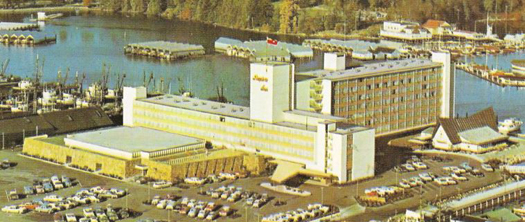
At which point, my newly-discovered Aunt Sally invited Cathy and I for lunch at the Bayshore Inn where she and her husband, Alex (Promislow) were staying while in town, on a mission to make contact with me. Aunt Sally told me that she’d already made arrangements with my mother to join us for lunch, and she expected Cathy and I to arrive at noon, where she would greet us at the entrance to The Bayshore.

Westin Bayshore Inn, Vancouver, circa 1972

Lunch was good, my mother remaining all but mute throughout the meal.
I met my Uncle Alex, Sally’s husband — who years earlier had secured the distribution rights for Lee’s jeans in Canada, a percentage of each pair of jeans, and other Lee’s products, placed into his bank account, making him a wealthy man. I heard all about my aunt, now living in Calgary, spending the early part of her life, after leaving home, in Winnipeg, where she’d met Alex. I was given the Five Books of Moses, and was provided with a more in-depth history of my family, dating back centuries, than I ever could have hoped for. Through it all, my mother denied her Jewishness — she readily admitted that Sally was her sister, but insisted she had been adopted, and had not a drop of Jewish blood in her, and as an atheist had never been a member of any church, never mind a synagogue, which notion she told us she found offensive and off-putting, her so-called “heritage” a complete and utter lie. My aunt Sally simply rolled her eyes, and harrumphed a bit.
I stayed in touch with my aunt Sally and Uncle Alex for another 15 years, but eventually lost touch with the both of them.

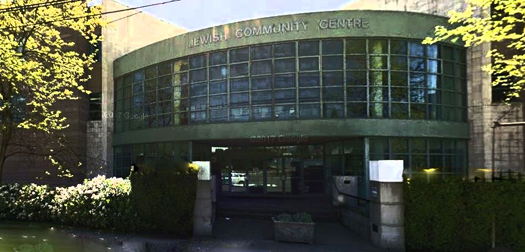
Jewish Community Centre, Vancouver

Growing up, I apprised both Jude and Megan of their Jewish heritage — much to their mother’s chagrin, my children’s mother both anti-religion and an avowed atheist. Hanukkah, one of the lesser Jewish holidays, was their favourite, occurring as it did in December, and generally just before Christmas. Jude and Megan loved receiving one small gift each day of Hanukkah, and enjoyed lighting the menora, as well. We always attended cultural celebrations at the Jewish Community Centre, dancing up a storm.
Jude and Megan had Jewish friends, and attended at various bat and bar mitzvahs, but did not have one of their own (their mother would have had a conniption fit!). During Passover, we were invited to friend’s homes for Seder, at which time our Jewish friends explained the importance of Passover, and what it meant to people of the Jewish faith.
I have come to believe that the immense amount of energy that I have brought to the tasks of my life — as is the case with my daughter, who possesses the same capacity as me to work days on end with little or no sleep, while maintaining both a high energy and output level — derives from the Jewish blood that courses through my veins. For my children, their Jewishness is not a factor in their lives, as is the case with my grandsons.
Still, I consider myself to be Jewish — my mother was Jewish, and Judaism is a matriarchy, so I am very much a Jew, even if my mother denied her Jewish heritage to her dying day. For my younger sister Linda, her Jewish heritage plays no role in her life, nor in that of my two nieces.
I have decided to take classes with Rabbi Dan Moskovitz in the new year to become better acquainted with my heritage — a bit late in my life, but better late than never. And, of course, at the invitation of my friend Jacob Kojfman, I will once again attend the Dreidels & Drinks Hanukkah celebration, for me the low-key, warmly inviting, edifying and humane event of the holiday season, to which are invited every federal, provincial and Metro Vancouver elected official, providing an opportunity to converse and interact across political boundaries (the number of political figures I introduced to one another, avowed “enemies” at first introduction, and only a few minutes later best of friends, person after person approaching me to say, “Thank you for that introduction, Raymond — who’d have thought that —- and I had so much in common? We got along famously!”

Dreidels & Drinks Hanukkah celebration in Vancouver

And, really, when you get right down to it, isn’t that what the holiday season is all about — peace, love, understanding, brother-and-sisterhood.

The Music of One’s Life, The Voices of Women | The Rescues

Music of Life

In 1993, my friend J.B. Shayne was visiting in my home, and as I was preparing a bit of lunch, he scanned my vast (at the time, anyway) CD collection — about 10 minutes into his investigative process, J.B. turned to me and said, “Do you realize that 80% of your music collection features female vocalists?” At the time, the thought had never occurred to me that J.B.’s statement might be true. Somehow, I’d just never realized it.
Over the coming months, then, as you might well expect, VanRamblings’ readers may reasonably project that the vast majority of music I’ll be writing about will feature women vocalists, from my country and Americana favourites Kasey Chambers, Allison Moorer, Iris DeMent, Kacey Musgraves, Lady Antebellum, Lori McKenna, Miranda Lambert, Nickel Creek, The Secret Sisters, Julia Stone and Lucinda Williams, to my fave urban contemporary artists like Chrisette Michelle, Teedra Moses, Nicki Flores, Rihanna, Mary J. Blige, Amel Larriuex, and Krys Ivory, to the following cross-genre artists …
Cat Power, Emiliana Torrini, Julien Baker, Laura Nyro, Lianne Le Havas, Rickie Lee Jones, Stina Nordenstam, Tracey Thorne, Gemma Hayes, Eva Cassidy, Feist, Imogen Heap, Robyn, Missy Higgins, Sharon van Etten, Laura Jansen, Lily Allen, Fiona Apple, Bic Runga, Beth Orton, Adaline, Coeur de Pirate, Emil Sande, Jem and Lykke Li, to female fronted groups like …
Apples in Stereo, Azure Ray, CocoRosie, The Roches, Rumer, and more.
The above artists only scratch the surface of my musical itch for discovery.

Let her sing, female vocalists in the contemporary era

Sometimes, there are songs that I just keep returning to, music with harmonies featuring women’s voices, songs that pick me up, brighten my mood and give me hope. That’s the music I’m presenting today.
The Rescues were formed in Los Angeles in 2008, a female fronted indie supergroup, featuring acclaimed singer / songwriter and multi instrumentalist Kyler England, composer, video director and artist Adrianne Gonzalez, who were joined by conductor and film score composer Gabriel Mann, and a rotating fourth vocalist, The Rescues together creating a free form amalgam of cross-genre musical styles ranging from acoustic, folk and Americana to progressive dance, electronica, hip-hop and rap.
Although Katy Perry did a cover of The Rescues’ Teenage Dream, Kyler England, Adrianne Gonzalez, Gabriel Mann and Rob Giles created the captivatingly gorgeous four-part harmonies that you’ll hear in their definitive version of Teenage Dream. Listen for yourself & enjoy …