Category Archives: Cinema

Arts Friday | Are Things Getting Better For Women In Hollywood?

Feminist | A person who believes in the social, political, and economic equality of the sexes

From the earliest days of Hollywood, women were stage managed and manipulated by older men in powerful positions. And it remains clear that, although Harvey Weinstein, Les Moonves, John Lasseter, Luc Besson, among a host of other male predatory Hollywood executives who have been outed, little good has been achieved still for women in the film industry.
In the Hollywood dream factory, trauma surfaces as light entertainment.
In 2013, introducing the list of best supporting actress nominees during the Oscar ceremony, actor and comedian Seth MacFarlane quipped: “Congratulations, you five ladies no longer have to pretend to be attracted to Harvey Weinstein.” What was chilling was that no one got the joke. The idea that female stars and aspiring, often young, female stars are required to accept the attentions, at the very least, of older male studio executives, producers and prominent male stars, is as old as the Hollywood hills.
Given the profile that the #MeToo movement has brought to sex discrimination, why does sexism continue to prevail in Hollywood?
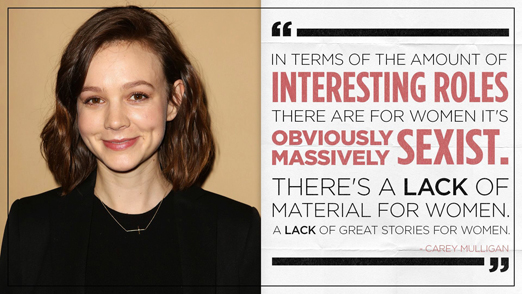
Actress Carey Mulligan on sexism in the film industry

According to San Diego State’s Center for the Study of Women in Television and Film, women made up only 7 per cent of directors on the top 250 films of 2018, which was actually a 2 per cent decline from 2017. The same study found that while women made up higher percentages of other fields in the industry — 24% of producers, or 17 per cent of editors, for example — they only accounted for 17 per cent of the workforce of all the jobs surveyed. And that too, was a 2 per cent decline from the year before.
The University of Southern California’s Viterbi School of Engineering’s Signal Analysis and Interpretation Lab (SAIL) revealed how sexism is embodied by characters on the silver screen. If female characters are taken out of the plot, it often makes no difference to the story the study found.
Analyzing 1000 scripts, the study found that there were seven times more male than female writers & twelve times more male directors than women.
The biggest impact in counteracting the gender imbalance was if female writers were present at script meetings. If this was the case, female characters on screen was around 50% greater.
Inherent in these observations of the film industry are powerful messages about what it means to be female.
In our “post-feminist” era, where we are frequently told the problems of girls are yesterday’s news — that girls are awash in the largesse of civil rights, and it is boys who really require our attention — it is worthwhile to consider the conduct of male Hollywood writers and executives.
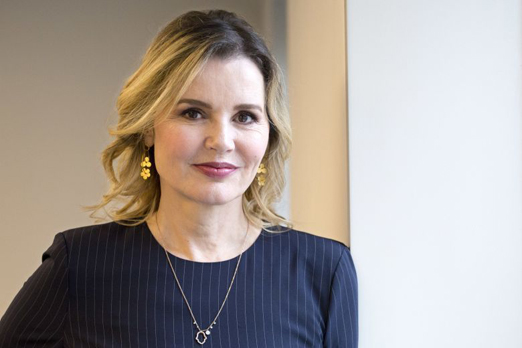
Actress Geena Davis, founder of the Geena Davis Institute on Gender in MediaActress Geena Davis, founder of the Geena Davis Institute on Gender in Media

The problem is so glaring that in 2005, the actress Geena Davis, who would go on to start her own gender institute, commissioned Stacy Smith, a researcher at the University of Southern California, to study the issue and help push the studios beyond the staid male-centred film industry.
From 2007 through 2017, according to Smith’s research, women made up only 30.2% of speaking or named characters in the 100 top-grossing fictional films.
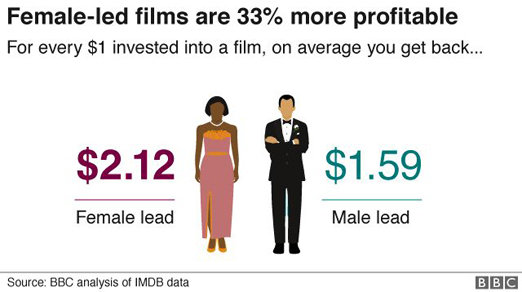
Female lead films make more money than films led by males.

The Geena Davis Institute on Gender in Media reports that films featuring women are financially profitable. “Guess what, Hollywood? Female-led films consistently make more money, year over year,” Madeline Di Nonno, the Institutes chief executive has reported to the heads of Hollywood studios.
Hollywood actor Charlize Theron has criticized the movie industry for gender bias. Promoting her film Atomic Blonde, she told feminist Bustle magazine: “Fifteen, ten years ago, it was almost impossible to produce female-driven films, in any genre, just because nobody wanted to make it.”

The Bechdel Test, the role of women in film

A quiz that was designed to find out how sexist a film might be was developed by Alison Bechdel and Liz Wallace in 1985. To pass, the film needed three positive answers to these questions: Does it have more than two named female characters? Do those two talk to each other? Is that conversation about something other than a man?
The Hollywood Reporter applied the Bechdel-Wallace test to the top-selling movies of 2018, finding that only around half of the films passed the test.
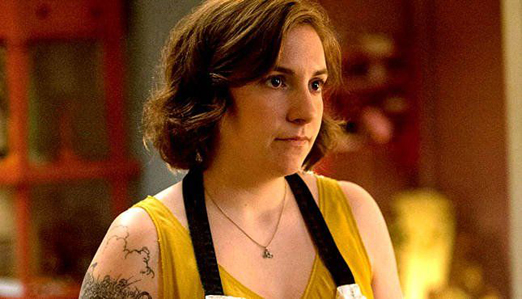
Actress-writer-director Lena Dunham, creator of the HBO series, "Girls"Actress-writer-director Lena Dunham, creator of the HBO series, "Girls"

Female directors are in what “Girls” creator Lena Dunham calls “a dark loop.” If they don’t have experience, they can’t get hired, and if they can’t get hired, they can’t get experience. “Without Googling it,” Dunham asked a recent Sundance panel, “Ask anybody to name more than five female filmmakers who’ve made more than three films. It’s shockingly hard.”
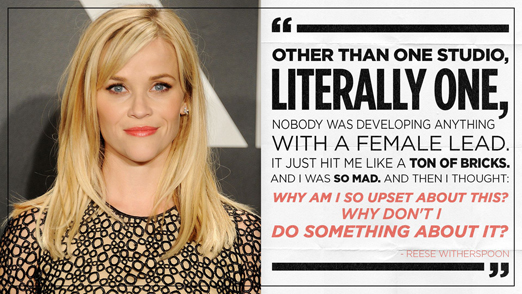
Actress Reese Witherspoon confronting sexism in the film industry

The sheer scale of rampant Hollywood sexism is daunting, the stories of what actresses have to put up with disturbing, the tales of pay inequity and pushing for more female-led stories are instructive.
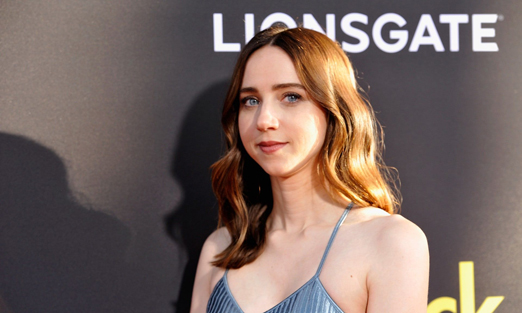
Actress-writer-producer Zoe KazanActress-writer-producer Zoe Kazan, star of the Oscar-nominated film Big Sick, and writer and executive producer of the films, Ruby Sparks and Wildlife (the latter now on Netflix)

Actress Zoe Kazan (The Big Sick) told IndieWire reporter, Kate Erbland, “There’s so much sexual harassment on set. And there’s no HR department, right? We don’t have a redress. We have our union, but no one ever resorts to that, because you don’t want to get a reputation for being difficult.”
The Oscar winner and star of The Favourite, Rachel Weisz, told Out Magazine that a number of her male co-stars have taken lower salaries in order to match her own. “In my career so far, I’ve needed my male co-stars to take a pay cut so that I may have parity with them,” she said.
Actress Emmy Rossum sounded off during a recent Hollywood Reporter roundtable about her experience with overt sexism in the industry.

“I’ve never been in a situation where somebody asked me to do something really obviously physical in exchange for a job, but even as recently as a year ago, my agent called me and was like, ‘I’m so embarrassed to make this call, but there’s a big movie and they’re going to offer it to you. They really love your work on Shameless. But the director wants you to come into his office in a bikini. There’s no audition. That’s all you have to do.'”

If the dynamic of older men and younger, submissive women greases the wheels of Hollywood production offices repeats itself on screen, it is not an accident, but the desires of the producers and directors who create these films played out on the biggest stage of all: Hollywood cinema, the world’s most effective propaganda machine. Who is Hollywood trying to kid?
Arts Friday | Netflix and the Death of the Theatrical Experience

Netflix and the Death of Hollywood

With movie theatre attendance at a two-decade low and profits dwindling, with revenues hovering slightly above $10 billion, Hollywood is on the verge of experiencing the kind of disruption that hit the music, publishing, and related cultural industries a decade ago and more.
Hollywood once ruled the world with must-see movies that would entice people to head to the nearest cinema every weekend. But movie crowds have been declining as more people opt to “Netflix”, and chill at home.
Like other industries, entertainment is feeling the shock of technology and scrambling to adapt to sharply shifting economics. Studios are increasingly banking on big-budget franchise films to bring in bucks. But is that enough?
Wall Street Journal reporter Ben Fritz considered those issues in his book, The Big Picture: The Fight for the Future of Movies.

“Netflix is having a massive impact on Hollywood,” Fritz writes. “They’re disrupting all the traditional economics of television and movies. It’s inescapable how much Netflix has become the TV diet for so many people. Now it’s happening to movies.”

“The movie industry is going through what the record industry has gone through. Subscription streaming is changing the movie business. The music business has had to adapt to people streaming, and that’s going to happen in the movie business. A lot of traditionalists are saying, ‘No, a movie is made to be seen in a theatre.’ That may be what Hollywood wants, but that is not what a lot of consumers want.”

As we wrote in a column published in 2018, in recent years Hollywood has been gun shy about producing romantic comedies.

Netflix, though, has proven just how durable the romcom formula is.
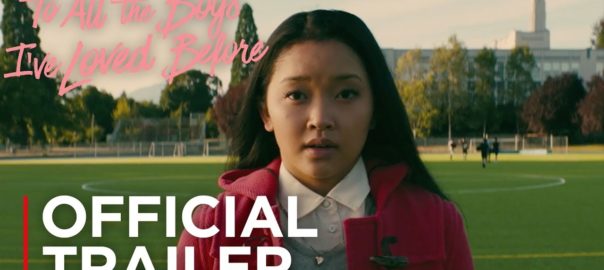
When Lara Condon and Noah Centineo’s To All the Boys I’ve Loved Before débuted last August, it set Netflix streaming records, with over 45 million viewers tuning in. Needless to say, a sequel will be released later this year, as is the case with Joey King’s breakout hit, The Kissing Booth.
Meanwhile, Rose McIver’s The Christmas Prince also spawned a much-anticipated sequel on Netflix this past holiday season.
In 2019, Netflix is set to spend around $18 billion on original programming, most of which is slated for movie production and documentaries, consisting of a 121 movie and documentary slate. Warner Bros.will release 23 films this year, while Disney (Hollywood’s most profitable studio) will début a mere 10. All the Hollywood studios combined in 2019 won’t spend $18 billion on production, and will release only a mere fraction of Netflix’s titles.
Looking into the financial crystal ball, investment firm Goldman Sachs predicts that Netflix could have an annual spending budget of $22.5 billion in 2022, a staggering number that would see Netflix far outstrip the total spending by all of the Hollywood movie studios combined.
With Netflix boasting 139 million subscribers, and growing by millions every month, according to tech mogul Barry Diller, a former senior member of the executive team at Paramount and 20th Century Fox and current Chairman of the Expedia group, “Hollywood is now irrelevant.”

The rise of Netflix may spell the end of the theatrical experience, and trips to your local multiplex

Having disrupted the model for TV broadcasters by making schedules extraneous and grabbing millions of viewers at the same time, Netflix is now making a run at Hollywood. “I think it’s going to be fascinating to watch,” says US journalist Gina Keating, author of Netflixed: The Epic Battle for America’s Eyeballs.
Netflix’s deep pockets have lured Hollywood stars such as Will Smith (Bright), Joel Edgerton, Sandra Bullock (Bird Box), Ben Affleck (Triple Frontier), Kevin Costner and Woody Harrelson (The Highwaymen), Anne Hathaway, Robert DeNiro, Al Pacino and Harvey Keitel, the latter three of whom will star in Martin Scorcese’s $150 million epic, The Irishman, arriving day and date on Netflix and a handful of theatres across the continent this upcoming autumn season, just in time for the Oscars.
And talking about the Oscars, Netflix’s Roma won a slew of Oscars this past Ocotber, winning Best Director, Cinematographer and Foreign Language Film for Alfonso Cuarón, while Period, End of Sentence won Best Documentary. Both films have been available on Netflix since December.
Although Netflix has been around for over two decades, the company’s rise to the top of Hollywood happened in a remarkably short period of time.
House of Cards, Neflix’s first foray into original content, débuted only six years ago. By expending monies to produce more shows and movies, it has managed to grow so rapidly that even its own executives are surprised.

“We’ve outperformed the business in a way we didn’t predict,” David Wells, Netflix’s (now former) chief financial officer, told The Hollywood Reporter in late February, after the company announced that its subscriber base had increased by over seven million in the first two months of 2019, its largest increase ever.

While Hollywood could take control of its fate, it’s very difficult for mature businesses — ones that have operated in similar ways for decades and where the top players have entrenched interests — to embrace change.
One can imagine the future looking something like this: You come home (in a driverless car) and say aloud to Alexa, Siri, Google Home or some A.I. assistant that doesn’t exist yet, “I want to watch a comedy with two female actors as the leads.” Alexa responds, “O.K., but you have to be at dinner at 8pm. Should I make the movie one hour long?” “Sure, that sounds good.” Then you’ll sit down to watch on a screen that resembles digital wallpaper.
At the Consumer Electronics Show this year Samsung débuted a flexible display that rolls up like paper.
There are other, more dystopian theories which predict that film and video games will merge, and we will become actors in a movie, reading lines or being told to “look out!” as an exploding car comes hurtling in our direction, not too dissimilar from Mildred Montag’s evening rituals in Fahrenheit 451.
When we finally get there, you can be sure of two things.
The bad news is that many of the people on the set of a standard Hollywood production won’t have a job anymore. The good news?
You’ll never be bored again.

Arts Friday | DOXA 2019 | Selina Crammond Celebration Day

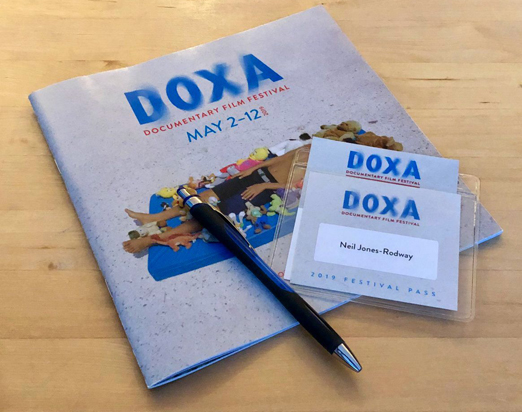
DOXA Documentary Film Festival

On VanRamblings yesterday, we wrote about Selina Crammond, all around good person, community activist, person of principle, and someone who keeps VanRamblings on the straight and narrow (as must appear obvious to anyone, VanRamblings needs all the help we can get — particularly when it comes from persons of conscience like Selina).

In addition to Selina Crammond’s community activism and commitment to change for the better, her ace drumming in the feminist four-piece moody-pop buddy-rock band supergroup Supermoon (see the video above), growing up in the chilly, rural climes of The Pas (630 km northwest of Winnipeg, and considered to be the Gateway to the North), Selina’s sterling work over the years with the good folks at the Vancouver International Film Festival, her longtime membership in Vancouver’s progressive, working class, roots-based political party, the Coalition of Progressive Electors, and by very dint of her presence in our lives just generally bringing a sense of joy, optimism and activism into people’s lives, the aforementioned 34-year-old Selina Crammond is also the Director of Programming (this is her second year in that capacity, although she’d worked with Dorothy Woodend and the fine staff and volunteers at DOXA, for years and years and years) with Vancouver’s prestigious, groundbreaking spring film festival, the acclaimed DOXA Documentary Film Festival, which kicked off last night, and gets fully underway tomorrow, although there’ll be screenings this evening at 6pm of Chilean director Nicolás Molina’s Flow, followed by an 8pm screening of Emmanuelle Antille’s A Bright Light: Karen and the Process, both films screening at The Cinematheque, located at 1131 Howe Street.

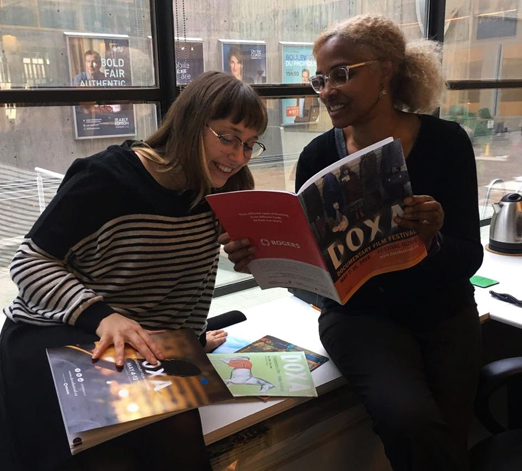
DOXA Documentary Film Festival Director of Programming Selina Crammond consulting with DOXA Operations and Volunteer Manager, Gina GarenkooperDOXA Documentary Film Festival Director of Programming Selina Crammond (left), and DOXA’s Operations & Volunteer Manager, Gina Garenkooper. Photo credit: Milena Salazar.

After a full year of preparing for DOXA 2019, VanRamblings believes that Selina Crammond is deserving of recognition for her critically important work in the arts, and across our community to makes ours a better world, and a more understanding love-based world. Therefore, VanRamblings officially declares today, Friday, May 3rd 2019 Selina Crammond Day (we’re sure our Vancouver City Council will be on board for next year!).

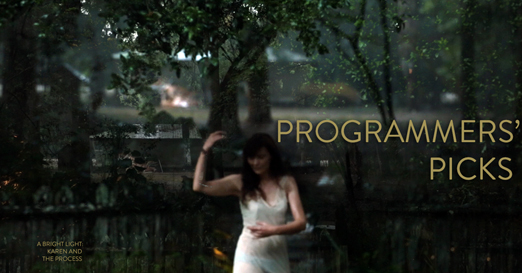
DOXA Documentary Film Festival 2019 Programmer Picks

Here are a couple of the DOXA 2019 Programmer’s Picks

Selina Crammond’s pick …

Midnight Traveler
After receiving threats from the Taliban, filmmaker Hassan Fazili, his wife and their two young daughters are forced to flee their home in Afghanistan and seek refuge in Eastern Europe. Intimate, and often shaky, footage shot by the family on their iPhones captures a wide range of moments, from startling racism in eastern Europe – to meditative reflections on Fazili’s love of cinema. The result is a portrait of a resilient family that offers a very human face to the ongoing refugee crisis.

Midnight Traveler, DOXA Documentary Film Festival, May 11 & 12 2019

Hassan Fazili, Emelie Mahdavian | US/Qatar/Canada/UK | 2019 | 87 min.
Saturday, May 11, 2019 - 6:30pm
Vancity Theatre (1181 Seymour Street)
Sunday, May 12, 2019 - 6pm
Cinematheque (1131 Howe Street)

star.jpg star.jpg star.jpg

Joseph Clark’s pick …
Instructions on Parting
Prepare to be devastated. Instructions on Parting is an emotionally challenging film, that is at once hand-crafted and cinematically stunning. Rarely has such an intimate film demanded to be seen on the big screen.

Amy Jenkins | US | 2018 | 95 minutes
Wednesday, May 8, 2019 - 8pm
Vancity Theatre (1181 Seymour Street)


Click here for the DOXA Documentary Film Festival 2019 Twitter account, and hashtag

Click on the graphic above to be taken to the #DOXA2019 Twitter account.

#DOXA2019 will present 82 films from across Canada and around the world, representing the very best in contemporary documentary cinema. Get your tickets at www.doxafestival.ca. Better hurry. Quite a few #DOXA2019 screenings are already sold out, or have limited tickets remaining for the scheduled screenings.
Here’s the full schedule. See ya at #DOXA2019. Bring your dancin’ shoes!

DOXA Documentary Film Festival 2019 Twitter account, and hashtag

Arts Friday | Diane | Teen Spirit | Finest Films Released This Year

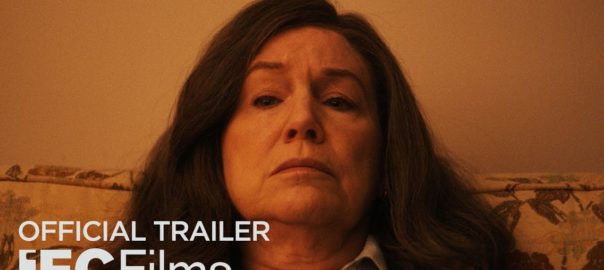
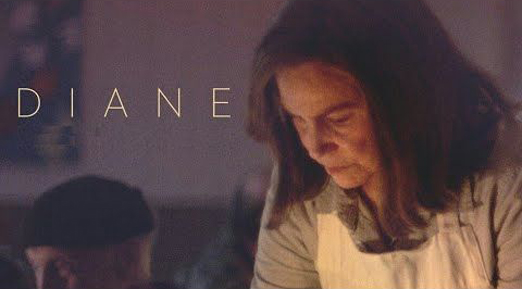
Diane, a new film by writer-director Kent Jones, starring Mary Kay Place as the titular character

Opening today for an eight day run at the Vancouver International Film Festival’s well-loved Vancity Theatre (on Seymour, just north of Davie Street, and across from Emery Barnes Park), the film considered by many film enthusiasts to be the best 2019 film released in what, to date, has pretty much been a fallow year for those among us who love cinema — and that special film of which we write is Diane, a certain awards winner come year’s end, most especially for the film’s star, Mary Kay Place, who according to Vancity programmer Tom Charity, “gets the role of a lifetime.”
As Variety’s lead film critic Owen Gleiberman writes

“Diane is a tender, wrenching, beautifully made movie, a haunting first dramatic feature from Kent Jones, and the most accomplished dramatic feature screening at this year’s Tribeca Film Festival, a majestic film and a vision of turmoil, peace, mystery and memory, built around Mary Kay Place’s remarkable performance, along with something that hasn’t always accompanied this generation’s journey into old age: a glimpse of God.”

Hollywood Elsewhere’s Jeffrey Wells has been raving about Diane since the beginning of the year — seems that he’s not alone in his enthusiasm, what with the 94% Rotten Tomatoes score the film has achieved.
Ty Burr, in the Boston Globe writes that Diane is “a quiet a tour-de-force”.

Part of Mick La Salle’s review in the San Francisco Chronicle reads …

“When I was a kid, my grandfather said something to me that I never forgot and that applies to this movie. ‘I’m 67,’ he said. ‘Twenty years ago, I was still a young man, and now I’m an old man.’ Diane is about something like that. It’s about the experience of early old age, the point in life where the memory and the identity of being young remain as fresh as ever, but the realities of aging are beginning to kick in.”

Some films you want to discover for yourself, without reading too much about it in advance, so that the film is fresh on the screen for you, and the process of discovery and revelation becomes deeply invested in you.
Diane, now screening at The Vancity, is one such film.

star.jpg star.jpg star.jpg

Teen Spirit. Starring Elle Fanning.

Teen Spirit, which only a handful of people will see (alas), is VanRamblings favourite film of 2019, and certain to make our year end ‘best of’ list, an entirely revelatory and transformative, if small, British independent film starring the actress of her generation, the luminous Elle Fanning, who unlike Rami Malek in Bohemian Rhapsody actually does her own singing.
Ms. Fanning plays Violet, a sensitive British 17-year-old who lives with her mother (Agnieszka Grochowska), a Polish immigrant, on the Isle of Wight. Aside from a beloved horse and her long disappeared father, not much defines Violet beyond her passion for music.
Violet’s days revolve around school, being mocked by the Island’s pretty-girl jerkettes, a dreary after school job at a local restaurant, helping her financially strapped and sullen mom manage their small family farm, and occasionally sneaking out to sing at a local pub.
Signing up to audition for a British pop show called “Teen Spirit,” director Max Minghella (an actor himself and the son of the late director Anthony Minghella of The English Patient, and The Talented Mr. Ripley) and cinematographer Autumn Durald Arkapaw during the film’s 92-minute running allow the audience to witness the beginnings of a young woman’s dreams of music making, giving a reluctant Violet the star treatment.
As Jesse Hassenger writes in his review in Slate

Teen Spirit may be about a singing competition, but this raw, slice of life film never devolves into the cynical undertaking you might expect. It’s refreshing, too, that Teen Spirit doesn’t view its heroine exclusively in terms of gatekeeping credibility, nor does it romanticize Violet’s life or the journey she’s on, which is to say that fortunate for us, Teen Spirit never sacrifices complexity on the altar of poptimism.”

Jeanette Catsoulis in her Critics Pick New York Times review writes of Violet, “the music might belong to Robyn and Ellie Goulding, but the journey from insecure child to tentative adult is all hers.”
Playing once daily, at 9:55pm, at Cineplex International Village.