Category Archives: #CdnPoli | Canadian Politics

#VanPoli | Homelessness + Housing | A Series | Part 1

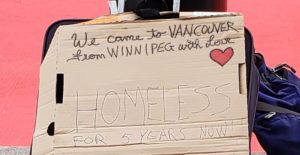
Each and every year for the past two decades, and more, hundreds of new homeless persons arrive on our shores to call Vancouver their new home.

These homeless persons, arriving without any money or resources, come down to Vancouver from the north of our province, from the Okanagan, Vancouver Island or some other provincial locale. More of the newly arrived homeless make their way to Vancouver from the Prairies, Ontario, Québec or the Maritimes, more often than not having been provided with a bus / train or plane ticket furnished by their provincial social services Ministry, having been told, “Go west, where the skies are blue, the weather warm, the people friendly, and the streets are paved with gold.”

A surprisingly large contingent of Vancouver’s new homeless arriving in our city each year, somehow make their way across the U.S. borders to both the north and south, arriving (mostly) from California — but, as well, from a polygot collection of other U.S. states — as well as from Mexico, and Central and South America.

Then, there are Vietnamese, Thai, Indonesian or Filipino citizens who jump ship (or who were onboard for the long journey across the Pacific, as stowaways) to arrive in Vancouver, here to stay, they hope, here to make Vancouver their new home.
Upon arrival, these émigrés to our lustrous Pacific shores often make contact with one of the hundred or more outreach workers populating the downtown eastside, those angels of mercy helping the newly arrived find a place to stay, registering them for social assistance, or persons with disability coverage, making sure that they’re covered by B.C. Medical, ensuring their needs are otherwise looked after.

Then, among the newly arrived émigrés, there is the contingent who want to stay under the radar: the heavily drug dependent, and the drug dealers.

Apart from Vancouver’s (mostly) good weather, the other key reason this new homeless population moves to Vancouver relates to the ready availability of drugs. Vancouver is North America’s largest drug distribution centre. Heroin arriving from Afghanistan through Amsterdam will find its way to Vancouver, to be carried across the continent. The raw ingredients to make fentanyl arrives in Vancouver from China (the Canadian government long ago staunched the supply of raw fentanyl into Vancouver … now fentanyl has to be “mixed”, locally, in Vancouver).
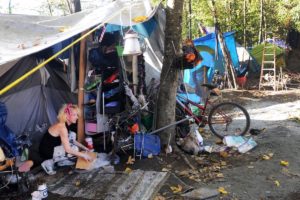
Of the new arrivals each year, approximately one-third of the new “out of town” homeless population remain in Vancouver, many sleeping in doorwells, under park benches, in alley ways, in garages, loading bays, under bridges, in and around Jericho or Stanley Parks, or have found themselves shelter, or life in an SRO.

Many others make their way to municipalities across the Metro Vancouver region, mostly to Surrey and Burnaby, but as well to the Tri-Cities (Coquitlam, Port Moody and Port Coquitlam), Ladner, Langley and Richmond, Haney, Maple Ridge and Pitt Meadows, not to mention the North Shore.
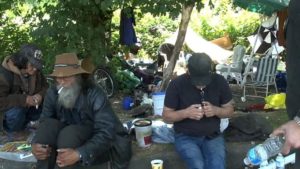
A contingent of members of the Vancouver homeless population make their way into the Fraser Valley (as far out as Chilliwack, Agassiz and Hope) or over to Vancouver Island — mostly Victoria, Nanaimo and Duncan, but across the entire Island, as a whole — with a sizeable number heading to the Okanagan’s inviting climes.

A remaining number of homeless persons return home — with the provincial government, more often than not providing the fare home — having enjoyed (or not) their brief vacation on the west, with a smaller number deported or in jail.
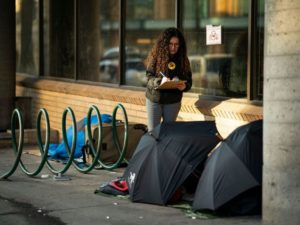
All of the above is by way of saying, when the annual Homeless Count is conducted each March, the number of homeless persons always rises, sometimes by substantial numbers, and not because it’s persons — seniors, or others — who have found themselves evicted from their apartments because rents have become too high, or young people who have aged out of the care system (or lack thereof) provided by the province of British Columbia.

Rather, this is a sorry tale of human misery.

In some sense, then, the problem of resolving Vancouver’s homelessness crisis would seem irresolvable — the more housing that is built, the more modular housing structures constructed, the more hotels purchased by the province, the more SROs that are renovated by the province to make this kind of congregate housing livable, the more shelters that are made available, the more homeless persons who will arrive on our shores, this year, and  all the years beyond.

Today’s VanRamblings’ column is not prescriptive, nor do we attempt to provide historical context — we’ll do that later in the week, plus offer what we feel may be a short term fix to help alleviate the lives of human misery for persons who are living at a bare subsistence level,  as VanRamblings sets about to present an historical context dating back decades, through until today.

#VanPoli | Taxes | Downloading the Tax Burden to Municipalities

In a disparaging VanRamblings story published last week on this site —  titled Vancouver City Council To Raise Property Taxes a Whopping 6.35% — we took Vancouver City Councillors to task for raising property taxes in our city beyond what most homeowners, small businesses, and landlords could reasonably afford.

Now, as it happens, VanRamblings is a big fan of taxes which, in good measure, pay for: our schools, from kindergarten through university post-graduate work; roads, highways, bridges and other transportation infrastructure (including public transit); our judicial and public safety systems (the courts, police, fire firefighters, paramedics, prisons); ‘social programmes’ including all aspects of child care (encompassing children in the care of the province, when family structures have broken down); all aspects of our vibrant health care system; and much, much more.

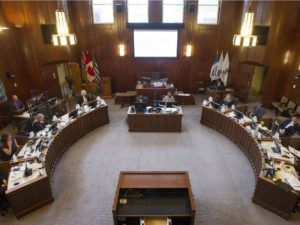
To be fair to Vancouver Mayor Kennedy Stewart, and the five Vancouver City Councillors who voted in favour of the 6.35% property tax increase in 2022 — that would be the three Green Party of Vancouver City Councillors, Pete Fry, Adriane Carr and Michael Wiebe, OneCity Vancouver’s Christine Boyle and COPE’s Jean Swanson —  as is our wont, today we’ll publish one of our infrequent “history lessons” to explain, at least in part, the rationale as to why the Mayor and five City Councillors cast their vote in favour of a  6.35% property tax increase for 2022.

In 1984, Conservative Party leader Brian Mulroney was elected as Canada’s 18th Prime Minister, supplanting a Liberal Party of Canada that had been in power for 21 consecutive years, Canada’s 33rd Parliament in the autumn of 1984 consisting of 202 Tories, 135 Liberals, and 31 New Democrats. During Mr. Mulroney’s nine years in power, his government had many successes, on the environment and on the trade front, negotiating a groundbreaking free trade agreement with the United States. Contrary to billing, more often than not, Conservatives in power tend to be spendthrifts, all while cutting taxes for corporations and the wealthy, and failing to keep an eye on the federal budget.

In the midst of a deepening recession, when Mr. Mulroney stepped down as Prime Minister of Canada on Friday June 25, 1993, apart from and in spite of the then wildly unpopular 7% Goods and Sales Tax (GST) his government had brought in, Mr. Mulroney left his successor, Kim Campbell, with the legacy of a multi-year $42 billion annual budget deficit — a grim sum absolutely unheard of in those days.

Only four short months later, on Monday, October 25th, 1993 Joseph Jacques Jean Chrétien was elected as Canada’s 20th Prime Minister. First order of business? Appoint a Finance Minister, and commit to not only eliminating the egregious annual deficit, but cut the accumulated $840 billion long term Mulroney legacy debt in half. Who would perform that masterful fiscal feat? The head of Canada Steamship Lines, from 1988 forward the Member of Parliament for the southwestern Montréal riding of LaSalle-Émard, and Prime Ministerial aspirant, Paul Martin.

In Canada, long ago the federal government negotiated what became known colloquially as a tax rental agreement with the provinces. The federal government would collect income taxes from Canadians, take a portion for federal coffers, while transferring the majority of the federal tax income collected back to the provinces. For years, back to 1945, the agreement worked well for all levels of government — until 1996, when Finance Minister Paul Martin “changed the game”.

In the 1995 federal budget Jean Chrétien’s Liberal government abandoned any pretense of federal financing of post-secondary education, changing what was known as the Canada Social Transfer into the renamed the Canada Health and Social Transfer(CHST), cutting a total of $3.5 billion in the CHST for the 1996/97 fiscal year. The total cuts to the provinces in the first five years Jean Chrétien was in power: $7.6 billion in transfer payments that would otherwise have gone to the provinces, or a devastating decline of 40.7% in health, education and other transfer payments to the provinces by the 1999-2000 federal fiscal year.

All of a sudden, the provinces were made almost entirely responsible for the largest provincial budget item: health care, and entirely responsible for funding post-secondary education, federally-funded programmes that had been in place since as far back as the end of World War II.

The good news for the federal government: by 2003 federal Liberal Finance Minister Paul Martin had not only eliminated any notion of an annual federal budget deficit — instead, creating a yearly surplus —  but had, as well, paid down $440 billion in long term debt, cutting the federal debt in half as Jean Chrétien had promised a decade earlier. The bad news for the provinces: provincial Premiers and their Finance Ministers had to come up with funds to make up for the lost / eliminated “tax rental agreement” revenue that funded provincial programmes.

Provincial governments made up for the lost federal revenue by creating, or dramatically raising, provincial sales taxes, instituting or raising fees for every imaginable service, from driver’s licenses to camp ground fees, along with instituting bridge and road tolls while looking to any other sources of revenue provincial Finance Ministers could come up with to make up for lost federal funding.

The major source of newfound provincial revenue: municipalities. If the federal government had download responsibility to the provinces for health care, housing, and post secondary education, provinces sought to gain revenue from the towns, villages and cities that filled the landscape of their provinces. All of a sudden, cities, towns and villages were almost entirely responsible for the provision of affordable and social housing, social programmes, child care, road construction and maintenance, and other infrastructure (sewers, provision of clean water), and any number of programmes previously almost the sole responsibility of the provinces.

Where senior levels of government may run deficit budgets, cities, towns and villages, school boards, and Vancouver’s Park Board are required to run an annual balanced budget. With responsibility for programmes previously funded by the province now the responsibility of municipalities, cities, town and villages scrambled to find the required revenue, which translated into: skyrocketing parking rates and extended paid parking hours, dramatically increased parking fines, and skyrocketing development permit fees for homeowners and developers alike — and, what is known as Community Amenity Contributions by developers paid to the city to fund child care centres, neighbourhood recreation centres, as well as social and affordable housing, and a variety of arts and other programmes.

Here, then — as may be seen in Councillor Boyle’s tweet above — was the dilemma faced by Mayor Kennedy Stewart and our City Councillors when, last week, together our elected civic leaders voted for a 6.35% property tax increase for 2022, to fund not just core programmes, but the programmes that determine the livability of our city, and also fulfill the election commitments made by the Mayor, the three Green Party City Councillors, and our OneCity and COPE Councillors. Last week, for Mayor Stewart and five of our Councillors, conscience won out over fiscal restraint.

#CdnPoli | Why Did Prime Minister Justin Trudeau Call a Summer Election?

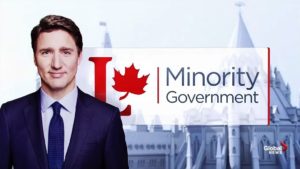
The most frequently asked question over the course, and throughout the duration, of the summer election called by the Prime Minister: why did Justin Trudeau call a needless summer election — particularly when, on Election Day, the final electoral result was a continuing minority Liberal government?

Internal Liberal Party polling conducted last spring, and throughout the summer, registered Justin Trudeau and the Liberals with a 45% approval rating, with Trudeau one of the most well-liked and respected Canadian Prime Ministers since Confederation. In the summer, within the Prime Minister’s office, the pressure on Trudeau to call a snap election was immense.

Prior to the 2021 federal election, the Liberal Party held 154 seats in a Parliament of 338 members. Pragmatically, what that meant for the Liberals was that all of the Committees of the House had majority Opposition party participation, and more importantly, decision-making power that could be — and more often than not was — wielded by the Opposition as a cudgel to serve their own partisan interests: the Conservatives, NDP, Bloc Québécois, and Greens, those parties less interested in the welfare of the Canadian people than scoring points against the government.

As they did during the election, in a display of rank partisanship and future, hoped-for increased electoral success,  and possibly government, the elected members of Erin O’Toole’s Conservative Party and Jagmeet Singh’s NDP colluded to make the life of the government as miserable as possible, using the committees not simply to hold the government to account, but to do all in their power to create an impression that Justin Trudeau’s government was both ‘do nothing’, and corrupt.

Little wonder Prime Minister Justin Trudeau wanted to call a summer election.

Why did Justin Trudeau call a summer election, then? To recap …

  • Throughout the first 8 months of the year, the Liberals had been riding high in the polls, Canadians grateful for the quick action by Prime Minister Justin Trudeau to secure the economy, through the introduction of CERB for Canadians who found themselves out of work due to the pandemic; the introduction of both a seniors grant for the poorest seniors, and an ongoing monthly supplement to the Canada Child Benefit to help families weather the storm of the pandemic; and the introduction of any number of business support programmes to keep the Canadian economy afloat. And, of course, securing the tens of millions of COVID-19 vaccine doses that would keep Canadians safe, and help over time to bring COVID-19 to an end. Thus far, more than 60 million doses of the mRNA Pfizer, Moderna, and the AstraZenica and Janssen vaccines have been administered to Canadians 12+, with millions more doses to be made available for children aged 5 to 12 years;
  • Focus on the economy and the health of Canadians rather than continue to allow the Conservatives and the NDP to play the sort of unproductive partisan politics that not only made the life of the government more difficult, but in having to respond to the partisanship of the Tories and the NDP on the Committees of the House, inhibited the Liberals from governing as effectively as the government deemed necessary, and to serve the best interests of all Canadians. A majority government, had that been the result of the September 20th election, would have made the life of the government easier, while still allowing the Opposition to hold the government to account.

In respect of the Trudeau government not being able to secure a majority, make no mistake: Shachi Kurl cost the Liberals a majority government.

Going into the English Leaders’ debate, the Bloc Québécois had lost their footing, with all polls showing them unable to retain more than 10 seats in Parliament, for a loss of 22 seats. The support of Québeckers had moved virtually wholesale to hometown boy Justin Trudeau and his Liberal party — which looked to pick up most of the lost Bloc seats, propelling them to a majority government. Then Ms. Kurl asked a damnedly poorly phrased question concerning Québec Bill 21 — banning Québec citizens from wearing religious symbols, and mandating that one’s face be uncovered to give or receive specific public services — the contentious nature of her question propelling the Bloc into a stratospherically high 32-riding seat count, costing the Liberals their much sought after majority.

One final point: the opportunity to exercise our franchise, to go to the polls and cast our ballot in seclusion, to hold our government to account, is central to our nation’s democracy. No election held in Canada, or elsewhere, is ever unnecessary. The opportunity to go to vote in an election is both our democratic right, and at the core of our democracy. Following a 35-day election period, Canadians went to the polls, and collectively decided that a continuing minority government for the Liberals would be for all of us the best possible outcome, and voted accordingly.

#CdnPoli | Erin O’Toole | The Times and Travails of Canada’s Tory Leader

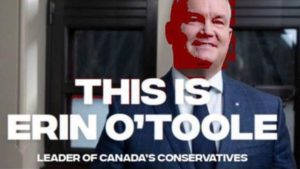
Poor Erin O’Toole, the beleaguered leader of the Conservative Party of Canada.

When Mr. O’Toole ran for the leadership of the Conservative Party of Canada, or order to defeat his  main rival, Nova Scotia’s Peter MacKay — a well-experienced senior Minister of the Crown in the near decade the Conservatives held power in Ottawa, from early 2006 through until late 2015 — Mr. O’Toole fashioned himself as a True Blue, Harperite social conservative who, although he would not allow a vote on abortion on the floor of the House of Commons were he to become Prime Minister of Canada, stood with and for the socially conservative values held by many members of the Conservative Party.

In a ranked ballot vote held on 0, in order to secure victory and the leadership of the Conservative Party, the former Minister of Veterans Affairs in the Stephen Harper government, Erin O’Toole, explicitly sought the support of socially conservative leadership hopefuls, Leslyn Lewis and Derek Sloan, to secure the winning votes in the 3rd round of voting, with 19,271 winning ballots cast in his favour, with his rival MacKay securing only 14,528 votes.

First time leadership hopeful, Leslyn Lewis, had finished in third place on the second ballot with 10,140 votes — many of those votes going to O’Toole on the third ballot. Sloan finished last on the first ballot, with 4,864 votes. Mere months later, on January 18, 2021, Erin O’Toole kicked Derek Sloan out of the Conservative caucus. Note should be made that when Mr. O’Toole recently appointed elected members of the Conservative Party to form the Opposition’s Shadow Cabinet, social conservative Leslyn Lewis did not make the cut.

During the recent federal election, much to the chagrin of the Conservative candidates seeking election or re-election, when Erin O’Toole released the Conservative Party platform early in the campaign, in mid-August, Tory candidates were taken aback that the party’s platform came out foresquare in favour of a carbon tax — contrary to long standing Conservative party policy.

In fact, the Tory platform read, as many disgruntled Conservative Party members complained, as a “red” document, or a Liberal Party lite policy document.

In order to win over Canadians who live in the vote rich Metro Toronto and Metro Vancouver regions of Canada, Erin O’Toole had created a platform document that almost entirely jettisoned Conservative Party dogma, and where it didn’t, during the course of the election campaign, O’Toole “re-adjusted” Tory policy on the fly, all in the hopes of securing centrist urban votes.

The appeasement strategy did not work — under O’Toole’s leadership, the Tories lost four  Metro Vancouver seats, while standing pat in Metro Toronto, where the Liberal Party went onto win a near overwhelming victory.

Erin O’Toole’s Conservative Party enters the House of Commons down two seats, in a party riven by division, with a petition launched days ago by prominent Tory Senator Denise Batters calling for a leadership review within 6 months, specifically pointing to Mr. O’Toole’s loss of the 2021 federal election, and his party policy reversals during the course of the election campaign.

To make matters worse for Mr. O’Toole, as the 44th session of the Canadian Parliament gets underway, at a press conference held yesterday morning in Ottawa, Government House Leader Mark Holland told reporters that he believes it would be “statistically improbable” for several Tory MPs to have valid medical exemptions to COVID-19 vaccination — and those who do have them should provide “assurances” they were given for legitimate reasons.

“The Conservative caucus is 119 people,” Mr. Holland told reporters. “Statistically, the likelihood that they would have multiple people who are exempt … is extraordinarily low. There might be some possibility of it but I suppose there’s a possibility that that chair could fly,” he said, pointing to a chair in the room.

If one Conservative MP is claiming an exemption, Holland said, that is “exceptionally unlikely but possible.” More than one Conservative MP claiming an exemption, he said, would be “statistically impossible.”

To be fair, Erin O’Toole’s centrist position on the issues will play much better with the electorate and all but assure the Conservatives victory at the polls, when voters tire of the Liberal Party. Politics is like major sport, though: you’re ‘hired’ … only to be fired at some point in the not-too-distant future.

Still and all, Mr. O’Toole is hardly signaling defeat at the beginning of the current session of Parliament.

Mr. O’Toole has stipulated that battling inflation will be top of mind, by re-naming Mr. Mean, Pierre Poilievre, as his finance critic earlier this month. Poilievre has repeatedly warned about the risk of inflation during the pandemic, and has lately taken aim at the $101.4-billion stimulus package promised in the spring budget, which he now dubs the “$100-billion slush fund.”

In an interview on Friday, O’Toole told National Post columnist John Ivison that his party’s major focus will be on “the economic situation in the country.”

“There’s an inflation crisis, there’s lack of confidence, wages are flat, the cost of everything is going up, so people are actually losing purchasing power as if they were getting their wages cut, and we’ve never seen the country more fractured,” O’Toole said.

Tory House leader Gerald Deltell has said his party was supportive of the initial emergency spending on COVID-19 aid measures because of the unprecedented lockdowns that decimated the economy and forced businesses to close.

But the Tories will now argue that the government was too slow to adjust to changing circumstances, pumping too much money into the economy while running up massive deficits. The result, Deltell has said: businesses are having trouble finding workers & Canadian families are getting hit with rising prices.

For the most part, though, Mr. Deltell told reporters in a press conference held in Ottawa last week, that he could not get into whether his party will oppose various government policies until he sees what’s actually put forward on paper by the Liberals. The Conservative caucus met for two full days prior to the beginning of this session of Parliament to build a strategic political game plan.

“We have a strategy behind each and every issue,” says Deltell. “I can’t be wide open on the strategy right now.”

Here’s CPAC’s Peter Van Dusen in discussion on Parliament’s return, with the Toronto Star’s Susan Delacourt, the National Post’s John Ivison, and Globe and Mail Ottawa Bureau Chief, Ian Bailey …

See you all back here tomorrow. Thank you for reading VanRamblings.