Raymond Tomlin is a veteran journalist and educator who has written frequently on the political realm — municipal, provincial and federal — as well as on cinema, mainstream popular culture, the arts, and technology.
View all posts by Raymond Tomlin →
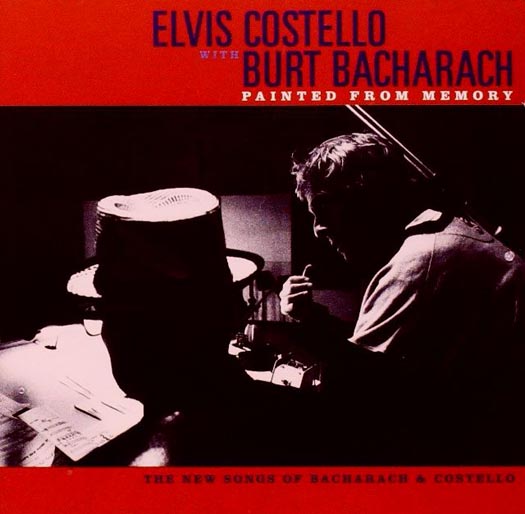
The perfectly matched, heartbreaking, heavenly collaboration between Elvis Costello and Burt Bacharach, Painted from Memory, the pop-music masterpiece, was released on the 29th of September 1998 — slightly old-fashioned, yet insistently clear and capable of flooding the heart with all the awful beauty of love’s highs and lows … mostly lows … “In the darkest place,” it all begins, “I know that is where you’ll find me” — remains to this day one of my favourite albums ever, one I go back to again and again.
The people we meet on the album who move through these 12 perfect pop songs aren’t teenagers tasting first-love tears.
They’re grownups who know what they’ve done to themselves, their hearts broken, who are now enveloped in a realm we’ve all visited from time to time, a dimension where time ticks away just a bit more slowly and the world passes by at a remove. They are displaced and disconnected, seen only in fine silver frames, distant cities or watching from afar. They live in empty houses, waiting for sleep to come to take them somewhere else, and all this they do to music meticulously crafted by two experts of the form.
Neither producer Burt Bacharach nor composer Elvis Costello is a stranger to collaboration, but together they are a singular pairing, as Costello brings discipline and edge to Bacharach’s lush melodic outpourings, while Bacharach returns the favour by setting Costello’s exacting progressions and taut wordplay in soundscapes that are both intricate and silky smooth.
Take, as a spectacular example, the gorgeous ballad What’s Her Name Today?, a Costellian pondering on the ruin brought about by those in pain that’s not so much backed by Bacharach’s purposeful grand piano as admonished — you’re a fool it declares, before sweeping up the whole affair into a whirlwind of strings and human wreckage.
Other times, they’re more sympathetic, deploying Bacharach’s famous mellow trumpet to harmonize with the vocals on the tricky tale of infidelity Toledo, or winking at the conceit of The Sweetest Punch by threading the tune with chimes, a lovely instrument you have to hit, with mallets.
In the song above, the horns say a little prayer, below … the bells chime.
The sum of this artistic one + one is more than strictly musical. By coming together when they did, each man underwent a kind of recalibration whereby the sheen of kitsch acquired by Bacharach’s body of work since his ’60s heyday was stripped away, and Costello, then in his mid-40s, shed the last lingering remnants of his image as an angry young man.
In turn, Painted from Memory itself became a bridge, connecting classic works of love and loss — think Frank Sinatra’s ninth studio release, 1955’s concept album, In the Wee Small Hours — to the wave of pop-jazz new schoolers (Norah Jones, Michael Bublé) that followed closely in its wake.
Costello and Bacharach know that opening yourself up to the sentimental side of life exposes you to its cruelties as well; it takes courage, so Painted from Memory concludes with a plea for fortitude and grace. God Give Me Strength — which they wrote over the phone lines — is the first of the pair’s dual efforts and it remains one of the best, an achingly gorgeous last-stand waltz through the end stages of grief. “That song is sung out,” it concedes, “this bell is rung out.” Except that it isn’t, because there’s something in all of us, the part Painted from Memory renders so well, that will always wait for the bell to ring. That damned, beautiful bell.
When Megan Jessica Tomlin was born on a Saturday night, March 26th, 1977, at Burnaby General Hospital at 10:26pm, given that she was a breach birth, the hospital room was filled with a harried collection of nurses and doctors & an anesthesiologist who’d been called to assist with the birth.
As a medicated Cathy lay peaceful, laying stock still on her white-sheeted hospital bed — given that she was infused with anaesthetic drugs to aid in the birth, to keep her sedated for what turned out to be her second, very difficult birth — upon delivery, a nurse gathered my new daughter, Megan, and brought her over to me, as I stood to Cathy’s left, just behind where her head lay, and handed my hushed newborn daughter into my arms.
For the 10 minutes that followed, a seeming lifetime of remembrance and love, Megan her eyes all blue peered directly into my eyes and deep into my soul, and for those few brief moments I into hers, as my daughter imprinted on me as the father who would become in her early years, and in succeeding years through to her late teens, the single most transformative person in her life, a father she trusted & loved with all her generous heart.
In the weeks that followed Megan’s birth, the wheels began to fall of the bus that was my marriage to Cathy, as Cathy seemed to lose herself, quitting her job at the Ministry of Human Resources office, drinking, staying out all night long, and otherwise engaging in self-destructive behaviour.
Why?
Given my position as the British Columbia Teachers’ Federation Learning and Working Conditions Chair for the Interior, and my long years of work previous with the Federation, and the great relationship I’d developed with Linda Shuto — working with her to form the first Status of Women office within an NGO anywhere on the continent — as well as BCTF President Jim McFarlane and, more especially with BCTF VP Don Walmsley, as you might well expect from a Federation comprised of mainly older members, Executive plans were afoot for Federation generational leadership change — and I targeted as the person who would become a future BCTF President.
Don Walmsley visited Cathy and me multiple times throughout 1977, in our newly acquired Interior home, to advise the both of us that plans were in process to, at the spring BCTF AGM in 1978, run me as a second vice-president of the Federation, with an eye to soon becoming BCTF President.
Here’s how the Federation saw it, Don explaining to the both of us: my organizing bona fides in the Interior had gained provincial attention, Cathy and I were a young couple “from the Interior” (the left on the Federation liked the idea of running candidates from rural areas), Cathy was a professional, was sophisticated and presented well, we had two children — we were, as far as the Federation was concerned, “the perfect couple”.
Here’s what Don Walmsley told Cathy and I …
“Next year, Raymond, we’ll run you for 2nd VP. Cathy, you can run as a Board of Education COPE trustee candidate for Vancouver School Board. Raymond, we’ll find you a job in Vancouver, find you a house, and Cathy we’ll make sure you’re employed, as well, finding you a job in the city similar to what you’re doing up here. Next year (1978), once you’re on the Executive, Raymond, and have moved down to the city, you’ll be closer to the Federation offices. In 1979, we’ll run you for 1st VP, and depending on how the election goes for President of the Federation, if our candidate loses, we’ll run you for President in 1980. If our candidate wins, and serves a three year term, we’ll run you for President in 1983.”
Sounded good to me — and not so good to Cathy, as elucidated above.
Once Don had left our home, Cathy told me that she had no intention of having the next 20 years of her life being planned by the teachers’ federation, nor was she enamoured of the idea of living in my shadow. Understandable.
You know how when you’re watching an awards show on TV, and the winner is (almost invariably) a man, the first person he thanks, whom he gushes over, is his wife, saying ardently, “I couldn’t have done it without her — she’s been my rock, and has stood by my side throughout the entire journey that has led to tonight. I will love you for always, my beloved.”
Believe me when I write: Cathy was having none of that arrant palaver.
Long story short, by early 1978, I had been awarded custody of both Jude and Megan, Cathy was off gallivanting around the globe with a drinking & carousing rock ‘n roll band — and I was left to raise two infant children.
From the outset, Megan was a bright and engaged child, far ahead of her milestone maturational markers — walking at 9 months, speaking at age 1, reading at 18 months — and by the time she was two years of age, as in control of her environment as any 11-year-old child of my acquaintance.
Where Jude — 21 months Megan’s senior — wanted to be out and about all the time, one of the friendliest, most gregarious and social children you’d ever want to meet, Megan was quiet, reserved, pensive and thoughtful, as big a “daddy’s girl” as could possibly be imagined, by my side throughout the day, and separated from me only when she was in daycare, or asleep.
As Cathy and I often remarked to one another as Megan was growing up, “Whose child is this, anyway? Megan certainly can’t be ours — she’s just so much brighter & more capable than either of us, or both of us combined.”
For me, there has never been anyone to whom I have been closer, who has understood me and “had my number”, with whom my relationship has proved more loving & honest than has long been the case with Megan & I.
We acknowledge — as if we have known each other across many lifetimes — that we have found one another on this Earth, in this lifetime, and as I josh Megan by referring to her as her very own diety, in this life the two of us take succour in the knowledge that we love one another, know one another, that as we live lives that are separate, Megan now married with children, and me in my west side home spending hours each day writing stories just like this, that as we run across one another from time to time, as we often do in my Kitsilano neighbourhood, that the first words each of us will utter will be, “I love you” — as we set about to continue our day.
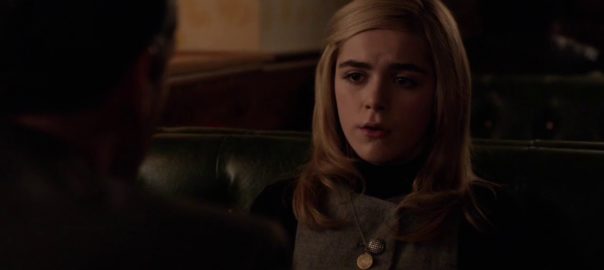
</ br>The knowing glance tells you everything you need to know about fathers & daughters
All animation, whether it depicts a whistling mouse, a walking dinosaur, or a leaping superhero, is a kind of magic trick. It’s right there in the name of one of the earliest devices used to project slides: the magic lantern.
If you take an image of an open hand and an image of a fist and project the two in sequence, you’ll convey the illusion of a clench.
“What happens between each frame is more important than what happens on each frame,” Scottish-Canadian experimental animator, the late Norman McLaren — a director and producer with the National Film Board of Canada (NFB), and a respected pioneer of hand-drawn animation and drawn-on-film animation — once explained, stating that ‘Animation is the art of manipulating the invisible interstices between frames.”
Arising from VanRamblings’ coverage this week of the meaning behind the majority BC NDP win in the recent provincial election, we failed to make mention of International Animation Day — which occurred this past Wednesday, October 28th — celebrated by the National Film Board of Canada through the streaming of 12 films, all of which are permanently available now – for free viewing – on the National Film Board website.
As Mercedes Milligan wrote this past Tuesday in Animation Magazine …
Now in its 14th year, this annual NFB event gives Canadian audiences the opportunity to explore a host of new works by Canadian and European filmmakers working in the National Film Board’s cutting-edge, internationally renowned studios. The rich 2020 selection puts women in the spotlight — both female directors and strong female characters — and features a wealth of different animation techniques.
</ br>Vancouver-based animator Ann Marie Fleming’s new animated short, Old Dog
Made by world-renowned animators, the outstanding animated films in this year’s International Animation Day programme have won prestigious awards and screened throughout the global festival circuit.
Long one of VanRamblings’ favourite arts and culture writers, Katja De Bock is now a publicist with the NFB (lucky, lucky them!). Here’s what she wrote to VanRamblings earlier in the week on one particular film she cherishes …
Old Dog, the latest film by Vancouver’s Ann Marie Fleming, started off as a way of talking about aging, inspired by Ms. Fleming’s namesake, Ann-Marie Fleming, whom she often gets mixed up with in Internet searches.
Ann-Marie has a company in 100 Mile House, B.C., that makes technologies for aging dogs, and also for their humans. Animator Ann Marie was struck by the compassion her namesake has for these vulnerable animals, as she helped them to navigate the latter stages of their lives, and by how much dogs have to teach human beings.
The COVID-19 pandemic made Ms. Fleming (the animator), whose elderly parents live overseas, reflect on how we take care of our elders and how our global values are being put to the test.
According to Ann Marie, animation is the perfect medium to tell this story. It makes the experience of the human and the dog more universal and helps us understand the unbearable lightness of being.
Now, as it happens Ms. De Bock informs us — and now, you — Old Dog is also featured at this year’s SPARK Animation Festival in Vancouver — which, by the way, began yesterday, and is set to run through Sunday, November 8th, and in addition to films will feature workshops, panels and talks by the world’s most talented artists, directors, and studio luminaries.
This year’s SPARK Animation Festival pass is only $25 — which will give you access to the dozens of films SPARK has on offer in 2020.
Guess what VanRamblings is going to be doing for the next nine days!
On Arts Friday, VanRamblings will leave you with this special treat …
In today’s wrap-up coverage of Decision 2020, in the main, we’re going to turn the column over to the reflections of others who’ve weighed in on the recently-completed, but not yet over, British Columbia provincial election.
That said, before we move to the observations of others, VanRamblings would like to weigh-in on what we consider to be the historic re-alignment of politics in British Columbia, and what that means for us going forward.
John Horgan assumes the leadership of the B.C. NDP on Thursday, May 1st, 2014
Since being acclaimed the leader of the B.C. NDP on May 1st 2014 — replacing Adrian Dix, who had failed miserably in the 2013 provincial election — John Horgan has taken the British Columbia New Democratic Party to the centre of the political spectrum, assuming the ground occupied by the B.C. Liberals as a resource extraction, pro-LNG, Site C dam loving, moving at a snail’s pace on promised social programmes like $10-a-day child care, and as a balanced budget loving provincial political party.
In other words, the B.C. NDP have become what the B.C. Liberals should have become following the defeat of the Christy Clark government in 2017 — as Wilkinson moved the party to the right, as a coalition of right-of-centre federal Liberals, and far right-of-centre Stephen Harper Conservatives, all the while failing to take the pulse of British Columbians, who in 2020 are no longer enamoured of the anti-union, corporate-backed politics British Columbians largely supported over the past 70 years, from the era of Wacky Bennett, to “Son of Bennett,” former Mayor and Premier Gordon Campbell — who on election tore up dozens of negotiated collective agreements — and vapid talk show host made good, Christy Clark.
With the BC NDP now occupying the centre of the political spectrum, and the B.C. Liberal Party set to transform into a Brad Wall-Scott Moe Sask-Party-style right-of-centre B.C. Party, as we wrote yesterday, the left side of the political spectrum in British Columbia has been ceded to Sonia Furstenau and Adam Olsen’s re-imagined eco-socialist B.C. Green Party.
VanRamblings is predicting that Premier John Horgan will step down in late 2023, with the leadership of the B.C. NDP going to his preferred successor, David Eby, or to the charismatic member for the Stikine riding, Nathan Cullen. With either leader, the B.C. New Democratic Party will be returned to government in 2024, for a third term of office in the province’s capital.
All governments have a shelf life, though — and that will be the case with the B.C. NDP when the 2028 provincial election is called.
By that time, B.C. Green leader Sonia Furstenau will have had ample time to define her party in the eyes of British Columbians.
Upon completion of the 2024 provincial election, VanRamblings predicts that the B.C. Greens will have picked up another half dozen seats in the Legislature, and in 2028 will have added more, for a total seat count that includes all of the following ridings: Victoria-Beacon Hill, Oak Bay-Gordon Head, Saanich and the North Islands, Saanich-South, Esquimalt-Metchosin, Parksville-Qualicum, Nanaimo, Nanaimo-North Cowichan, Cowichan, Courtenay-Comox, North Island, Powell River-Sunshine Coast, Vancouver-False Creek, West Vancouver – Sea to Sky, New Westminster, Nelson-Creston, and Kootenay West, with the B.C. Greens holding the balance of power in a coalition-style British Columbia minority NDP government.
In the eventuality outlined directly above, by 2028, now a well-seasoned politico, B.C. Green leader Sonia Furstenau will hold the whip hand, in support of minority NDP government — given there’s no way a B.C. Green Party could support a right-of-centre B.C. Party, although she could hold the potential for that possibility over the heads of the B.C. New Democrats.
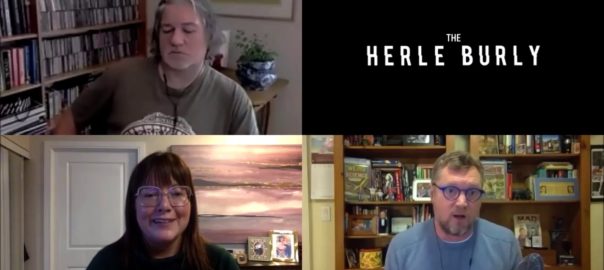
Now onto the observations of others, including the political strategists who comprise the endearing and engagingly foul-mouthed, beloved by many (including me), and well-experienced political difference makers — the rumpled David Herle, the good looking Scott Reid, and the swears-like-a-drunken sailor, Jenni Byrne — who over the course of the past 40 years have helped shape Canadian politics, mostly at the federal level, but often enough, too, at the provincial level: the wily, riotously humourous, utterly non-rancorous, incredibly bright, truth-telling, and — believe it or not — non-partisan panel who comprise The Herle Burly podcast, a must-listen for anybody who has a life, cares even a whit about the state of our nation, and gives a good galldarn about how the sausage is made, and how decisions are arrived at in government that determine how our lives are lived in this country we call Canada — surely, that must be you.
David Herle, Scott Reid & Jenni Byrne on British Columbia’s Decision 2020 provincial election — guaranteed to be the best thing you’ll hear all day.
Let’s excerpt a number of comments made by political pundits published on The Tyee post-election, in a story titled, So, What Does BC’s Election Outcome Really Mean? Here a few of the more provocative insights …
UBC Political Science prof, Max Cameron
Several conditions contributed to the success of John Horgan’s NDP. First, the world is going through a social democratic moment. Social democracies in other places have managed the COVID-19 pandemic effectively, in part because they have invested in universal health care and economic security …
Second, the NDP government has shown that it pays to listen to science and make policies informed by evidence. Elected officials — notably Adrian Dix — worked closely with public health officers — especially Dr. Bonnie Henry — to win the trust of the public and mobilize support for public health directives …
Third, the NDP benefited from a minority Parliament. Minority situations encourage governments to be cautious, responsive and to hew closely to public opinion. Working within a historic Confidence and Supply Agreement with the BC Greens, the NDP ran a government that made few errors and suffered few scandals.
Finally, new campaign finance rules introduced by the NDP eliminated corporate and union donations and capped contributions from individuals. This levelled the playing field.
Karen Ward: With your majority, NDP, ‘choose to be brave.’
British Columbians rejected the vicious politics of Wilkinson’s Liberals. They don’t like it when you use people in trouble as a weapon to punish them further. I hope the message to the NDP is clear: Be brave.
Alex Shiff, former BC Liberal spokesperson
While the BC Liberals needed to win back suburban Metro Vancouver swing ridings that they lost in 2017, the BC NDP was able to defend those ridings while pushing deeper into the Fraser Valley. The BC NDP was able to scoop up voters who decided that John Horgan’s first term as premier was not the radical activist administration that some had predicted, and a change in government in the middle of a pandemic was ultimately not what the doctor ordered.
The results represent an inflection point for the BC Liberals. The party needs to find a way to regain their appeal to suburban and urban ridings in Metro Vancouver, who, along with the party’s dominance in rural communities, were key to a pathway to the premier’s office.
Mario Canseco, Research Co, B.C. polling firm
The BC Liberals have a monumental dual task ahead: a need to reconnect with federal Liberal Party voters who did not feel uncomfortable voting for the BC NDP in this election, and ensuring that voters do not see the BC Conservatives as a more palatable option in 2024 or during any byelections that happen before then.
It was going to be a daunting task for any opposition party to erase the emotional edge that the handling of COVID-19 had bestowed upon the BC NDP. This is the first provincial election in this century where the incumbent premier had an approval rating higher than 60 per cent heading into election day. The BC Liberals certainly faced difficulties adapting to a campaign that minimized their natural strengths: the ability to fill rooms of supporters who wanted to hear the leader speak and an effective get-out-the-vote operation when more than half a million voters requested packages to vote by mail.
George Abbott, former BC Liberal MLA and Cabinet Minister
The Liberal campaign struck me as largely tone deaf around the issue that dominates public concern: the pandemic. If a BC Liberal government was prepared to offer up $10 - 11 billion in stimulus spending (a short-term elimination/reduction of provincial sales tax), a more imaginative platform might have embraced, for example, a billion dollar program for climate-proofing communities from wildfire and flood. The best stimulus programs deliver a “triple word score:” create or protect jobs, generate spin-off economic activity and enhance community safety and services.
As we bring VanRamblings’ post-mortem coverage of Decision 2020 to a close, we’ll leave you with this thought, that will likely gladden the heart of Sharon Gregson, as well as the working moms who’ve had to remain at home during the pandemic to care for their children: the biggest mistake made by the NDP in this election was in not identifying child care as both an economic and a feminist issue, and promising dramatically increased funding and near immediate movement towards $10-a-day and greatly expanded child care, allowing mothers to return to work while building the economy — which is a critical concern going forward — while showing a greater degree of caring and compassion for the children of the province.
While John Horgan promised free transit for children 5 – 12 years of age, that initiative failed to meet the needs of working families with teenage children who, as is the case in Surrey, must walk 5.8 kilometres, as the crow flies, to their school before becoming eligible for busing. At the very least, the John Horgan government could have promised to halve the fare for children aged 12 – 18 — a necessary initiative they failed to implement.
C’mon back Monday & Tuesday for VanRamblings’ take on the November 3rd U.S. Presidential election, where Democrats hope to win the Presidency, and both houses of Congress — and return sanity to all of our lives.