Stories of a Life | 1988 | Fitness in a Time of Despair | VCC, Pt. 3

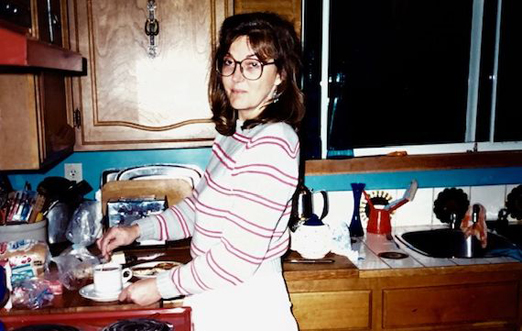
Linda Dudley, circa 1988 | Vancouver

1987 was a terrible year for me, one of the worst in the past five decades.
Cathy and I were still embroiled in an ugly, seemingly never-ending custody battle, when my two partners pulled out of our successful business the business was so prejudiced that I was forced to close it, displacing a dozen workers, after which over the course of the year I lost two professional jobs through no fault of my own, and the housing co-op where I had lived for the previous three years had moved to evict me because, “you’re gay, you have AIDS, you’re gonna kill us all, and we want you gone!” — by the time 1988 rolled around, I was experiencing an ever deepening despair, gripped by a black depression that had me almost catatonic, and without hope.
I was also in the worst shape, physically, that I’d ever found myself in —eating poorly, and weighing in at an unhealthy 225 pounds.
When in February 1988 I was offered a teaching job at Vancouver Community College, I wasn’t sure I had the stamina to stand in front of a class 15 hours a week to teach courses in English Literature, and writing.
Linda, a friend who lived nearby (in the picture above), one day when I was over at her home, who was aware of my various travails, turned to me on that chill, overcast mid-winter afternoon, and said to me …

“I want you over at my house at 9 a.m. tomorrow morning with your best pair of runners, and dressed warmly. We’re going to turn your life around, get you fit, deal with Cathy and your children, and those assholes in your co-op. You’re starting a new job in two and a half months, you have EI coming in so you’re not hurting for money, and you’ve got the time to get yourself into shape — beginning at 9 a.m. tomorrow morning, sharp.”
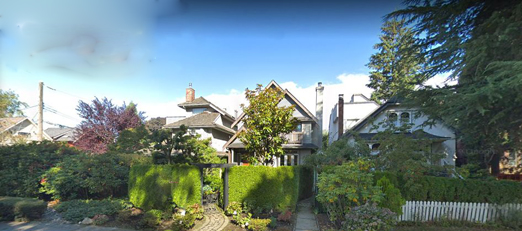
3387 West 2nd Avenue, in the west side Kitsilano neighbourhood of Vancouver

The next morning at 9 a.m. sharp, I arrived at her home on West 2nd Avenue on the north side of the street just east of Waterloo Street. Linda put some coffee on, and we smoked a joint (“it’ll help you focus on your body, and what needs to be done”) and by 9:30 a.m. we were off, walking towards Jericho Beach, on the first leg of our walk along Spanish Banks.
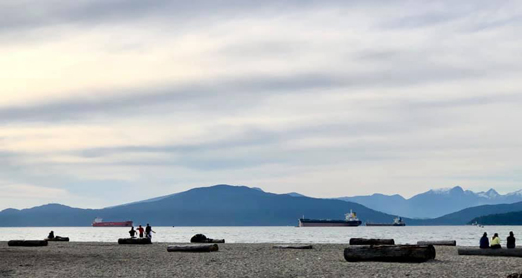
Jericho Beach, along the east end of Spanish Banks, in the Point Grey neighbourhood of Vancouver

I was so out of shape that by the time we reached Jericho Beach, I needed a 15-minute break, to sit down and catch my breath before continuing on the walk Linda had planned for us, to the end of Spanish Banks, just east of the forests of Pacific Spirit Park, and the University of British Columbia.
That first morning, I had to stop seven times on the way to the end of Spanish Banks, and seven times on the way back. A walk that should have taken us an hour or an hour and a half, instead took three hours — and I was wiped out. Upon arriving back at Linda’s house, she made us both a warming cup of coffee, and afterwards sent me home, saying, “I want you back here in two hours. We’re going to do the same thing again this afternoon, and every morning and afternoon until you’re in shape.”
I returned at 2:30 p.m. that afternoon and we were off again. This time we stopped only five times on the way to the end of the beach, and four times on the way back. It was raining outside, the skies dark and overcast. “Rain or shine, we’re going to be out here every day. Get your head around it!”
Linda was like a drill sergeant, “Head up, look over at the mountains, this is an exercise as much for your eyes and for your head as it is for your body. No looking down, ever.” By the end of the first week, I could walk to the end of the beach without stopping, the same on the way back. We would rest at the far west end of the Spanish Banks beach for 10 – 15 minutes before heading back, taking in the beauty of the nature around us.
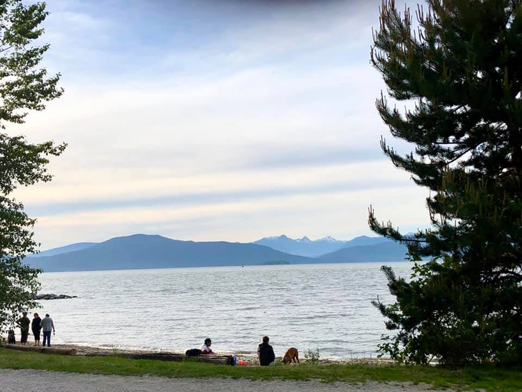
Spanish Banks, just east of Pacific Spirit Park and UBC

During our walks we talked about everything.
Linda knew Cathy from our days living in the Interior — the first time they met one another, each took an immediate, visceral dislike to the other, which was odd given how similar their respective backgrounds were, and what strong, take charge personalities both possessed. Linda knew my children; she had a son the same age as my son, Jude, and had met Megan many times (Megan didn’t like Linda — again, a clash of personalities and will). Linda and I continued our walks and hikes, twice a day every day.
By the beginning of the second week of our walks, we were not only walking along the full length of Spanish Banks twice a day, Linda had added a twice daily hike through Pacific Spirit Park. The third week had us making a foray into Stanley Park, walking through the woods, and up the 45 degree embankment leading to Prospect Point. By mid-March, one month into our twice daily walking and hiking regimen, I had dropped 40 pounds, while consuming a satisfyingly substantial amount of healthy foods.
Linda had also added yoga as a feature of our walks, involving a great many stretching exercises. Between the twice daily walks, the hikes, the yoga, and my new healthy diet, by mid-April, I had lost 75 pounds and was down to a fit 150 pounds — I felt like Superman, stronger and healthier than I’d been since I was in high school twenty years previous. My depression? Gone. My ability to stand up for myself, and not allow myself to get pushed around, by circumstance or by some of the malcontents in my life (those who meant me ill), and ready to do battle with Cathy in the Courts? I was back. By mid-year, the custody battle was resolved, as was the battle with my co-op (the latter, which I’ll write about another day).
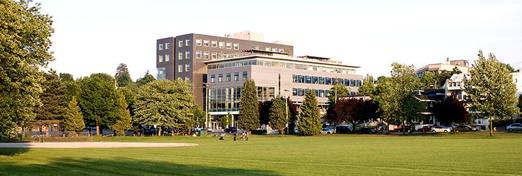
Vancouver Community College, East Broadway campus, photo taken from the parkPhoto, Broadway campus, Vancouver Community College, taken from Chinacreek Park

By the time classes at Vancouver Community College began at the beginning of May, I was me again — tough, strong-minded, confident, fit and healthy, and ready for whatever was coming my way … which, as I wrote two weeks ago, was love. In May, as the classes I taught were scheduled in the evening, Linda and I continued our walks during the day, with Lori and I walking in the late afternoon, once we were living together.
For the next three years, I continued my daily walks from my home to Jericho Beach and along Spanish Banks, leaving the hikes through Pacific Spirit and / or Stanley parks for the weekend. In two and a half months in 1988, Linda had trained my body such that it was as easy for me to power walk and hike 7 miles, as it is for most people to cross the street.
In 2017, after walking well over 400 miles in service of both Morgane Oger’s NDP campaign in Vancouver False Creek and David Eby’s campaign in Vancouver Point Grey, that summer — arising from a case of plantar fasciitis — for the first time in 29 years I did not keep up with my regimen of walking along the beach and through the woods of Pacific Spirit Park.
Still, I will never forget, and will always be grateful for, the gift Linda gave me of health and not just just the ability and willingness to leave my home to get out into the elements, but the pure joy I experience when walking along Spanish Banks or through Pacific Spirit Park, riding my bike, or otherwise engaging in healthy activity, a regimen that prevails to this day.

Arts Friday | The 72nd Annual Cannes Film Festival | Winners!

The 72nd annual Cannes Film Festival | 2019

Saturday night, the 72nd annual Cannes Film Festival draws to a close.
Why should that matter to you?
Well, if you love film, and foreign cinema in particular, the award winning films that will be announced Saturday night in Cannes highlight the most important films made outside the North American continent this year, and most probably predict this year’s Oscar award contenders for what used to be called Best Foreign Language Film but for the 2020 Oscar ceremony will be renamed the Best International Feature Film. Not to mention, for aficionados of the Vancouver International Film Festival, a raft of Cannes films will arrive on our shores this upcoming September and October.
Here’s IndieWire chief film critic Eric Kohn’s wrap up column on the 72nd annual Cannes Film Festival, Class War & the 2019 Cannes Film Festival.
WINNER, Palme d’Or | Director: Bong Joon-ho
Parasite | South Korea

The fearlessly and fiendishly well-crafted new film from director Bong Joon-ho (The Host, Snowpiecer) offers a masterful dissection of social inequality, in a film that while a diabolically fun watch is also resolutely political, the film’s tonal shifts clearly in service of its class politics, infecting Parasite’s breezy dark-comedy with notes of rage and melancholy. Bong delivers a stunning return to form with this newest venture, which takes bold leaps between tenors and tone, the film entertaining and intelligent, and an unsparing social indictment of class inequality — a roaringly raucous, blood-spattered social satire that is also luxuriously watchable, suspenseful, uproarious, and a brilliant return to form for South Korean auteur Bong.
For background on how the Cannes Jury chose Parasite, click here.
WINNER, Grand Prix | Director: Mati Diop
Atlantics | Senegal

Mati Diop entered the Official Competition at Cannes with plenty of attention, as the first black woman with a film in the section across the festival’s 72 years. But, according to IndieWire film critic, Eric Kohn …

“The real reason to pay attention to Atlantics is its singular vision of the migration crisis. Diop’s gorgeous, mesmerizing feature directorial début focuses on the experiences of a young woman named Ada (Mama Sané) stuck in repressive circumstances on the coast of Dakar after her boyfriend vanishes en route to Spain. But the film is less fixated on his departure than with the community around her.

Diop’s enigmatic, lyrical narrative left audiences dazzled by its cinematic textures and haunting atmosphere. The peculiar allegorical nature of its story, and a supernatural twist that creeps into the plot, could make it a tough consensus choice for this year’s jury. But it’s quite the impressive début, and could very well wind up with some sort of prize by the end of the festival.”

There was a tie for the next category …
WINNER, Jury Prize | Tie
Les Misérables | France | Director: Ladj Ly

The directorial début of Ladj Ly offers a relentless tale of mounting tension between tough police officers and an oppressed Muslim population in modern-day Paris. Ly’s jittery, naturalistic style spends much of its running time focused on several officers as they clash with the neighborhood youth, and one conflicted new recruit (Damien Bonnard) with a moral conscience. The suspense builds to an anxiety-inducing showdown involving the bubbling frustrations of a local Muslim boy (Issa Perica) whose pithy crimes receive a nasty comeuppance in the film’s wrenching finale, causing audiences to draw thematic parallels to Spike Lee’s Do the Right Thing.
Bacurau | Brazil | Directors: Kleber Mendonça Filho Juliano Dornelles

A bracingly confrontational commentary on the direction his home country of Brazil is taking in the Trump-like era of Bolsonaro, Bacurau’s propulsive storytelling doesn’t come at the expense of the vividly sketched personality of Brazil, in this often strange fever-dream Jacobean-style bloodbath of a film, all at once densely layered and rich, ruthless and clear-minded, a film that divided the critics, but not this year’s Cannes Jury, it would seem. Mendonça Filho has scored before at the Vancouver International Film Festival, with his absolutely brilliant Neighbouring Sounds, which took VIFF 2016 by storm, emerging as an audience favourite.
Best Screenplay | Writer / director: Céline Sciamma
Queer Palm (Feature) | Céline Sciamma
Portrait of a Lady on Fire | France

Acclaimed French director Céline Sciamma makes her long-overdue Competition début with this vivid period drama, which focuses on an 18th century lesbian romance about a painter (Noémie Merlant) hired to create a portrait of a woman from a wealthy family (Adèle Haenel) without her knowledge. In the process, the two women fall in love, against the backdrop of a magical seaside landscape. Sciamma’s sharp, picturesque imagery meshes with the palpable erotic sparks between her two stars, who transform this emotionally resonant two-hander into a riveting portrait of hidden sexuality, a film Hollywood Elsewhere’s Jeff Wells writes is “as close to perfect as a gently erotic, deeply passionate period drama could be,” while The Guardian’s Peter Bradshaw writes in his five-star review …

Céline Sciamma has brought a superbly elegant, enigmatic drama to Cannes that compels a shiver of aesthetic pleasure and fear, demonstrating a deeply satisfying new mastery of classical style to go with the contemporary social realism she showed in Girlhood (2014) and Tomboy (2011).

The setting is 18th-century Brittany, where an Italian noblewoman (Valeria Golino) has engaged what is officially a ladies’ companion for her beautiful daughter, Héloïse (Adèle Haenel), who has just come out of a convent and is recovering from the loss of her sister. The companion, Marianne (Noémie Merlant), is actually an artist, and the countess wishes her to paint a portrait of Héloïse in secret, to be shown to a wealthy prospective husband in Milan, because headstrong Héloïse would never consent to sitting for any such picture.

Sciamma brings the erotic together with the cerebral. The final scenes set in the art gallery and the opera house are gripping: a past obsession simultaneously sour and yet vividly alive. What did it remind me of? De Laclos’ Dangerous Liaisons? Nicolas Roeg’s Bad Timing? I don’t know.

But what a story of desire.

From the reviews out of Cannes, Portrait of a Lady on Fire is a sure-fire contender for the Palme d’Or, with a seeming Best Actress nod for the luminous Adèle Haenel [2017’s BPM (Beats Per Minute)] a near certainty.
Best Actor | Antonio Banderas
Pain and Glory | Spain

A beautiful, full-hearted celebration of the craft of filmmaking, Pain and Glory is one of the most meditative of Pedro Almodóvar’s career, an especially personal work, anchored by the director’s on-off muse Antonio Banderas in perhaps his greatest performance, as he sweeps through the Spanish maestro’s recurrent themes: high melodrama and kitsch comedy, piety and carnal lust, sex and death, human pain and transcendent glory.
Best Actress | Emily Beecham
Little Joe | France

An artfully unnerving, austerely hypnotic horror movie about a very sinister plant, visually Little Joe is a total feast for the eyes, contrasting art-deco pinks and mint greens against sterile, symmetrically framed expanses of white, vaguely evoking the aesthetic of some lost sci-fi film of the ’70s. Another film that divided the critics, with CineVue critic John Bleasdale writing, “compared to the sophisticated and nuanced horrors of Black Mirror, Little Joe feels like a fairly straightforward riff on a very familiar idea. Nonethless, because it won an award at Cannes, because it’s a horror film (and outside of the hothouse of the Cannes Film Festival, the film will receive stronger reviews), Little Joe will likely arrive on our shores at some point this summer or autumn.
Best Director | Jean-Pierre & Luc Dardenne
The Young Ahmed | Belgium

Camera d’Or
Our Mothers | Guatemala | Director: César Díaz

From the military dictatorship established in the late 1970’s in Guatemala was born a civil war that only ended some twenty years later, leaving in its wake more than 200, 000 victims, and burying the memories of 40, 000 missing people. With Our Mothers, selected in the Critics’ Week section of this year’s Cannes Film Festival, César Díaz offers a film of remembrance and resilience, Our Mothers erupting like a shout in the darkness that surrounds this often overlooked massacre that cost mostly Indian lives, the film a heartbreaking portrait of a mother and her son.

star.jpg star.jpg star.jpg

Otherwise, the following films garnered praise at Cannes 2019 …

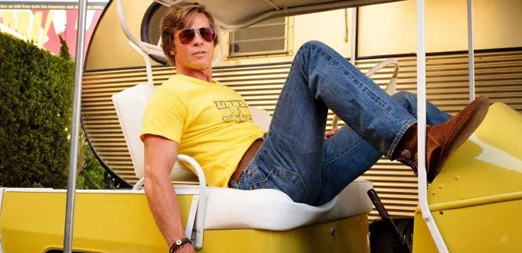
An American film, but director Quentin Tarantino and his all-star cast of Leonardo DiCaprio, Brad Pitt, Margot Robbie, Al Pacino, Lena Dunham, Kurt Russell, Dakota Fanning, James Marsden, Tim Roth, Timothy Olyphant and a host of other actors, stepped onto The Croisette at Cannes for the international début of his latest film, Once Upon a Time in Hollywood, which more than lived up to its hype in advance of the film’s much-anticipated mid-summer (July 26th) release in theatres across the continent.

The buzz out of Cannes 2019 for a Best Oscar nomination for Brad Pitt was very strongStrong buzz out of Cannes 2019 for Brad Pitt as a potential Best Actor Oscar winner in Quentin Tarantino’s enthusiastically received Once Upon a Time in Hollywood..

At screening’s end, Once Upon a Time received a rare 7-minute standing ovation, with both Brad Pitt and Leonardo DiCaprio scoring great reviews and buzz for the two as potential Best Actor Oscar nominees.

Another film emerging from Cannes with immense positive buzz for probable Best Actor Oscar nominee Taron Egerton, in the title role, is Dexter Fletcher’s Rocketman, the story of Elton John’s life, from his years as a prodigy at the Royal Academy of Music through his influential and enduring musical partnership with Bernie Taupin, a film that the critics raved about, writing that Rocketman “explodes with the kind of colour and energy that only Elton John himself could invoke.”

“Freddie Mercury may have had the better voice,” writes the New York Post’s Johnny Oleksinski. “but it’s Elton John who gets the better movie. Rocketman, director Dexter Fletcher’s trippy new biopic about the flamboyant rocker is braver, deeper and more enlightening than last year’s slobbering piece of Queen propaganda Bohemian Rhapsody (which he also partly directed), a flashy fantasia of a movie that will have you both cheering and in tears in the film’s phenomenally moving pivotal scene.”

We’ll know soon enough — Rocketman opens in theatres next Friday.

Films striving to winner the coveted Cannes 2019 Palme d'Or

Since 1955, the Cannes Film Festival has awarded the coveted Palme d’Or to the greatest filmmakers of our age, from Frances Ford Coppola to Michael Haneke, Terrence Malick, Abdellatif Kechiche, Costas Gavras and Jane Campion. While Oscar season involves thousands of voters and aggressive, months-long campaigns, the Palme d’Or race among the 20, or so, films selected for Official Competition is often difficult to predict.
This year’s Cannes jury stands out for being particularly filmmaker-centric, with Cannes veteran Alejandro G. Iñarritu serving as president, joined by fellow directors Kelly Reichardt, Alice Rohrwatcher, Maimouna N’Diaye, Yorgos Lanthimos, and Pawel Pawlikowski — as well as Elle Fanning, the youngest Cannes juror in history. All have screened work at the festival, this year’s jury composed of particularly complex & disparate sensibilities.
Today’s update: the winners, and more, at the 2019 Cannes Film Festival, some of which will receive a Best International Film Feature Oscar nomination, most of which will screen at the 38th Vancouver International Film Festival, running from September 26th through October 11th, 2019.

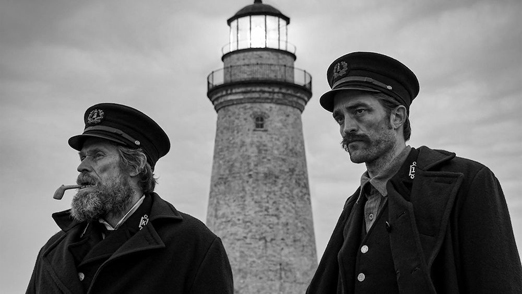
Robert Eggers' The Lighthouse, starring Willem Dafoe and Robert Pattinson Wins Fipresci Critics Awards At Cannes Film Festival

Just announced: The Lighthouse has won the Fipresci Critics Awards at Cannes, about which the Deadline website writes …

“A story of two lighthouse keepers who drive each other to madness, won the Cannes Film Festival critics’ award for best first or second features in Directors’ Fortnight and Critics Week. The award was announced Saturday by the International Federation of Film Critics (Fipresci).

Robert Eggers The Lighthouse was shot in black and white and starred Willem Dafoe and Robert Pattinson.


Fipresci also honoured Elia Suleiman’s It Must Be Heaven as the best film in competition and Kantemir Balagov’s Beanpole as best film in the sidebar Un Certain Regard.

Terrence Malick’s Cannes competition entry, Hidden Life, won the Prize of the Ecumenical Jury.

The Lighthouse sees ‘two lead actors give stormy, career-best performances,” according to the statement from the Fipresci jury. It described the Eggers film as “a brutal work of art, all shot in beautiful black-and-white cinematography and fueled by a soundscape that echoes like a foghorn.”

The full list of winners at the 72nd annual Cannes Film Festival.

#BC + VanPoli | An Update on the Affordable Housing File in B.C.

BC NDP announces 20,000 affordable homes either completed or under construction in B.C. in 2019

After 16 years of despair under a too often far right-of-centre B.C. Liberal government where, in their final full year in office, 120 children died in the care of the province, while another 791 children in care were critically injured — all while the Christy Clark government left a $2.7 billion surplus for what would turn out to be an incoming BC NDP government — whether it was Gordon Campbell or Clark, the B.C. Liberal government proved day in and day out that they were dedicated not to the interests of the people of British Columbia (and certainly not the most vulnerable among us), but to the monied corporate titans and financial backers who, working collectively, built barely one unit of affordable housing amidst an unprecedented and ever worsening housing crisis in Canada’s third largest city and region.
Whether it’s the B.C. Liberals — as they’re presently constituted (VanRamblings awaits the day when Vancouver City Councillor Sarah Kirby-Yung is leader of the party, and Premier, to redefine fiscally and socially responsible, nominally right-of-centre government in B.C.) — or Andrew Scheer’s ultra-conservative Conservative party, make no mistake, right-of-centre parties & politicians are rarely on the side of the 95% of Canadians who earn less than $100,000 a year, which is to say not on your side.
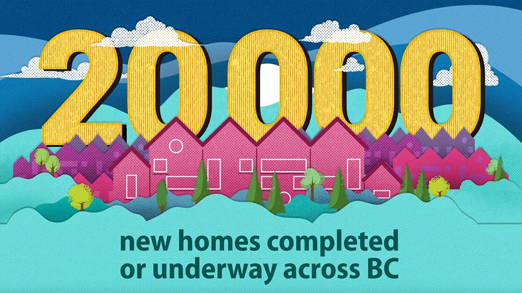
BC NDP Government Has Built, or Will Build, 20,000 Affordable Homes in BC in 2019 | A Further 94,000 Homes Are on Their Way

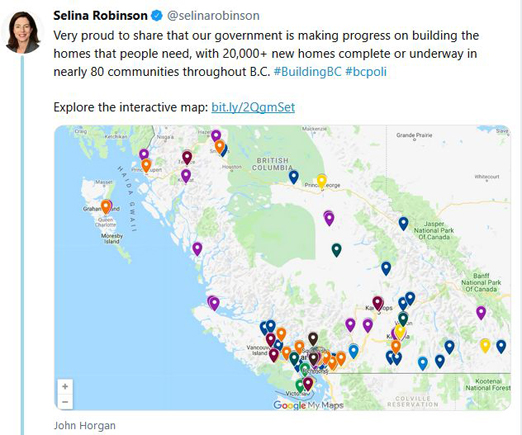
B.C. Housing Minister reports that  20,000 affordable housing units under construction in B.C.Here’s the link to detail on the BC Homes graphic B.C. Housing Minister Selina Robinson presents above, including indigenous, community, student, regional, supportive, affordable rental and other housing currently completed, or under construction, in B.C.

Whether it be Chris Gailus and Global BC, the news team at CTV Vancouver, or as the local paper of record, the Vancouver Sun — or the Globe and Mail, or their even further right-of-centre brethren at the National Post — make no mistake, you’re not going to turn on your TV, pick up a local newspaper or surf to their online sites and read about the 20,000 affordable housing homes that have been completed, or are in process of being completed, in 2019, during the next year, or in early 2021.
God knows that corporate-owned media — none of which endorsed the BC NDP in 2017 — are interested in the least in reporting out to you the news that really matters: that in British Columbia citizens have a government in Victoria that actually cares about working people, and is committed to the realization of the construction and completion of 114,000 affordable homes, $10-a-day child care, and the construction of 24-hour-a-day, open and accessible urgent care centres in every municipality across B.C. — more than 780,000 British Columbians (that’s almost 17% of the population) don’t have a family doctor, the previous Liberal government abandoning their plan to link every person to a doctor by 2015 as “unachievable”.

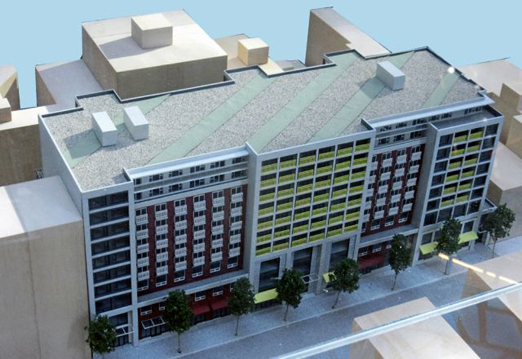
British Columbia government funding 102 units of low cost housing in East VancouverConstruction on this 109-unit affordable rental building to be completed in early 2021. Location: 3185 Riverwalk Avenue, in the East Fraserlands area of Vancouver.

Funded by the British Columbia government under their Deepening Affordability Fund, this past December B.C. Housing Minister Selina Robinson announced the construction of 109 low-cost, affordable homes at 3185 Riverwalk Avenue in the East Fraserlands area of Vancouver — a five-storey project that will offer 7 studios, 30 one-bedroom, 48 two-bedroom & 24 three-bedroom homes + a shared amenity space — for seniors, families & those on fixed incomes, not a social, but an affordable rental, housing project, where tenants will pay no more than 30% of their income in rent.
Click on this link, and scroll down to the Deepening Affordability Fund section for more information on 490 more homes being built through the fund in Burnaby, Kamloops, Saanich, Port Alberni, Terrace and Courtenay.
In addition, by clicking on the link you will find detail on homes being built under the Supportive Housing Fund, as well as the Rapid Response to Homelessness, the Regional Housing First and the Student Loan Housing programmes, the Indigenous Housing Fund & the two projects being built as part of the Housing Hub programme, for a total of 20,000 new homes.

58 West Hastings Street in Vancouver will see the construction of 231 low-cost,affordable homesConstruction of 231 low-cost, affordable homes at 58 West Hastings underway.

In March of this year, the B.C. government provided a list of 25 affordable housing projects, currently under construction in Vancouver, to Vancouver Courier civic affairs journalist Mike Howell — a total of 2,450 new affordable rental homes, including a $14.8 million, 74-unit project at 6390 Crown Place that will be operated by the Musqueam Indian Band, and a $90 million 231-unit project at 58 West Hastings that will be operated — including $30 million in funding — by the Vancouver Chinatown Foundation.
The bottom line: all is not lost, there is a government in Victoria that is on our side, and although the provincial government may not be moving fast enough for some on their election promises, remember (as folks were wont to say in times past): “Rome wasn’t built in a day.”
The same very well might be said about our current Vancouver City Council, each of whom VanRamblings knows well, and who we know to be persons of grit, integrity & social responsibility who are also very much on our side.
If by 2022 (the next civic election) Vancouver City Councillors have not followed through on their commitment to the alleviation of the affordable housing crisis, they will become — as some have written — a one-term civic government, replaced by Councillors who can get the job done.
But you only have to know Christine Boyle, Lisa Dominato, Sarah Kirby-Yung, Pete Fry, Rebecca Bligh, Michael Wiebe, Jean Swanson, Colleen Hardwick, Adriane Carr and Melissa De Genova to know that this remarkably capable and utterly unique group of change makers are not about to let you down, that they’re on the case, with their heads screwed on straight and much sooner than later, they’ll come through for all of us.

#VanPoli Civic Politics | Civic Politicians’ Annual Remuneration

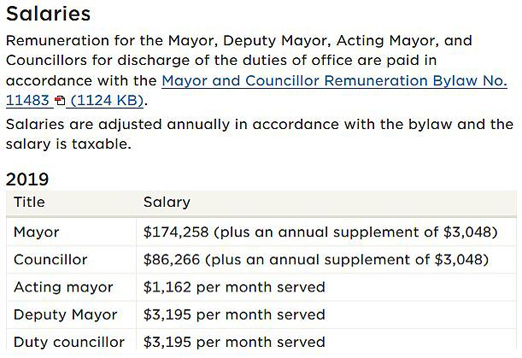
Vancouver Mayor and Vancouver City Councillor salariesThe table above represents only a portion of the annual remuneration for our Mayor and Councillors. In fact, civic official remuneration can, and often is, much more.

The most frequent query put to VanRamblings occurs in respect of the remuneration received by our City Councillors, in most people’s estimation only a part-time job. In fact, many folks believe that holding the office of City Councillor to be a volunteer position, without any remuneration whatsoever. These folks are stunned to learn that Vancouver’s City Councillors annual remuneration exceeds $100,000, and often much more.
From a January 8, 2019 article by Vancouver Courier civic affairs journalist, Mike Howell, reporting the 2.7% salary increase for Mayor Kennedy Stewart and Vancouver City Councillors will receive in the 2019 calendar year …

“The 2.7% bump shouldn’t be viewed as a surprise. Every Jan. 1 the mayor and council of the day get a pay increase. It fluctuates and has involved formulas that factor in the Consumer Price Index, the average weekly wage for B.C. and data from Statistics Canada.

In 2014 it was a 3.24% increase. In 2015, it was 0.82%.

Back in 1995, an independent panel decided the mayor and councillors needed a raise. Part of the rationale was based on mayors and councillors in other big cities making more cash than the Vancouver crew, which still holds true today. For example, the mayor of Edmonton pulled in $200,586 last year and councillors earned $113,325.

In 2016, Vancouver councillors made a move to get them closer to their counterparts in Edmonton and other cities by approving a series of changes to the payroll …

In addition to the base salary of $86,266 (plus an annual supplement of $3,048), according to the Deputy Mayor roster published by the Mayor’s office on November 1, 2018, Councillor Pete Fry will sit as Deputy Mayor twice in 2019 — in January and December — adding $6,390 to his “base” salary of $89,314; in addition, Councillor Fry will be Duty Councillor in September (another $3,195), and sit as Acting Mayor once during the year ($1,162). Total salary compensation for Councillor Fry in 2019 equals $100,061, and that figure doesn’t include compensation for his work on the Union of B.C. Municipalities, on which he is a Vancouver Council delegate.
Note, and perspective: the most recent census data shows the median income in 2015 for a one-person household in Vancouver was $38,449, and $89,207 for a household of two or more people. The “total household” median income was $65,327. Lone parent families earned $52,242.
In point of fact, 95% of Canadians earn less than $100,000 a year.

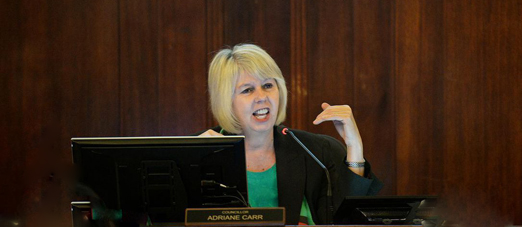
Vancouver City Councillor Adriane Carr to receive more than $143,000 in salary in 2019Base compensation for City Councillor Adriane Carr will exceed $143,000 in 2019.

In addition to a “base salary” in the range of $100,000, Green Party of Vancouver Councillors Adriane Carr and Michael Wiebe, OneCity Vancouver Councillor Christine Boyle, and Non-Partisan Association Councillors Colleen Hardwick and Lisa Dominato were appointed by the Mayor last autumn to sit on the Metro Vancouver Board, where they will be compensated to the tune of a minimum of $17,000 for the year.
Councillor Carr, in her role as Metro Vancouver Climate Action Committee Chair will receive a further $25,000 in compensation, in 2019.
For Councillors Wiebe, Boyle, Hardwick and Dominato, total salary compensation for 2019 will be in the range of $112,704, with Councillor Carr adding a further $25,000 to that figure.
The transportation allowance afforded each Councillor “for the conduct of city business” is compensated at up to $600 per month, or another up to $7200 annually. Each Councillor is entitled to “payment for local expenses incurred in any calendar year”, at a sum not to exceed 10% of the Councillors’ annual salary. There’s an annual travel and training expense budget afforded Councillors, as well as a “discretionary expenses budget” — when, in 2020, the City publishes figures for these latter “budgets”, voters will know the exact figure claimed by our City Councillors in 2019.
Suffice to say, our Vancouver City Councillors are not going to sleep hungry each night, or living in wont and financial despair, a circumstance afflicting far too many in our city, in every age demographic, across every neighbourhood. Let us hope that our Councillors — currently living high off the hog — remember they were elected as servants of the public interest.

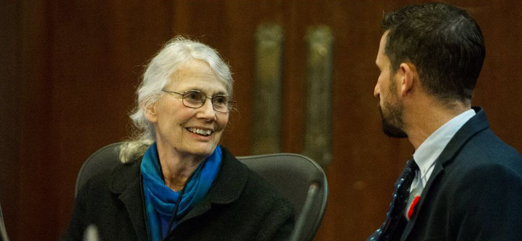
Vancouver City Councillor Jean Swanson speaking with fellow Councillor Michael WiebeVancouver City Councillor Jean Swanson speaking with fellow Councillor Michael Wiebe.

Meanwhile, Coalition of Progressive Electors Vancouver City Councillor Jean Swanson, in keeping with an election promise made to voters last autumn, has stated that she aims to reduce her income to the average wage earned by single Vancouverites — about $44,000 — although she’s not there yet.