Stories of a Life | 1989 – 90 | The Balloon Story

Stories of a Life | VanRamblings | The Balloon Story, 1989 - 90

Christmas of 1989, Cathy asked me if she might have the children on Christmas Day, as her mother would be in town and very much wanted to spend Christmas Day with her two grandchildren, Jude and Megan.
Now, just the previous year Cathy and I had come to the bitter end of an arduous and discomfiting 10 year, million dollar separation and divorce journey that had near bankrupted me. Although I had sole custody of the children from 1978 through 1981, because Myrtle (Cathy’s mother) hated having to go through me to see her grandchildren, she financed what turned out to be a brutal seven year campaign to wrest sole custody away from me in favour of Cathy having the children year round, in the court proceedings setting about to deny me access to my two loving children.
In order to pay for the legal fees necessary to put my position forward in the Supreme Court (and to preserve my access to Jude and Megan), I worked three jobs simultaneously, teaching, working as a social worker, as well as a corrections officer, taking an inheritance from my aunt, as well, to fund legal fees from 1981 through 1988 — going so far in the late eighties as to cash in my teacher’s pension to pay off the last of my legal bills — all but living in the Supreme Court throughout the 1980s, until one fine day, Supreme Court Justice Patrick Dohm seized himself of our divorce and custody matter (which meant that all future proceedings would be directed to his court), with Justice Dohm finally deciding in 1988 that “enough was enough”, scolding Cathy, instructing her to “behave”, and then awarding the two of us joint custody, which gave me 183 days of access to the children each year, Wednesday evenings, Friday evenings through Sunday evenings, half of each of the Easter and Christmas holidays, as well as all summers, from the beginning of July through the end of August.

Note of reflection: I will say this, had I to do it all over again, I would not have fought what was for me a half million dollar custody battle with Cathy throughout the 1980s. Some people are meant to be parents — Cathy is not one of those people. Had I not fought with her, gone to court half a dozen or more times each year for seven years, because Cathy is who she is, I likely would have spent just as much time, perhaps even more time, with Jude and Megan throughout the 1980s than I did by fighting with her in court to maintain my access to the children — and would most probably have a better relationship with my children than is the case today.

In 1988, as per the Supreme Court ruling of Justice Dohm, in the first year of the Court mandated agreement I was given the latter half of the Christmas holidays as access, which meant that in 1989, I would have the two children from the last day of school through Boxing Day morning. But as Myrtle was in Vancouver during Christmas 1989, Cathy asked if she might have the children from the end of the school term in December through Boxing Day morning.

“Raymond, you know you want to spend time with the children. School gets out for the holidays on Friday, December 22nd and Boxing Day is only four days later, which would give you very little time with Jude and Megan. If you take them for the second half of the holidays, you would have the children from Boxing Day through the late evening of Sunday, January 7th — which would give you the children for thirteen full days, more than three times the number of days you would get if you just had them through Boxing Day, which I’m sure would make you happy.”

The more time I got to spend with the children the better, I had long thought, so I agreed to take the children from Boxing Day through their return to school on the 8th of January, agreeing to forfeit spending Christmas Day with the children in favour of a longer period with the children over the holiday season, granting Myrtle her Christmas wish.
Now, given the previous seven year history of our rancorous divorce, I should have known something was up, but being the good-hearted, naïve fellow I was then (and remain today), I readily — if stupidly — agreed to Cathy’s plan. And thus the conditions are set for part one of today’s story.
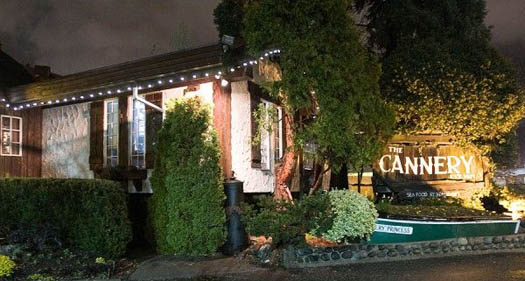
The Cannery Restaurant, along Vancouver's waterfront, in its glory days

A bit of background as to why I should’ve been wary of Cathy’s intentions:

On my birthday on August 11th 1989, Cathy drove over to my home to drop the kids off, as Jude, Megan and I prepared to spend my birthday afternoon together, after which we would attend at The Cannery Restaurant for my much-looked-forward-to birthday dinner.

Cathy drove up in her late model Jetta, parked illegally across the street, leaving Jude and Megan (who were all dressed up) in the car, approaching me as I stood on the front lawn of my home. Cathy said, in an angry tone, “I want to talk with you.” “Something contentious?” I asked. “Yes,” she said, to which I replied, “Could we put off having that discussion until tomorrow? I’d very much like to speak with you, and I’m sure we could work out to your satisfaction whatever it is that you feel needs doing — it’s my birthday, though, and as you well know from having been married to me, I like to steer clear of any sort of contention on my birthday.”

Before I knew what was happening, Cathy balled up her fist, and moving her arm back and then towards my face hit me squarely on my left cheek, with such force that it knocked me to the ground. With me now lying sprawled out on the ground, Cathy stomped back across the street, got back into her car, and drove off, the children looking at me piteously through the rear window of their mother’s car as she speedily drove off.

Cathy could have her moods, and that is an example of one of them.
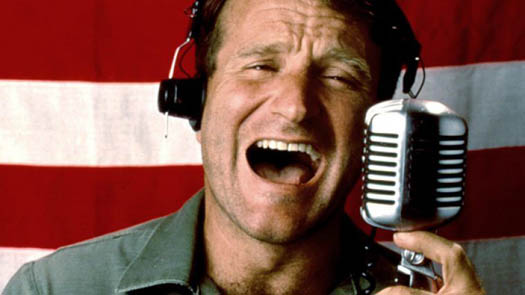
Robin Williams in the movie Good Morning Vietnam

Boxing Day 1989: the Beginning of a Three Month Interregnum
As pre-arranged and agreed upon, Cathy dropped the children off to my place in the late morning of Boxing Day 1989. Upon alighting from their mother’s car, both children approached me to say that they wanted to go shopping for clothes, the first stop on our buying spree to be Aritzia at Oakridge where Megan had scoped out exactly what she wanted to acquire, with Jude asking afterwards that we drive downtown to Robson Street to a shop where he wanted to acquire a pair of jeans he’d had his eye on, and were on sale on Boxing Day. The three of us spent that day after Christmas day bopping around town, shopping, walking along crowded streets, stopping off for lunch, driving around Stanley Park and out to Horseshoe Bay — the children loved to be driven across the landscape of our region, soaking in the sights, listening to the radio and spending time together — before heading home for dinner, and a night in together watching a video.
Jude and Megan had chosen Good Morning Vietnam as the video, and after cleaning up the kitchen post dinner, set about to create the warming conditions to watch the Robin Williams movie, the three of us all snuggly & toasty warm in our pj’s and housecoats, sitting on the sofa hot chocolate in hand, and snacking on an array of chocolates and shortbread cookies.

Vancouver police officers

At 11:30pm, the front door buzzer in my apartment sounded, with me thinking, “Who could that be at this time of night?” In fact, it was two Vancouver police officers, who asked to be let in, who told me that one of them would be knocking on my apartment door within the next minute. When the officer arrived at my door, I greeted him, the officer looking into my apartment to see Jude and Megan on the sofa staring out at him, the officer asking, “Are you two alright?” “Yep, we’re fine,” they said. The officer asked me to step out into the hallway of my apartment, which I did.
The officer explained to me that a frantic Cathy was in the foyer of my apartment building, court order in hand, exclaiming that I had not returned the children to her earlier in the day, as per the court order (a court order which she had re-proclaimed for this evening event). Cathy contended, the officer said, that I had not returned the children to her, so she called the police to enforce the court order — which he and his fellow officer were now compelled to do. I set about to explain the circumstance, but the officer was clear that the court order trumped whatever exclamation of events I was presenting to him. The officer asked me to return to my apartment to instruct the children to get dressed, and prepare to return to their mother’s home — which I solemnly and reluctantly set about to do.
Within 15 minutes, Jude and Megan were in the custody of the officer, after which they took the elevator to the main floor, reuniting with their mother.
I had no contact with the children for the next three months. Despite the fact that I was earning good money, I had no desire to spend even more money taking Cathy back into court, before Justice Dohm — who, no matter what he ruled, would at the end of the day, as had been the case in the past, have little effect on Cathy’s arbitrary and injudicious conduct.
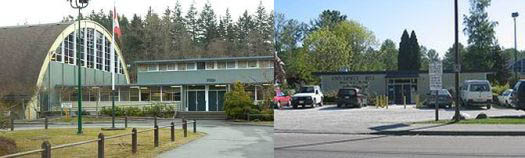
University Hill Secondary School in the 1980s

Megan was born on March 26th, 1977. March 26th, 1990 would not only mark her 13 birthday, but her entrance into teenage hood. There was no likelihood that I was not going to move the sun, the moon, the stars to become a part of the celebration of the young woman I had raised, despite the fact that we’d had no contact with one another for three months.
So, I did what any good father would do: I arranged to have a large bouquet of birthday helium balloons delivered to the offices of University Hill Secondary, addressed to the young woman, Megan Jessica Tomlin.
That afternoon, I received a telephone call from Megan asking me to pick her up from school, which I did. Megan told me how disconcerting and embarrassing she found my outré birthday gift to be, but that her friends prevailed upon her that afternoon, saying what a wonderful gesture it was, that she couldn’t possibly not see how loving the gift was, and that she must, must, must get in touch with me as soon as was practicable.
For the next nine years, Megan’s and my relationship was steady and as close as it had always been, with no breaks away from one another throughout that entire time period, trusting confidants and friends with one another, lovers of baseball both, father and daughter, advocate and advocatee, Megan in charge (Megan always had to be in charge, then and to this very day), decided and loving, independent, feminist and caring.


Megan Jessica Tomlin, age 13, in Vancouver

2019 Year in Review | The Best Films of 2019, Part 1 | Cinema

2019 Year in Review, Best Films of the Year, Part 1

In the coming weeks, VanRamblings will publish a list of our top 20 films of 2019, from Teen Spirit (now available on Amazon Prime) back in February through all the films yet to screen in Vancouver — from Clint Eastwood’s new film, Richard Jewell (December 13) to director Jay Roach’s story of the takedown of Fox News’ Roger Ailes, Bombshell (December 20), plus Greta Gerwig’s all-star cast adaptation of Louisa May Alcott’s Little Women, and Sam Mendes’ epic WW1 blockbuster, 1917, both set to open Christmas Day.
Now, two of VanRamblings’ top 20 films of 2019 that demand to be seen …
Best Propulsive Good Time Hollywood Popcorn Flick of 2019

The first Hollywood film of 2019 that offers movie patrons a guaranteed good time inside a darkened movie theatre, a film for the whole family, the last film made by 20th Century Fox before they sold the company to Disney, a glorious barn burner of a film redolent with heart-in-mouth and tug-at-the-heart emotion, not only one of the greatest racing movies ever made, but an infectious, engrossing true life drama that features some of the finest onscreen performances of the year, Matt Damon as you’ve never seen him before and Christian Bale sympathetic and at top of form, with a supporting cast who will pull you into this audience-pleasing story like mad.
In other words, a must-see film at the multiplex. And it opens today!
Ford v Ferrari is expected to win the weekend box office handily with as much as $31 million at 3,528 venues across the continent (and, likely, another $20+ million in foreign markets over the first weekend, with China and the rest of Asia set to screen Ford v Ferrari in the weeks to come — all of which oughta make the film a solid 2019 Oscar contender). The Disney-Fox film follows an eccentric team of American engineers and designers, led by automotive visionary Carroll Shelby (Matt Damon) and his British driver, Ken Miles (Christian Bale), who are dispatched by Henry Ford II (Tracy Letts) and Lee Iacocca (Jon Bernthal) to build a new vehicle to defeat the dominant Ferrari at the 1966 Le Mans world championship in France.


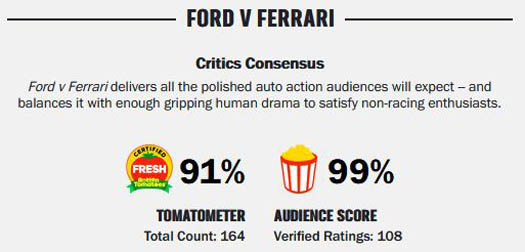
Ford v Ferrari reviews on the Rotten Tomatoes critics reviews aggregation website


Click on the graphic above to access reviews for Ford v Ferrari on Rotten Tomatoes

star.jpg star.jpg star.jpg

The Probable Best Picture Academy Award Winner for 2019

Opening today for two weeks only in exclusive engagement at the Vancouver International Film Festival’s Vancity Theatre on Seymour Street — where advance tickets for the three screenings each day this weekend are already sold old — Martin Scorsese’s gangster opus, the capper of a directorial career that spans fifty years, the film that opened the New York Film Festival to rave reviews, a film that clocks in at 209 minutes that will seem like half that time the film is so enthralling, one of the five films that will garner the most Oscar nominations — a probable Best Picture Academy Award winner come Sunday evening, February 9th — The Irishman is, as Boston Globe critic Ty Burr enthuses, “a masterpiece”, a film Richard Roeper in the Chicago Sun-Times says is “the best film of the year and one of the best films of the decade,” and as other critics have written …

… a genuinely new, deeply satisfying, serenely confident film presented with subtlety, wit and resonance, a sumptuous film that tells an epic, extraordinary tale of organized crime’s grip on American life as seen through the eyes of one outwardly ordinary man, a film that is a revelation throughout, intoxicating, history-making cinema, a melancholy eulogy for growing old and losing your humanity, a film to be savoured in every one of its 209 minutes, a knockout story that is surprisingly, surpassingly delicate, told by a master filmmaker with heart and sombre introspection, a film that takes a deep dive into the darkest of souls but manages to remain engaging, lively, funny, full of grace, tender, reflective, mournful, a film of grandeur and bloody memories, a heartbreaking film that presents Joe Pesci as you’ve never seen him before, with superb performances from Al Pacino and Robert De Niro — together for the first time in a Scorsese film — and an absolute must-see at the cinema.”

So, that’s it: two of the best films of 2019, both deserving of your time and scarce dollars, both films (in their own way) epic and unforgettable cinema.

Decision Canada 2019 | VanRamblings’ Post Election Wrap Up

Vancouver on a sunny autumn day, in Stanley Park

On the Tuesday, October 22nd, 2019 morning on Canada’s west coast, the day after the consequential 43rd Canadian federal general election, the sun shone in the skies for the first time in nearly 42 days on British Columbia’s stormy, coastal rainforest, since that fateful day when Justin Trudeau dropped the electoral writ on the afternoon of Wednesday, September 11th.
Clearly, sunny ways and sunny days had once again blessed our nation, as the gods above celebrated our collective good fortune that in the infinite wisdom of the Canadian people, voters had elected what will in all likelihood turn out to be a stable, four year Liberal minority government.
Yes, for six, long, dreary, relentless weeks, the rains poured down from the heavens like the cascading tears that tumble down our cheeks when life seems so uncertain, when we don’t know what will occur next in our lives.

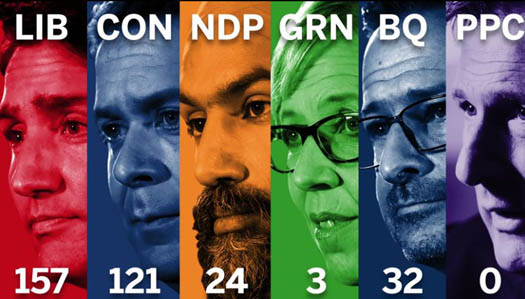
The seat count in the House of Commons following the 2019 Canadian federal election

But all now seems well — fighting climate change remains at the top of the political agenda, Greta Thunberg will rally with west coast citizens on Friday (at the Art Gallery downtown), affordable housing, the very real prospect of both a long promised national pharmacare and dental care closer to realization than, perhaps, ever before — and indigenous reconciliation, and public transit also at the top of the federal government’s political agenda.

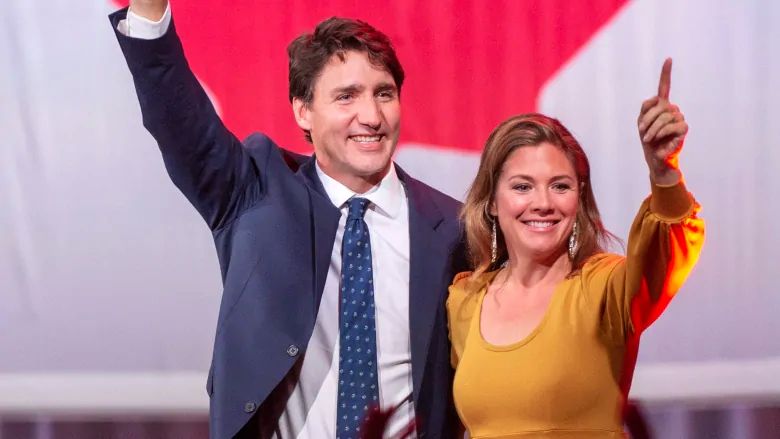
Justin Trudeau and his wife Sophie Gregoire celebrate the 2019 Canadian Liberal Party victory

In the next short while, Canadians will be afforded a unique and expansive opportunity to get to know our Prime Minister Justin Trudeau better than we’ve ever known him, as he sets about to make an historic decision as to what form governance will take over the course of his coming mandate …

  • 1. Will Justin Trudeau choose to become Stephen Harper redux, and adopt the former Conservative Prime Minister’s approach following the 2008 federal election — when he won only 143 seats in the House of Commons, 11 seats shy of forming a bare majority government — and govern as if he has a majority, and damn the consequences?;

  • 2. Will Justin Trudeau, if he is truly a progressive, adopt some form of a co-operative ‘Confidence and Supply’ agreement (as we have in B.C. between the NDP and the Greens), with Jagmeet Singh and the NDP (as well as Elizabeth May and her two Green Member of Parliament colleagues), as did Lester Pearson in 1963 with NDP leader Tommy Douglas — when in a two year period, Canadians saw the introduction and realization of universal health care, the Canada Student Loan programme, the Canada Assistance Programme, and the Canada Pension Plan — or as did his father in 1972 when his government achieved only a minority in Parliament, but working closely with NDP leader David Lewis set about to create a made in Canada solution to the provision of socially just affordable housing, constructing 2500 housing co-ops across Canada, housing more than 130,000 Canadians?;
  • 3. Or, will Justin Trudeau govern on a catch-as-catch-can basis, looking for support from the NDP and Greens when such support is deemed necessary (say, on reconciliation or climate change issues), or from Yves François Blanchet and the Bloc Québécois when it comes to issues of importance to the citizens of Québec, or from Andrew Scheer and the Conservatives when it comes to pipeline issues?

Whatever the case, over the course of the next four years (many pundits believe the Trudeau government will realize a full mandate), Justin Trudeau will be sticking much closer to home, he and his Ministers traveling the globe much less, particularly should he choose option one or three above.
None of the federal parties want to return to the polls anytime soon.
Jagmeet Singh’s New Democratic Party is flat dead broke, having mortgaged their party headquarters in Ottawa to pay for the 2019 campaign. Andrew Scheer faces what is sure to be a contentious review of his leadership next spring, and should he fare as Tom Mulcair did in 2017, the Conservative Party will be looking for a new leader. Elizabeth May will be gone within a year to 18 months, with (in all likelihood) Jody Wilson-Raybould stepping into the breach to become national leader of the Green Party of Canada. The Bloc? Thirty-two seats — far, far better than Mr. Blanchet believed was possible only a month ago. Already he’s told anyone who will listen that Mr. Trudeau deserves a four year term in office.
The next order of business for Justin Pierre James Trudeau (who will turn 48 on this upcoming Christmas Day) will be for the Prime Minister to appoint a new Cabinet, which he announced yesterday would occur on Wednesday, November 20th.
Early speculation has Mr. Trudeau pleading with recent Alberta Premier Rachel Notley to join his Cabinet (given that the Liberals lost all four seats in Alberta), as well as appointing outgoing and defeated Public Safety Minister Ralph Goodale to the Senate, after which he would appoint Mr. Goodale to his new Cabinet (no Liberal elected in Saskatchewan, either).
Canadians proved their wisdom in consigning Andrew Scheer and his far right-of-centre Conservative Party to her majesty’s loyal opposition, so there is that to celebrate. What else might we celebrate in the days, weeks, months and years to come? Only time and good fortune will tell.

Decision Canada 2019 | VanRamblings Predicts Election Outcome

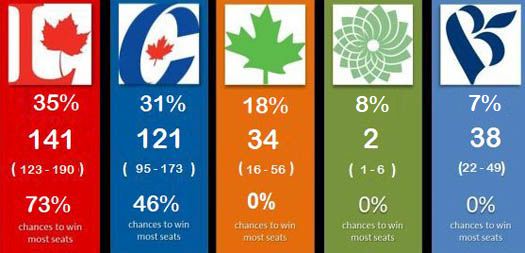
VanRamblings predicts outcome of 2019 Canadian federal general election

Forty days after Justin Trudeau dropped the writ on Wednesday, September 11th, tomorrow — Monday, October 21st — will see the conclusion of the 43rd Canadian federal general election, as terrible, dispiriting, unfocused, frought and ugly an election as doleful Canadians have ever been privy to.
The graphic above represents VanRamblings’ prediction as to the outcome of tomorrow’s general election. We base our judgement on: Éric Grenier’s meticulous work on the CBC Poll Tracker website; a careful listen to the prediction made by respected political pundits Scott Reid and David Herle (and what Conservative party apparatchik Jenni Byrne refused to say during that podcast) on the most recent episode of Mr. Herle’s must listen to political podcast, The Herle Burly; and from in-depth discussions with senior party strategists in the four main political parties offering candidates in the election: the Liberals, Conservatives, NDP and the Greens.

In what Jenni Byrne has called a shit election, only the New Democrats and the Bloc have run anything closely resembling an energized and winning political campaign, confounding the pundits, performing significantly better on the campaign trail and during the debates than anyone had predicted.
In addition to predicting the outcome of tomorrow’s Canadian federal election, today we’re going to weigh in on the various party campaigns.

Andrew Scheer and the Conservative Party of Canada ran the second worst 2019 federal election poltical campaign

The Conservative Party of Canada ran the second worst campaign in the 2019 Canadian federal general election, failing to move the needle at all (their poll numbers were mired at 32% throughout the entire campaign).
The Conservative message: affordability.
The response of Canadian voters, not to mention the Liberal party and the New Democrats: affordability at whose and what cost?
Cutting $54 billion in spending over the next four years would mean: no spending on public transit (or bridges) in Canada’s major metropolitan centres, from Montréal, Toronto and Vancouver, through to Edmonton, Calgary, Saskatoon, Regina, Winnipeg, Hamilton, and all the capitals of the Maritime provinces — not to mention defeating any hope that work would occur to respond to our current pan-Canadian affordable housing crisis.
No Tory plan to address climate change, while committing to a $100 billion national energy corridor that was opposed by all but the Conservative premiers of Canada, a national energy plan that would be wrapped up in the courts for years and, like Trump’s wall, would never, ever be built.
Although VanRamblings is assured by our friends who are members of the Conservative party that Andrew Scheer is a “nice guy”, loves his kids and loves his wife, Andrew Scheer on the campaign trail displayed all the charisma of a kumquat, and a not particularly ripe, tasty kumquat at that.
Throughout the campaign the media caught Andrew Scheer in one lie after another (a Liberal / NDP coalition would raise the GST to 7% … uh no), caught him lying on his résumé (he was not a licensed insurance broker before getting into politics), he’s a dual Canadian-American citizen — although he was front and centre attacking former governor general Michaëlle Jean for her dual French and Canadian citizenship when she was named to the post in 2005, not to mention his hypocrisy in attacking former Liberal leader Stéphane Dion and former NDP leader Tom Mulcair, accusing them of having divided loyalties as both had dual Canadian and French citizenship while holding public office. Glass houses and all that …
The icing on the cake to finish off Andrew Scheer’s woebegone campaign for office came only yesterday, on Saturday, October 19th (just two days before the election), when he and the Conservative party were caught out as having hired political consultant Warren Kinsella to run a vicious social media attack against People’s Party of Canada leader Maxime Bernier. And, oh yeah, at a rally in Ontario last night, the largest yet crowd at a Conservative party campaign rally began a chant of “Lock him up, lock him up” — referring to our current Prime Minister. Sound at all familiar to you?
Perhaps the biggest mistake of the ‘gang the couldn’t shoot straight’ Conservative party campaign was having Andrew Scheer insisting at every campaign event that he and the Conservatives would win a majority government come the evening of Monday, October 21st, and that their first order of business would be to cancel the carbon tax.
Why was this talk of a majority a major campaign faux pas?
Insisting that the Conservative party would win a majority government would have likely elicited two responses from voters: non-evangelical Conservative party supporters would be more likely to stay home if they believed a majority Conservative party government was a fait accompli — thereby depressing the Conservative supporter turnout — and … if low information voters who didn’t necessarily support the Conservative party, and those voters who had been unlikely to turn up at the polls (think voters age 18 – 34), also thought an undesired Conservative party government was in the offing, the potential for these voters (and their friends) turning up at the polls to do their part to thwart the potential for a Trump-like Andrew Scheer government would serve only to exponentially increase the turnout of this voting group. Tch, tch, Conservative party campaign.

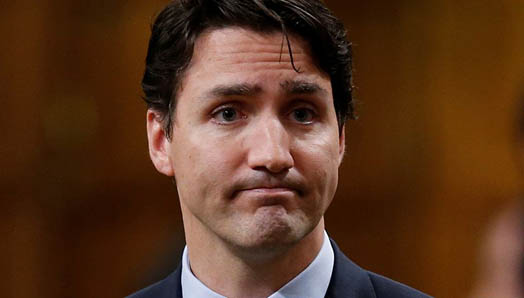
Justin Trudeau is, by nature, as essentially she, introverted person

VanRamblings believes that Justin Trudeau is, at his core, a shy introvert, given to a somewhat naïve (if generous) view of the world, who throughout his life has depended on the support of his friends and those close to him — particularly the women in his life, because as every good man knows, it is women who are more generally the smarter, more emotionally centred, and more authentic of the two genders — to keep him centred emotionally.
In the early part of Mr. Trudeau’s first term, when he and his lovely wife, Sophie Gregoire Trudeau, were traipsing across the globe introducing themselves to world leaders, to let the world community know that Canada was back on the world stage, and that 10 years of a mean-spirited, right-of-centre Stephen Harper administration was now but a sorrowful feature of Canada’s past, Mr. Trudeau was in his element: a Liberal caucus who were 50% women, new funding of programmes for women and women’s centres, front page photos in Vogue magazine of he and his wife, and large portions of the U.S. electorate exclaiming, “Why can’t Justin Trudeau be our President? We don’t want Donald Trump. We want Justin!” Life was good.
And then the Jody Wilson-Raybould non-scandal happened, with Mr. Trudeau’s polling numbers plummeting, and the Prime Minister all but withdrawing from the public eye, the talk of sunny ways (certainly not reflected in Mr. Trudeau’s demeanour) long gone. VanRamblings believes Mr. Trudeau found the disloyalty of Ms. Wilson-Raybould to be personally devastating, so devastating it has resulted in a listless, near funereal campaign by the Liberal leader all these months later (although that, fortuitously for all of us, seems to have changed somewhat this past week).
That the Liberal campaign didn’t trumpet it’s many successes (e.g. no talk about their kept promise to lift CPP / OAS / GIS dependent seniors out of poverty) served only to exacerbate the failure of the Liberal campaign. Still, it looks as if Trudeau may soon manage a workable minority government, while gearing up to implement both a national pharmacare and dental care programme (thank you Jagmeet Singh, thank you NDP), so that’s good.

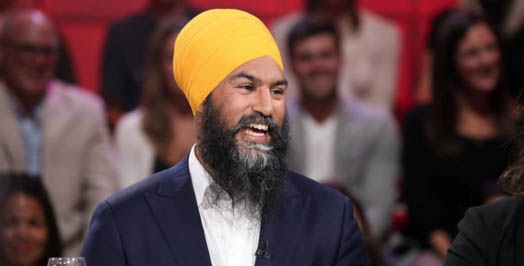
Jagmeet Singh, leader of the New Democratic Party of Canada, on the campaign trail in 2019

With almost no money, and no on the ground riding infrastructure, the NDP has run a near faultless, upbeat and positive textbook campaign that saw the leader, Jagmeet Singh, moving across the country to assure the Canadian people that hope and generosity of spirit, kindness and compassion still exists in the political realm — which it certainly did for Mr. Singh both on the campaign trail, and the NDP fortune enhancing prospects coming out of the two campaign debates with the other party leaders.
Only 2 months ago talk was about replacing Mr. Singh as leader. No more.
In 2017, 124,000 NDP members made it clear that they wanted the party to return to the values of Tommy Douglas, David Lewis and Ed Broadbent, and in Jagmeet Singh they found the leader who would represent what the NDP (and its predecessor, the CCF) have always stood for: compassion for working people, change for the better for working people, and ensuring the wealthy and corporations would pay their fair share. Welcome back NDP!
Those who stand for nothing, will fall for anything
The self-inflicted wound that became the Green Party campaign

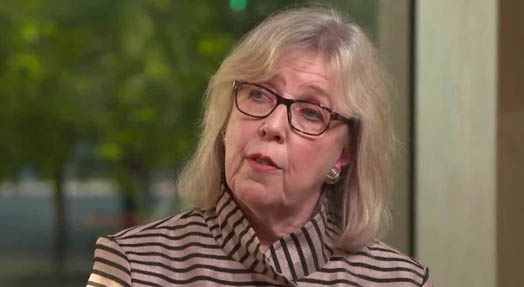
Elizabeth May, leader of the Green Party of Canada

Elizabeth May (a lovely person) and the Green Party of Canada, in 2019, ran the worst, most inept campaign in recent Canadian political history, the consequence of which will be dire for the Green movement across Canada, at the municipal and provincial level. A one issue party that stood for nothing other than fighting climate change (“Yes, folks, we’ve cornered the market on addressing our current climate emergency,” Ms. May might well have said. “The rest of the party leaders are just lying ne’er-do-wells — so that means you’ve got to vote for us, or vote for no one at all.”).
Canadians may reasonably expect that Ms. May will step down as Green Party leader of Canada at some point over the course of the next year, having done irreparable damage to the reputation of the Green movement.
So, let’s get a bit of history out of the way: in Europe, the Green movement arose out of the work of the far left Baader-Meinhof gang of the 1970s, who gave up violent direct action — industrial sabotage, blowing up buildings and infrastructure, and other forms of political violence — in favour of creating a Green movement that would enter government and fight against restrictions on immigration, advocating for women’s reproductive rights, supporting the legalization of marijuana, fighting for LGBTQ rights, having the state draft “anti-authoritarian” concepts of education and child-rearing, fighting against the dual threats of air pollution in the cities and the acid rain then destroying forests across Europe, fighting for civil rights, fighting against military incursions into developing states, and against state-sanctioned imperialism — well, you get the idea. The European Green movement is a progressive, far left-of-centre, multi-faceted civil rights and environmental movement — was in the 1980s, and remains so to this day.
The Green parties of Europe have held the balance of power, and more often than not sat in government for near 40 years, realizing substantive change as an activist movement well able to articulate the conditions necessary to create a fair and just state to serve the interests of all.
Not so in Canada. The Green movement at the federal level was founded by Jim Harris, formerly a far right member of the Conservative party, who was found to be so extremist that he was kicked out of the party, only to emerge as leader of the Green Party of Canada. Following charges of corruption, Mr. Harris stepped down as Green Party leader, and was replaced by Elizabeth May at the party’s convention held in August 2006.
Since her investiture as leader, Ms. May has focused her leadership, almost exclusively, on the environment and fighting climate change, on May 2nd, 2011 becoming the first elected Green Party MP to sit in the House of Commons, as the member for the B.C. riding of Saanich-Gulf Islands.
The Green Party has drawn candidates and support from two groups: the well-intentioned but politically naïve (with a surfeit of young, apolitical members), and those who are disenchanted with the old line parties (or parties that have an infrastructure, a broad and all encompassing raison d’être, and are committed to Canada as a diverse, inclusive nation).
Ms. May, personally, represents the best of the federal Green party movement. As a leader promoting the interests of women’s reproductive rights, diversity and inclusion within her own party, and issues other than the environment, not so much. Quite honestly, the Green Party of Canada doesn’t stand for much, which became all too clear during the course of the current Canadian federal election, during which the electorate discovered:

  • Only 12% of Green candidates are visible minorities;

    Only 12% of Green Party candidates running in the 2019 Canadian federal election are visible minorities.

  • Although Ms. May herself is a strong proponent of women’s reproductive rights, when it was brought to her attention that one of her (non-diverse, male) candidates was running on a strident anti-abortion message, she replied, “In the Green Party we have a diversity of opinion, and given that a core value of our party is that we don’t whip our candidates, and although I disagree with this candidate on women’s access to reproductive services, there is nothing that I can do to impact on his candidacy;”
  • When Pierre Nantel, formerly an NDP member of Parliament who was kicked out of the party and recruited by Ms. May as a Green candidate in the Québec riding of Longueuil-Saint-Hubert, said in an interview that he is a Québec separatist, and as a Green party member of Parliament he would work towards separation, when asked for comment, Ms. May gave the same yada yada reply;
  • The Green Party’s confused, errant position on cannabis;
  • The Institute of Fiscal Studies and Democracy at the University of Ottawa issued a “Fiscal Credibility Assessment”, giving the Green Party a failing grade respecting the party’s economic assumptions, responsible fiscal management, and transparency.

    Kevin Page, the former parliamentary budget officer who heads the institute, says the Green Party costing is riddled with errors — for example the numbers in the detailed tables don’t match the overview totals. And it all appears to be based on outdated, 2018 fiscal projections. “To us, it looked like it was put together in a very hurried fashion,” says Page. “Somebody made a mistake.”

  • And, oh yeah: at campaign outset, when 7 “senior” members / upcoming federal and former candidates of the New Brunswick NDP defected to join the Greens, Ms. May was all smiles. Up until it was reported that the number of defections was not the 15 she originally announced to much foofaraw, but only 7 — only one of whom was a senior party member. Not to mention, when the defectors who left the NDP were asked why they did so, almost in unison they said, “We come from rural ridings. No one we know would vote for a party whose leader wears a turban.” Ms. May remained silent when hearing of this bit of hurtful racism.

Well, the travails of a botched Green Party of Canada campaign goes on and on — that’s what happens when the media shines a spotlight on an ill-thought out policy platform, and an unfocused, disingenuous campaign, that serves only to reinforce the notion that the Green Party is, at its very essence, as is often said about them, “Conservatives who ride bicycles”.

Yves Francois Blanchet, leader of the Bloc Quebecois

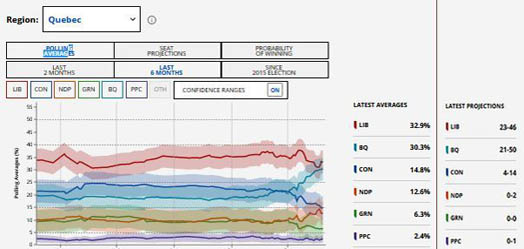
The man pictured above is Yves François Blanchet, the leader of the Bloc Québécois — a year ago a moribund separatist party that had little prospect of winning any seats in the current federal election. How times change.
As little as two months ago, polls showed Justin Trudeau and the Liberals at 43% intended vote and running the board in la belle province, and winning as many as 60 out of the 80 seats that were up for grabs. No more.
With Mr. Blanchet running on a “Quebec for Quebeckers” and “ain’t no damn dirty Canadians gonna tell us what we can do with Bill 21″ — we mean business, and that means no turban-wearing miscreants in Québec. We don’t wawn ’em,” the Bloc Québécois could win as many as 50 seats tomorrow, giving the majority of Canadians the worst possible election outcome: an Andrew Scheer-led minority government — giving away the farm to Québec separatist Mr. Blanchet in exchange for his support (which Mr. Blanchet has said he would willingly give).
Even though Québeckers are at the forefront of the fight against climate change, and only 7% of Québeckers will cast a ballot for Mr. Scheer, why it is that Mr. Blanchet would agree to participate in an Andrew Scheer-led Conservative party government, for this reporter, beggars belief.

Prediction as to how Quebec will vote in the 2019 federal election

Monday night, when you tune in after 7pm to see the election results back east, if the people of the Maritimes have voted in only 20 Liberal members of Parliament, and if Yves François Blanchet has secured 45 seats or more for his party, the 2019 election will be over for Justin Trudeau and the Liberal party — at which point, you should prepare yourself for a far right-of-centre, Trumpian Andrew Scheer as Canada’s 24th Prime Minister.