
#BC Poli | John Horgan Wins Majority Government NDP Sought

The BC NDP won a comfortable majority government in British Columbia on Saturday, October 24, 2020

On Saturday night, Premier John Horgan and British Columbia’s New Democratic Party became the first BC NDP government to win back-to-back elections with the same Premier. John Horgan made history Saturday night.
At present, there are some 500,000 outstanding mail-in ballots yet to be counted, but no matter the outcome of the final ballot count, a re-elected Premier John Horgan will remain in place, with a majority government.
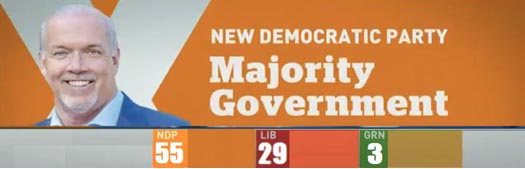
The BC NDP's John Horgan's wins 55 seats in the Legislature, and a majority government

Although soon-to-be outgoing B.C. Liberal leader Andrew Wilkinson failed to concede defeat election night, he did so on Sunday afternoon.

B.C. Liberal leader Andrew Wilkinson concedes defeat in the 2020 British Columbia election

Meanwhile, B.C. Green Party leader, Sonia Furstenau — whose party, at last count, had managed to maintain three seats in the B.C. Legislature — was somewhat less sanguine than her B.C. Liberal counterpart, as she continued to berate re-elected Premier John Horgan for calling a “needless election in the middle of a pandemic,” failing to recognize that the election is over, that a winner has been declared, and such circumstance most generally is best served by a good measure of graciousness and humility.

Sonia Furstenau, B.C. Green Party leader, wins re-election in her Vancouver Island Cowichan seat

Of course, the good folks who represent the proportional representation movement — whose numbers include a good portion of B.C. Green party supporters — were quick to point out that Mr. Horgan had not won a plurality of the votes, and as such, his was an “illegitimate” government.
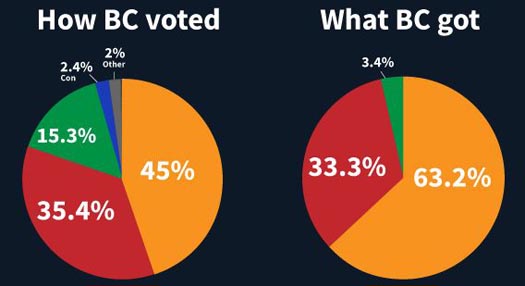
bc-election-prop-rep.jpg

All of which whinging has no effect — at least for now, when incumbent governments seem loathe to change a voting system which, more often than not rewards them with government — and won’t buy you a coffee.

British Columbia's New Democratic Party | Win a Majority Government

VanRamblings has no great insight, nor any particular reflection on Decision 2020 that we’re prepared to publish today — that’ll come tomorrow.
On Wednesday, we plan to write about the B.C. Green Party fortunes going forward — and lest you be concerned, we intend to be generous.
Suffice to say for now that the B.C. NDP got the majority they wanted, the B.C. Liberal party did as badly as the polls — and their godawful, off-the-rails campaign — had predicted they would, that against expectation both incumbent B.C. Greens, Ms. Furstenau and Adam Olsen, won re-election and although, as expected, the B.C. Greens lost former B.C. Green leader Andrew Weaver’s old riding of Oak Bay-Gordon (to former federal NDP MP Murray Rankin, likely to become British Columbia’s next Minister of Justice and Attorney General), B.C. Green candidate Jeremy Valeriote appears on track, at this writing, to win the seat of West Vancouver – Sea to Sky.
VanRamblings supposes, as well, that it is incumbent on us to comment on the B.C. NDP wins in Surrey, Langley and the Fraser Valley.
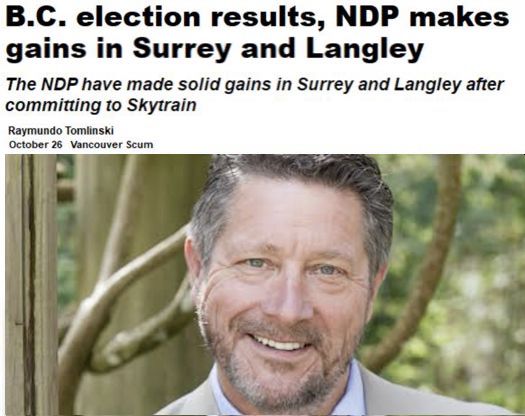
BC NDP win seats in Surrey and Langley, including Mike Starchuk in Surrey-CloverdaleFormer Surrey City Councillor, Mike Starchuk, became the winning British Columbia New Democratic Party candidate in the Surrey-Cloverdale riding on Saturday night.

Who’da thunk in a million years that the once invincible B.C. Liberal seat of Surrey-Cloverdale, held for many years by the all powerful Kevin Falcon, and most recently by popular former Surrey City Councillor, Marvin Hunt, would turn orange, and become an NDP seat, won by former Surrey City Councillor Mike Starchuk — in a walk, with 50.14% of the vote?
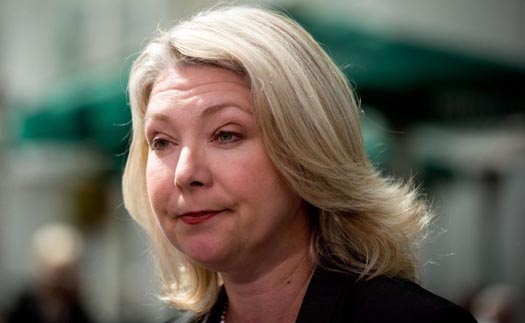
Four term Langley MLA goes down to defeat in 2020 British Columbia provincial electionLiberal MLA Mary Polak soundly defeated as her party runs an anti-LGBTQ campaign

Langley. Former right-of-centre, “ain’t gonna allow no ‘two dads’ books in our school system, no sirree‘ Surrey School Board Chairperson, and for four consecutive terms winner of her in-the-heart of Langley riding, recent B.C. Liberal house leader and, in various terms in government dating back to 2005, Minister of the Environment, Transportation and Infrastructure, Aboriginal Relations and Reconciliation, Children and Family Development and Minister Responsible for Child Care, and Minister of Healthy Living and Sport, the indefatigable Mary Polak, lost her seat. That’s a shocker.
The people who live out Langley way are supposed to be troglodytes, and aren’t supposed to be voting for those damnable socialists in the New Democratic Party, and turning over not one but both of the Langley seats, including Rich Coleman’s Langley East seat, where the NDP’s Megan Dykeman — a Langley farmer, Managing Director of a small business, 10 year Trustee and current Chair of the Langley Board of Education — continues to hold onto the riding by the thinnest of electoral margins, as she awaits the results of the final vote count next month. But still …
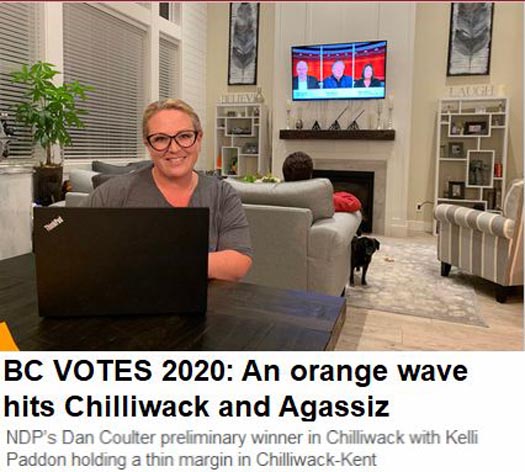
An orange wave hits Chilliwack as BC NDP defeat BC Liberal incumbents

At this writing it appears the New Democrats have taken both Chilliwack ridings, long-held BC Liberal seats, long thought to be ultra-conservative.
Incumbent BC Liberals John Martin in Chilliwack and Laurie Throness in Chilliwack-Kent were challenged not just by the NDP but from a right-of-centre vote-splitting problem in the form of a surging and popular BC Conservative candidate, Diane Janzen. With the results of this election, it would seem the political landscape of the Fraser Valley is changing.
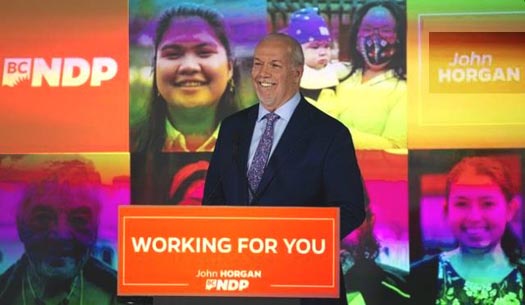
The BC NDP won a comfortable majority government in British Columbia on Saturday, October 24, 2020

Final note for today.
All and all, John Horgan was “lucky” to win the size of majority he did.
Why?
Had the B.C. Liberal campaign collapsed as badly as many were predicting, and John Horgan had to deal with an outsized caucus of, say, 69 elected Members of the Legislature — a goodly number of whom would be in the climate action camp, and likely to be shut out from Cabinet, Parliamentary Secretary or Committee Chair positions — he would have had a problem on his hands responding to a discontented, disenfranchised, yet inspired Green New Deal brigade of climate change activists deep within his NDP caucus, giving rise to the age old proverb, “idle hands are the devil’s playthings”, or in plainer English, when one is unoccupied or has nothing to do, one is more likely to cause or get into trouble — and insist on climate justice. Fortunate for Mr. Horgan, for now at least he’s avoided such an ill fate.
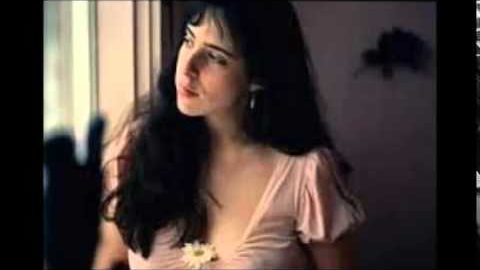
Music Sundays | Laura Nyro, and Christmas & The Beads Of Sweat

The music of American singer-songwriter, Laura Nyro

On this post election Sunday, a needed and necessary break from politics.
Last Sunday, October 18th, would have been beloved American singer-songwriter Laura Nyro’s 73rd birthday, born Laura Nigro on that date in The Bronx, New York. Ms. Nyro passed far too early on Tuesday, April 8, 1997.
Years ago, for me, one of the great joys of my life was playing the breadth of Laura Nyro’s music library during my regular afternoon shift on Simon Fraser University’s CKSF radio, when I was in love with her music, and simply couldn’t get enough of the albums she released, and I softly spun.

Laura Nyro, the song Up on the Roof, from her 1970 LP Christmas & The Beads Of Sweat


A bit of background on Ms. Nyro: As a child, she spent summers in the Catskills with her family, where her father played trumpet at various resorts. She credited the Sunday school at the New York Society for Ethical Culture with providing the basis of her education; she also attended Manhattan’s High School of Music & Art. While in high school, she sang with a group of friends in subway stations and on street corners.
Her father Louis Nigro’s work brought him into contact with record company executive Artie Mogull, and his partner Paul Barry, who in 1966 auditioned a young Laura Lyro, then all of 20 years of age, subsequently going on to become her first manager. Mogull then set about to negotiate a recording and management contract for his young protégé. On November 29, 1966, Laura Nyro released her début album, More Than a New Discovery, for the Verve Folkways label. A song from the album, Wedding Bell Blues / Stoney’s End became a minor hit for Nyro, especially on the west coast.

Later, other songs from the album became hits for The 5th Dimension, Blood, Sweat & Tears, and Barbra Streisand.
On Saturday, June 17, 1967, Laura Nyro appeared at the Monterey Pop Festival. Soon afterwards, impresario David Geffen approached Mogull about taking over as Nyro’s agent. Geffen became her manager, and together the two established a publishing company, Tuna Fish Music, under which the proceeds from her future compositions would be divided equally.
Geffen also arranged Nyro’s new recording contract with Clive Davis’ Columbia Records, and purchased the publishing rights to her early songs.
The new contract allowed Nyro more artistic freedom and control. In 1968, Columbia released Eli and the Thirteenth Confession. Eli was followed in 1969 by New York Tendaberry, another highly acclaimed work which cemented Nyro’s artistic credibility. Nyro’s fourth album, Christmas and the Beads of Sweat, was released at the end of 1970. The set contained Upstairs By a Chinese Lamp and Been on a Train (one of my all time favourites), and featured Duane Allman and other Muscle Shoals musicians.
In the early 70s, there was no greater reflection to be had on a rainy autumn afternoon up on the fog-bound hill at Simon Fraser University than to be snugly sequestered, and warm inside the tiny broadcast studio at CKSF, lights down, experiencing Laura Nyro’s melancholy Been on a Train.

The following year’s album release, Gonna Take a Miracle was a collection of Nyro’s favourite “teenage heartbeat songs”, and was recorded with the blues vocal group Labelle (Patti Labelle, Nona Hendryx, and Sarah Dash).

In 1976, Ms. Nyro released an album of new material, Smile, after which she embarked on a four-month tour with a full band, which resulted in the 1977 live album Season of Lights. After the 1978 album Nested, recorded when she was pregnant with her only child, she again took a break from recording, this time until 1984’s Mother’s Spiritual.
Between 1968 and 1970, a number of artists had hits with her songs: The 5th Dimension with Blowing Away, Wedding Bell Blues, Stoned Soul Picnic, Sweet Blindness, and Save the Country; Blood, Sweat & Tears and Peter, Paul and Mary, with And When I Die; Three Dog Night and Maynard Ferguson, with Eli’s Comin’; and Barbra Streisand with Stoney End, Time and Love, and Hands off the Man (Flim Flam Man). Nyro’s best-selling single was her recording of Carole King’s and Gerry Goffin’s Up on the Roof.

Laura Nyro’s final album release, Walk the Dog and Light the Light came in the late summer of 1993, with the song, Oh Yeah Maybe Baby. I remember going down to Zulu Records, when it was located at the corner of 4th and Burrard, with my friend J.B. Shayne, who all but took my hand as he led me into the store, and to the bin where Walk the Dog and Light the Light lay, the album becoming the soundtrack of my life in 1993.

Nyro passed away April 8, 1997, at the age of 49.
She was posthumously inducted into the Songwriters Hall of Fame in 2010, and into the Rock and Roll Hall of Fame in 2012.

Stories of a Life | 1983 | A Sad Political Story | Every Vote Counts

If you haven't voted in the 2020 British Columbia provincial election | GO VOTE !!!

In 1983, while teaching in the Tri-Cities, I also sat as Education Chair on NDP MLA Norm Levi’s Coquitlam-Maillardville riding executive.

Now, I’d known Norm dating back to his days as Minister of Human Resources in Dave Barrett’s groundbreaking NDP administration, when he was the government’s liaison to the grassroots Tillicum and Fed Up co-operative movement where I was the Executive Director, a co-operative movement which not only initiated the distribution of organic and natural foods across the province, but fundamentally changed the eating habits of British Columbians, and was instrumental, as well, in establishing the first worker-run co-operative: provincial recycling initiatives, child care centres, organic orchard, vegetable and poultry farming communities, bakeries, car repair, furniture building, housing construction, and an import wholesaler.

Vancouver in the seventies

By the time Dave Barrett called a snap election on Monday, November 3rd, 1975, Norm and I had already lost touch with another, when earlier in the year I had accepted a teaching job in the Interior, Cathy, our young son Jude, and I travelling north, where we bought our first home, settling in.

On Thursday, December 11th 1975, when the Barrett government was defeated by the right-wing Bill Bennett Social Credit party — when, earlier, the Socreds had made a commitment to B.C.’s Liberal & Conservative parties to join them in a coalition, offering their elected MLAs Cabinet positions in government — although Norm was re-elected as the Coquitlam-Maillardville NDP MLA, he was no longer in government, and could do little to promote the co-operative movement, as he’d happily done since 1972.

By the time 1983 rolled around, I had completed work on my Masters degree at Simon Fraser University, was sitting on the Coquitlam BCTF Executive, and was working as an English and Drama teacher in School District 43. And, of course, when Norm and I renewed our friendship, he asked me to sit on his constitutency executive as Education Chair.

All was well with the world when Premier Bill Bennett called a provincial election on Thursday, April 7th, 1983. Norm was a popular sitting MLA, as he had been since first being elected in 1968. The Socreds were running a low profile, virtually unknown car dealer by the name of John Parks.

Norm Levi, member of the British Columbia Legislature, 1968 thru 1983
Norm Levi, respected member of the British Columbia Legislature, 1968 thru 1983

The constituency and the provincial NDP immediately went into campaign mode, signing up more than 500 volunteers in Norm’s riding alone.

Money poured in, we had a first-rate, experienced campaign manager in Dawn Black, who would go on to run successfully as an NDP New Westminster federal candidate. Phone banks were set up, the campaign office was bustling, leaflets were printed and distributed by 400 volunteers, and burmashaves throughout the constituency became a fixture on the landscape through E-Day, some two months later, Thursday, May 5th, 1983.

My job on E-Day was to pick up voters for transport to their polling station, the operation efficient and finely-honed, the office buzzing with activity. Throughout the day, I delivered and returned home almost two dozen voters, who were thrilled to re-elect their beloved MLA, Norman Levi.

My final pickup of the day was an 86-year-old woman who lived in the Burquitlam area, with me arriving at her home shortly after 7pm. I went to knock on the door, helped her down the steps of her home and into my car, and off the two of us went to her polling station, gabbing to beat the band, both of us excited about election day and the opportunity to socialize and get to know new people. During our relatively short drive to the polling station, when I drove at a snail’s pace at my rider’s insistence, she gave me some shocking news: she told me that she’d thought about the matter, and as much as she liked and had voted for Norm Levi in the past, just that afternoon she had decided to cast her ballot for that “nice boy, John Parks.”

So, here I was with a Socred voter in my car, transporting her to the polling station so that she could cast her vote for Norm’s opposition. I talked with her about all of Norm’s fine traits, all that he had accomplished over the years, and how Norm was a much better choice for Coquitlam-Maillardville than that John Parks fella — but she was having none of, saying to me, “Are you telling me that I can’t vote for John Parks?”

No, I told her, you can vote for whoever you choose, but I know Norm Levi well, and know that he’ll make a better representative for Coquitlam-Maillardville residents than John Parks, who didn’t even live in the riding.

“Well, get moving,” she said to me, “time’s a wasting, and I want to cast my ballot for John Parks, and that’s all there is to it!”

Now, if I had my wits about me, and was more mature than I was at age 32, I would have taken her home rather than to the polling station, telling her that my job was to take NDP voters to the polls, not Socred voters, that she’d have to make her own way to the polls. But that’s not what I did.

Instead, I drove her to the polling station, and helped her into the polling station for her to cast her ballot. I waited through the time it took for her to vote, and drove her back home, with her full of smiles, and me with a frown on my face — then I headed to the polling station where I’d been assigned to work as a vote count, ballot box scrutineer.

The British Columbia Legislature building in Victoria

When the final vote count was announced at 10:45pm that cool May 5th evening, Bill Bennett had scored a smashing victory, winning 35 seats to the NDP’s 22 seats, with just shy of 50% of the popular vote, to 44.94% for Dave Barrett’s third time defeated British Columbia New Democratic Party.

How did Norm Levi do in the 1983 British Columbia provincial election, running for re-election in his beloved Coquitlam-Maillardville riding?

John Michael Parks became the new Member of the Legislature for Coquitlam-Maillardville, where he went on to become Speaker of the House in Victoria. And what was Mr. Park’s margin of victory over Norm Levi?

One vote.

John Michael Parks won the riding by the single vote of the 86-year-old woman I had transported to her polling station earlier that evening. One vote had defeated Norm Levi, the incumbent, long-serving and well-respected Member of the Legislature for the provincial Coquitlam-Maillardville riding.

One vote.

So don’t go telling me that every vote doesn’t count — because, as may be seen in the “story” above, every ballot cast & every recorded vote counts.

Take it from someone who knows, much to my everlasting, persistent regret, heartfelt consternation, and ever sorrowful chagrin.

Make your vote count in the 2020 British Columbia provincial election | GO VOTE !!!

Arts Friday | The Impact of Cinema in Pre-Pandemic Times

watching-movies.jpgNostalgia for a Time When Going to the Movies Was a Pleasure We All Enjoyed
Each and every one of us possess within us memories of our experiences visiting the cinema: as a child of attending at the movies with our parents; our first foreign or independent film with a group of friends; or simply visiting our local multiplex cinema to catch the latest superhero blockbuster, or making the pilgrimage to one local film festival or another.
Pre-pandemic, going to the movies was still a popular past-time, even in an age when media consumption and “film viewing” has radically changed (think of the Netflix revolution). In North America in 2019, there were 1.3 billion cinema admissions — a not-insignificant, nor surprising figure.

An art deco cinema in the 1930s

In 1930, more than 65% of the population went to the movies weekly. That means for every 5 people you knew, 3 of them went to the movies weekly.
Can you even imagine that?
Eighty-five years ago, cinema-going remained astoundingly popular across the continent, reaching a peak of 1.64 billion admissions in 1946 — even though the North American population was less than half of what it is today.
Why was cinema so popular in times past?
Some of the reasons are fairly straightforward: there was limited opportunity long ago for inexpensive recreational activities outside of the home, television had yet to assert its power, and film was an established medium which exposed millions to different worlds and alluring cultures (or, more often, to the vicissitudes of North American culture).
There was, however, a deeper and perhaps more fundamental reason for movie-going’s immense popularity in North America mid-20th century.
Recent research on movie-going habits in the twenty and 21st centuries has focused on the interplay between space and emotion, and how cinemas act as facilitators of emotional experiences in ambiguous spaces.
Over the years, movies have aided people in helping to reveal new insights into their lives, while allowing a better understanding of the lived experiences of people across the globe, and in their own neighbourhood. Cinema has not only traced our conception of life, but has also served to affect our outlook on life and the lives of others.
Watching a film in the presence of others is different from watching a film alone, or with our family: the collective constellation affects the way viewers experience a film, made all the more obvious once strong emotions and affective expressions come into play: laughter, sadness, shame, anger, screaming, and more often than not (if we’re lucky) being moved to tears.
Different times in history — and different spaces — have served to create new affective landscapes and altered existing ones, making cinema a useful category for historians to study changes in society and culture over time.
The history of cinema has been integrated alongside other sociological methodologies to help form a more refined and complex picture of the past, and in consequence has offered a valuable way of introducing new insights into the establishment of popular culture, and societal development.
The darkness of the cinema environment presents the opportunity to experience a strong shared emotional experience in a public setting, in the anonymous environment of the auditorium. No other public space has facilitated this to such a degree, and this uniqueness reveals how the life of our society developed in specific contexts and in precise locations.
The enclosed and defined space of the cinema auditorium, containing a distinct group in the form of an audience, is an obvious example of community. Patrons in the cinema are aware of both their own emotional response to what they are viewing onscreen, and the feelings of those around them, providing reassurance that our emotional responses to a film are being mirrored by our fellow patrons.
Respected film critic Leslie Halliwell recalled in his memoir on cinema-going that film took “people furthest out of themselves, into a wondrous and beautiful world which became their Shangri-La”.

the-rialto.jpg

This utopia was reflected in the very names of cinemas — the Orion, the Rialto, the Plaza, the Regal — and in the architecture of the buildings which encompassed a range of styles including the clean lines of Art Deco and the high theatrics and excess of the “atmospherics”.

The Grandview Theatre, Commercial Drive at East 1st Avenue in Vancouver, in the 1950sThe Grandview Theatre, Commercial Drive at East 1st Avenue in Vancouver, in the 1950s

Evidence suggests that many people viewed their local movie-house, whether a stand-alone, second-run neighbourhood movie house or a first-run super-cinema, as a reassuring and familiar space characterized by a hazy emotionality fluctuating between the individual and the group, in the process offering a sense of connection with those who surrounded us.
This ambiguity — the individual vs the collective experience — lies at the heart of what attending at the cinema signifies to people. In few other areas of life are the landscapes of our lives softened to such a degree, in turn making attendance at the cinema a welcoming experience.

cineplex-cinemas.jpg

Cinemas have long occupied a position on the boundary between the domestic and the public, allowing our emotional experience of a movie concurrently as both communal and private, the evolving emotional landscapes which were crafted by cinema patrons in the mid-20th-century serving to break down anomie while creating a sense of connection.
The fundamentals of our affective experience at the movies has changed little over the past 100 years.
The price of popcorn, however, most definitely has.