VIFF 2020 | Vancouver’s Premiere Film Festival Wending to a Close

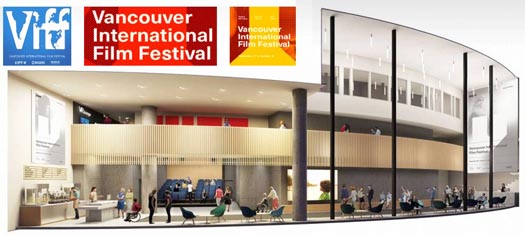
The Vancouver International Film Festival's newly renovated VIFF CentreThe newly-renovated Vancouver International Film Festival Centre | Vancity Theatre

Here we are fewer than 54 hours until the 39th annual Vancouver International Film Festival wends its way to a close fourteen days on, at 11:59pm precisely, this upcoming late evening, Wednesday, October 7th.

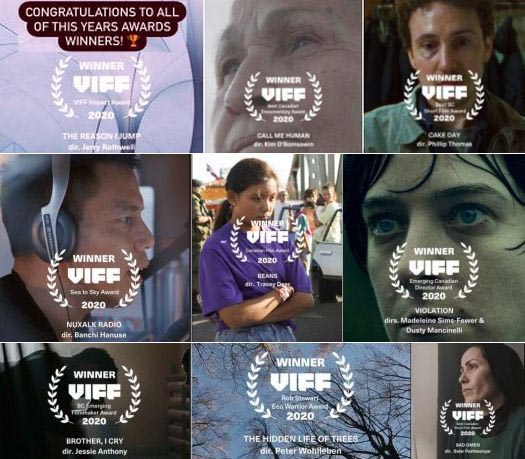
The 2020, 39th annual Vancouver International Film Festival Award Winners

This past weekend, VIFF 2020 awarded nine outstanding films, including …
The Reason I Jump | VIFF Impact Award

Call Me Human | VIFF Best Canadian Documentary Award

Cake Day | Best British Columbia short


Nuxalk Radio | Sea to Sky Award

Brother, I Cry | Jessie Anthony, B.C. Emerging Filmmaker Award

The Hidden Life of Trees | Rob Stewart Eco Warrior Award

Bad Omen | VIFF Short Forum: Programme 4

star.jpg star.jpg star.jpg

VIFF Talks filmmakers Jennifer Abbott and Joel Baken | The New Corporation: The Unfortunately Necessary Sequel

At 6pm Tuesday, VIFF passholders will be able to go online to gain insight into the making of Jennifer Abbott and Joel Bakan’s hard-hitting The New Corporation: The Unfortunately Necessary Sequel, and their insight into how all of us can come together to engage in the fight to limit the power of corporations & engage in the struggle to respond to our climate emergency.

VIFF 2020 Recommendation

The Pencil. Recommended by VanRamblings friend and longtime VIFF aficionado, Joseph Jones, awarded both best director & Special Jury Prize at Japan’s Skip City Film Festival, and Russian Film Festival Grand Jury Prize & Best Actress winner, The Pencil emerges as yet another VIFF 2020 knockout, Russian director /writer /actress Natalya Nazarova’s heartwrenching tale of redemption framed by shots of a town’s pencil factory machinery, the film tracking Atonina — a young woman from St. Petersburg, who uproots to a cold, forbidding region of rural northern Russia where her artist husband is being held as a political prisoner — as she takes on a job as an art teacher at the local school. Confronted by a violent thuggish element who torment her and bully the children, as determined as she is to transform the lives of the children she engages, she soon becomes aware that she, and she alone, is the only one in the town willing to tackle the cruel realities of corruption in her new home.
Note of perspective: at the start of the film, Nazarova shows a pencil factory making millions of yellow pencils, the pencils emerging as both a metaphor and a symbol for the children in the town, who the adults see as both fragile and dispensable. At one point in the film, a bully easily snaps a pencil in half, as easily broken as the spirits of the children Atonina has set about to rescue. A hopeful note: at film’s end, Nazarova shows the factory again, except now the pencils are green, a symbol perhaps for the inspiring possibility of change Atonina has wrought in the lives of the children.

star.jpg star.jpg star.jpg

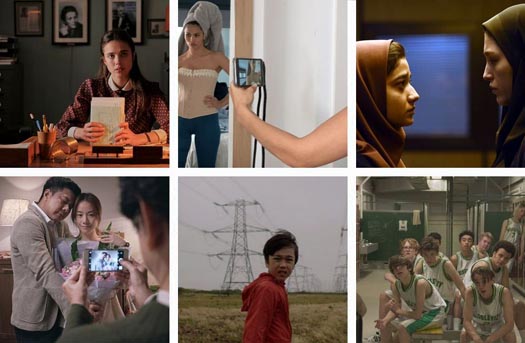
Contemporary World Cinema set to screen at the 2019 Vancouver International Film Festival

Full VanRamblings coverage of VIFF 2020 may be found here.

Stories of a Life | The Disgusting Men’s Group & Fallout Therein

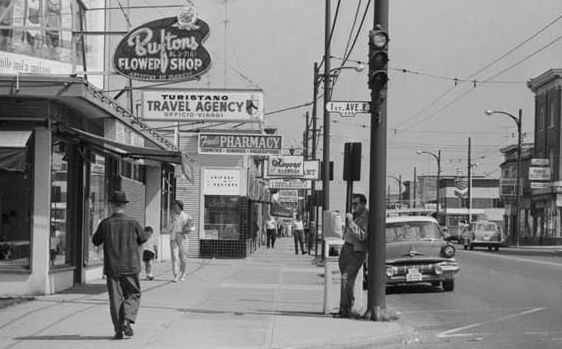
Vancouver's Commercial Drive at East 1st Avenue, 1950s

East 1st Avenue and Commercial Drive, in Vancouver, in the 1950s, facing north

Growing up in Grandview-Woodland in the 1950s and 1960s as a poverty-ridden, slum dwelling east side kid, getting into fights was almost a daily feature of my young life, as it was for most of my peers.
As bad as I often had it, though, life for my mother was often much worse.

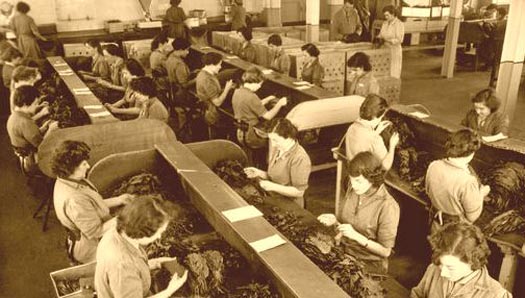
Women at work in the 1950s

Working for 35¢ an hour at one back breaking job after another, subject to the whims and the unwanted attentions of her male bosses, sexual assault was as much a feature in my mother’s life as fighting was in mine.
And my working class mother was as tough as they come, let me tell you.
Still, seeing what my mother had to endure every day, early on turned me into a feminist, and a staunch, lifelong defender of women, central to the way I’ve brought myself to the world, from as far back as I can remember.
When I met Cathy in the late ’60s, a big part of her attraction to me was as a bad boy, a wiry, never say die street fighter who could defend her interests and integrity when the occasion arose — which became a regular occurrence in the first half dozen years we were together.
Then the 1970s happened, the era of women’s consciousness-raising groups, and marching on picket lines to defend the interests of women exploited by their bosses at their place of employment — including up at Simon Fraser University, where men filled all of the senior administrative positions at the university, with women relegated to performing the work that needed to get done, although ill-paid for their endeavours, unrecognized, and denied always the opportunity for advancement.
Let us not forget, all of the above occurred less than fifty short years ago.
By the time the 1970s ended, every man of my acquaintance identified himself as a feminist, and a staunch ally of women. We learned to cook and participated with our partners in preparing meals, sharing household duties, and were as much involved with child raising as were our female partners.

Man preparing dinner, while his wife makes the salad

Then the 1980s came along, and many changes were wrought.
The women in the lives of these “liberated” men to whom I’d been close for a decade and more turned to us, one by one, expressing how dissatisfied they were with the progressive, supportive, domesticated men we had become — each woman leaving her marriage, to take up with what we had once been: sexist, thoughtless men who would never dream of preparing a meal, taking care of our children, or “helping out around the house.”
To say that my male friends and I were flabbergasted, taken aback at the state of affairs described above would be an understatement.
We thought we’d become everything our wives had needed us to be: loving, supportive men who were gentle of spirit and presentation to the world, breadwinners as well, but equal participants in every aspect of our lives at home, the growing of organic foods in the garden, vacuuming and washing the floors on weekends, doing the laundry and ironing, child raising, all in addition to the more “manly chores” involving carpentry, electrical work, yard work, and anything that approached some degree of hard labour.
Yet, here we were: our marriages ended, our wives remarried to (or in a relationship with) a Cro-Magnon “thug”, while we were left paying alimony and maintenance through the nose, and were more often than not denied anything approaching reasonable access to our children. As a group we weren’t angry, just confused at this unforeseeable turn our lives had taken.
Every Friday evening, a bunch of us would get together at Scott Parker’s house in Burnaby, at the corner of Frances and Gilmore. We’d drink, listen to music, head out to a concert if one was happening, and kvetch about our undeserved fate. Perhaps not the most productive use of our time, hardly a ‘manly’ activity, but for a time it met our collective need for context.
Once, when high as a kite, one of the men gathered at Scott’s house suggested we constitute ourselves as the Disgusting Men’s Group, or the DMG. As plastered as we all were, individually and collectively we immediately cottoned on to the idea, adopting the DMG moniker for our regular Friday night get-togethers. In passing, it must said, once we became the DMG, our progressive politics went out the window for the few short hours we met each Friday night — at all other times, it was back to being the progressive feminist men we all had long known ourselves to be.
The member of the DMG who came up with the group’s name went so far as to draft a wildly provocative and overtly sexist DMG Manifesto, which — without informing any of the men in the DMG — he printed and distributed all across town. The response was immediate: every feminist woman in British Columbia hated us, each member was condemned, as to a man we became despised, detested, execrable, and scorned. Affairs reached such a fever pitch, that the man who drafted the Manifesto had to return to his home in Ireland, fearful for his personal safety, and the potential for harm.
In short order, members of the now disbanded Disgusting Men’s Group, were not only shunned, but became targets by our distaff comrades for horrendous abuse, not just verbal but often physical — affecting our employment, our access to our children, our standing in the community and any potential for a relationship with any woman on the Lower Mainland who considered herself to be a feminist, and a supporter of women’s causes.
In my case, when the then Ministry of Human Resources became involved in a child custody dispute between Cathy and I, when she removed my two children from the jurisdiction (read: kidnapped) upon her return, both of our children were placed in the care of the province, rather than returned to me, the custodial parent. The apprehending social worker — who I knew from left groups I’d worked with for years — hated me arising from her reading of the manifesto, the drafting / distribution of which I’d had no role.
Nonetheless, for two long, seemingly endless and miserable years, the social worker made my life a living hell, arbitrarily withholding access to my children — who didn’t know what the hell was going on, why they’d been wrenched away from their father — and otherwise engaging in court-related activity that, as the documents she submitted to the courts required a response, came to cost me a small fortune, in the many tens of thousands of dollars. When the courts appointed a mediator to assess the parenting skills of the respective warring partners – that would be Cathy and I – a feminist psychiatrist was appointed to conduct the mediation activity.
In 1983, working together, the social worker and the psychiatrist submitted a devastating report to the Supreme Court, alleging I was a combination Franco / Hitler / Mussolini / Pinochet / Stalinist provocateur, and an utterly despicable man, who not only should never see his children ever again, but to the benefit of all, must be removed from society as I posed a threat and a danger to good, innocent and well-intentioned citizens everywhere.
At the Court hearing where the Supreme Court Justice was to render a verdict on the report and my continued access to my children, the Justice became so enraged with the contents of the document that the social worker and psychiatrist had submitted to the Court, he picked up the report and flung it across the room, into the area in front of the table where the psychiatrist and the social worker sat, stating, “In all my years on the bench, I have never read as biased a report as has been submitted to this Court, a garbage report that this Court utterly rejects.” Turning to the plaintiff table, the Justice castigated the social worker & the psychiatrist, removing the social worker from the case for “bias”, and telling the psychiatrist she ought to be ashamed of herself, that arising from her report that the Court would submit her name to the College of Physicians and Surgeons for a review of her “damnable practice of medicine.”
In addition, the Justice removed the jurisdiction of the Ministry of Human Resources from involvement in the case, ordered that a Court-appointed mediator be assigned to the case — who, as time passed, did everything in her power to bring reason and justice to a case where such had been absent the previous two years — ordering, as well, that regular access to my two children be re-established sans supervision and, further, that I be afforded the opportunity to re-establish my relationship with my two children, to see and spend time with them during the week, to have them stay with me on weekends, on holidays, and for a month in the summer.
That the misery of access to my two children continued on for another five long, arduous, painful and expensive years, as Cathy took me to Court multiple times a year through 1988, is a story (or not) for another day.

VIFF 2020 | You Have Less Than One Week to Stream VIFF Films


Tracey Deer's new film on 1991's OKA crisis, Beans, awarded Best Canadian Film at the 2020 Vancouver International Film Festival

Click or tap on the picture above to access the trailer for Tracey Deer’s new film, Beans

Flat out VanRamblings’ favourite film at VIFF 2020 — along with Jennifer Abbott’s new documentary, The Magnitude of All Things — writer-director Tracey Deer’s new film, Beans, is a poignant, wrenching, heartrending, gut-punch of a film, the first narrative feature to focus on 1991’s Oka Crisis on Québec’s Kahnawake reserve, the story told through the eyes of a 12-year-old girl (the ‘Beans’ of the title) whose family, friends and neighbours lived through the violent 78-day conflict on Mohawk land, with young Kiawentiio embodying, with beyond-her-years wisdom, and forceful determination, director Deer’s own experience as a young girl. An absolute knock-out of a film that had me in tears throughout, and as I say above, a must-see.
VanRamblings’ review of The Magnitude of All Things may be found here.

Another film that has emerged as one of VanRamblings’ favourites is the Serbia/Croatia/Slovenia/Bosnia and Herzegovina co-production, Father, about which Taste of Cinema’s David House writes

unsettling, a bleak and heartbreaking tale of the struggle of a father, Nikola, to regain custody of his children from a corrupt Serbian bureaucracy determined to separate the children from their family. With a powerful, quiet, understated, award-worthy performance from Goran Bogdan as Nikola, whose love and devotion to his family emerges as a drama of tender devastation, that tells its story with an unblinking neorealist simplicity redolent of the plainspoken purity of Vittorio De Sica.

In addition, Father offers a damning critique of an uncaring Eastern European government, as well as a rallying cry for those who fall through the cracks. A film filled with gentle humanity, and an unquenchable decency, courage and perseverance, Father is a spare, unadorned film, with as touching a story as you’ll see at VIFF 2020. Recommended.
More Taste of Cinema VIFF 2020 reviews may be found by clicking here.

VIFF 2020 film reviews by Jason Chen, in Kaleidoscope online arts & culture magazine

Finally for today, a few VIFF 2020 reviews written by Kinetoscope film critics, the acclaimed Jason Chen and Robert Snow.

My Salinger Year | Opening night film Berlinale 2020 | Kinetoscope review by Jason Chen

My Prince Edward | Best New Director Hong Kong 20 | Kinetoscope review by Jason Chen

The Reason I Jump | Audience Award, World Documentary Competition, Sundance 2020 | Kinetoscope review by Robert Snow


A Life Turned Upside Down: My Dad’s an Alcoholic
| Kinetoscope review by Jason Chen

#BC Poli | Will John Horgan Win the Provincial Election in a Rout?

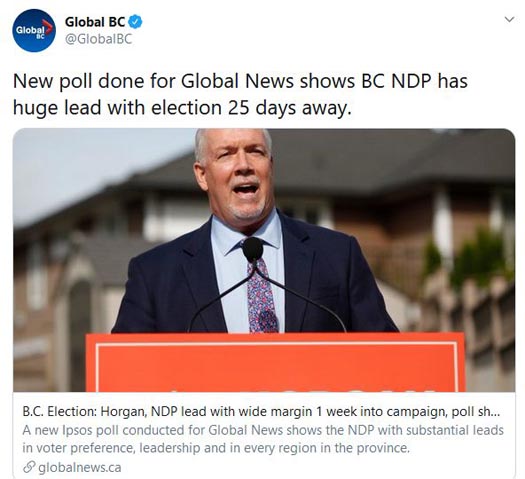
John Horgan and the BC NDP with a commanding lead in the second week of the 2020 election

At the beginning of the second week of the current 32-day British Columbia provincial election, according to a province-wide poll conducted by IPSOS Public Affairs’ Kyle Braid for Global BC, John Horgan’s B.C. NDP hold a commanding lead over both the B.C. Liberal party — in power from 2001 to 2016 — and the B.C. Greens that will not only return the New Democrats to power, but could very well end in an election rout, and an overwhelming majority for the only elected social democratic government in Canada.

“It’s not close,” says Braid. “The NDP started the campaign with an 18-point lead over the BC Liberals. Currently, 51% of decided voters say they would be most likely to support or lean towards the New Democrats. The BC Liberals are next at 33% support, followed by the Greens at 12%.

The NDP have a 25-point lead among women (53% NDP vs. 28% Libs) and a narrower, but still substantial, 11-point lead among men (49% Libs vs. 38% NDP).

The NDP has a large 26-point lead on Vancouver Island (51% NDP vs. 25% Libs) and a 23-point lead in Metro Vancouver (55% NDP vs. 32% Libs). Things are much closer in the Southern Interior/North, where the NDP has only a 5-point lead (44% NDP vs. 39% Libs). The Green Party does best on Vancouver Island at 20% support (vs. 11% in Metro Vancouver, 9% in Southern Interior/North).

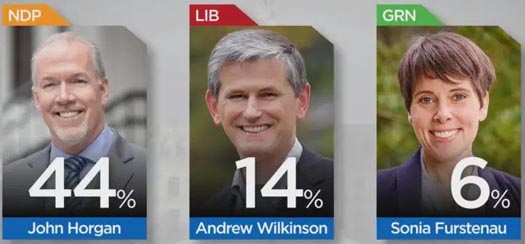
B.C. NDP leader John Horgan, at 44%, has a huge lead over both B.C. Liberal leader Andrew Wilkinson (14%) and recent winner of the contest for leadership of the B.C. Greens, Sonia Furstenau (6%) as the leader who British Columbians think would make the best Premier of B.C.

According to poll aggregator 338 Canada John Horgan’s NDP are on track to win as many as 69 seats in the British Columbia legislature (there are 87 ridings across the province), with Andrew Wilkinson’s B.C. Liberal party set to win as few as 18 seats, leaving the B.C. Greens without a seat in the house in Victoria. Be mindful, tho, these are early days in the B.C. election.
The election chances for all three B.C. political parties will likely come into clearer focus following the upcoming televised leaders’ debate, a date for which event has not been set as VanRamblings’ column goes to print.

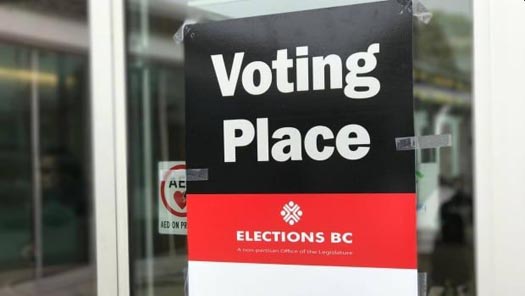
Masked safe distanced voters in the 2020 British Columbia pandemic provincial election

For those who are interested, as of midnight, here are the number of seats filled by each party: NDP: 83/87 | Liberals: 82/87 | Greens: 44/87 | Libertarians: 11/87 | Conservatives: 8/87. In a press conference she held yesterday in Vancouver, the B.C. Greens’ Sonia Furstenau told reporters that it was unlikely the Greens would field candidates in many more ridings than have been filled to date, while both the B.C. NDP and the B.C. Liberals will have all their parties’ candidates in place no later than this weekend.

Polling shows that B.C. NDP leader John Horgan the overwhelming favourite to be Premier

In the early days of Decision BC 2020, John Horgan and the B.C. NDP have gotten off to a near faultless start, with little interfering respecting the leader’s messaging — although Mr. Horgan was forced to respond to a tempest in a teapot issue that arose yesterday, when former B.C. NDP vice-president and 2017 Vancouver-False Creek NDP candidate Morgane Oger posted a selfie on Instagram on Monday as she stood in front of a framed photograph of graffiti reading “f*** the” with the rest of the text cropped out. CTV News obtained a photo of Ms. Oger posing with the entire photograph, showing a stone wall where the phrase f*** the police is fully legible, with a caption reading, “Art is a window into society’s soul.”

“That photo really frames the sentiment of people who are on the receiving end of policing, not because police officers themselves are discriminatory, but because society actually still tolerates discrimination through its enforcement,” Oger said in an interview yesterday morning.

John Horgan responded to the “controversy”, stating, “I know Morgane, I know her to be a passionate woman who’s focused on increasing the well-being of people in vulnerable situations. The sentiment expressed in the photo on Morgane’s Instagram feed does not reflect my sentiment.”

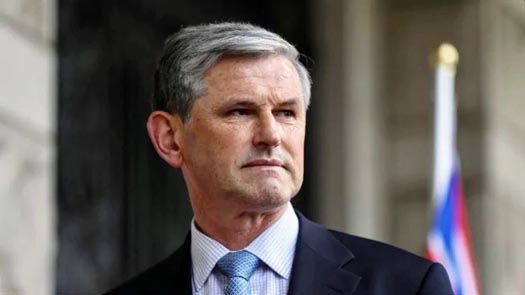
B.C. Liberal leader Andrew Wilkinson's 2020 election campaign off to a less than salutary startB.C. Liberal leader Andrew “The Grouch” Wilkinson campaign off to an unsalutary start

Poor Andrew Wilkinson. Not only is he an almost anonymous political figure in our province, with a leadership standing of a sorry 14%, the woebegone B.C. Liberal leader has had to contend with one very real candidate controversy after another. If this keeps up, his political fortunes are toast.

  • Abbotsford South B.C. Liberal candidate, Bruce Banman — the former Abbotsford Mayor best known for ordering city staff to lay chicken manure down on a homeless encampment, while calling homeless Abbotsford residents, “drug using criminals” — was forced by Andrew Wilkinson to apologize for his intemperate remarks and actions.

  • Meanwhile, in the riding of Langley East, B.C. Liberal candidate Margaret Kunst came under fire for opposing a rainbow crosswalk for the township.

  • And lest we forget, Chilliwack-Kent MLA Laurie Throness continues to face criticism for running advertisements in the Christian lifestyle publication The Light Magazine, which has included anti-LGBT articles including content against SOGI resources in schools and in support of conversion therapy. Not to mention which, just this morning, several Chilliwack and Tri-Cities organizations have written a joint letter to Liberal Leader Andrew Wilkinson calling for the removal of Chilliwack-Kent candidate Laurie Throness over his expressed views on conversion therapy, a controversial practice that aims to convert LGBTQ+ members that the federal government is moving to ban.

  • And just last evening, B.C. NDP Delta North candidate Ravi Kahon alleged Surrey-Fleetwood B.C. Liberal candidate Garry Thind had violated the B.C. Elections Act. Lawyer Rachel Roy reported to Elections B.C. that dozens of members of a WhatsApp group called “Garry Thind-Fleetwood” were asked to collect information including names, dates of birth, addresses, phone numbers, email addresses and a piece of government-issued identification (e.g. Social Insurance number, driver’s license number) from voters, in order that Mr. Thind’s campaign staff could order mail-in ballots to his election headquarters, with an eye to campaign staff filling out and posting the mail-in ballots without the express knowledge of the voters they were purporting to represent — a fraudulent activity, and a clear violation of the B.C. Elections Act.

B.C. Liberal leader Wilkinson also found himself in hot water with former senior Liberal party adviser, Martyn Brown, for “arguably the most cynical, most dishonest, and most outright dumb all-time acts of desperate vote-buying” when Mr. Wilkinson vowed to scrap B.C.’s 7% provincial sales for a year and then cut it to 3% the next year.

“When they go low, we go lower, might as well be his motto,” writes Mr. Brown in a column in The Straight. “It shows that Wilkinson’s B.C. Liberals have learned absolutely nothing from their well-deserved banishment from office following former premier Christy Clark’s pathetic attempt to throw her party’s “principles” out the door, in her vain effort to cling to power.

Before the COVID pandemic brought our economy to a standstill, crippling government revenues in the process, the sales tax was projected to yield $7.5 billion to provincial coffers. It is the B.C. government’s second-largest source of funding, accounting for some 22% of total taxation revenues. Deliberately losing whatever remains of the government’s drastically reduced revenue stream wouldn’t just be grossly irresponsible; it would be insane.

This is what the lust for absolute power does to otherwise smart people like the Brainiac Wilkinson: it turns them and anyone who votes for them into partisan lunatics, devoid of all sense and principle. Fiscal discipline was supposed to be the B.C. Liberals’ central tenet. No longer.”

Gosh, if this is how a longtime friend of, and senior party official within, the B.C. Liberal party is expounding on the political acumen respecting his beloved provincial political party, one is left to wonder how the average British Columbian feels about Mr. Wilkinson’s crass attempt to buy votes?
For all that, Andrew Wilkinson has to thank his lucky stars that John Horgan called the election when he did, months before Justice Austin Cullen’s Commission on money laundering within the province of British Columbia provides a summary report to government on the extent, growth, evolution and methods of money laundering in gaming and horse racing, real estate, unregulated entities and persons who provide banking-like services, the use of shell companies, trusts, securities and financial instruments for the purposes of money laundering, luxury goods, and … well, you get the picture. Money laundering in B.C.: a legacy of the Christy Clark government that, due to B.C. Liberal government inaction, distorted British Columbia’s economy, fuelled the opioid crisis and overheated the real estate market.

British Columbia 2020 provincial election

As VanRamblings was saying to a friend yesterday, and as we reported in an earlier column, the government of John Horgan is the first British Columbia government in more than a half century not to be dogged by controversy and the taint of corruption. So much for British Columbia’s vaunted reputation as the disreputable wild, wild west of Canadian politics.