#BC Poli | How The 2020 BC Election Differs From 2013 | Pt. 1

2013 British Columbia provincial election vs 2020 B.C. election

Having won the leadership of the B.C. Liberal party on Saturday, February 26, 2011, the newly anointed, but unelected, Premier Christy Clark had two years to put her imprimatur on the party of government before she was compelled by law to call a provincial election for May 14, 2013.

Meanwhile, the British Columbia New Democratic party, having jettisoned party leader Carole James also had a newly-elected leader, Adrian Dix, who achieved a three-ballot win on April 17, 2011, defeating his challengers, Mike Farnworth (recent Minister of Public Safety and Solicitor General), and John Horgan (current B.C. Premier) in a closely contested race.

Hope reigned for both British Columbia mainstream political parties.
As fortune would have it, though, with Ms. Clark in the Premier’s chair, B.C. Liberal prospects for re-election were dire, despite the new leader, arising from the memory of folks who were less than pleased with the HST fiasco, that saw the resignation of both B.C. Liberal Premier Gordon Campbell, as well as his Finance Minister, Vancouver-Quilchena MLA, Colin Hansen.
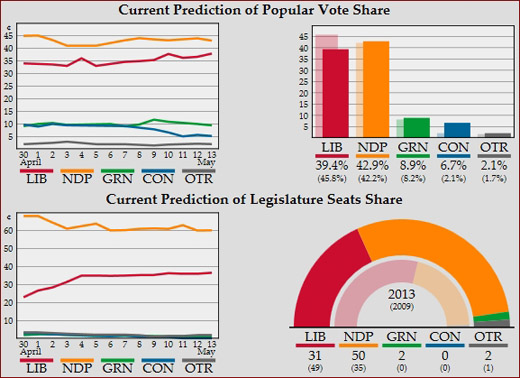
UBC's Sauder School of Business Election Prediction Market analysis
UBC’s Sauder School of Business 2013 B.C. Election Prediction Market forecast

As the clock ticked down towards the 2013 provincial election, month after month polls showed Ms. Clark and her B.C. Liberal party to be often far behind Adrian Dix and the NDP, with an average of 36.5% support among the electorate, while an invigorated B.C. NDP with Adrian Dix at the helm was polling consistently at around 46% among declared voters.

The forces of capitalism in our province were verklempt about the potential for an Adrian Dix-led BC NDP forming government after May 14, 2013.
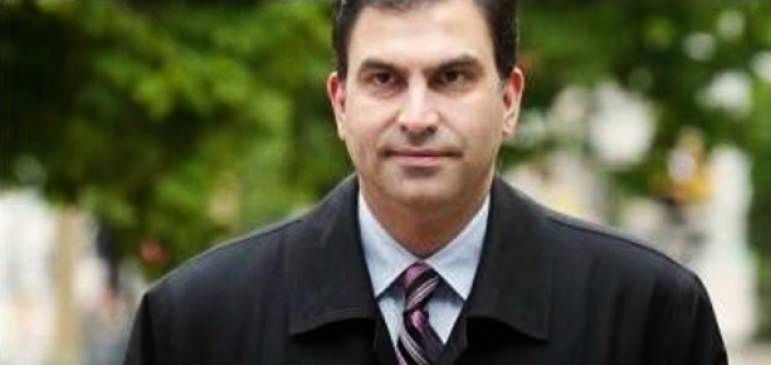
Dimitri Pantazopoulos, the right-of-centre federal, provincial, municipal election whisperer
Dimitri Pantazopoulos, right-of-centre federal, provincial, civic election whisperer

The B.C. Liberals and their powerful backers had an ace up their sleeve, though, in the form of renowned Stephen Harper pollster, boy genius Dimitri Pantazopoulos — who had not only delivered government after government to Stephen Harper, but had performed the same function for the B.C. Liberals and the right-of-centre Vancouver municipal political party, the strangely named and alleged (but not really) Non-Partisan Association.

In February of 2013, Mr. Pantazopoulos and his team from Maple Leaf Strategies travelled out to B.C. to conduct some very expensive and intensive polling across all, then, 84 British Columbia constituencies. After a month in the field, Mr. Pantazopoulos reported back to B.C. Liberal campaign manager Mike McDonald and Premier Clark, telling them this …

“Of the 84 ridings across the province, 34 are unwinnable. The B.C. Liberal party shouldn’t spend a plug nickel in those ridings, should write them off, and focus on the 50 ridings where the party has a good chance of prevailing come the evening of Saturday, May 14th. You’ll want to make sure that you have first-rate candidates in those 50 ridings, who are well known to voters, and can run a winning local campaign. The party must place massive resources into those ridings in order to ensure a win.

As U.S. Speaker of the House Tip 'O Neill once said, "All Politics is Local" And so it is.
As U.S. Speaker of the House Tip ‘O Neill once said, “All Politics is Local.”

For my part, my team of leading strategists I’ll be bringing out west from Maple Leaf Strategies will conduct nightly polling in those 50 ridings, to ensure that we have the pulse of the electorate in each of those 50 winnable ridings. I’ll let you know what the issue of the day is in each of those ridings, and your communications team will have to write a press release ready for distribution first thing the following morning, and have a campaign official meet with each of the candidates in the winnable ridings to instruct the candidate as to what to say when the press comes calling.

The B.C. Liberal party must run a hyper-local election campaign — that’s the only way you’re going to win when you’re so far down in the polls.”

Turning to the Premier, Dimitri Pantazopoulos told Ms. Clark, “Come election night, you’re going to win 50 seats and form a majority government. I am going to put my reputation on the line, and tell you right now that I guarantee a 50-seat win for you on May 14th. You can take that to the bank.”

Many in the B.C. Liberal party thought that Mr. Pantazopoulos was talking out of his hat, that he was nuts — but the only voices that counted among the din were that of Mr. McDonald and Premier Clark, who voiced full confidence in Mr. Pantazopoulos to pull out a majority win for the B.C. Liberal party. And thus, one of the central tenets of the 2013 B.C. Liberal British Columbia election campaign was in place, no questions asked.

In fact, Mr. Pantazopoulos and his crack team of Maple Leaf strategists were out in the field every night, specific communications were drafted for each of candidates in the 50 winnable ridings ready for distribution each morning, and 50 senior B.C. Liberal campaign officials were on the ground with the local candidates prepping each candidate on what to say to the press, and the issue to focus on that day on the campaign trail.

On election night 2013, May 14th, with Vancouver-based real estate marketer and B.C. Liberal financial guru Bob Rennie standing by her side, Dimitri Pantazopoulos looked Premier Clark directly in the eye, telling her, “Premier Clark, you’ve got this in the bag. I promised you a 50-seat majority government, and in just a couple of hours, I’ll deliver those 50 seats to you. By 8:30pm, media across the province will be reporting a landslide win for the B.C. Liberal party.”

Dimitri Pantazopoulos' Maple Leaf Strategies Research Company

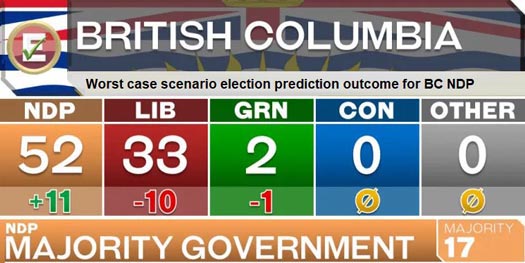
Indeed, as per the graphic at the top of today’s post, Dimitri Pantazopoulos was right: contrary to the polls, Premier Clark was handily elected as B.C. Premier, with a comfortable 17-seat majority government, having defeated a now stunned and beleaguered British Columbia New Democratic Party.

Was Mr. Pantazopoulos a genius, had he pulled off the impossible? Here’s what a fellow pundit had to say to VanRamblings last week when we were discussing the role of Dimitri Pantazopoulos in the 2013 British Columbia provincial election …

“I know Dimitri. I like Dimitri. I’ve worked with Dimitri, and I can tell you, he’s a good guy. Was he solely responsible for the B.C. Liberal win in 2013, when we were working on opposite sides of the fence? I’d have to say no to that. But, let’s face it, Raymond, there’s no arguing with the results. Dimitri promised 50 seats, he delivered 50 seats. That counts for something.”

So, maybe Dimitri Pantazopoulos is not quite the boy genius VanRamblings painted his as on social media last week.

Certainly, there were other factors at play that contributed to the diminution of the BC New Democrat campaign, and the rise of Premier Clark and the B.C. Liberals, a topic we’ll explore in part two, tomorrow.

For today, let us leave you with this.
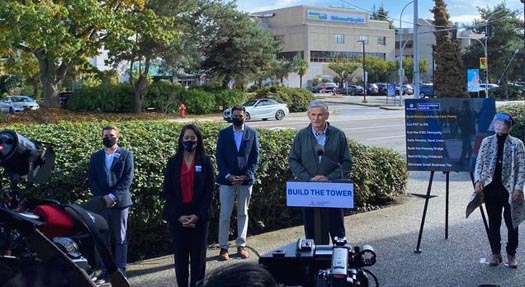
2020, Andrew Wilkinson campaigning in Richmond

In 2020, when Dimitri Pantazopoulos arrived in BC in early September — as a “snap” B.C. election seemed a near certainty — Maple Leaf Strategies intensively polled across the province for two weeks, and here’s what they found: the B.C. Liberals were a lock to win only seventeen seats, although the party might be competitive in another fifteen ridings.

Mr. Pantazopoulos advised B.C. Liberal leader Andrew Wilkinson that his becoming 37th Premier of the province was not in the cards, that in order to avoid embarrassment, the party must focus on the thirty-two winnable ridings, and pour party resources into those ridings.

And thus the 2020 campaign has played out.

The B.C. Liberal party and Mr. Pantazopoulos and his Maple Leaf Strategies team are laser focused on 32 ridings, in Richmond, in Surrey, in Langley and the Fraser Valley, in the Okanagan and in the Interior and the North, where the party continues to be either a few points behind the New Democrats or are running a neck-and-neck campaign.

In 2020, the B.C. Liberals are in a fight for their lives, are not looking to pick up seats, but maintain as many of the seats they currently hold in the Legislature, as possible. Andrew Wilkinson knows Sam Sullivan will lose in Vancouver-False Creek — there’s no love loss between the two, and although Mr. Wilkinson regrets losing the seat, it’s more than made up for by not having Mr. Sullivan in the B.C. Liberal caucus.

In the final week of the campaign, you can expect to see Mr. Wilkinson focusing on Surrey, Richmond, the Fraser Valley, Kamloops / the Shuswap, south central B.C., Prince George & region, Skeena & the North. Everything else is a write-off, and unworthy of the leader’s time, and party resources.
Cropped photo of former NDP MP Nathan Cullen, and current BC NDP Stikine candidate

Certainly, the foofaraw around comments made by star Stikine candidate Nathan Cullen have done nothing to either aid the cause of Mr. Cullen — John Horgan’s likely next Finance Minister — nor Skeena NDP candidate Nicole Halbauer, both of whom were expected to win in walk. No more.

All things being equal though, and barring any more NDP self-inflicted wounds, John Horgan and the B.C. New Democrats remain on track to form a majority government in Victoria, thanks in large measure to a textbook, near faultless and winning 2020 NDP campaign, and the fine work of recent — and one would hope, soon again — British Columbia Health Minister Adrian Dix in what is, after all, the “pandemic election”, where the health of British Columbians and fighting COVID-19 remains top of mind for voters.

C’mon back tomorrow to VanRamblings, for Part 2 of our “getting down to brass tacks” reasons as to why and how the 2020 British Columbia election remains significantly different than the 2013 provincial election campaign.
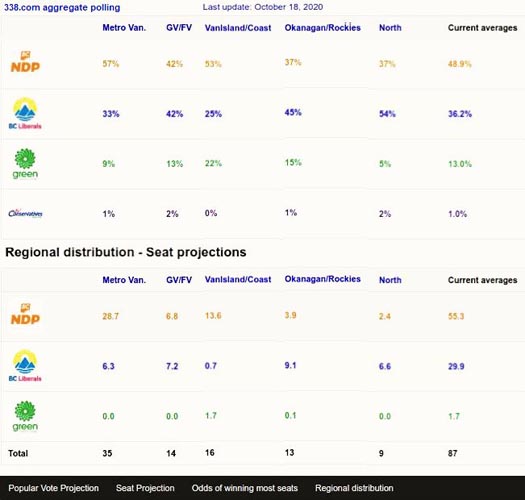

338 aggregate polling on the British Columbia provincial election, published October 18, 2020

Stories of a Life + Music Sundays | Three Resonant Love Songs

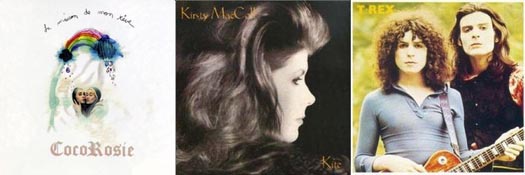
Three love songs, one each from CocoRosie, Kirsty McColl, and T-Rex

The first of the three love songs on VanRamblings today is sung by an American avant-garde musical group formed in 2003 by sisters Sierra Rose “Rosie” and Bianca Leilani “Coco” Casady, and may be heard on their 2004 album release, La Maison de Mon Rêve.
Having lead a nomadic life, in 2000 after residing in in New York City for two years, Sierra moved into a tiny apartment in the Montmartre district of Paris to pursue a career as an opera singer. Meanwhile, Bianca had moved to Brooklyn in 2002 to study linguistics, sociology, and visual arts. Neither sister had seen one another for a period of ten years.
In early 2003, Bianca made an impromptu visit to Paris to rejoin Sierra, and the two ended up spending months together creating music in Sierra’s bathroom which, according to them, was the most isolated room in the apartment and had the best acoustics, adopting a lo-fi, experimental approach to production, utilizing a distinct vocal style, traditional instruments, and various improvised instruments (like toys), recording with just one microphone and a broken pair of headphones.
By late 2003, the sisters had named themselves CocoRosie and created what would become their début album, La Maison de Mon Rêve, releasing the recording only to friends. However, word got out about the album, and by February 2004 CocoRosie was signed to the independent record label Touch and Go Records, and the album was released on March 9, 2004 to unexpected critical acclaim. The rest, as they say, is history.
The song Good Friday has meaning for me, as I sent it to Lori (who I’ve written about previously), expressing in the note I sent her that the song had particular resonance because it reminded me of her. After not having communicated with one another for almost a decade, posting the following song to Lori caused the two of us to, briefly, rekindle our relationship.

If 1988, the year I met Lori, was one of the great years of my life, the next great year in my life was 1995, and the summer of the gregarious 22-year-old Australian twins Julienne and Melissa, now all nicely married with great husbands, and two children apiece. That the three of us still communicate today I consider to be one of the great achievements of my life. I love them as much now as I did 25 years ago — both women (who I will write about someday, but employing pseudonyms) hold a special place in my heart.
1995 was also the year that my friend J.B. Shayne introduced me to the music of British singer-songwriter Kirsty McColl, whose 1989 album Kite became the soundtrack of my life that particularly warm and loving summer. I remember alighting from the #9 bus at Macdonald and West Broadway, as Julienne and Melissa were rounding the corner onto West Broadway, having just come from the Kitsilano library.
Spotting me, the two ran down the street towards me, jumping into my arms and wrapping themselves around me — the same thing happened later that summer, when I had just entered the west entrance of the Macdonald and Broadway Safeway, with Justine Davidson — then all of 15 years of age, and someone to whom I’d been close, and in whose life I had played a fatherly role for years — having entered from the east entrance, upon spotting me ran across the Safeway, jumping into my arms, wrapping herself around me, clearly happy to see me. There is no other time in my life when I felt more loved than was the case in the summer of 1995.

I was first introduced to the music of T. Rex (initially known as Tyrannosaurus Rex), the English rock band formed in 1967 by singer-songwriter and guitarist Marc Bolan, when working at LG-FM, by Bob Ness, one of the great all time radio announcers in Vancouver, and more than anyone else of my memory, the father of alternative music radio in Vancouver, when he brought the music of Marc Bolan to my attention.
By the early 1970s, I was a student up on the hill at Simon Fraser University, and arts and entertainment editor at the student newspaper, The Peak — where among my myriad endeavours, I was afforded the opportunity to review five albums a week, one of which was, in early 1971, T. Rex’s eponymous fifth album, and the first under the name T. Rex.
If you haven’t guessed, I am a romantic, always have been, always will be. For me, there is no greater joy than being in love — in which respect I have been very lucky, in platonic and other kinds of love (and even a marriage) with incredibly bright and empathetic women, who are responsible for all the best parts of who I am, and how I have brought myself to the world.
My first great love, of course (and the mother of my children) was Cathy Janie McLean, a striking 18-year-old blonde Amazon of a woman, possessed of a keen intelligence, and the woman more than any other who shaped me, in the early years loved me, and created the somewhat sophisticated wordsmith and bon vivant I’ve been for nigh on 50 years now.
T. Rex’s song Diamond Meadows was a song that was particularly resonant in Cathy’s and my life, a song we returned to for years, when I was at university, and later teaching in the Interior. For me, listening to Diamond Meadows reminds me of a time when I was truly loved, when everything was going well in my life, when I was surrounded by friends, politically and socially active, and a young man of promise and capable of much good.

Arts Friday | Netflix Takes Over the Oscars in 2021

Netflix to overtake the Oscar ceremony in 2021

In 2019, Netflix landed its first Oscar nomination for Best Picture with the release of Alfonso Cuarón’s critically acclaimed Roma. A year later, the streaming service was leading the field with 24 Oscar nominations, including Best Picture nods for both The Irishman and Marriage Story.
As Netflix’s impact on the world of cinema became increasingly undeniable, the younger and more diverse film academy was no longer prepared to shun the streaming service as the old Hollywood guard tried to do. Earlier this year, on April 28th, responding to the changes that COVID-19 had wrought, the Academy of Motion Picture Arts & Sciences removed the stipulation that a movie must be shown in a theatre before it could become eligible for the coveted Best Picture Oscar nomination.
And thus the stage was set for an Oscar ceremony in 2021 the likes of which no one will have ever seen before, with at least seven Netflix releases eligible for a Best Picture nomination, with each of those films set for Oscar nominations, ranging from Best Actor and Actress, Supporting Actress and Actor, to Best Director, Music, Sound and technical awards.
Today on VanRamblings, the Netflix features set to dominate Oscars 2021.

For the upcoming Academy Awards — delayed due to the pandemic until Sunday, April 25th — Netflix has pulled out all the stops. Already streaming, there’s Spike Lee’s Best Picture contender Da 5 Bloods, Gina Prince-Bythewood’s well-mounted action thriller The Old Guard, and Charlie Kaufman’s screenplay contender, I’m Thinking of Ending Things.
And, available today on Netflix, there’s writer-director Aaron Sorkin’s The Trial of the Chicago 7 which is, as Variety lead critic Owen Gleiberman writes, “a knockout, and the rare drama about the 1960s that’s powerful, authentic and moving enough to feel as if it were taking place today, a briskly paced and immersive film bristling with Sorkin’s distinctive verbal fusillades, a cinematic powder keg of film with a serious message that seamlessly blends a conventional yet compelling courtroom procedural with protest reenactments and documentary footage, the film offering an absorbing primer of a ruefully meaningful period in American history.”

Due to arrive on Netflix on Tuesday, November 24th — on the eve of American Thanksgiving — director Ron Howard’s big budget film adaptation of J.D. Vance’s autobiographical best-seller, Hillbilly Elegy offers a powerful account of growing up in a poor Rust Belt town, that also provides broader, probing insight into the struggles of America’s white working class.
A passionate and personal analysis of a culture in crisis, Glenn Close and Amy Adams are at the centre of Howard’s film, and solid prospects for Best Actress and Best Supporting Oscar nods. Howard will be in the mix, as well.

Netflix will release David Fincher’s Mank in select theatres in November before the black-and-white film begins streaming on December 4th.
The Hollywood-centric period piece follows alcoholic screenwriter Herman J. Mankiewicz (certain Best Actor nominee Gary Oldman) as he races to finish the screenplay for Orson Welles’ 1941 masterpiece Citizen Kane. That classic picture was fraught with behind the scenes drama, as Mankiewicz and Welles argued over credit and who wrote what, which became even more important once the film won the Oscar for Best Original Screenplay.
The original script for Mank was written by Fincher’s father, Jack Fincher, so this project certainly means a lot to the filmmaker. Mank boasts a running time of 2 hours and 11 minutes, so it won’t be quite as long as Zodiac or The Curious Case of Benjamin Button, not that Fincher ever wastes a single frame. The film is expected to be a major awards contender for Netflix.

Ma Rainey’s Black Bottom. George C. Wolfe directs, Denzel Washington produces, and Oscar-winner Viola Davis (Fences) stars as Ma Rainey in Ruben Santiago-Hudson’s adaptation of the hit August Wilson Broadway play. The late Chadwick Boseman and If Beale Street Could Talk star Colman Domingo play members of Rainey’s ’20s jazz band.
Awards prospects: Ambitious trumpeter Levee was 43-year-old Boseman’s final role before succumbing to his private battle with colon cancer in August; he looks rail thin in film stills. Posthumous Oscars went to Heath Ledger (The Dark Knight) and Peter Finch (Network) among others. In this case, with the beloved Black Panther star also in the running for his supporting role as a U.S. Army soldier in Vietnam in the Spike Lee joint, Da 5 Bloods, many believe that it’s likely Boseman will wind up in the Best Actor category for Ma Rainey, with Davis as Best Actress. Like Mank, the elaborate period setting should be attractive to Academy craft branches.
Release date: In theatres early December, streams on Netflix December 18.

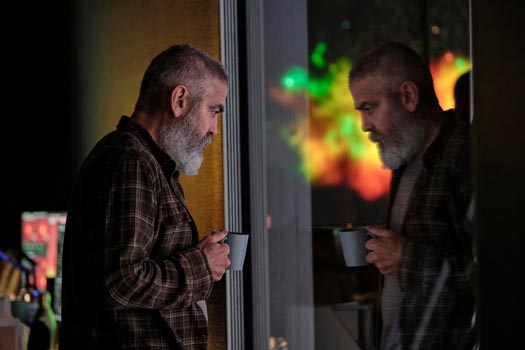
The Midnight Sky, director-star George Clooney's new sci-fi film for Netflix

Oscar-winner and Hollywood icon George Clooney directs The Midnight Sky, a sci-fi thriller with a script by Mark L. Smith (The Revenant) based on the Lily Brooks-Dalton novel about an Arctic scientist (Clooney) attempting to warn a NASA spaceship astronaut (Felicity Jones) not to return to doomed planet Earth. Awards prospects: Netflix took advantage of the London Film Festival this month (October 2 – 18) with a tribute to Clooney, complete with clips. Critical reaction will determine whether The Midnight Sky will figure in the Oscar sweepstakes, but Clooney (Syriana) has delivered in the past, as has Oscar-nominated Jones (Theory of Everything).
Release date: In theatres early December, Netflix début to be announced.

#BC Poli | 9 Days to Go, Will It Be a Tiny Majority or an NDP Rout?

British Columbia 2020 election predicted outcome and seat count

Although post-debate polls are not in as of this writing, John Horgan’s New Democratic Party still seems destined to form a majority government once the last vote is counted following the closure of the polls at 8pm Saturday, October 24th. The question is: how big a majority government will it be?
Coming out of the 2017 provincial election, the B.C. Liberals and the B.C. New Democrats were virtually tied in the popular vote, and exactly tied in the number of seats: 41. There was then, and there remains today, 87 seats in the British Columbia legislature. In order to form government, a party needs 44 seats. Should the New Democrats hold on to their current seats, and gain just three more seats, John Horgan will return as B.C.’s 36th Premier, with a minimum of 44 seats. Chances are he’ll get a lot more.
Polling for the New Democratic Party is strongest on Vancouver Island and across the Lower Mainland. Vancouver-False Creek candidate Brenda Bailey is expected to find herself in the win column once all the votes are counted. When the B.C. legislature was dissolved back in September, the New Democrats held 16 of 20 seats across the Metro Vancouver region.

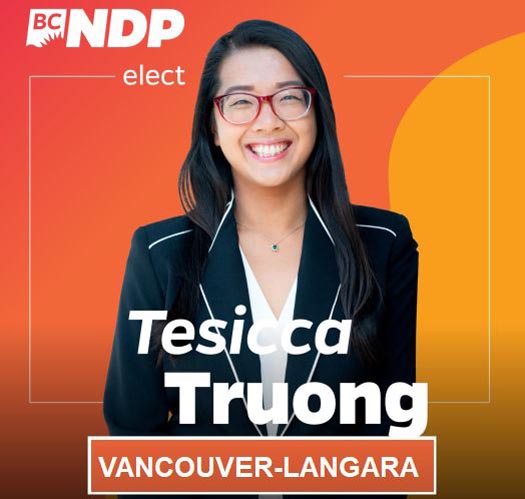
Tesicca Truong, environmentalist, BC NDP candidate in the riding of Vancouver Langara

Rumour has it, too, that environmentalist NDP candidate in Vancouver-Langara, Tesicca Truong, could very well take incumbent BC Liberal Mike Lee’s seat away from him, with Mr. Lee already preparing for a bid to run as Mayor in the 2022 Vancouver municipal election, or so VanRamblings was told earlier in the week by a highly-placed B.C. Liberal apparatchik.
As Georgia Straight editor Charlie Smith wrote last evening, “There’s a reasonable chance that after the October 24 election, the NDP will hold 18 of the 20 seats in the Burrard Peninsula.” The other seat the BC NDP are almost assured of winning: ex-federal MP Fin Donnelly, running in the provincial riding of Coquitlam-Burke Mountain, a seat won by B.C. Liberal MLA Joan Isaacs in a squeaker, with a bare margin of only 87 votes.

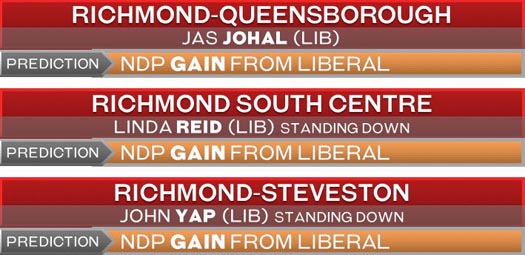
The BC NDP are expected to pick up three seats in Richmond in the 2020 provincial election

Polling is so strong for John Horgan and the New Democratic Party across the Metro Vancouver region that the NDP is expected to take away three more seats from the BC Liberals, once all the votes have been counted. In 2017, BC Liberal Jas Johal barely won the Richmond-Queensborough riding, taking only 116 more votes than his NDP opponent. One can see why both Mr. Horgan and BC Liberal leader Andrew Wilkinson are spending an inordinate amount of time in Richmond this election cycle — with Mr. Horgan recently announcing “a far larger, far grander, far more ambitious” Richmond Hospital expansion than had been announced in 2018.

Over on Vancouver Island, long time Oak Bay resident and former Victoria MP, Murray Rankin, is the sure-to-win Oak Bay-Gordon Head NDP candidate in the current provincial election, given that former BC Green Party leader Andrew Weaver — who held the seat from 2013 through the dropping of the writ in September — is on the campaign trail for the affable and accomplished Mr. Rankin, making his win a New Democratic Party gimme.
Given her debate performance on Tuesday evening, VanRamblings is giving newly-elected BC Green Party leader Sonia Furstenau even odds of retaining her Cowichan Valley riding — although the BC NDP have poured massive resources into the traditionally strong NDP riding these past three years, the least of which includes the construction of a new Cowichan District Hospital, announced on July 6th, 2018. Not to mention which, popular two-term North Cowichan municipal Councillor, Rob Douglas, has proven to be a much more formidable challenger than was Ms. Furstenau’s NDP opponent in 2017, Lori Lynn Iannidinardo, in what turned out to be a neck-and-neck race, where Ms. Furstenau just eked out a win. Note should be made, too, that much of Ms. Furstenau’s vote came from disaffected BC Liberals — a prospect unlikely to be the case in the 2020 provincial election.
VanRamblings is being kind to Andrew Wilkinson’s BC Liberals, by predicting that Michelle Stilwell will hold onto her Parksville-Qualicum seat, although that’s far from a certainty. Otherwise, Vancouver Island will be awash in a sea of orange save, perhaps, Ms. Furstenau in the Cowichan Valley, and Adam Olsen, Green Party incumbent in Saanich North and the Islands.

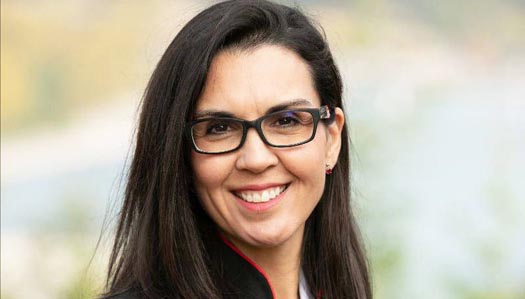
Nicole Halbauer, British Columbia New Democratic Party 2020 candidate in the Skeena ridingNicole Halbauer, British Columbia New Democratic Party 2020 candidate, Skeena riding

According to insider major political party polling, in the North, recent Chair of the Board of Directors at Coast Mountain College, Nicole Halbauer, a longtime, passionate advocate for increased health services in the North, is expected to put the Skeena riding into the win column for the BC NDP, by handily defeating one term B.C. Liberal, Ellis Ross, once all the votes are counted, taking back a seat for the NDP, a traditional stronghold riding for the New Democratic Party, dating back to the early nineteen seventies.

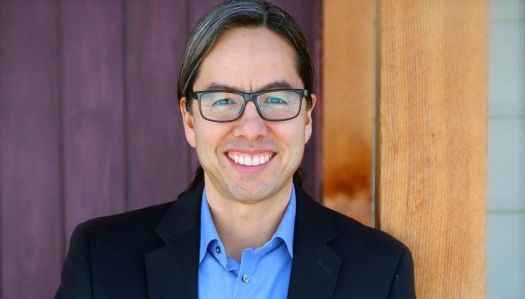
Aaron Sumexheltza, the B.C. NDP candidate in the riding of Nicola-Fraser, in 2020First Nations lawyer Aaron Sumexheltza, the BC NDP candidate in Fraser-Nicola.

In the riding of Fraser-Nicola, the BC NDP’s Aaron Sumexheltza is not only expected to win his south central Okanagan seat — a take away from BC Liberal incumbent Jackie Tegart — but be appointed to a Horgan Cabinet.

South east British Columbia ridings that the New Democratic Party is expected to win in 2020

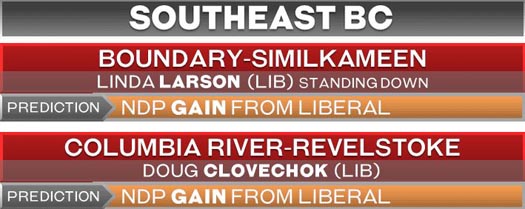
Meanwhile, in Columbia River-Revelstoke, BC NDP candidate Nicole Cherlet, a popular, activist Revelstoke City Councillor since 2018, who has also served as the president of the Revelstoke Chamber of Commerce, is widely expected to regain the traditional NDP seat from BC Liberal incumbent Doug Clovechok, first elected in 2017, who took the Columbia-Shuswap seat by the slimmest of margins.
In Boundary-Similkameen, Roly Russell, Regional District of Kootenay-Boundary director for rural Grand Forks is widely expected to reclaim the southeast BC riding for the NDP, from BC Liberal newcomer Petra Veintimilla, on leave as an Oliver councillor, following the retirement of BC Liberal incumbent (who could read the writing on the wall), Linda Larson.

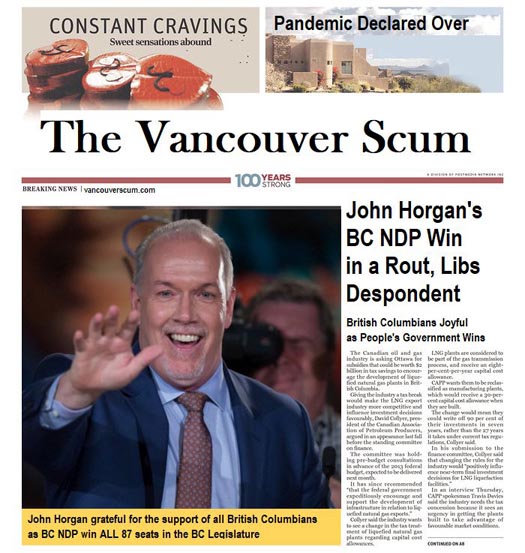
Vancouver Scum newspaper reports 87 seat win for the BC New Democratic Party

The foofaraw directly above aside, John Horgan’s BC New Democratic Party are all but assured a win once all the mail-in ballots are counted somewhere around November 10th.
For Andrew Wilkinson’s BC Liberals, it’s been one bozo eruption after another, from North Vancouver-Seymour’s Jane Thornthwaite’s sexist rant about North Vancouver-Lonsdale NDP incumbent Bowinn Ma, to Abbotsford candidate Bruce Banman when Mayor ordering chicken manure to be thrown onto a homeless encampment, to Langley East candidate and Langley Township Councillor Margaret Kunst voting against the painting of a rainbow crosswalk, to Chilliwack-Kent incumbent candidate Laurie Throness’ “perceived homophobic and transphobic views” (Update: as of 2pm this afternoon, BC Liberal Leader Andrew Wilkinson accepted the resignation of controversial Chilliwack-Kent candidate Laurie Throness). The list goes on and on for poor Mr. Wilkinson, whose once thriving B.C. Liberal party could very well find their seat count in the British Columbia Legislature reduced to as few as 17 seats. No, these are not happy times for the BC Liberals.


Click on the graphic for info on where to vote at the advance polls

VanRamblings is back on Monday with a report on why the 2020 British Columbia provincial election is so much different than the 2013 B.C. election, when Christy Clark scored a come from behind victory on May 9th. Ain’t gonna happen in 2020 lemme tell ya. Read why on Monday.