Nostalgia for a Time When Going to the Movies Was a Pleasure We All Enjoyed
Each and every one of us possess within us memories of our experiences visiting the cinema: as a child of attending at the movies with our parents; our first foreign or independent film with a group of friends; or simply visiting our local multiplex cinema to catch the latest superhero blockbuster, or making the pilgrimage to one local film festival or another.
Pre-pandemic, going to the movies was still a popular past-time, even in an age when media consumption and “film viewing” has radically changed (think of the Netflix revolution). In North America in 2019, there were 1.3 billion cinema admissions — a not-insignificant, nor surprising figure.
In 1930, more than 65% of the population went to the movies weekly. That means for every 5 people you knew, 3 of them went to the movies weekly.
Can you even imagine that?
Eighty-five years ago, cinema-going remained astoundingly popular across the continent, reaching a peak of 1.64 billion admissions in 1946 — even though the North American population was less than half of what it is today.
Why was cinema so popular in times past?
Some of the reasons are fairly straightforward: there was limited opportunity long ago for inexpensive recreational activities outside of the home, television had yet to assert its power, and film was an established medium which exposed millions to different worlds and alluring cultures (or, more often, to the vicissitudes of North American culture).
There was, however, a deeper and perhaps more fundamental reason for movie-going’s immense popularity in North America mid-20th century.
Recent research on movie-going habits in the twenty and 21st centuries has focused on the interplay between space and emotion, and how cinemas act as facilitators of emotional experiences in ambiguous spaces.
Over the years, movies have aided people in helping to reveal new insights into their lives, while allowing a better understanding of the lived experiences of people across the globe, and in their own neighbourhood. Cinema has not only traced our conception of life, but has also served to affect our outlook on life and the lives of others.
Watching a film in the presence of others is different from watching a film alone, or with our family: the collective constellation affects the way viewers experience a film, made all the more obvious once strong emotions and affective expressions come into play: laughter, sadness, shame, anger, screaming, and more often than not (if we’re lucky) being moved to tears.
Different times in history — and different spaces — have served to create new affective landscapes and altered existing ones, making cinema a useful category for historians to study changes in society and culture over time.
The history of cinema has been integrated alongside other sociological methodologies to help form a more refined and complex picture of the past, and in consequence has offered a valuable way of introducing new insights into the establishment of popular culture, and societal development.
The darkness of the cinema environment presents the opportunity to experience a strong shared emotional experience in a public setting, in the anonymous environment of the auditorium. No other public space has facilitated this to such a degree, and this uniqueness reveals how the life of our society developed in specific contexts and in precise locations.
The enclosed and defined space of the cinema auditorium, containing a distinct group in the form of an audience, is an obvious example of community. Patrons in the cinema are aware of both their own emotional response to what they are viewing onscreen, and the feelings of those around them, providing reassurance that our emotional responses to a film are being mirrored by our fellow patrons.
Respected film critic Leslie Halliwell recalled in his memoir on cinema-going that film took “people furthest out of themselves, into a wondrous and beautiful world which became their Shangri-La”.
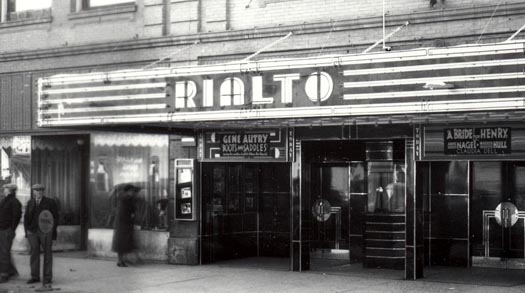
This utopia was reflected in the very names of cinemas — the Orion, the Rialto, the Plaza, the Regal — and in the architecture of the buildings which encompassed a range of styles including the clean lines of Art Deco and the high theatrics and excess of the “atmospherics”.
The Grandview Theatre, Commercial Drive at East 1st Avenue in Vancouver, in the 1950s
Evidence suggests that many people viewed their local movie-house, whether a stand-alone, second-run neighbourhood movie house or a first-run super-cinema, as a reassuring and familiar space characterized by a hazy emotionality fluctuating between the individual and the group, in the process offering a sense of connection with those who surrounded us.
This ambiguity — the individual vs the collective experience — lies at the heart of what attending at the cinema signifies to people. In few other areas of life are the landscapes of our lives softened to such a degree, in turn making attendance at the cinema a welcoming experience.
Cinemas have long occupied a position on the boundary between the domestic and the public, allowing our emotional experience of a movie concurrently as both communal and private, the evolving emotional landscapes which were crafted by cinema patrons in the mid-20th-century serving to break down anomie while creating a sense of connection.
The fundamentals of our affective experience at the movies has changed little over the past 100 years.
The price of popcorn, however, most definitely has.
With the interim results of the current British Columbia provincial election only two days away, and as per regulations mandated by Elections BC, and as VanRamblings will not be writing about the election in the 24-hour period prior to October 24th, nor on E-Day itself, it’s time for us to weigh in with our wrap-up column on the 2020 British Columbia provincial election.
As VanRamblings has written previously, the B.C. NDP have run a high energy, flawless and humanist re-election campaign that early on defined Liberal opposition leader Andrew Wilkinson as a corrupt, Trump-like tool of B.C.’s wealthy billionaire class, and John “dad” Horgan as your best friend, the guy you’d most like to get together with over a beer, the results of the 2020 B.C. election all but a foregone conclusion in the minds of most.
The B.C. New Democrats will form the next provincial government with a comfortable and comforting majority, with Adrian Dix returning as British Columbia’s much-loved and much-respected, activist Health Minister — and all will be well with the world. Yes, post-election we can all set about to prepare for the upcoming holiday season, with a little more jingle jangle in our pockets thanks to the election commitment John Horgan made, that B.C. couples will receive $1000, and B.C. singles $500, due to arrive no later than early December, along with the promised retroactive rent freeze for renters, that will last all the way through to December 31st, 2021.
In 2020, the B.C. New Democrats have positioned themselves as the progressive, forward-thinking, fiscally responsible, and diverse British Columbia political party that seeks to represent the interests of all wage-earning British Columbians — that’s the vast majority of working people in our province — and seniors, while looking after the interests of families by ensuring the provision of affordable child care, and an education system that will see new state-of-the-art schools built across B.C., and every primary, middle and secondary student attending class in schools across the province that are seismically-safe, where parents will no longer have to fundraise for playgrounds, or fund basic school supplies for their children.
As such, the British Columbia New Democratic Party have positioned themselves as the new, perpetual natural governing party of B.C., supported by an undeniable coalition of working people, union members, parents, small business owners, and members of the LGBTQ2+, Indigenous and diverse persons of colour communities who comprise the British Columbia we all love, where access to opportunity is available to everyone.
The sobriquet “natural governing party” was initially deployed to characterize the success of the federal Liberal Party in the 20th century, the notion of a “natural governing party” well entrenched in the literature on Canadian party politics. The NDP — firmly embedded in the provincial political culture of British Columbia dating back to the days of the Co-operative Commonwealth Federation (CCF) in the 1930s, transformed themselves in 1961 to the newly renamed New Democratic Party.
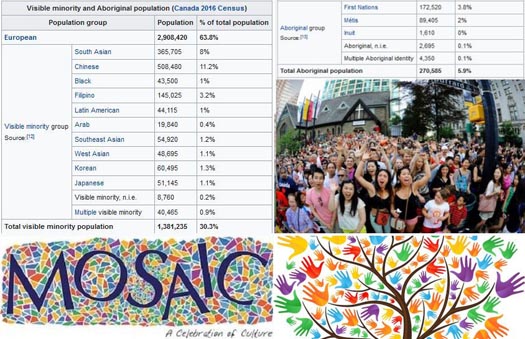
Since 2017, John Horgan’s NDP has developed an image of the New Democratic Party that projects a policy path which both pursues and is congruent with the touchstones of our province’s ethos, while assembling a vigorous electoral coalition comprised of working class persons of European origin, as well as the 31% of British Columbia’s population comprised of persons of east, southeast and south Asian, middle eastern, Latin, central and south American, and African descent, and including the 5.9% of our province’s First Nations’ Indigenous population, while drawing in the young and focusing on the health, safety & welfare of our senior citizen populace, ensuring opportunity for all, and an inclusive B.C. for all of its citizens.
So, let’s take a moment to see how the three main political parties have defined themselves in the 2020 British Columbia provincial election. VanRamblings hasn’t written a great deal about the B.C. Green Party during the course of this election — should B.C. Green leader Sonia Furstenau appear to retain her seat when election results are published on Saturday night, we’ll correct that oversight in a column to be published next week.
John Horgan’s BC NDP are defining themselves as, essentially, an activist, union-supporting version of Justin Trudeau’s federal Liberal party, or more accurately a Canadian version of Joe Biden’s Democratic Party, placing the NDP smack dab in the middle of the political spectrum, taking up the territory where, in 2020, the B.C. Liberals oughta be: promoting diversity and social justice, while also strong on the economy — but that’s not the case, so the empty space ceded to them by Andrew Wilkinson has been taken up by the political party that is set to become British Columbia’s new, natural governing party, a broad, non-scary coalition party dedicated to a strong economy, and focused on health care, child care, Indigenous reconciliation, education, jobs, our province’s thriving cultural sector, public transportation, the natural resources industry, and B.C.’s flourishing green, high tech industry, a low key government ensuring prosperity for all.
The B.C. Liberals, as has become abundantly clear in this election, is liberal in name only. With a name stolen from Gordon Wilson in the early 1990s, the B.C. Liberals have since Gordon Campbell took the reins of the party fashioned themselves as latter day pavement politics Socreds, and in recent years, as (increasingly) far-right-of-centre Reform Party Stephen Harper Conservatives, closely associated with the fear-based politics of Donald Trump and the U.S. Republican party — which, by the way, worked for the Socreds and the B.C. Liberals for years, but with diminishing returns during the course of the 2020 British Columbia election. The B.C. Liberals are a party of the past, not the future. In time, they’ll either fade away, adopt the Conservative name, or re-fashion themselves as the B.C. Party.
Unless B.C. Green Party leader Sonia Furstenau can get herself re-elected in the B.C. NDP stronghold riding of Cowichan Valley — which is a tall order, given that most insider party polling shows her running third in the riding, with both the B.C. Liberals and a surprisingly ungenerous BC NDP wishing her prospects for re-election ill, a salutary future for the B.C. Green Party, and the Canadian Green Party movement, in general, does not bode well — which would be pitiable, indeed. Should Ms. Furstenau fail to win back her Cowichan seat — a possibility which VanRamblings finds to be unthinkable, and contrary to the best interests of British Columbians — the electoral fortunes of the Green Party are done, which would be a tragedy for us all.
Sonia Furstenau has moved Green politics in Canada to where it should have been since the founding of the Green Party movement in Canada: as eco-socialists, as concerned with the welfare of our province and our nation, as with the environment — which, as any thinking person knows, are inextricably entwined. Sonia Furstenau is the great hope of our future.
Should Ms. Furstenau appear to prevail on Saturday night, we’ll expand on the theme expressed above, and set about to dedicate an entire column to Ms. Furstenau and a rejuvenated Green Party movement under her visionary, Jacinda Ardern-like leadership — long overdue and full of hope.
VanRamblings will return next week to conduct a four-part political post-mortem on the 2020 British Columbia provincial election campaign. In the meantime, tomorrow you can look forward to our regular Arts Friday coverage, on Saturday a new Stories of a Life, and then … Music Sunday.
The momentum we have going into these final few days has been inspiring! It was great to have @jjhorgan come for a visit to discuss housing, healthcare, seniors care and other #NorthVan#Seymour priorities and how our BC NDP government will keep us moving #ForwardTogetherpic.twitter.com/BxQVPuFpss
Spirits have never been higher than is the case with the broad swath of candidates running with John Horgan & British Columbia’s New Democratic Party, as we catapult towards election day on Saturday, October 24th.
After 29 days on the campaign trail, the younger, more diverse contingent of New Democrats are energized — and having loads of fun, as can be seen in Ravi Kahlon’s tweet directly below — which is to say, the dancing, and the sentiment expressed in Arrested Development’s Metamorphosis mix of Sly Stone’s Everyday People, perfectly expressing what the B.C. New Democratic Party is all about in the B.C. NDP’s winning 2020 campaign …
Proud to have the support of @unifor and unions across BC! The @bcndp will fight for workers' rights to a safe workplace & fair wages. We're the party that will work for everyday people.
Advance voting is open until 8pm today, and from 8AM-8PM tmrw. Cast your ballot now!???? pic.twitter.com/QmR1k01f3t
Although, pollster Angus Reid reports that the race is tightening …
Just out. BC race is tightening. Liberal voters mainly motivated by opposition to Horgan and NDP rather than inspired by Wilkinson. A Tale of Two Voters: Shifting dynamics tighten BC Election race in its final days – Angus Reid Institute https://t.co/oeZ2tfpb3t
In fact, John Horgan’s New Democrats maintain their twenty-three-point-five per cent lead across both the Metro Vancouver region, and along the entire length of Vancouver Island — although the race is tightening up some in traditional B.C. Liberal strongholds like the Fraser Valley, South Central BC and the Okanagan, the Cariboo and the Interior, and the North.
Even so, Nathan Cullen is heavily favoured to re-take the Stikine riding, given that retired Minister of Forests, Lands, Natural Resource Operations and Rural Development, Doug Donaldson, had held the riding with fifty-two per cent of the vote in 2009, 2013 and 2017 — all of which looks good to soon-to-be-Premier-again John Horgan, and Mr. Cullen, as Mr. Horgan’s probable incoming Finance Minister, replacing the retired Carole James.
No, this is a race that is all over but the counting, although the B.C. NDP aren’t taking anything for granted (why would they, given 2013?), as expressed by Vancouver-Point Grey NDP candidate David Eby in this tweet:
Haven't mailed your ballot?
Just deliver it to any voting place, they've got a drop box waiting for you.
It's an easy way to guarantee Elections BC gets your vote before deadline: 8 pm, Oct 24. pic.twitter.com/rHs95cGZe7
VanRamblings will be back with our final, catch-all, throw the kltchen sink at the election edition of Decision 2020 Thursday, when we’ll posit that the New Democrats are set to become British Columbia’s natural governing party for the next 50 years! As well, we’ll bring out our crystal ball to predict who’ll make it into John Horgan’s Cabinet — among other foofaraw.
In 2013, that the Adrian Dix-led British Columbia New Democratic Party could lose the provincial election was unthinkable. Mr. Dix was popular. Ms. Clark was not. After 12 years in power, British Columbians were fed up with the B.C. Liberals. Change was in the air. And then the election happened.
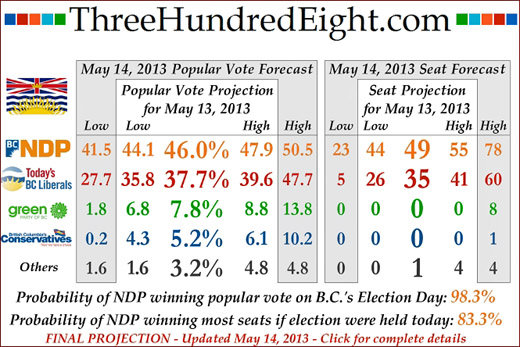
Éric Grenier’s 308.com final British Columbia election prediction, May 14, 2013
Despite polls which showed Adrian Dix and the BC NDP ahead by as many as 14 points, in the end such couldn’t have been further from the truth, as Christy Clark’s B.C. Liberals went on to win a 17-seat majority government, winning 50 of 84 seats in the British Columbia Legislature for a surprising and comfortable win for the first elected female British Columbia Premier.
What happened? Why did the Christy Clark-led B.C. Liberal party prevail, and why were the hopes, dreams and aspirations of B.C. New Democratic Party followers everywhere quashed, devastated, causing despondency?
Of course, there was the role Maple Leaf Strategies pollster Dimitri Pantazopoulos played, which we explored in Part 1 of this two-part series.
Next, there were the polls — which were wrong, way wrong, off on another planet wrong. So wrong, in fact, that it caused polling companies across North America to change the way they interpreted the raw data that came flowing into their offices.
Angus Reid was the first pollster to issue a mea culpa, some two months after the provincial election, writing …
“The principal flaw in our methodology was that we represented voters under 35 (where the NDP held a commanding lead) in relation to their proportionate share of the BC population (roughly 30 per cent) rather than in relation to their actual share of voters (closer to 15 per cent according to research conducted by Elections BC after the 2009 contest). Had we made this one change in our turnout projection model the final Angus Reid poll published on May 9 would have shown the NDP lead diminish to only three points.”
Of course, 20-20 hindsight looks good — but retrospect didn’t look so good for NDPers, who had believed Eric Grenier’s 338.com poll (above), his site the then credible Canadian equivalent of Nate Silver’s American fivethirtyeight.com aggregate polling website. Note should be made that following Mr. Grenier’s own mea culpa, the CBC hired him as their pollster, which he remains to this day.
When covering the 2015 federal election campaign, while traipsing through the West End one day to visit each of the Vancouver Centre campaigns, I happened into Hedy Fry’s Liberal campaign office, and had an impromptu sit down with the campaign manager (please forgive me, but I can’t recall his name), by far the friendliest of the campaign managers with whom I spoke that day, who told me, “Raymond, I always run a campaign as if I am 10 points behind. That’s the winning ethos for any successful campaign. Never believe the polls, always run your campaign as if you’re behind, keep staff and volunteers motivated and happy, and work your tail off.”
Much to their chagrin, the New Democrats believed the polls. Never again. How the 2020 and 2013 British Columbia Election Campaigns Differ 1. A Campaign of Ideas vs A Campaign Attacking Your Opponent
In the months leading up to the 2013 B.C. provincial election, New Democratic Party leader Adrian Dix issued an edict to the party, and to his campaign officials …
“We’re going to run a clean campaign. We will not attack Christy Clark, the B.C. Liberals, or their history as government over the past 12 years. Instead, we’re going to run a relentlessly positive campaign, a campaign of ideas that speaks to the angels of the better natures of British Columbians right across the province — and that my friends will win us the 2013 British Columbia provincial election, and a majority government.”
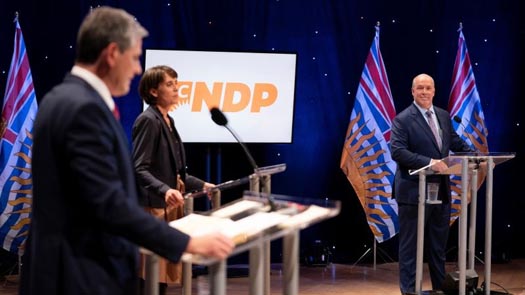
Now, we’ve all seen Adrian Dix these past months standing next to Dr. Bonnie Henry at the podium, and as is the case with her, when referring to the deaths of British Columbians due to the ravages of COVID-19, both have a great deal of trouble not breaking down in tears. We recognize that as compassion, as humanity and caring — and not to put too fine a point on the matter, it is Mr. Dix’s innate humanity and compassion that will carry the BC NDP to victory once all the votes have been counted next month.
Meanwhile, back in 2013, the B.C. Liberals were having none of this “nicey nicey” campaign, as they went after Mr. Dix with hammer and tong, castigating him for his role in writing a letter, as then Chief of Staff to Premier Glen Clark, to support his timeline of events involving a casino application, and then proceeded to hammer Mr. Dix into the ground with the weathervane ad above, which ran with voiceover as 15-second stingers at the beginning and end of each group of evening newscast commercials on CBC, Global and CTV — at least 12 times an hour hammering Adrian Dix for having changed his mind on the proposed Kinder Morgan pipeline (he came out against it), mid-campaign, and at variance with the party policy that had been developed by NDP Energy shadow minister John Horgan.
In the annals of B.C. election campaigns, 2013 was one of the dirtiest ever.
But that was then, and this is now. 2020. And who is John Horgan’s Chief of Staff? That’s right, Geoff Meggs, who spent 9 years as a Vision Vancouver City Councillor, in a municipal political party that learned the lessons of Stephen Harper well, and ran consistently dirty — and in their case, class-based — campaigns against their Non-Partisan Association opposition.
In 2013, Christy Clark’s B.C. Liberals defined Adrian Dix as a weak, indecisive leader who would thrust B.C.’s thriving Liberal party-led economy into the ditch. In 2020, the NDP have defined B.C. Liberal leader Andrew Wilkinson — hardly the warmest and most engaging character — as a tool of his rich friends, working for “them” and not for “you”, a despicable excuse for a politician and someone who definitely does not have yours, your family’s, neighbours, colleagues and friends best interests at a heart.
The narrative the NDP have created about Andrew Wilkinson has stuck to him like glue throughout the campaign, and has defined him in the eyes of voters across the province, which by campaign’s end will lead to an overwhelming, unrepentant defeat for Wilkinson & his B.C. Liberal party. 2. 2013 Debate performance. Christy Clark Trounces a Nervous Adrian Dix. 2020. John Horgan Trounces an Uncomfortable Andrew Wilkinson.
In 2013, whether it was the televised debate, or the withering radio debate on CKNW — which for years had Christy Clark in their employ as an afternoon talk show host — given her comfort with being inside the studio where she’d worked for years, where she had developed a friendly, calm and reassuring demeanour, and given Mr. Dix’s twitchy, uncomfortable and often confused and confusing debate performance, both election debates served to reinforce the notion promoted by the B.C. Liberals that Dix was unfit for office, and would make a lousy Premier. Score one for the Libs.
In 2020, it’s a whole different story. According to various of the post debate polls, 53% of British Columbians were favourably impressed with the performance of John Horgan, followed by Sonia Furstenau at 48%, with Andrew Wilkinson trailing with only a 36% favourable rating among British Columbia voters who tuned into the broadcast. Score one for the Dippers. 3. 2013 BC Libs Campaign Style = Christy “Energizer Bunny” Clark vs Dix. 2020 NDP Style = Everywhere. On Your Side, Always Working for You.
In 2013, the B.C. Liberals ran a flawless, high energy “hard hat” campaign that had the Premier making ten stops a day, every day, 7 days a week for the duration of the campaign, a high energy, relentlessly positive “chicken in every pot” campaign that promised billions in tax revenue to the province from LNG, creating the condition that would all but eliminate taxes for working people, yet provide for better education, child care, transportation and housing outcomes than could be dreamed, all provided by a Clark administration that would create a paradise on Earth for all British Columbians. Of course it was all a lie — but it sounded damn good!
NEW: BC Liberal candidate voted against town council motion recognizing that science shows ‘human activities’ cause climate changehttps://t.co/x8ZWYvJmZ6#bcpoli#vanpoli
In 2020, Andrew Wilkinson’s B.C. Liberals have run one of the most inept and tone deaf election campaigns this province has ever seen, as Mr. Wilkinson and his party has lurched from one crisis to another — whether it was the sexist Zoom roast that targeted 35-year-old North Vancouver Lonsdale NDP MLA Bowinn Ma, or the homo-and-transphobic / “Contraception is Eugenics” campaign of Chilliwack-Kent Liberal MLA Laurie Throness (who has since resigned), to Langley Township Councillor / BC Liberal candidate Margaret Kunst who spoke vehemently against a rainbow crosswalk, it’s been one bozo eruption after another for the B.C. Liberals, who haven’t found an effective campaign message, running one of the lowest energy election campaigns ever by a mainstream provincial party in the province of British Columbia. Score Another One for the Dippers.
Here’s B.C. Liberal Membership Chair Nicole Paul criticizing Mr. Wilkinson …
I have long been a supporter of the BC Liberal Party. I continue to stand by the values of free enterprise that originally drew me to this party. The BC Liberal Party under Andrew Wilkinson does not reflect values I support. #bcpoli#BCelxn2020
I am a proud ally of the LGBTQ+ community and strong advocate for women’s health, pay equity and have long advocated for free contraception. I am part of the BC Liberal coalition and these views are not minority views in the BCLP.
And here’s Jas Johal, B.C. Liberal candidate in Richmond-Queensborough …
Laurie Throness’ comments are appalling. They don’t represent BC Liberal values. I support investing in women’s health, including free contraception. I’m proud to have played a role in making sure greater access to IVF was included in our platform. #bcpolihttps://t.co/KZ7zoMFm0m
And this is what passes in 2020 with the B.C. Liberal party, as Trump-style Republican party scare-mongering. Um … inadvisable , Mr. Wilkinson …
Honestly, do you know any BC NDP candidate that you would consider to be “radical”?
4. 2020. Diversity and Inclusion vs Sexism, All Male Slates, and Misogyny.
(Clockwise from upper left) the all-male B.C. Liberal candidate slate in Vancouver: Michael Lee, Alex Reid, David Grewal, George Vassilas, Paul LePage, Andrew Wilkinson, Cole Anderson, Sam Sullivan, George Affleck, Jon Ellacott, and Mark Bowen.
On Saturday, February 3rd, 2018, when Australian-born Andrew Wilkinson, a former B.C. Minister of Advanced Education and Minister of Technology, Innovation and Citizens’ Services in the Christy Clark government won the B.C. Liberal leadership race, he had before him a golden opportunity to renew a political party that had lost the 2017 British Columbia election, to diversify the party he now lead, and to draw in new BIPOC and LGBTQ2+ candidates, in order that his right-of-centre B.C. political party might be at least appear to present a more representative cross-section of the British Columbia electorate when the province next went to the polls.
Yet, when John Horgan called an election on Monday, September 21st to go to the people to not only seek a rewewed mandate, but to conduct a referendum on how the people of B.C. felt his government had responded to the COVID-19 pandemic crisis, B.C. Liberal leader Andrew Wilkinson, who had been leader of his party for over a year and a half, more than enough time to diversify his party and present a new, fresh face to the British Columbia electorate, presented the same old rag tag collection of out of touch anti-LGBTQ2+ and misogynist B.C. Liberal candidates.
Just take a look above at the exclusively male slate of candidates the B.C. Liberal party has on offer in Vancouver in the 2020 election. Little wonder that Wilkinson’s B.C. Liberal party is polling so poorly with women voters.
In the meantime, in Vancouver, the BC NDP are running Niki Sharma in Vancouver-Hastings, Brenda Bailey in Vancouver-False Creek, Mable Elmore in Vancouver-Kensington, Heather McQuillan in Vancouver-Quilchena, Tesicca Truong in Vancouver-Fairview, and Melanie Mark in Vancouver-Mount Pleasant. Now, let’s count, shall we? B.C. Liberal female candidates running in Vancouver in 2020 = 0. BC NDP Vancouver woman candidates = 6. Causes one to stop and think for a moment: just who does the B.C. Liberal party presume to represent? Yep, we’re talkin’ older rich men.
In 2020, the B.C. NDP are also running 5 star Indigenous candidates …
Left to right, Aaron Sumexheltza (Fraser Nicola), Ann Marie Sam (Nechako Lakes), Melanie Mark (Vancouver-Mount Pleasant) Nicole Halbauer (Skeena), Anna Thomas (Kamloops-South Thompson)
In 2020, diversity thy name is British Columbia’s New Democratic Party.
The BC NDP learned their lesson in 2013 to, in future, run a more diverse slate of candidates, representing the full spectrum of British Columbians, including Indigenous, LGBTQ2+, and the diverse persons of colour communities which comprise the British Columbia in which we all live.
The B.C. Liberal party on diversity and inclusion? Lesson not learned.
Let’s face it, let’s get real for a moment.
In 2020, the B.C. Liberals under Andrew Wilkinson have run a Trumpian campaign of intolerance for differences — perhaps not necessarily meaning to — since the outset of the campaign. With only four days to go before Decision 2020 comes to a close, there is simply no coming back from one of the most botched political campaigns in British Columbia history.
Fundamentally, how do the 2013 and 2020 British Columbia election campaigns compare? In 2013, Christy Clark’s B.C. Liberals ran a high energy, focused campaign that never, ever went off message.
Although Ms. Clark lost her own seat in Vancouver-Point Grey to newcomer David Eby, the B.C. Liberals won 50 seats, a comfortable majority, and at least for awhile, the confidence of the B.C. electorate.
In 2020, John Horgan’s B.C. NDP have run a textbook winning campaign, staying on message, reinforcing the diversity in the party and progressive values which best reflect the values of the people of British Columbia, and with only the Nathan Cullen misstep this past weekend, the 2020 B.C.NDP campaign has been flawless, high energy, positive, and — unbeatable.
The tale will be told no later than mid-month next month, when all the votes of British Columbians are counted. In the same way that Donald Trump will lose the November 3rd U.S. election in record numbers, in British Columbia, John Horgan and the New Democrats remain on track for a majority government, perhaps even a massive majority government.
 Nostalgia for a Time When Going to the Movies Was a Pleasure We All Enjoyed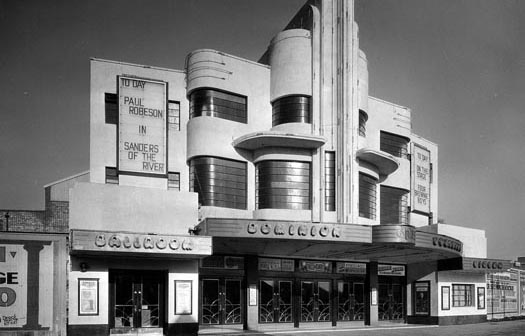
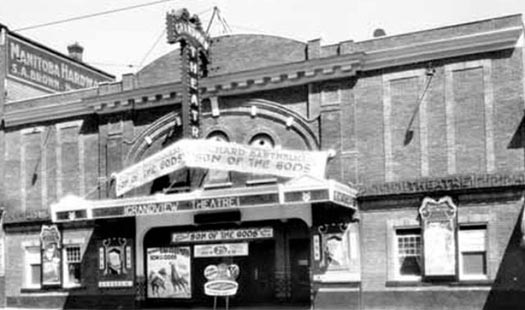 The Grandview Theatre, Commercial Drive at East 1st Avenue in Vancouver, in the 1950s