Decision 2021 | Day 16 | Jagmeet Singh Screws NDP, Libs, & Us

NDP leader Jagmeet Singh welcome the prospect of a far right Erin O'Toole-led Conservative government

In 2019, when asked, federal New Democratic Party leader Jagmeet Singh told reporters — and the nation — that a Jagmeet Singh-led NDP would never support the Tories in a Conservative Party minority, or majority government. A chasm existed, he said, between the values that New Democratic Party members hold dear, and the far right values of intolerance Conservative party members have long held close to their mean bosoms.

Last week, in a radical departure from NDP party policy, and what he’d said in the past, Jagmeet Singh told reporters that the federal NDP would have no problem in supporting an Erin O’Toole-led Conservative government, that now may be the time for change, that he felt he could hold sway over Mr. O’Toole that would allow the NDP to inform Tory government policy.

The cynical electoral politics of the federal NDP always come to the fore.

NDP leader Jack Layton and Prime Minister Stephen Harper smiling together

At this juncture, a bit of history respecting the federal New Democratic Party’s policy of accommodation with right-wing parties is in order.
In late 2005, Liberal Prime Minister Paul Martin met with relatively newly-anointed NDP leader Jack Layton to discuss with him legislation that he would introduce in the House of Commons within the coming 30 days …

  • Child Care. Arising from a report submitted by Social Development Minister Ken Dryden calling for the implementation of a universal child care programme in Canada, his government would soon be introducing legislation that would create the first national universal social programme in 40 years, a fully-funded national child care programme, and …

  • The Kelowna Accord. Arising from a First Ministers’ Meeting in Kelowna, British Columbia in the autumn of 2005, and the passage of an initiative entitled “First Ministers and National Aboriginal Leaders Strengthening Relationships and Closing the Gap” — more commonly known as The Kelowna Accord — legislation that Mr. Martin had fought for his entire political life that would fundamentally change the relationship of Canada to its Indigenous peoples, wherein the federal government would commit to $5.085 billion in spending over 5 years on bettering health care services for Canada’s Indigenous peoples, create a new Indigenous education system that would be run by native bands across Canada, and would train new Aboriginal teachers while constructing new schools on remote Indigenous reserves, while also addressing the issue of clean water in remote Indigenous communities.

Prime Minister Martin asked Mr. Layton for his support for both of these progressive and groundbreaking pieces of social legislation, how important it was for him personally, for families with young children — and for women held out of the workforce due to the inadequate provision of affordable quality child care and, finally, for Canada’s Indigenous peoples, that their concerns might finally be addressed in a caring and fulsome manner.

Sadly, it was not to be.

With the enthusiastic support of the New Democratic Party, and that of its leader, Mr. Jack Layton, Mr. Layton colluded with then Official Leader of the Opposition, Conservative Party leader Stephen Harper to vote against the child care and the Indigenous relations legislation brought before the House by the Liberal minority government of Paul Martin, with Mr. Layton voting to thwart both pieces of groundbreaking legislation, in the process defeating the government, and leading to the calling of a federal election, and subsequent minority Harper-led Conservative government in Ottawa.

As he repeatedly told Canadians throughout the 2005-2006 election period, Conservative leader Stephen Harper was admantly opposed to both pieces of “social legislation,” neither of which pieces of “social engineering legislation” would move forward in a Stephen Harper-led government.

And so, such socially regressive government policy — opposing any sort of universal national child care programme, nor any re-definition of the relationship between the government of Canada to its Indigenous peoples — came to pass, with the full and cynical support of NDP leader, Jack Latyon, who would go on to become best friends with Stephen Harper, the two party leaders meeting regularly for friendly, but utterly non-productive, chats at 24 Sussex, for five long years, Mr. Layton cynically propping up a corrupt Tory government led by his good pal, Prime Minister Harper.

A bit of background on Mr. Layton’s cynical approach to politics. From the time Jack Layton became leader of the federal New Democratic Party in 2003 thru until 2011, Mr. Layton had one dual-pronged goal on his mind …

  • Gain seats for the NDP in the House of Commons, and

  • Replace the Liberal Party as the official Opposition, with the eventual goal of forming an NDP government in Ottawa.

Under Jack Layton’s leadership, support for the NDP increased in each election. The party’s popular vote doubled in the 2004 election, which gave the NDP the balance of power in Paul Martin’s minority government. In May 2005, the NDP had supported the Liberal budget in exchange for major amendments, in what was promoted as Canada’s “First NDP budget”. In November 2005, Layton voted with other opposition parties to defeat the Liberal government. The NDP gained more seats in the House in the 2006 and 2008 elections, in which the party elected 29 and 37 MPs, respectively.

In the 2011 election, Mr. Layton’s NDP won 103 seats, the most successful party result ever — enough to allow him to form the Official Opposition. Federal support for the NDP in 2011 was unprecedented, especially in the province of Québec, where the party won 59 out of 75 seats. Unfortunately, Jack Layton was never afforded the opportunity to lead the Opposition in the House of Commons, succumbing to cancer on August 22, 2011.

In 2015, under the soon-to-be deposed leadership of NDP leader Thomas Mulcair, the New Democratic Party of Canada did not realize its dreams of government, instead devolving its meagre riding count to only 44 seats.

child care

Here we are in 2021. By the end of the 2019 election, the seat count for the NDP in the House of Commons had been reduced to 24 seats.


NDP attack ad, not against Erin O’Toole, but against Prime Minister Justin Trudeau

Current federal New Democratic Party leader Jagmeet Singh has clearly taken a page out of the cynical electoral playbook created by Jack Layton: child care, who needs it?; improved relations with Canada’s Indigenous peoples … yeah, tell it to someone who cares; the Liberals’ Child Care Benefit that has reduced child poverty 40% since 2015 … children want money, they can work in factories or go begging on the streets, the NDP just don’t care; seniors living in care or assisted living facilities, yeah well, you’ve had your time enjoying the good life on this planet … if Erin O’Toole wants to place former Ontario Conservative Party leader Mike Harris in charge of privatizing corrupt seniors care centres across Canada, such that Mr. Harris can rake in even more millions of dollars than he has running Ontario’s corrupt Sienna Senior Living, Revera, Extendicare and Chartwell seniors facilities, where thousands have died … again, we just don’t care.


Another cynical NDP ad targeting Justin Trudeau, not Tory leader Erin O’Toole

Federal New Democratic Party Members of Parliament want more seats in the House of Commons, so that more Dippers can earn $168,000 annual salaries (plus all those great benefits, like free dental care, unlimited massages, and more) as sitting members in the House of Commons — not to mention, those gold-plated pensions that will keep them living the life of riley when they retire, or are defeated — with Mr. Singh earning even more, given the top up he receives as leader of the fourth Opposition party.


Rabid and violent non-mask wearing anti-vaxxer, anti-democratic supporters of the Conservative party, fools all, create mayhem at a Justin Trudeau rally, where he committed to a one billion infusion of monies to the provinces to fund vaccine passports, to keep all Canadians safe. Tory leader Erin O’Toole’s response, “People have the right to voice their concerns about the Liberal government’s overreaching pandemic policy. Conservatives are opposed to federally-funded vaccine passports.” O’Toole later moderated his position on rally violence, given that some protesters were Conservative Party supporters. And what did we hear, initially, from NDP leader Jagmeet Singh, when asked about the violence at the rally … crickets; only later did he condemn the attack.

For the second time in 16 years, the federal New Democratic Party is not only willing, but actively working towards the goal of ensuring Canada will not have a national child care programme, nor do the federal NDP seem interested in preserving or improving the Child Care Benefit that has made life so much easier for young families, and neither does the federal NDP seem to care, in supporting the Tories, about Indigenous reconciliation.

Nor does Jagmeet Singh and the federal NDP seem to care about the health of Canadians during this once in a century pandemic, for while the Liberals offer up one billion dollars to provinces to ensure the implementation of vaccine passports to support the 90% of Canadians who are demanding that we be kept safe, allowing the pandemic to end sooner than later, Erin O’Toole’s cynical and fanatical Conservatives seem deeply indebted to the support offered by the violent fools in the the anti-vaxx movement. Jagmeet Singh seems not to care one iota about our safety and our health. Of course, as always, New Democrats talk a good game — but when it comes right down to it, the federal NDP cannot be counted on.

The New Democratic Party of Canada is running some great candidates, and as a lifelong member of the NDP (dating back to 1963) VanRamblings would like to see more New Democratic Party members of Parliament elected — becauses there are good and great persons of conscience and integrity in the NDP, like longtime federal MP Don Davies, or newcomers like the recently nominated Vancouver-Granville NDP candidate, Anjali Appadurai.

EKOS EKOS Research founder Frank Graves says Erin O’Toole NDP support tone deaf.

But if achieving the goal of more Dippers in Parliament means the federal NDP have made the cynical calculation that the only way for them to gain more seats in Parliament is to target Justin Trudeau, while keeping absolutely mum on what a far-right-of-centre Erin O’Toole-led Conservative government in Ottawa would portend, for VanRamblings that is simply a bridge too far, as well as cynical and repugnant electoral politics in the extreme that, we believe, most thinking, progressive members of the NDP — who truly do not want an Erin O’Toole government in Ottawa — will find utterly insupportable, leading to an inevitable decline in support for the NDP, with many New Democrats strategically casting a vote for the Liberal party which, although far from perfect, do not represent the abomination a Tory government in Ottawa would mean for most caring Canadians.


Music Sunday | Clairo | Meditations On Anguish, Hope & Trust

American singer-songwriter Clairo

American singer-songwriter Claire Cottrill was born in Atlanta, Georgia on August 18th, 1998, and was raised in Carlisle, Massachusetts, the daughter of marketing executive Geoff Cottrill. From the age of 3 on Clairo displayed a distinct gift for writing songs, and by the time she was a teenager had taught herself Pro Tools, a digital audio home workstation cum music studio, recording, editing, and mastering the songs she had written in her bedroom — not to mention, creating the videos to accompany her songs.

Clairo first drew widespread attention in late 2017 when the video for her feminist song Pretty Girl went viral on YouTube. The song was later recorded for an indie rock compilation benefiting the Transgender Law Centre. At the time, Clairo drew the attention of filmmaker Crystal Moselle — best known for her award-winning documentary The Wolfpack, the tale of six cloistered brothers and their unusual upbringing, raised in near-total isolation in a public housing complex on New York’s Lower East Side.

On the subway riding into New York one day, Moselle ran across a group of skater girls heading into the city, and opened a conversation with them. Within the year, Moselle began work on her début fiction film, Skate Kitchen, an empowering coming-of-age portrait of six young women on wheels, and a touching ode to the rewards and challenges of female friendship — asking Clairo to score and record the soundtrack for the film, as well as write and record a song for both the film, and the film’s trailer.

Clairo, her song Heaven, recorded for Crystal Moselle’s Skate Kitchen film soundtrack

And now Clairo has a new album, Sling, the second full-length release for the pop chanteuse, a luminous and devastatingly intimate lo-fi portrait and pandemic-induced exercise in reflection, the new record finding the singer-songwriter meditating on her own self-growth, and the quiet frustration of living in isolation. Expanding her sound with grace and subtlety, employing an instrumental palette including flutes, saxophones and a string section — with the support of co-producer Jack Antonoff — the concluding, gut punch coda on the album has the 23-year-old making a winking joke, and a dead-serious personal statement on aging, and feeling older than you ought to.

The coda to Clairo’s new album, Sling, the song Management, a dead-serious personal reflection on “aging”, and the meaning behind becoming an adult in our troubled world.

Cat Zhang writes in her review of Sling, in Pitchfork magazine online …

“On Blouse, the hushed lead single of Clairo’s new album, Sling, the little thrills of adolescence are gone. “Why do I tell you how I feel/When you’re just looking down the blouse?” she sings, the dewy sincerity she once radiated now hardened into bitterness. Here is another young woman whose trust has been abused by an older man, and who is so hungry to be validated that she’ll risk being sexualized again: “If touch could make them hear, then touch me now.” It’s brutal to realize when you’re young that the ogling curiosity older people regard you with is not the same as respect, and getting attention does not mean having real agency.”

Since she stumbled into fame in 2017, and not entirely of her own volition, Clairo has been narrowly interpreted through the prism of her generation — keywords: viral, YouTube, bedroom pop, bisexuality — as an avatar for sensitive youths more comfortable online than outside, and who speak frankly about their feelings. On Sling, you feel her sense of exhaustion.

The song Blouse, from Clairo’s sophomore July 2021 album release, Sling.

Harbor, a short film edited by Clairo, from Noah Baumbach’s film, Marriage Story.

Clairo, in concert in Vancouver Monday, March 28, 2022, at the Orpheum.

Stories of a Life | 1974 | Cathy & Raymond’s European Vacation

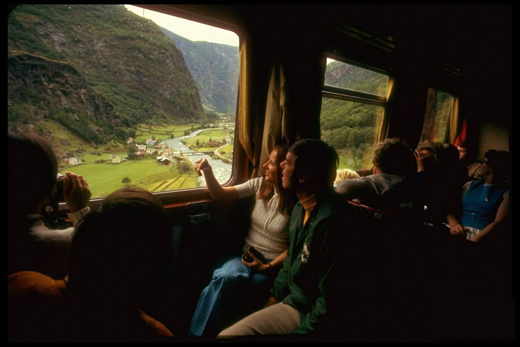
Traveling on a train across Europe, with a Eurail Pass, in the 1970s

In the summer of 1974, Cathy and I travelled to Europe for a three-month European summer vacation, BritRail and Eurail passes in hand, this was going to be a summer vacation to keep in our memory for always.

And so it proved to be …

On another day, in another post evoking memories of our cross-continental European sabbatical, I’ll relate more stories of what occurred that summer.

Train travel in Spain, in the 1970s, as the train makes its way around the bend

Only 10 days prior to the event I am about to relate, Cathy and I had arrived in Lisbon, Portugal, alighting from a cruise liner we’d boarded in Southampton, England (passage was only 5£s, much cheaper than now).

After a couple of wonderful days in Lisbon, Cathy and I embarked on the first part of our hitchhiking sojourn throughout every portion of Portugal we could get to, finally traveling along the Algarve before arriving in the south of the country, ready to board a train to Spain. Unfortunately, I developed some intestinal disorder or other, requiring rest and fluids. Once Cathy could see that I was going to be fine, she left the confines of our little pensão to allow me to recover in peace, returning with stories of her having spent a wonderful day at the beach with an enthusiastic retinue of young Portuguese men, who had paid attention to and flirted with her throughout the day. Cathy was in paradisiacal heaven; me, not so much.

Still, I was feeling better, almost recovered from my intestinal malady, and the two of us made a decision to be on our way the next morning.

Traveling from the south of Portugal to Spain, in the 1970s

To say that I was in a bad mood when I got onto the train is to understate the matter. On the way to the station, who should we run into but the very group of amorous men Cathy had spent the previous day with, all of whom were beside themselves that this braless blonde goddess of a woman was leaving their country, as they beseeched her to “Stay, please stay.” Alas, no luck for them; this was my wife, and we were going to be on our way.

Still suffering from the vestiges of both an irritable case of jealousy and a now worsening intestinal disorder, I was in a foul mood once we got onto the train, and as we pulled away from the station, my very loud and ill-tempered mood related in English, those sitting around us thinking that I must be some homem louco, and not wishing in any manner to engage.

A few minutes into my decorous rant, a young woman walked up to me, and asked in the boldest terms possible …

Do you kiss your mother with that mouth?

“Huh,” I asked?

“Do you kiss your mother with that mouth? That’s the filthiest mouth I’ve ever heard. You’ve got to teach me how to swear!”

At which point, she sat down across from me, her lithe African American dancer companion moving past me to sit next to her. “Susan. My name is Susan. This is my friend, Danelle,” she said, pointing in the direction of Danelle. “We’re from New York. We go to school there. Columbia. I’m in English Lit. Danelle’s taking dance — not hard to tell, huh? You two traveling through Europe, are you?” Susan all but shouted. “I come from a large Jewish family. You? We’re traveling through Europe together.”
And thus began a beautiful friendship. Turns out that Susan could swear much better than I could; she needed no instruction from me. Turns out, too, that she had my number, and for all the weeks we traveled together through Europe, Susan had not one kind word for me — she set about to make my life hell, and I loved every minute of it. Susan became the sister I wished I’d had, profane, self-confident, phenomenally bright and opinionated, her acute dissection of me done lovingly and with care, to this day one of the best and most loving relationships I’ve ever had.

Little known fact about me: I love being called out by bright, emotionally healthy, socially-skilled and whole women.

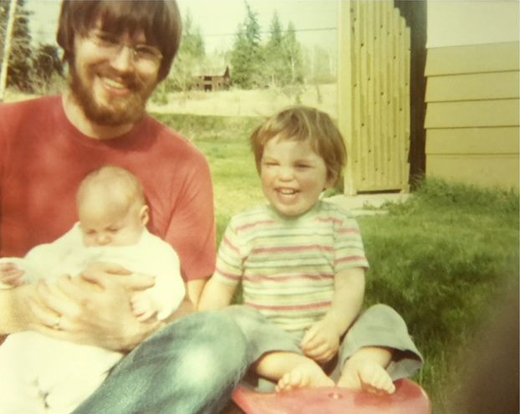
Two-year-old Jude Nathan Tomlin, baby Megan Jessica, and dad, Raymond, in June 1977The summer of 1974, when Cathy became pregnant with Jude, on the right above.

Without the women in my life, Cathy or Megan, my daughter — when Cathy and I separated — Lori, Justine, Alison, Patricia, Julienne or Melissa, each of whom loved me, love me still, and made me a better person, the best parts of me directly attributable to these lovely women, to whom I am so grateful for caring enough about me to make me a better person.

Now onto the raison d’être of this first installment of Stories of a Life.

Once Susan and I had settled down — there was an immediate connection between Susan and I, which Cathy took as the beginnings of an affair the two of us would have (as if I would sleep with my sister — Danelle, on the other hand, well … perhaps a story for another day, but nothing really happened, other than the two of us becoming close, different from Susan).

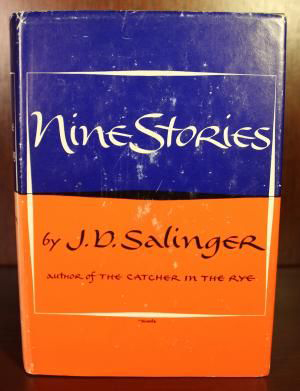
J. D. Salinger's Nine Stories, an anthology of short stories published in April 1953

Danelle saw a ragged copy of J.D. Salinger’s Nine Stories peeking out of Cathy’s backpack. “Okay,” she said. “In rounds, let’s each one of us give the title of one of the Salinger short stories,” which we proceeded to do. Cathy was just now reading Salinger, while I’d read the book while we were still in England, about three weeks earlier.

Cathy started first, For Esmé — with Love and Squalor. Danelle, Teddy. Susan, showing off, came up with A Perfect Day for Bananafish, telling us all, “That story was first published in the January 31, 1948 edition of The New Yorker.” Show off! I was up next, and came up with Uncle Wiggily in Connecticut. Phew — just barely came up with that one! Thank goodness.
Onto the second round: Cathy, Down at the Dinghy; Danelle, Pretty Mouth and Green My Eyes; Susan, showing off again, De Daumier-Smith’s Blue Period, “turned down by The New Yorker in late 1951, and published by the British Information World Review, early in 1952.” Me? Struggling yet again, but subject to a momentary epiphany, I blurted out, Just Before the War with the Eskimos. There we were, eight stories down and one to go.

But do you think any one of us could come up with the title to the 9th tale in Salinger’s 1953 anthology of short stories? Nope. We thought about it, and thought about it — and nothing, nada, zero, zilch. We racked our brains, and we simply couldn’t come up with the title of the 9th short story.

We sat there, hushed. For the first time in about half an hour, there was silence between us, only the voices of children on the train, and the clickety-clack of the tracks as the train relentlessly headed towards Madrid.

We couldn’t look at one another. We were, as a group, downcast, looking up occasionally at the passing scenery, only furtively glancing at one another, only periodically and with reservation, as Cathy held onto my arm, putting hers in mine, Danelle looking up, she too wishing for human contact.

Finally, Susan looked up at me, looked directly at me, her eyes steely and hard yet … how do I say it? … full of love and confidence in me, that I somehow would be the one to rescue us from the irresolvable dilemma in which we found ourselves. Beseechingly, Susan’s stare did not abate …

The Laughing Man,” I said, “The Laughing Man! The 9th story in Salinger’s anthology is …” and before I could say the words, I was smothered in kisses, Cathy to my left, Susan having placed herself in my lap, kissing my cheeks, my lips, my forehead, and when she found herself unable to catch her breath, Danelle carrying on where Susan had left off, more tender than Susan, loving and appreciative, Cathy now holding me tight, love all around us. A moment that will live in me always, a gift of the landscape of my life.

The State of Cinema | Women, Misogyny and The Old Boys Club

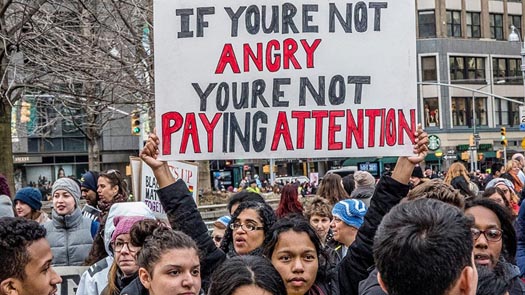
Angry women fighting sexism and misogyny in our culture

From the earliest days of Hollywood, women were stage managed and manipulated by older men in powerful positions.

And it remains clear that, although Harvey Weinstein, Les Moonves, John Lasseter, Luc Besson and James Toback, among a host of other male predatory Hollywood executives have been outed, little has changed.

In the Hollywood dream factory, trauma surfaces as light entertainment.

In 2013, introducing the list of Best Supporting Actress nominees during the Oscar ceremony, comedian Seth MacFarlane quipped: “Congratulations, you five ladies no longer have to pretend to be attracted to Harvey Weinstein.” What was chilling in that moment was that no one got the joke.
The idea that female stars and aspiring actresses are required to accept the attentions, at the very least, of older male studio executives, producers and prominent male stars, is as old as the Hollywood hills.

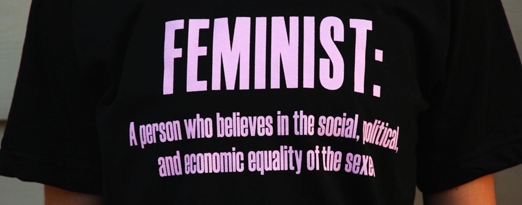
Feminist | A person who believes in the social, political, and economic equality of the sexes

Given the profile that the #MeToo movement has brought to sex discrimination, why does sexism continue to prevail in Hollywood?

According to San Diego’s State’s Centre for the Study of Women in Television and Film, women made up only 7% of directors on the top 250 films of 2019, which was actually a 2% decline from 2018.
The San Diego State study found that while women made up higher percentages of other fields in the industry – 24% of producers, or 17% of editors, for example – they only accounted for 17% of the workforce of all the jobs surveyed. And that too, was a 2% decline from the year before.

The University of Southern California’s Viterbi School of Engineering’s Signal Analysis and Interpretation Lab (SAIL) revealed how sexism is embodied by characters on the silver screen. If female characters are taken out of the plot, it often makes no difference to the story the study found.

Men’s language was linked with achievement, while their conversations contained more coarse language and was associated with sex and death. “Writers consciously or subconsciously agree to established norms about gender that are built into their word choices,” Anil Ramakrishna, one of the San Diego study’s researchers, said in a Los Angeles Times report.

Upon analysis of 1000 scripts, the study found that there were 7x more male than female writers and 12x more male directors than women.

The biggest impact in counteracting the gender imbalance was if female writers were present at script meetings. If this was the case, female characters on screen was around 50 per cent greater, the study found.

Inherent in these observations of the film industry are powerful messages about what it means to be female.

In our “post-feminist” era, where we are frequently told the problems of girls are yesterday’s news — that girls are awash in the largesse of civil rights, and it is boys who really require our attention — it is worthwhile to consider the conduct of male Hollywood writers and executives.

Actress Geena Davis, founder of the Geena Davis Institute on Gender in MediaActress Geena Davis, founder of the Geena Davis Institute on Gender in Media

The problem is so glaring that in 2005 actress Geena Davis, who would go on to start her own gender institute, commissioned researcher Stacy Smith, from the University of Southern California, to study the issue and help push the studios beyond the staid male-centred film industry. From 2007 through 2019, according to Smith’s ongoing research, women made up only 30.2% of speaking or named characters in the 100 top-grossing fictional films.

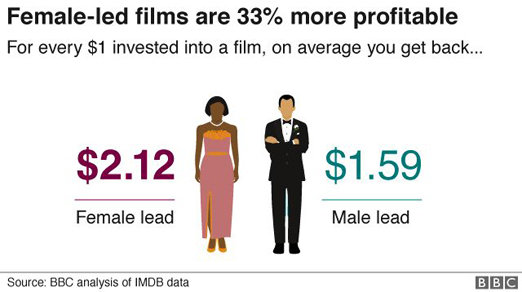
Female lead films make more money than films led by males.

The Geena Davis Institute on Gender in Media reports that films featuring women are financially profitable. “Guess what, Hollywood? Female-led films consistently make more money, year over year,” reported Madeline Di Nonno, the Institute’s chief executive, in a 2021 interview with Variety.
Hollywood actor Charlize Theron has criticized the movie industry for gender bias. Promoting her film Atomic Blonde, she told feminist Bustle magazine: “Fifteen, ten years ago, it was almost impossible to produce female-driven films, in any genre, just because nobody wanted to make it.”

The Bechdel Test

A quiz that was designed to find out how sexist a film might be was developed by Alison Bechdel and Liz Wallace in 1985.

To pass what has become more commonly known as the Bechdel test, the film needed three positive answers to these questions: Does it have more than two named female characters? Do those two women talk with one other? Is that conversation about something other than a man?

The Hollywood Reporter applied the Bechdel test to the top-selling films in 2019, finding that only around half of the films passed the test.

The sheer scale of Hollywood sexism is daunting, the stories of what actresses have to put up with disturbing, the tales of pay inequity and pushing for more female-led stories instructive.

Actress Zoe Kazan (‘The Big Sick’) told IndieWire reporter, Kate Erbland, “There’s so much sexual harassment on set. And there’s no HR department, right? We don’t have a redress. We have our union, but no one ever resorts to that, because you don’t want to get a reputation for being difficult.”

In the lead up to this year’s Oscar ceremony, actress Emmy Rossum sounded off during a Hollywood Reporter roundtable about her experience with overt sexism in the industry.

“I’ve never been in a situation where somebody asked me to do something really obviously physical in exchange for a job, but even as recently as a year ago, my agent called me and was like, ‘I’m so embarrassed to make this call, but there’s a big movie and they’re going to offer it to you. They really love your work on Shameless. But the director wants you to come into his office in a bikini. There’s no audition. That’s all you have to do.'”

If the dynamic of older men and younger, submissive women greases the wheels of Hollywood production offices repeats itself on screen, it is not an accident, but the desires of the producers and directors who create these films played out on the biggest stage of all: Hollywood cinema, the world’s most effective propaganda machine.