Decision 2021 | Day 32 | Hubris As A Motivating and Ill Factor in Politics


Liberal Prime Ministers Paul Martin and Jean Chrétien, two men who really don’t like one another

In 1990, after having lost two elections to Brian Mulroney, Liberal Party of Canada leader John Turner tendered his resignation, and asked the party to hold a convention to select a new leader.

Five leadership hopefuls entered the race, the most prominent of whom were  …

    • Paul Martin, 51, MP for LaSalle—Émard, Québec since 1988, and Opposition Critic for Treasury Board, Housing, and Urban Affairs; as well as former president and CEO of Canada Steamship Lines;
    • Sheila Copps, 37, Member of Parliament for Hamilton East since 1984 and Opposition Critic for the Environment and Social Policy, who from 1981 to 1984 — before entering federal politics — had been a Member of Provincial Parliament in Ontario;
    • Jean Chrétien, 56, who had placed second to Turner at the 1984 Liberal leadership convention. As the MP for Saint-Maurice, Québec from — 1963 until 1986 — Mr. Chrétien had served in several senior portfolios under Pierre Elliott Trudeau, including Industry Minister, Finance Minister, Energy Minister, and Justice Minister and was the minister responsible for constitutional negotiations from 1980 to 1982 when the Constitution of Canada was patriated and the Canadian Charter of Rights and Freedoms negotiated and ratified.

During the course of the leadership campaign, Mr. Chrétien and Mr. Martin developed an intense dislike for one another, an enmity that continues to this day.

Mr. Chrétien thought Mr. Martin to be a servant only to the wealthy elite — given Mr. Martin’s family ownership of the behemoth that was Canada Steamship Lines, that Mr. Martin lacked a touch for “the common people”,  and that Mr. Martin was unfit for the cut and thrust of federal politics, as well as utterly naïve politically.

On the other hand, while Mr. Martin held great respect for Mr. Chrétien and all he had achieved, his  assessment of Mr. Chrétien was no more generous. Mr. Martin thought Mr. Chrétien’s le petit gars de Shawinigan persona to be disingenous, was far too populist, and sensed in Mr. Chretien, an utter lack of a “moral centre.”

The 1990 Liberal Party of Canada leadership election was held on June 23, 1990 in Calgary, Alberta. The party chose former Deputy Prime Minister Jean Chrétien as its new leader, replacing the party’s outgoing leader.
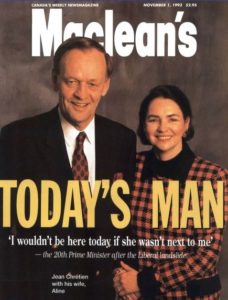
When Jean Chrétien won a massive majority government on Monday, October 25, 1993, when forming Cabinet, Prime Minister Chrétien was quick to appoint Paul Martin as his government’s Finance Minister, assigning him the thankless task of wrestling to the ground the $42 billion annual deficit left to him by former Tory PM Brian Mulroney, and cutting in half the $840 billion accumulated long term debt.

Paul Martin proved an able Finance Minister, and by the time Mr. Chrétien had resigned his office on December 13, 2003, with Paul Martin installed as Canada’s 21st Prime Minister only nine short days later, Jean Chrétien left behind a Liberal corruption legacy that would keep the Liberal Party out of office for 10 long years.

The sponsorship / Sponsorgate / or AdScam scandal, as it came to be known, involved illicit and even illegal activities ostensibly established to counter the actions of the Parti Québécois government intent on achieving Québec independence, with federal monies awarded to Liberal Party-linked ad firms in return for little or no work, in which these firms maintained Liberal organizers or fundraisers on their payrolls or donated back part of the money to the Liberal Party.

Prime Minister Martin was incensed when he learned of the malfeasance of Jean Chrétien, his hated rival, confronting the former Prime Minister …

“Paul, Paul, Paul,” Mr. Chrétien intoned to Prime Minister Martin. “There is only one avenue for you to take. Tell the public that you will order a full investigation of the circumstance that has been brought to your attention. Of course, you’re not really going to conduct an investigation. You’ll do what I did for 10 years: let the public move on from a momentary concern, and continue governing. A failure to do so on your part will mean an early end to your time in office, and a long period of time in the wilderness for the Liberal party.”

Prime Minister Martin’s response to Mr. Chrétien: the establishment of a Commission of Inquiry into the Sponsorship Program and Advertising Activities, headed by Justice John Gomery — which came to be known as “the Gomery Commission.” When reporting out, the Commission found that millions had been awarded in contracts without a proper bidding system, that millions more had been awarded for work that was never done, and that the Financial Administration Act had repeatedly been breached by the government of Jean Chrétien.

The Gomery Commission Report created a firestorm, the scandal featured as a significant factor in the lead-up to the 2006 federal election when, after more than 12 years in power, the Liberals were defeated by the Conservatives — not to return to power in Ottawa for more than 9 years.

Had Prime Minister Martin taken Jean Chrétien’s “advice”, more than likely he would have served many years as Canada’s 21st Prime Minister.

That’s where the hubris comes in.

Hubris derives from the Latin adrogare, meaning one has a right to demand certain attitudes and behaviours from other people. Hubris, it must be observed, generally indicates a loss of contact with reality, and an overestimation of one’s own moral good and capabilities. As such, hubris is often considered to be a fatal, or near fatal, character flaw that can become, if left unchecked, so obsessively all-consuming that it, more often than not, will lead to the complainant’s downfall.

As Prime Minister Martin sought to (rightfully, perhaps) “besmirch” and vilify the legacy of his hated rival —  the “villainous and contemptible” Mr. Chrétien —  Mr. Martin succeeded only in bringing his time in government to a premature and inglorious end, assigning himself to the scrap heap of history as a “failed leader”, while Jean Chrétien’s multi-term era as Prime Minister continues to be well celebrated through until this day, as a highly revered and universally respected former leader of Canada’s natural governing party, the Liberal Party of Canada.

L-R | People’s Party’s Maxime Bernier,  ex-Tory leader Andrew Scheer + current Tory head, Erin O’Toole

So what does all this have to do with the cost of kombucha at your favourite local grocer, and the current perambulations of #Elxn44?

Think current People’s Party of Canada leader Maxime Bernier, former federal Tory leader Andrew Scheer, and current Conservative Party leader, Erin O’Toole, pictured “left to right” above —  which in no way reflects their political positioning.

When, on May 27, 2017, former Speaker of the House and MP for the Saskatchewan riding of Regina—Qu’Appelle, Andrew Scheer, defeated Maxime Bernier —  Member of Parliament (MP) for Beauce from 2006 to 2019, and former Minister of Foreign Affairs in the Conservative government of Stephen Harper — with Mr. Scheer becoming the new leader of the Conservative Party, in what was a hotly contested (and, later, a disputed) leadership bid, which at the very last minute saw Mr. Scheer barely defeat his rival by a mere 50.95% to 49.05% margin, bad blood existed between the two rivals from that moment on, causing an excoriated Mr. Bernier to vow that he would seek revenge against a person he found to be wholly inept, and undeserving of the mantle of Leader of Her Majesty’s Loyal Opposition.

In this neck of the woods — way out here on Canada’s west coast, our country’s Pacific playground — we call that kind of revenge … wait for it, wait for it … hubris.

As VanRamblings will express in more detail tomorrow, had Maxime Bernier’s People’s Party not emerged in this election as a rival for the affection of the right wing, libertarian “fringe element” of Erin O’Toole’s Conservative Party — rising as high as 15% in some polls, in Alberta and Ontario, and in the process stealing votes  from the Tories — this upcoming Monday, September 20th, Mr. O’Toole would win a majority government, and become Canada’s 24th Prime Minister.

As a  play on and reversal of Michelle Obama’s 2016 campaign dictum to aid Hillary Clinton’s Democratic party campaign for President, Maxime Bernier’s campaign theme in 2021 has emerged as: “When they go low, we go even lower.” And, in the process, thwart the ambitions of both Andrew Scheer and Erin O’Toole — leaders of a political party, whose leadership he believes “rightfully belongs” to him.

Decision 2021 | Day 31 | A New Canada, or Back to an Era of Intolerance?


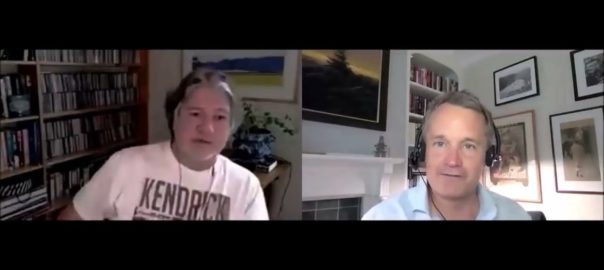
St. John’s South—Mount Pearl Liberal MP,  Seamus O’Regan. A necessary listen, and must watch.

On March 9, 2020 the Liberal government of Prime Minister Justin Trudeau introduced legislation that would impose a blanket ban on causing a child to undergo therapy aimed at altering their sexual orientation or gender identity.

The bill would also make it a criminal offence to cause an adult to undergo so-called conversion therapy against their will. It would not prevent a consenting adult from voluntarily undergoing the therapy.

“Conversion therapy is premised on a lie, that being homosexual, lesbian, bisexual or trans is wrong and in need of fixing,” Justice Minister of Canada David Lametti told Members of Parliament moments after tabling the bill in the House of Commons.

“Not only is that false, it sends a demeaning and a degrading message that undermines the dignity of individuals and the LGBTQ2 community as a whole.”

Bill C-6 proposed five new Criminal Code offences.

In addition to the ban on conversion therapy for minors, the legislation sought to outlaw removing a minor from Canada for the purpose of obtaining conversion therapy abroad. Both those offences would be punishable by up to five years in prison, as would forcing an adult to undergo conversion therapy against their will.

The bill would make it an offence to profit from providing conversion therapy or to advertise such — both punishable by up to two years in prison.  The new offences would not apply to parents, friends, teachers, doctors, mental health professionals, school or pastoral counsellors and faith leaders who provide support to individuals questioning their sexual orientation or gender identity.

“There is a difference between asking someone who they are and telling someone that who they are is wrong and in need of fixing,” Justice Minister Lametti told members of the House of Commons, adding that those who engage in ‘open-ended’, supportive discussions with an individual exploring their sexual orientation or gender identity have nothing to fear.”

Conservative Party Members of Parliament Push Back on Bill C-6

In addition to Tamara Jansen, Fraser Valley MP’s Ed Fast and Brad Vis were among the 62 Conservative Party members who voted against Bill C-6, which outlaws the practice of conversion therapy. Vis told The Abbotsford News that he was not concerned about the optics of only Conservatives voting against the bill and that he believed in the party’s right to allow MPs to vote according to their own judgment.

“I have a responsibility to my constituents to make decisions and the Conservative Party was the only party that wasn’t whipped on the vote. I’m more so concerned that charter rights are protected.”

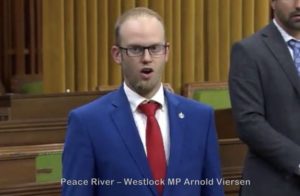
Peace River-Westlock MP Arnold Viersen also voted against the bill, as did fellow Conservative MPs: Prince George- Peace River- Northern Rockies MP Bob Zimmer; Manitoba MP Ted Falk; Albertan MPs Tom Kmiec, Damien Kurek, Jeremy Patzer, and David Yurdiga, Conservative MP for Fort McMurray-Cold Lake.

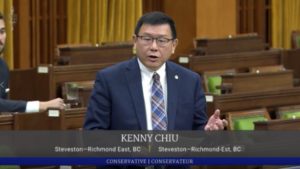
Two Richmond, British Columbia Conservative members of Parliament voted against the bill to restrict conversion therapy, MPs Alice Wong and Kenny Chiu.

Former Tory leader Andrew Scheer was not present for the vote, and neither was Grande Prairie-Mackenzie MP Chris Warkentin. Independent and former Conservative MP leadership hopeful Derek Sloan also voted to defeat Bill C-6.

On Twitter, Canadian singer songwriter k.d. Lang responded, “How terribly sad for them. Ignorance is not an easy thing to live with.”

The vote on the third reading of Bill C-6 in Parliament passed 263-63 in favour.

Meanwhile, social media giant TikTok announced in a statement following passage of the bill — despite the virulent, intolerant and often hateful commentary from a majority of Conservative Party MPs — that the service would be removing all content that harms the LGBTQ+ community, including conversion therapy videos.

Following passage of the bill banning conversion therapy in Canada, the bill languished in the Senate, where Conservative Party members of the chamber repeatedly threw roadblocks in the way of a timely passage of Bill C-6 —  in order that it might become law — instead,  Bill C-6 died on the Order paper, expunged from history. Erin O’Toole has said his government would not re-introduce Bill C-6, or move to outlaw conversion therapy in Canada, stating, “If the provinces or municipalities wish to introduce similar legislation to that which was passed in the spring, my government would not oppose such an initiative. As you know, I voted in favour of Bill C-6 — a majority of my Conservative caucus colleagues did not accept Bill C-6.”


Decision 2021 | Day 30 | The State of the Race | Progressivism Reigns

With only one week to go, Canadians — who just 11 days ago seemed almost completely unaware there was a federal election going on —  have come out of their slumber, and in vast numbers have set about to change the complexion of the current election.

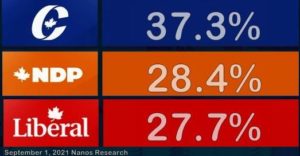
Here’s what the polls were looking like on September 2nd …

On Thursday, September 2nd, Erin O’Toole’s Conservatives seemed to have the election in the bag, their policy-driven campaign a wild success, while at the same time Jagmeet Singh’s federal NDP campaign had caught fire, and catapulted the usual also-ran social democrats into second place, and ready to assume the mantle of Opposition party in the next session of Parliament.

So, what happened in 11 days to turn the Liberal campaign around?

1. Voters took a closer look at a Conservative Party platform that would annul a national child care programme signed onto by eight provinces and territories; nullify a Canada Child Care benefit programme that has provided much needed aid to young families, while cutting child poverty in Canada by 40% since 2015; rescind the ban on tanker traffic along British Columbia’s pristine coast; and reverse the current ban on assault weapons that have murdered so many of our fellow citizens; among dozens of other provocations;

2. Canadians took a closer look at the fiasco that is pandemic policy in the four provinces where the Conservative party is in power, and what that might mean for Tory pandemic policy federally. The provinces of Alberta and Saskatchewan —  both of which refuse to consider a vaccine card to help keep their citizens safe —  have the highest per capita COVID-19 infection rates in Canada, and a citizen vaccination rate lower than anywhere else in the country, where the Premiers of these provinces say, “Everything is back to normal. We had lockdowns, quarantined our citizens, did contract tracing, and spent far too much taxpayer money on fighting a war against an invisible foe.” Recently resigned Manitoba Premier Brian Pallister and Ontario Premier in hiding, Doug Ford, have done little better in protecting their citizens and fighting the scourge that is COVID-19.

https://twitter.com/EDenhoff/status/1436810714677604352?s=20

Canadian voters aren’t stupid: they know what an Erin O’Toole government would mean for the health of their families.

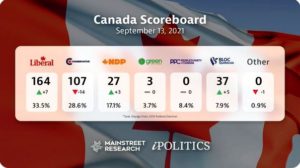
3. If Justin Trudeau and the Liberal Party have risen 5.8 points in the polls in the past 11 days, and Erin O’Toole’s Conservatives have lost 8.7 points in Canada-wide polling, the party that has experienced the steepest decline in support is Jagmeet Singh’s NDP, who in falling from a September 2nd high of 28.4% to a mere 17.1% standing today — for an incredible (if not unexpected) drop of 11.3 percentage points — simply have to be reeling.

Although, the NDP will pick up three seats if the Mainstreet Research / iPolitics poll above is correct.

Election Day 2021 is but one short week away from today.

By late in the evening of Monday, September 20th, Canadians will know whether we’ve elected an Erin O’Toole government — certainly not out of the realm of possibility, given the volatility of the current election cycle — or returned Prime Minister Justin Trudeau to Ottawa, for what will likely be his final term in office, allowing him to complete his work on creating a national child care programme, and seeing us through this pandemic that has so disrupted the lives of all Canadians.


Arts Friday | The Much Anticipated Autumn Film Festival Season Underway

In 2021, wherever a film festival may take place, appropriate COVID protocols will be in place, including mandatory masks in the screening rooms and common areas, and proof that cinephile patrons have been vaccinated.

The pandemic – particularly given the ravages of the COVID-19 fourth wave – will probably mean, and has meant at the Telluride and Venice film festivals, prejudiced attendance numbers at fall film festivals. As was the case in 2020 – and once again will be so in 2021 – films on offer will be made available for home viewing, with a small number of films  available exclusively for in-person screenings. In other words, in order for film festivals to “work” in 2021, festival directors have adopted a “hybrid model” to satisfy the viewing demands of their loyal patrons.

At Telluride and Venice, major film studios made their star-driven, Oscar contending film slates available to these two prestigious film festivals, as will be the case in Toronto – which got underway yesterday – and later this month in Gotham City, at the 59th annual New York Film Festival, which will share half their slate with VIFF.

At Telluride and Venice, Hollywood stars turned out in all their finery, engaging in post screening discussions with audiences, sitting in rapt & appreciative attention.

Above is a clip of Japanese-English director Will Sharpe’s The Electrical Life of Louis Wain, a whimsical Victorian biopic starring Benedict Cumberbatch and Claire Foy which, it was announced at the annual Vancouver International Film Festival media conference has been selected as VIFF40’s opening night film, on October 1st.

“Movies are a distraction from reality,” says a character in Paolo Sorrentino’s Hand of God — which débuted at Telluride a sprawling, funny-sad, autobiographical coming-of-age story. That’s a good thing. Reality is drab and painful — “lousy,” according to the film’s English subtitles — and film provides a much needed respite.

The break-out Oscar contenders that débuted at Telluride include …

Cyrano, a lovely new telling of the classic story of Cyrano de Bergerac, which had its world première at Telluride, and took that film festival by storm with guaranteed Oscar nods all around;

https://youtu.be/MUnsoxe7K4g

The North American première of Spencer, the mesmerizing new drama starring Kristen Stewart (a guaranteed Best Actress Oscar nominee) as Princess Diana; and

The crowd-pleasing King Richard, a drama charting the rise of tennis superstars Venus and Serena Williams, expected to launch Will Smith into the Oscar race for his portrayal of the girls’ demanding dad and coach, Richard Williams — a loving, egocentric father who, it turns out, did know what was best for his daughters.

Céline Sciamma’s exquisite Petite Maman — which débuted at the Berlinale, and has been set as VIFF40’s closing night film (cuz it’s VIFF programmer, Curtis Woloschuk’s, favourite film at VIFF this year, he told VanRamblings earlier in the week — don’t tell anybody, though, cuz it’s a secret) — a delicate film full of surprises. Sciamma, whose Portrait of a Lady on Fire was a VIFF standout in 2019 (at the pre-pandemic VIFF festival), examines female intimacy from a different angle.

Nelly and Marion (played by young twins named Joséphine and Gabrielle Sanz) are 8-year-old girls living in similar houses in the woods. They strike up a friendship tinged with elements of fairy-tale supernaturalism, magical realism and time travel. The twists packed into the film’s compact 72 minutes arrive gently and matter-of-factly. The intense emotions they leave behind — this is one of the quietest tear-jerkers you’ll ever see — are at once familiar and wholly new.

Soon, the sane and responsible among us will be fully vaccinated and in possession of our province-issued vaccine card — making attendance at movie theatres, restaurants, bars and pubs safer and more enjoyable for the vast majority of us.

As much as COVID’s fourth wave will keep us in its troubling grip, for the most part it is the anti-social unvaccinated amongst us who will bear the malignant brunt of the coronavirus — for the rest of us, a return to a near normal state of being holds promise for our immediate future, and the prospect of an autumn movie-going season sitting amongst our brothers and sisters inside a darkened movie theatre.