|
Meanwhile, Strategic Thoughts columnist David Schreck says it’s ‘payback time’ for the BC voters …
In an ideal world voters would evaluate each of the candidates, read the platforms of all of the parties, and carefully consider informed debates during the course of the campaign. In the real world people have busy lives with much more to do than follow every nuance in politics.
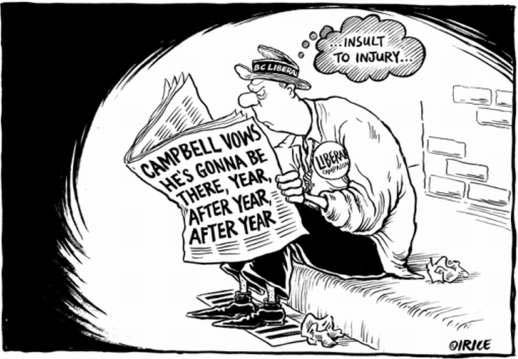
Traditionally voters are said to have very short memories, but the 2005 election may be very different. Most policy issues do not personally affect very many voters, hence it is easy to put them out of mind. The same isn’t true when you get laid off, have your pay cut, or have your tuition doubled. There are dozens of decisions taken by the Campbell government that inflicted significant harm on tens of thousands of voters. Chiropractors, podiatrists and physiotherapists lost patients because MSP delisted their services; on the patients’ side, they either paid more or did without. Some people skipped their regular eye exams because they no longer had coverage. Some seniors walked away from the prescription counter after learning how much more they had to pay for their drugs. The use of provincial parks declined when families got hit with $1 an hour or $5 a day parking fees. It is not just about the gut wrenching stories of seniors being separated from their spouses after 50 years of marriage as a result of the Liberal’s community care policies, or about the tragedies created when people were turned away from emergency rooms. The election is about thousands and thousands of stories big and small where people know that they were hurt as a result of a mean spirited, uncaring government. May 17th is the time when those who were hurt can inflict some pain on Gordon Campbell. For some voters, it is payback time.
Over at The Tyee, Tyee election prognosticator Will McMartin is now calling for the NDP to win 25 seats, with another 8 seats up for grabs. But when you consider that, according to the Mustel Group poll, that a full 11% of BC voters have not decided on how they’re going to cast their ballot, and news reports have Green Party support soft with the potential of half their supporters voting strategically to defeat Gordon Campbell’s government, the potential for a squeaker must be looming heavy in the Liberal camp.
And factor in, too, the record number of voters eligible to vote this time around — 700,000 more than last year and more than ever in the province’s history — attributable to a decision by Elections BC to make British Columbia the first jurisdiction in North America to allow voters to register, update and confirm registration online. Who’s most comfortable with online registration? That’s right, younger voters. And will the vote of young people go to the Liberals, considering a doubling of tuition fees at post-secondary institutions across the province over the course of the past four years; not to mention, cuts to bursaries and scholarships?
The denouement to Campaign 2005 is shaping up to be interesting, indeed, no matter how quiet the parties have been on the hustings. Campaign 2005, in the end, has become our opportunity to tell the Liberals just how unhappy we are with a government that dramatically reduced funding to legal aid; cut funding to 37 women’s centres; got rid of the Ministry of the Environment and cut staff whose job it was to protect our eco heritage.
Slashed funding for childcare; slashed funding for programmes that would have brought street kids off the streets and into safe conditions; closed 1/3 of the court houses across the province; closed major departments in 69 hospitals in BC while closing three hospitals altogether; closed 1,464 long-term care beds, 2,529 residential care beds and 1,200 hospital beds.
Raised fees in provincial parks and put parking meters in place; sold off BC Rail; gutted labour legislation to the point where it’s now almost impossible to certify a bargaining unit in British Columbia; privatized hospital services with the attendant loss of 7000 frontline health care worker jobs, leading to a radical decline in the quality of food and support services, and dietary and hygiene standards; raised MSP premiums by 50%; doubled or tripled fees for most government services, ranging from renewing your driver’s license to applying for a birth certificate; fired 3000 teachers, raised class sizes, and closed 100 schools; the list could go on and on and on.
Enough is enough. Vote for change May 17th. Kick da bums out of office.