Day 5: Vancouver’s Civic Political Scene, As The Worm Turns

Sammie Jo Rumbaua, Coree Tull, Trish Kelly, Naveen GirnNew Voices, One Vision slate: Sammie Jo Rumbaua, Coree Tull, Trish Kelly, Naveen Girn

The fix is in: awhile back VanRamblings received the following information from one of our regular correspondents, offering insider insight into the — tried and true, par for the course — selection process for Vision Vancouver Park Board candidates to fill out the slate for this November’s civic election …

Heard through the grapevine that the Vision backroom has decided that the four candidates for Park Board will be Trish Kelly, Sammie Jo Rumbaua, Coree Tull, and Naveen Girn. How exactly this squares with their election by the membership I’m not sure.

Some of COPE’s supporters were approached by both successful and unsuccessful candidates to sign up as members to vote and told various COPE people about it.

If this “gang of four” is true, then that means no Brent Granby and no Catherine Evans. No Katherine Day, Mark Mitchell, or Graham Anderson either. The latter two are bikes & gardens respectively. Granby also espouses bikes.

So … Vision is foregoing their environmental keeners and going for representation from visible minorities (I understand “racialized” is the current term) with Naveen and Sammie Jo, and the “L” in LGBTQ with Trish? And youth with Coree? Hmmm … will be interesting to find out if the rumour is true, but the person who told me seemed pretty sure.

VanRamblings has tweeted out the information above — denied by Vision Vancouver Executive Director, Stepan Vdovine — hoping to open the nomination process, somewhat, and provide a level playing field for those candidates not among the “chosen few” New Voices, One Vision slate.
Thursday morning, a kink was thrown into the nominating process when Hollyhock Board Chair, and Vision Vancouver supremo, Joel Solomon, endorsed five Park Board candidates for the four vacant positions on Vision’s Park Board slate, Brent Granby and Graham Anderson receiving his favour, and Filipina Sammie Jo Rumbaua left to hang out to dry.
According to a story published in The Straight last evening, more than 800 Vision members showed up at the advance polls, yesterday, for park and school board nominations. Results from the nomination process will be announced after 8pm, this Sunday, June 22nd, at the Waterfall Building, at 1540 West 2nd Avenue, near the entrance to Granville Island.

star.jpg star.jpg star.jpg

Housekeeping: Ken Charko Dumped from NPA Board of Directors
Ken Charko For the second time in 19 months, maverick NPA member Ken Charko has found himself “removed” from the Non-Partisan Association Board of Directors.
There’s been bad blood between Charko and the NPA for some time now — last summer, at the NPA’s AGM, the NPA’s Board of Directors brought a motion forward that would have stripped Charko of his membership in the party. The motion was narrowly defeated, with the support of a ragtag group of Jesse Johl and Charko acolytes and hangers on who’d turned out at the NPA AGM specifically to defeat the motion.
In respect of Charko’s recent expulsion, which was moved and voted on Wednesday, June 17th, a statement on the civic party’s website reads:

The decision to remove Charko was deemed necessary given his decision to knowingly, purposefully, and repeatedly violate the confidentiality that he and the entire NPA Board agreed to respect and uphold as part of their duty as directors.

Of course, there’s a great deal more to the story than may be gleaned from the otherwise reasoned, if enigmatic, statement above.
For some time now, the movers and shakers in the NPA have believed Ken Charko to be a quisling, an individual who has set about to not only provide aid and comfort to the “enemy” (civic opposition parties), but someone who has set a course to actively undermine the party’s chances for power this November, by consistently acting as a “confidential informant” to members of the fourth (bloggers) and fifth (mainstream media) estates.
In addition to all of the above, various reports have emerged in the community over the past year that indicate Ken Charko was the major funder of the nascent right-wing municipal party, Vancouver First, and that working with Jesse Johl — and anticipating that he’d likely be removed from the NPA once again — Charko and Johl would mount a bid for civic office this autumn, with Vancouver First as their newly chosen vehicle.
With all the controversy surrounding Jesse Johl, in his role as President of the Riley Park-Hillcrest Community Centre Association, Johl has emerged as a disgraced and spent force. Charko — who managed 45,372 votes in the 2011 Vancouver civic election, coming in 14th, just 3276 votes behind the last Councillor to be elected — would like nothing better than to emerge as Vancouver’s oleaginous answer to Rob Ford (minus the drugs, of course).
Ain’t gonna happen, though, despite The Straight’s ringing endorsement.

Day 4: Little Mountain Housing, the NPA, and the Greens Party

The Little Mountain Housing Development Story. A documentary project by David Vaisbord

Vancouver-based independent filmmaker and documentarian David Vaisbord has created a compelling crowdfunding campaign on indiegogo, a personal film project to document the story of, as CityHallWatch wrote last year …

The premature destruction of the Little Mountain social housing complex in Vancouver and the ongoing saga about the community and the site’s fate … offshore investors, egos, political influence and spin, bureaucratic bungling, mainstream media blindspots and incompetence, and more, are some of the factors determining the flow of the saga of the Little Mountain housing development.

Riley Park community activist Ned Jacobs weighed in recently, writing …

“Since 2009, when all but four of the 224 homes at Little Mountain Housing were demolished, the 15-acre site, which housed a well-functioning community in 2007, has sat fenced off and empty except for a scattering of trees. A single rowhouse building remains because several of the tenants courageously refused to be displaced by BC Housing (BCH).

Supportive housing is a core element of our social safety net. Former NDP MLA David Chudnovsky has pointed out that we don’t sell off our parks to cover social assistance and disability cheques; why then would we sell our social housing sites to fund supportive housing? It would make much more sense to fund supportive housing through general revenue, and redevelop Little Mountain and other appropriate social housing sites as rentals and cooperatives to house a broad range of incomes — and especially “first responders” and other essential service workers that have been frozen out of the Vancouver market.

For the City to allow the project to proceed without the crucial amenities would be irresponsible and a slap in the face to the entire community, as well, as would permitting greater height or density than set out in the Little Mountain Policy Statement (LMPS).

David Vaisbord’s powerful, revealing documentation of nearly five years of the Little Mountain saga has already helped move the tide of events in a positive direction. A feature-length documentary telling this important story through the spoken words and images of the people and the place could contribute to achieving a far happier outcome.

Donations to the Little Mountain Film Project may be made here.

star.jpg star.jpg star.jpg

Rogue NPA Board of Vancouver Education trustees Ken Denike and Sophia Woo

As reported widely in the media, rogue Non-Partisan Association Vancouver Board of Education trustees Ken Denike and Sophia Woo (pictured above) were expelled from the NPA caucus this past Friday for having “chosen to follow their own course in various matters without consulting with the other members of Caucus,” a statement from the party read, relating to the adoption of an updated policy designed to better accommodate LGBTQ+ and Gender Variant persons enrolled in Vancouver schools.
In a statement issued yesterday by the NPA’s Board of Directors …

The NPA Vancouver Board of Directors has voted to support the recent expulsion of school trustees Ken Denike and Sophia Woo from the NPA Caucus.

The Board also decided that Denike and Woo will not receive the party’s endorsement as candidates in the upcoming municipal election.

NPA President Peter Armstrong said the Caucus’s decision to expel Denike and Woo was not unexpected.

“The Caucus has had ongoing issues with Ken and Sophia for a long time and the Board has been aware of this,” said Armstrong. “The raucous news conference called by Ken and Sophia last week was just one issue among many that forced the Caucus to take action.”

The NPA Caucus celebrates and supports the diversity of all of the people in our city and fully supports efforts to assist LGBTQ+ and Gender Variant persons in our community and in our schools. Fostering inclusion and understanding is central among the NPA’s guiding principles

For further background, read this story in the Vancouver Courier.

star.jpg star.jpg star.jpg

Green Party of Vancouver 2014 Campaign Kickoff

Tickets for the Vancouver Greens 2014 campaign kick-off are available here.

Decision 2014: Vancouver Civic Election Campaign Coverage

One City Vancouver

VanRamblings was disappointed to hear yesterday, from informed sources, that Vancouver’s newest municipal political party, One City Vancouver, has made the decision to contest only seats for Vancouver City Council in 2014, and will not be offering candidates in the Board of Education or Park Board sphere heading into Vancouver civic election day, on November 15th.
Our sources report that the decision was made some time ago, and despite the imprecations of many associated with the nascent civic political party, the decision’s been made, and there just ain’t no changing it. Sad.
With former COPE School Board trustee Jane Bouey, former Vancouver PAC Chair Gwen Giesbrecht, and longtime education activist Marcy Toms ready to head up a One City Vancouver Board of Education slate — and given the support of Vision Vancouver Board of Education chair Patti Bacchus for the candidacies of these three aforementioned, well-respected community and education activists — it is a pity, indeed, that One City Vancouver will focus solely on gaining one or more seats on Vancouver City Council this autumn.
In respect of Park Board, as we wrote to OneCity co-founder David Chudnovsky yesterday, there is very little doubt in our mind that OneCity’s Mia Edbrooke would make a damn fine Park Board Commissioner. Seems that the affable, informed and very bright Ms. Edbrooke will not present her name as a candidate for Park Board this autumn — a loss for all Vancouver citizens who possess a degree of caring for parks and recreation in our city.

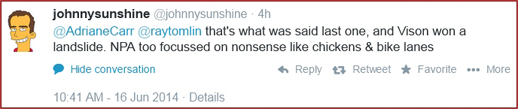
johnny-sunshine.jpg

NPA Running to the Left in Campaign 2014, Means to Win This Time
Speculation is running rampant as to the nature of the civic election campaign that Vancouver’s natural governing party, the Non-Partisan Association (now, the New Progressive Association) will run this autumn.
Will it be the unfocused NPA, Rob Ford apparatchik-led botch job that Vancouverites experienced in 2011, or has the NPA in 2014 finally learned their lesson, and set about to embark on, and adopt the strategy of, a winning, centrist, socially progressive, neighbourhood-focused and citizen-engaged campaign for office? In the coming months, VanRamblings will report out on NPA strategy. Suffice to say: the NPA means to win in 2014.

Vancouver First

Readers have written to enquire as to why VanRamblings had not included Vancouver First in Sunday’s posting on municipal political parties vying for office this autumn? Hell, we were very much looking forward to a viable Jesse Johl (pictured above) campaign, but alas it is not to be — which is not to say that Jesse won’t run, but rather to say with all the recent shenanigans afoot surrounding allegations about “misappropriated” funds at the Riley Park-Hillcrest Community Centre Association (where Johl sits as President), and lawsuits launched by Park Board, and NPA Board of Directors (and former good friend) member Ken Charko, directed at the oleaginous (if amiable, and outspoken) Johl, any latent candidacy for Vancouver civic office by Mr. Johl would only be met with huzzahs of derision. Would’ve been an interesting, noisy candidacy, tho. C’est la vie.

Civic Election Spending: Vision Pot Calls NPA Kettle Black

25k-lunch-meme

Vision Vancouver is in no position to play the money card against the NPA in this fall’s civic election after condo developer Bob Rennie hosted a $25,000 a plate fundraising lunch for Vancouver mayor Gregor Robertson in March, according to IntegrityBC’s Executive Director Dermod Travis, in a statement issued last week. The luncheon caused outrage across the city.

“Political parties that live in glass money houses shouldn’t throw stones. Neither of Vancouver’s two major civic parties is holier-than-thou when it comes to political fundraising and neither of them seemed pressed for cash in 2011. The Bob Rennie lunch will also likely set a Canadian record for the cost of admittance to a political fundraising event.”

Rennie’s luncheon for Vision Vancouver also included a private “roundtable” discussion granting special access to Mayor Gregor Robertson. “It’s a pretty safe bet that they weren’t discussing the Vancouver Canucks for two hours over canapés,” said Travis.

Coalition of Progressive Electors members Daniel Tseghay, Maria Wallstam, Nathan Crompton, Sean Antrim and Tristan Markle, writing in The Mainlander, recently asked the pertinent question, “When developers give Vision $25,000, what kind of government do they get in return?”

Corporations and the real-estate industry donate to Vision Vancouver because it pays off.

The ruling party strategically approves developments that make their donors rich. Most notably, Wall Financial was a founder of Vision Vancouver and donated $280,000 in 2011. Since Vision came to power in 2008, Wall has seen its profits increase from $18 million to $61 million. Rize Alliance (who donated $10,950 to Vision in 2011) had their 26 story tower approved at Broadway and Kingsway, right in the heart of working class Mount Pleasant, despite community opposition of 80%.

Westbank, which donated $11,705 to Vision and $31,000 to the BC Liberals in the last municipal and provincial elections, was given a rezoning in Chinatown right in the middle of a community planning process. The Aquilini Family, who donated at least $10,000 to Vision over the last two elections … got a $35 million tax exemption for their project next to GM Place. Concord Pacific, which donated $36,250 to Vision in 2011 … is allowed to use urban farms to evade property taxes.

Under Vision’s corporate governance, condos are targeted at the most affordable existing neighbourhoods: Marpole, Grandview Woodland, the DTES, Mt. Pleasant, and the West End. Corporations see affordable and social housing as a threat to the market and an unwelcome competitor in the scarce supply of housing. As a result, Vision has worked to liquidate the existing affordable housing stock.

In the 2011 election, Vision Vancouver raised $2.2 million, mostly in five figure donations from corporations/developers and unions. The NPA raised $2.5 million. Last time out, campaign spending in Vancouver hit $5.3 million, in a city with 419,000 eligible voters. In 2008, it was $4.5 million.
Meanwhile, under Mayor Gregor Robertson’s leadership, the city has seen rents soar and its street homelessness population more than double this year, a 249 per cent increase since the last regional count in 2011. In 2014, there were 1,798 people without homes in Vancouver, and more people sleeping outdoors than in any other MetroVancouver municipality.
In March, candidates in Calgary’s 2013 election filed their campaign disclosure reports. Calgary Mayor Naheed Nenshi — who ran his campaign on a self-imposed limit of 65 cents per eligible voter — spent $391,124. In April of this year, a Vision Vancouver-led majority City Council defeated a motion by Green Party of Vancouver City Councillor Adriane Carr urging voluntary campaign finance restrictions for the November 2014 election.

“I think we have, in the public, a feeling of distrust of politicians,” said Carr. “I hear us not trusting ourselves, not trusting each other in terms of holding to a voluntary pact together. I know that (my motion) would be voluntary, it would not be enforceable. It would however be ultimately trackable. I think perception here is critical, and it is related to the confidence in democracy, and the democracy in our decisions, and that we should as a Council extend the hope that speakers have asked us to uphold, the hope that we can work together in terms of setting some voluntary limits, and adhere to them.”

Meanwhile, in Calgary, with 668,000 eligible voters, Mayor Naheed Nenshi underspent his own cap by six cents per voter and ended the campaign with a surplus of $120,000, most of which he donated to local charities.
Three provinces — Quebec, Ontario and Manitoba — have existing campaign finance rules for local elections that could easily be adopted in Vancouver, argues IntegrityBC, which goes on to state that since Vancouver is the only major Canadian city that doesn’t have a ward system, Vancouver should adopt Ontario election spending rules as a basis for discussion among the parties and candidates, where campaign expenditures for Mayor, Council and School Board trustee candidates top out at 85¢ per elector.

“This isn’t a big leap for Vancouver’s municipal parties,” says IntegrityBC’s Travis. “The four parties that have sat on Council in the past eight years have all supported motions calling for electoral finance reform. This is a chance to show some leadership and put into practice what they’ve already agreed to. The will is there and there’s sufficient time before this fall’s elections to find the way.”

From CityHallWatch: Donation declarations are done on an “honour system.” No independent audit is conducted. Of particular concern, CityHallWatch suggests, is the non-reporting of “in-kind” donations (think: the undeclared 2011 CUPE BC Vision Vancouver election “donation” of $1.5 million, which months later magically transformed into a precedent-setting 6.85 per cent wage increase over three years for Vancouver civic workers, setting the stage for municipal employee contracts across the province).
And where does this leave the average Vancouver citizen, minimum and low wage workers, our homeless population, senior citizens living on a fixed income, and all the rest of us? At best, of secondary concern to a cynical, Vision Vancouver-led City Council, who are more focused on paying off their friends and supporters than in representing the needs and aspirations of the diverse, majority population who reside in the city of Vancouver.