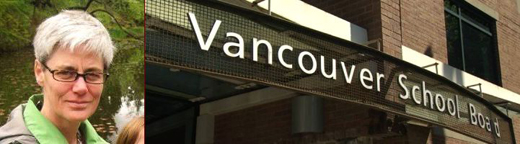
There exists in our city, governance serving the public interest that sets the standard for democratic engagement — the likes of which VanRamblings does not recall ever previously having witnessed in the public realm.
We are, of course, speaking of the work of Chairperson of the Vancouver School Board, Janet Fraser, who meeting in, meeting out conducts a Master Class on how one must conduct a meeting, efficiently and well, in the public interest, respectful meetings of democratic engagement, where the Board of Education trustees are encouraged to work as a team — and woebetide the person who does not accede to Dr. Fraser’s unspoken ordinance.
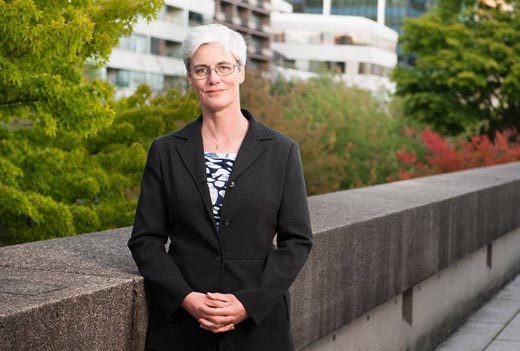
For Dr. Janet Fraser, outward appearance to the contrary, is a tough as nails, brooks no nonsense, respectful, engaged, informed, demands the best from those sitting around the VSB Board of Education table, who absolutely and utterly does not ever allow untoward commentary to stand — the finest and most democratic public official, and Chairperson of any civic body we have ever had the privilege of witnessing.
A story. Early in her term as Vancouver School Board Chairperson, Janet Fraser allowed One City Vancouver trustee Carrie Bercic to move a motion that would see the newly-elected trustees working with staff to ensure the timely hiring of teachers and other educators, so as to meet the conditions of the November 2015 ruling of the Supreme Court of Canada.
Ms. Bercic, even as early as the beginning of her term as school board trustee, was making it clear to anyone with ears to listen that she would be the new conscience of the Vancouver School Board ‘Board of Education’, as has proven to be the case throughout the course of 2018.
Veteran trustee Allan Wong, in support of trustee Bercic, seconded her motion, the motion now open for discussion, recently-elected Chairperson Fraser presiding at the head of the Board of Education table. Early reception for trustee Bercic’s motion was not salutary, with both Vancouver Non-Partisan Association trustees Fraser Ballantyne and Lisa Dominato, as might well be expected, speaking against “interference” by trustees in the work of administrative staff. Trustee Wong spoke in support of trustee Bercic’s motion, as did his Vision Vancouver colleague, Joy Alexander, while their colleague Ken Clement chose not to weigh in on the matter.
Trustee Estrellita Gonzalez, a novice in political life, looked on, attempting to weigh what she heard. And what trustee Gonzalez heard next, from her Green Party of Vancouver colleague, Dr. Judy Zaichowski rocked the meeting, sounding the death knell for trustee Bercic’s motion …
“Never have I heard such a poorly worded motion” trustee Zaichkowski proclaimed. “Trustee Bercic seems not to know what it is she is attempting to move, injudiciously unclear in her intent — quite honestly, I cannot make head nor tail of what trustee Bercic is attempting to accomplish. From what I’ve read, looking at her motion — a motion which she did not discuss with me, nor to the best of my knowledge, with other of the trustees around this table — I would suggest that, perhaps, “she” might benefit from one of the courses on ‘Clear Communication’ I teach at Simon Fraser University in the Beedie School of Business. I will not be supporting Ms. Bercic’s motion, and stand adamantly against it.”
A hush fell over the room. Trustee Gonzalez seeming to weigh no longer on how she would vote — she would cast her vote in the negative.
Meanwhile, trustees Dominato and Ballantyne seemed thunderstruck — it is usual business at the school board table that Fraser Ballantyne is the one who acts out. Meanwhile, Joy Alexander — always calm, had a look of alarm in her eyes, while you could almost hear trustee Wong’s thoughts on the matter (“Never in my 19 years as a trustee on school board, have I ever witnessed …”), while trustee Clement looked on, disbelieving of what he’d just heard — for this group of trustees, perhaps with one notable exception, are persons of conscience, as humane and caring of the public process that leads to the decisions that affect the lives of thousands as may be found on any publicly-elected body. All the while, even though it was but mere seconds, Chairperson Fraser sat at the head of the table, her face inscrutable, her thoughts unreadable. And then Dr. Fraser spoke …
“Around this school board table, trustees speak to and about one another with respect. Trustee Zaichkowski (ed. note, one of the two Green Party trustees elected last October, along with Dr. Fraser), despite your statement and suggestion to the contrary, I feel quite assured that you know exactly what trustee Bercic’s motion intends. How could you not? The content and activism of trustee Bercic’s motion is as clear as day to me, as I am sure is the case with all of my other trustee colleagues sitting around this table this evening — clearly with the exception of yourself, if I am to believe what you said earlier … and I do not.
I will be supporting trustee Bercic’s motion, as I hope would be the case with my trustee colleagues, on whom I am depending for support of trustee Bercic’s motion, a motion the intent of which I clearly understand, and without reservation support. Could I now have a trustee Call the Question, so that we might vote?”
All tension in the air evaporated, you could hear the audible sighs of relief around the school board table, trustee Gonzalez was smiling for she now knew for certain how she would vote, with trustee Ballantyne speaking out of order to say, “I am fully in favour of trustee Bercic’s motion.”
Chairperson Janet Fraser asked for a show of hands, “All those in favour of trustee Bercic’s motion raise your hands.” Seven hands shot up: trustees Bercic, Wong, Alexander, Ballantyne, Clement, Dominato and Gonzalez. Chairperson Fraser next asked for a show of hand(s) for those opposed. Nothing. Trustee Zaichkowski had abstained on the motion that only minutes earlier she had spoken so vehemently against.
With the above described interaction of trustees now history, Dr. Fraser proved herself to be … how do we say it? … someone not to be fucked with. A tone was set. Dr. Janet Fraser was in charge. Going forward, members of the Vancouver School Board would work together in the best interests of children enrolled in the Vancouver school system.
Meanwhile, Dianne Turner (for whom I possess some great affection, and who is owed an apology from me … nothing too egregious, just some casual thoughtlessness on my part, if casual thoughtlessness can ever be juxtaposed with use of the word “just” … surely, a contradiction in terms) — the Official Trustee appointed by B.C. Liberal Education Minister, Mike Bernier, on behalf of the Christy Clark government, and kept on as a Special Advisor to current B.C. Education Minister, Rob Fleming, her term as Special Advisor expiring earlier this spring — looked around the room, at the gallery, at the trustees, and at Dr. Fraser. With a subtle, yet warm and reassuring smile, Ms. Turner limned the moment of reason and humanity that she had just witnessed around the school board table. You could almost hear her say, “I think they’re going to be just fine. Soon, I’ll be speaking with Minister Fleming, when I will seek to assure him that the Vancouver School Board is in good hands, and that he need not worry.”
Dr. Janet Fraser. Master Class in Meeting Conduct. Every Chairperson of every body, be it housing co-op, arts organization, elected body, or in any other forum where people come together to promote good governance and democratic decision-making would do themselves well to arrive at the offices of the Vancouver School Board this upcoming Monday evening.
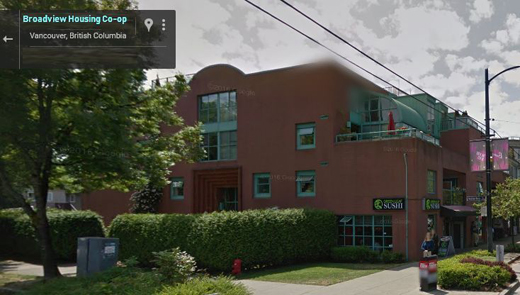 Broadview Housing Co-operative, located in Vancouver’s Kitsilano neighbourhood
An Invitation to the Members of the Broadview Housing Co-operative, and to all Vancouver citizens
For anyone who is familiar with VanRamblings’ activist work in the community, you would know that we are a lifelong democrat, that we believe in respectful and informed democratic engagement, where although within a group or on an issue of contention on occasion we might disagree, we believe in humanity and what constitutes the best of us, as persons of conscience, as social activists, as engaged citizens striving always for more and better, not for ourselves — because we recognize that we are persons of privilege — but for others, for whom it is our obligation to use our privilege to make a difference in the lives of those with whom we come into contact daily, and for those whom we have not yet met, the vulnerable members of our community, for whom we harbour a deep and abiding caring, and for whom we will do our best to make theirs a better life, and in doing so give our own lives a sense of meaning and a deeper purpose.
Working together, striving to improve the lives of others, the creation of community, and a sense of social obligation defines life in housing co-ops, as it defines life in the public realm, at Council, Park and School Board.
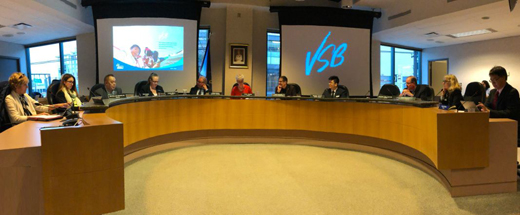
Why is VanRamblings inviting the members of our housing co-op, and you as citizens of Vancouver, to next Monday’s, May 28th public meeting of Vancouver School Board trustees, set to start at 7pm, at 1580 West Broadway, in the Board room at the Vancouver School Board’s head office?
In part, it’s because Broadview is a mere 19 blocks from the Vancouver School Board offices, an enjoyable walk, bike or bus ride away. And why not? Aren’t housing co-ops all about respectful, democratic engagement, and is it not important for the well-functioning not only of the Broadview Housing Co-op at our various general, finance, membership and maintenance committee meetings — but for all of us in the public weal — to strive always for better in the conduct of our lives, and in meeting engagement where decisions that have profound effect are rendered?
At next Monday’s Board of Education trustees meeting, you will see …
- VSB Chairperson Janet Fraser working to increase engagement and teamwork among the trustees, in a meeting of passion and commitment;
- Dr. Fraser creating an environment in the Board room where all the trustees contribute to the decision-making around the school board table, creating personal ownership of issues;
- Chairperson Fraser setting standards for the meeting, by encouraging behaviors of respect needed for the meeting to be successful;
- Dr. Fraser providing a sense of purpose, energy and optimism, and a sense of vision, mission and aspirational values that give meaning to the meeting, resulting in productive and demonstrably effective outcomes.
What you won’t see at meetings chaired by Dr. Fraser …
- Cross-talk, verboten in proper and democratically-run meetings. Cross-talk occurs when someone has the floor, and others in the meeting are engaged in separate conversations, being disrespectful of the person who has the floor, and to others members present at the meeting;
- A disrespect for Robert’s of Order, through which intimate knowledge ensures respectful, democratic decision-making by which all meeting governance must abide.
All meetings, whether at the Broadview Housing Co-operative, at City Council, School Board or Park Board must observe the rules of proper and respectful meeting conduct, and all chairpersons — whatever the body — must take their obligation as chairperson, as seriously and with as much import as does Dr. Fraser, who is as serious as death about ensuring democratic engagement will carry the day at school board, as should all persons engaged elsewhere who are charged with the responsibility of conducting respectful, fulsome and democratically-run meetings.
Victoria’s Cameo housing co-op has adopted rules of order to ensure their meetings abide by a central tenet on which Canada’s housing co-op movement was founded in the 1970s …
“The empowerment of housing co-op members, through the establishment of respectful, democratically-run meetings, occurs in order that members will feel empowered, not just around the co-op meeting table, but in the society at large, and in the public realm, so that the housing co-op movement might serve to fight against anomie, alienation, cynicism and disengagement from the decision-making that affects their lives in the municipal, provincial and federal political realm, for when a meeting is well run, when members are intimately familiar with Robert’s Rules of Order, when Co-op members are energized and engaged they might come to work with others to change the conditions of their lives, and the lives of others, so as to better serve the common good.”
Of course, in British Columbia, members of the Co-operative Housing Federation of British Columbia can avail themselves of the three-hour Good Governance and Principled Leadership workshop, where a CHF-BC staff person travels to housing co-ops to teach a simplified version of Robert’s Rules of Order, how to capably chair a meeting, how to manage difficult situations, how to make meaningful decisions in a timely and respectful manner, and how to conduct a productive meeting.
Or, as CHF-BC is wont to say …
“In a well-run co-op, meetings run smoothly. They’re a place where things get done instead of done to you. Good meetings produce sound decisions and are a positive experience for members. Bad meetings don’t get the work done and undermine morale.”
Members of Broadview are always open to ensuring that our meetings run better, are more efficient and respectful of members’ time, that decisions are arrived at thoughtfully and in a timely manner, that humanity and a respect for others around the meeting table is of prime importance for the well-functioning of not only a co-op meeting but for the interests of our housing co-operative, and the housing co-op movement, as a whole.
For we in Vancouver, and in British Columbia, are at a crossroads in the history of the provision of affordable housing. The conduct of the affairs of any of the housing co-ops in Metro Vancouver and across the province, must reflect the best values of the housing co-op movement, as respectful, member-owned-and-run affordable social housing projects — for soon, very soon, we are about to witness our municipal, provincial and federal governments embark on a housing co-op construction programme, the likes of which we have not witnessed in 40 years.

VanRamblings would then ask of Broadview members, and of you …
When such a resource as Dr. Fraser is so nearby, so readily available, the meetings she has been charged by the public to conduct, as close to beauty in the public realm as one is likely to encounter in the course of our prosaic daily lives, why would one — and members of Broadview Housing Co-op, in particular — not wish to avail themselves of nonpareil beauty extant?
And as Broadview’s Laurie and Kevin, Libbi and Yvon, Alex, Goran, Josh, Laurette and Yoshi, Judi and Max, Tatiana, Kyle, Charlotte and Richard, Tina and Shane, Joe, Jette, Heather and Jason, Natasha and Meaghan will be present this next Monday evening for the well-conducted one and a half hour, critical to the future of children enrolled in the Vancouver school system, movingly profound meeting of our Board of Education trustees …
One City’s ‘move you to tears’ social justice warrior, Carrie Bercic; Beedie School of Business professor, Dr. Judy Zaichowkski, and her quiet, yet passionately engaged Green Party colleague, Estrellita Gonzalez; retired school principal, Fraser Ballantyne, and the utterly tremendous Lisa Dominato, mom to a daughter enrolled in Grade One, and up until recently, the Director of Integrated Services and Safe Schools in B.C.’s Ministry of Education; the calming, informed, reasoned — and we think, sometimes mischievous — Joy Alexander, and her Vision Vancouver colleagues, the entirely tremendous Allan Wong, a father of daughters, and a 19-year veteran School Board trustee; and Ken Clement of the Ktunaxa First Nation, long a voice for social justice, health and housing for our indigenous peoples, and at School Board, an activist for better educational outcomes for Aboriginal students …
VanRamblings believes that you, too, must be present to witness, to avail yourselves of the opportunity to be a participant school board meeting observer, in what we assure you — and what we assure Broadview Housing Co-op members — will prove to be a transformative experience in your life, in their lives, in service to what is the best of us, democracy, respectful democratic engagement, and needed and necessary change for the better.