Category Archives: Politics

Netflix | Central Park Five | Rise of a Racially Charged Demagogue

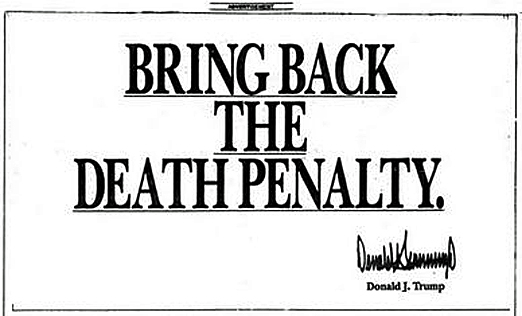
In the 1980s, Donald Trump called for the death penalty to be brought back for the Central Park Five

In 1989 five young black men were wrongfully convicted of raping a woman jogging in New York City. Leading the charge against them was a real estate mogul whose divisive rhetoric can be found in his Presidency today.
Nearly three decades before the sociopathic pseudo-billionaire began his run for Presidency of the United States — before Donald Trump called for a ban on Muslims entering the U.S., for the expulsion of all undocumented migrants, before he branded Mexicans as “rapists” and mocked the disabled — Trump called for the reinstatement of the death penalty in New York following a rape case in which the five teenagers were wrongfully convicted.
The miscarriage of justice is widely remembered as a definitive moment in New York’s fractured race relations.
But Trump’s intervention — he signed full-page newspaper advertisements implicitly calling for the boys to die — has been gradually overlooked. Now those involved in the case of the so-called Central Park Five and its aftermath say Trump’s rhetoric served as an unlikely precursor to a unique brand of divisive populism that powered his rise to political prominence.

Donald Trump ‘was the firestarter’ when he called for the death penalty in the 1989 Central Park jogger case, says Yusef Salaam, one of the wrongfully convicted Central Park Five: “To see that he has not changed his position of being a hateful person … what has become of the country with a person like Donald Trump as President?”

Why is this raising of the case of the Central Park Five relevant now?
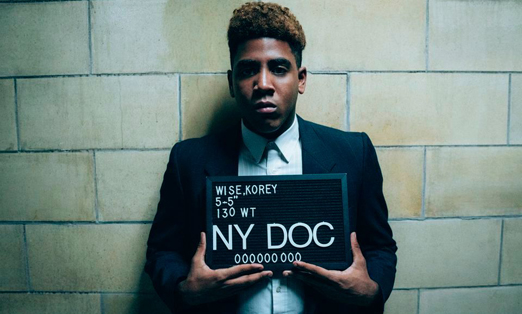
when-they-see-us-line.jpgJharrel Jerome, in Ava Duvernay’s new Netflix mini-series, When They See Us.

Today on Netflix, acclaimed director Ava DuVernay sets about to restore the good names of the five Harlem teens who were arrested, convicted and imprisoned in the 1989 rape of a jogger, only to have those convictions vacated in 2002. They’re more commonly known as the Central Park Five, but that’s a pejorative creator DuVernay excludes almost entirely from her riveting four-episode documentary dramatization, When They See Us.

Here’s a brief survey of critical reviews of Duvernay’s narrative drama …

It is unsettling to realize that many people looking for something new to watch on Netflix this week will actually be unfamiliar with what happened in Central Park, New York, on an April night in 1989. What happened was the rape and attempted murder of a young woman who was jogging there, Trisha Meili. The 28-year-old Meili was doing her usual evening run after a long day at work on Wall Street.

And while there are many unsettling scenes in the first hour of When They See Us (streams today on Netflix), nothing is more disconcerting than the realization, an hour into the drama, that we know very little about Trisha Meili. She is not the focus of the story. The five boys charged with the attack on her are the point. The way in which they were coerced into confessions, threatened and intimidated, is the point.

When They See Us is superbly made and startling in its invective. That invective is aimed with blistering intensity, not just at a justice system that allowed a miscarriage of justice, but at all of American society. The point of the title is that nobody actually saw the boys, who became known as the Central Park Five, as who they were. They saw black youths and wanted to convict them.

Donald Trump took out ads in New York newspapers calling for the restoration of the death penalty so that the boys would be executed. Now, he runs the country. And the state of the country is the real point of When They See Us. As such, it’s a heightened, fraught series, the most unsettling drama so far in 2019, and meant to be.

John Doyle, The Globe and Mail

A searing portrait of injustice and innocence lost
Matthew Gilbert, Boston Globe

Ava Duvernay’s mini-series will break any heart, except, perhaps, that of our president, who maintains their guilt despite the confession and DNA evidence that exonerated them in 2002 and led to a $41 million legal settlement from New York City. Knowing with certainty that the boys are innocent makes watching each step of their descent into hell — from the manipulated false confessions that open the miniseries and the damning group-think media coverage that follows, to the way their young promise is squashed by prison and the stigma that trails them once they’re released — into an unnervingly doom-ridden tragedy.

The Vindication of the Central Park Five
Judy Berman, Time magazine

Nearly an hour into the premiere episode of Ava DuVernay’s Netflix miniseries When They See Us, four of the boys who will soon be known as the Central Park Five are left alone together in a holding cell. (The fifth, Korey Wise, is locked in with adults because he’s all of 16 years old.) They’ve just spent hours being interrogated — and intimidated — by police seeking confessions to support the theory that they gang-raped a woman in the park and left her for dead. In fact, most of them don’t even know each other. There’s a long silence before they start talking. The camera alternates between closeups of these scared, exhausted, beaten-up kids’ faces. They see each other. Hopefully, we see them, too.

As the title suggests, the idea of seeing is crucial to this elegant, wrenching four-part reenactment of the Central Park Five saga. DuVernay, who wrote, directed and (along with collaborators including Oprah and Robert De Niro) executive produced the miniseries, has a gift for framing a familiar historical moment so that you can really see it for the first time. In this case, the Selma director’s simplest but most profound decision is to portray these five black and Latino boys, ages 14 to 16, as the scared children they are, rather than as the gangsters or delinquents they were made out to be.

All four episodes of When They See Us are now available on Netflix.
#VanPoli | Vancouver City Council | Vapid & Not on Your Side

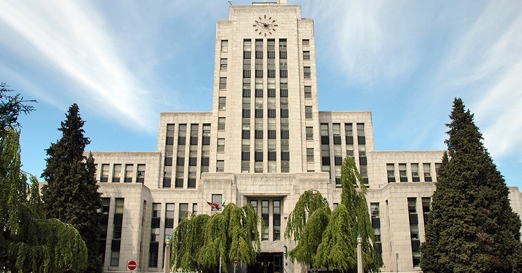
Vancouver City Hall.

Today’s VanRamblings column was originally intended to take our “new” Vancouver City Council to task, a City Council in which we are profoundly disappointed — who have against all reason turned out to be a reactionary amalgam of self-serving, do-nothing municipal politicians who have surrounded themselves with sycophants who praise them for their “good works”, a group of electeds who not only have lost the thread of why it was they were elected (read: build affordable housing!), but rather who have proven these past seven months to be just like the character in the Danish author Hans Christian Andersen’s 1837 tale, The Emperor’s New Clothes, who seem to as the child in the story says appears not to be “wearing anything at all!”
We here at VanRamblings had intended on employing satirical commentary, combined with our tried-and-true hyperbolic approach to recording our thoughts on the screen in front of you for the Thursday post today.
But, alas, we’re simply not up for doing that on this tremendous day!

Vessi footwear | Carbon blue | 100% waterproof | comfyVanRamblings’ new carbon blue Vessi shoes. Comfy. Stylish. 100% waterproof!

For you see, it is a wonderfully sunny day in Vancouver, deserving of a walk along the beach and an opportunity to spend time with friends. Today, VanRamblings — our disappointment in our “new” Vancouver City Council notwithstanding — find ourselves enjoying our new carbon blue Vessi shoes that are comfy and swell-looking and oh-so-stylish, which makes us happy.
So, in consequence, VanRamblings will hold off until next week to spell out exactly why we find ourselves dispirited in respect of Vancouver’s “new” do-nothing, survival of the fittest Darwinian City Council, and instead will set about to enjoy the day, while thinking to our self: why was editor, author, columnist, political activist, father, lover of baseball, and person of principle (always!) Derrick O’Keefe not elected to Council, to hold the current ne’er-do-well group of “oh we love our City staff, they’d never give us advice and provide direction to us that is anything other than true to the interests of the citizenry of our fair city” members of our inept Council to account?
Arts Friday on Friday. Stories of a Life on Saturday. Music Sunday Sunday.
And back to municipal political writing on Monday or Tuesday. See ya then.

Taxpayer vs Citizen | Responding to Right Wing Propaganda

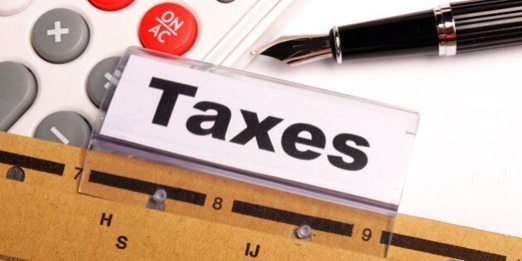
Taxes

The suffering hero of our times is, we are told, the tormented taxpayer.

Conservative politicians mount campaigns to protect the taxpayer, editorial writers evaluate politicians and their policies on whether they will increase or decrease the “burden” to taxpayers, and some self-described taxpayers have formed faux, corporate-funded organizations to plead their cause & lament their plight. Thus, you have the Canadian Taxpayers Federation.

Toni Morrison, American novelist, essayist, editor, teacher and professor emeritus at Princeton University.
Nobel prize winning author Toni Morrison, in her New York apartment. Photo | Tim Knox

At a speaking engagement, a few years back, at a New Yorker festival, Pulitzer Prize winning American novelist, essayist, editor, teacher and professor emeritus at Princeton University, Toni Morrison, offered insightful commentary on topics about race, gender, writing, and other issues. One particular observation made by Ms. Morrison was quite memorable …

The complexity of the so-called individual that’s been praised for decades in America somehow has narrowed itself to the ‘me’. When I was a young girl we were called citizens — American citizens. We were second-class citizens, but that was the word. In the 50s and 60s they started calling us consumers. So we did — consume. Now they don’t use those words any more — it’s the American taxpayer, and those are different attitudes.

The phrase “taxpayer’s money” is almost always propaganda — that must be rejected and resisted by all of us who support progressive politics.A better phrase is “public money”.

So, why do so few in the news media, if any at all in these times of corporate-owned media, refuse to use the term public money, replacing it instead with the far from benign word taxpayer?

Public money is the property of the entire public, not of taxpayers.

Taxes are a way to pool our resources and develop common infrastructure that can have a positive impact on us all. They build our roads and bridges, pay for our police and firefighters, our system of justice, offer support for raising children and contribute to reducing child poverty, provide income security and housing for people who are in need, contribute to foreign aid, and help to ensure our environment is clean and safe. All of these things are much cheaper and effective when we pay for them collectively.

The taxes paid by previous generations benefits us today, and the taxes we pay hopefully act to benefit the generations of tomorrow.

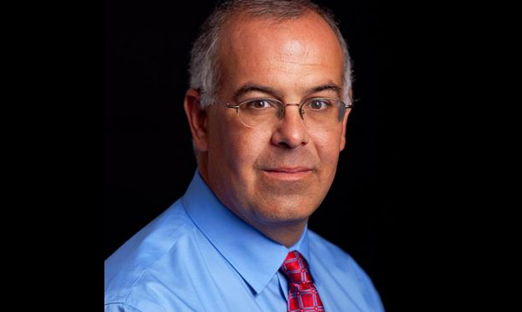
David Brooks, conservative political pundit and commentator, and New York Times columnist
David Brooks. Toronto-born American centre-right, self-described “moderate centrist” political pundit and cultural commentator who writes for The New York Times

In 2016, New York Times columnist and PBS political commentator David Brooks wrote about the difference between taxpayers and citizens …

You can be a taxpayer or you can be a citizen. If you’re a taxpayer your role in the country is defined by your economic and legal status. Your primary identity is individual. You’re perfectly within your rights to do everything you legally can to look after your self-interest.The problem with the taxpayer mentality is that you end up serving your individual interest short term but soiling the nest you need to be happy in over the long term.

A healthy nation isn’t just an atomized mass of individual economic and legal units. A nation is a web of giving and getting. You give to your job, and your employer gives to you. You give to your neighbourhood, and your neighbourhood gives to you. You give to your government, and your government gives to you.

If you orient everything around individual self-interest, you end up ripping the web of giving and receiving. Neighbours can’t trust neighbours. Individuals can’t trust their institutions, and they certainly can’t trust their government. Everything that is not explicitly prohibited is permissible. Everybody winds up suspicious and defensive and competitive. You wind up alone at 3 a.m. miserably tweeting out at your enemies.

And this is exactly the atomized mentality that is corroding North America.

Years ago, David Foster Wallace put it more gently …

“It may sound reactionary, I know. But we can all feel it. We’ve changed the way we think of ourselves as citizens. We don’t think of ourselves as citizens in the old sense of being small parts of something larger and infinitely more important to which we have serious responsibilities. We do still think of ourselves as citizens in the sense of being beneficiaries — we’re actually conscious of our rights as citizens and our nation’s responsibilities to us and ensuring we get our share of the American pie.”

This is where the Canadian Taxpayers Federation comes in, a shady, secretly-funded (who are, in fact, funded by right wing elements within Canada’s corporate culture), unrepresentative organization that sells itself as a populist “citizens advocacy group” looking to cut waste and ensure accountability in government, when such couldn’t be further from the truth.

Income tax

Larry Haiven, a professor in the faculty of management at Saint Mary’s University in Halifax, says most of CTF’s stances on issues — and particularly their relentless calls to lower taxes — are …

“the most simplistic garbage. It assumes that nothing that is purchased with our taxes is of any use for us. Despite CTF’s anti-tax, spending-is-out-of-control rhetoric, taxes are lower now than they’ve been in decades, leaving governments struggling to provide essential services.

Provinces and the federal government have been cutting taxes frenetically, frantically, for the past 25 years. Governments across Canada are taking in about $250 billion less than they did 15 years ago. You have to weigh that against everything the Taxpayers Federation says.”

Yet night in, night out the Canadian Taxpayers Federation is given a platform on the corporate-owned and operated evening news, with folks on Shaw-owned Global TV, anchors like Chris Gailus and Sophie Liu, and Bell Media CTV Vancouver hosts Scott Roberts and Mi-Jung Lee fulfilling their supplicant role as handmaidens to their corporate bosses & not on our side.

The Canadian Taxpayers Federation media presence is truly remarkable when you consider it has a membership of five people.

You read that correctly: five.

money.jpg

Writes Dougald Lamont for CBC News Manitoba

This might come as a surprise, but the Canadian Taxpayers Federation is not now, nor has it ever been, a grassroots, member-based organization where anyone can pay $10 to sign up (or sign up free) and have a say in how the organization is run.

Instead, it has supporters — about 90,000 of them, who, like followers on Facebook, can like, comment, answer surveys and make donations, but they have no actual say in how the organization is run.

While the CTF’s mandate is to hold elected officials to account, who holds the CTF’s five members to account? Each other. Who decides who else can become a member? They do. It should be no surprise that the Canadian Taxpayers Federation has, as a result, faced accusations of being an Astroturf organization — a fake grassroots organization.

Writing in The Tyee, journalist David J. Climenhaga says the following …

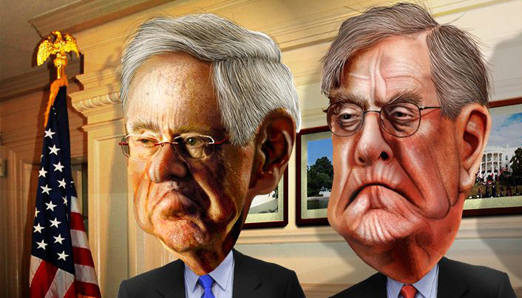
Charles and David Koch, right-wing American billionaires
Right-wing billionaires Charles and David Koch are among the funders of the international Atlas Network, a Canadian Taxpayers Federation partner. Photo credit: DonkeyHotey.

The Canadian Taxpayers Federation,” writes Climenhaga, “a self-described non-partisan tax watchdog and taxpayer advocacy group once headed by Alberta Premier Jason Kenney, has always been tight-lipped about the sources of its own funding and support. This may be mildly ironic, given its vocal demands for transparency in government policy.”

Since the 1980’s and the rise of the Koch brothers in the U.S. and the Canadian Taxpayers Federation in Canada, there has been a deliberate effort to reframe citizens as “taxpayers” and public spending as “taxpayers’ money,” as if taxpayers are shareholders. CBC’s Dougald Lamont writes …

Journalists and politicians in every political party routinely use these terms without considering that this framing is anti-democratic. That is because politicians are elected by citizens, not just taxpayers. The word “taxpayer” is not in the constitution; the word “citizen” is.

All citizens are equal. Taxpayers are not.

It is self-evident that you can contribute to the economy and society without paying taxes. Many citizens don’t pay income taxes, notably children, the working poor and a few millionaires and billionaires. Charities, churches and places of faith are all tax-exempt.

Defining taxpayers as the only people who matter has real and serious consequences for policy. It is not a politically neutral position: it is a radical right-wing ideology that drives inequality by making the rich richer while neglecting the poor.

That is why the Canadian Taxpayers Federation’s real membership of five people matters, as does its ideology. We don’t have to care what they think, but we should be clear on just where they are coming from.

So the next time you hear British Columbia’s new wicked witch of the west, CTF spokesperson Kris Sims, blathering on your TV about how your “taxpayer dollars” are being wasted, remember: Kris Sims and the Canadian Taxpayers Federation could give a damn about you as a citizen of the province of British Columbia, and could care even less about what our provincial government is doing to alleviate child poverty, build urgent care centres to serve the 780,000 British Columbians without a family doctor, build truly affordable housing for seniors and working people across the vast expanse of our province, create affordable $10-a-day child care for working families, while funding our public safety and justice, education, transportation and infrastructure, agriculture and fisheries, climate action and environment, social development and poverty reduction, indigenous relations and reconciliation, and jobs, training, trade and technology ministries of government to better serve your interests, and the interests of your family, your neighbours, your co-workers, and your friends.

And while you’re at it, ignore Kris Sims when you see her next on your TV!

Disinhibition, Coarseness & Social Cantagion In The Age of Trump

Disinhibition, Coarseness, Anti-Semitism and Social Cantagion In The Age of Trump

Two centuries ago, a wave of suicides swept across Europe as if the very act of suicide was somehow infectious.
Shortly before their untimely deaths, many of the suicide victims had come into contact with Johann von Goethe’s tragic tale The Sorrows of Young Werther, in which the hero, Werther, himself commits suicide. In an attempt to stem what was seen as a rising tide of imitative suicides, anxious authorities banned the book in several regions across Europe.
During the two hundred years that have followed the publication and subsequent censorship of Goethe’s novel, social scientific research has largely confirmed the thesis that affect, attitudes, beliefs and behaviour can indeed spread through populations as if they were somehow infectious.
Simple exposure sometimes appears to be a sufficient condition for social transmission to occur. This is social contagion theory; that sociocultural phenomena can spread through and leap between people like outbreaks of measles or chicken pox rather than through a process of rational choice.
The online disinhibition effect is a term used to describe the lowering of psychological restraints, a seeming inability to regulate our behaviors in an online social environment leading to reduced behavioural inhibitions online, and a negating of normative behavioural boundaries while in cyberspace, resulting in destructive interpersonal behaviors while using social media.
Welcome to the Age of Trump, the age of unreason and disinformation, of Russian bots and the spreading of racial hatred, the targeting of minority populations as “the other”, the rise of anti-Semitism, rampant cynicism, misplaced anger, isolation and the breakdown of contemporary society.

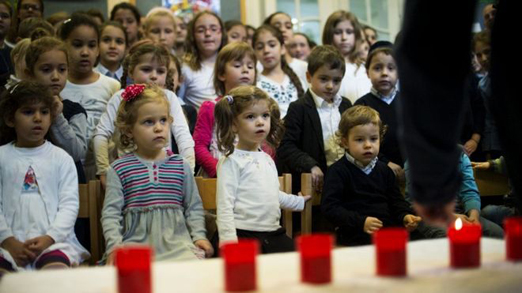
Germany to fight rising anti-SemitismGermany to fight anti-Semitism. Children learn about Holocaust at Berlin Jewish school.

On Saturday, May 25th, Felix Klein, the German government’s anti-Semitism commissioner, told the Funke media group

“I cannot advise Jews to wear the kippah everywhere in Germany. Jews should think twice before wearing the traditional kippah skullcap in public arising from a recent and sustained rise in attacks against Jews.

Anti-Semitism has always existed in Germany, but in this new era of social dysfunction, brought on in some measure by the odious conduct of the U.S. President, anti-Semitism is now showing its ugly face more openly.

There is no question that the rise in social disinhibition and coarseness has played a role in the worsening situation we’re currently experiencing in Europe. The internet and social media have also strongly contributed to this — and also to the continuous attacks on our culture of remembrance.

The word Jew as an insult was not common in my time when I went to school. Now, in the early part of the 21st century, it is and it’s even an insult at schools where there are no Jews, where there are no Jewish students. So that is a growing concern and of course we have to develop strategies to counter that, in Germany and across Europe.”

Toxic disinhibition, an empathy deficit, the absence of restraint — and online, anonymity, invisibility and intermittent, unfledged asynchronous communication are far from benign in their impacts, not only on social discourse, but at the ballot box and in each and every one of our lives, where increasingly otherwise good people live without conscience, informed social awareness, and their role in the social collective we call Canada.

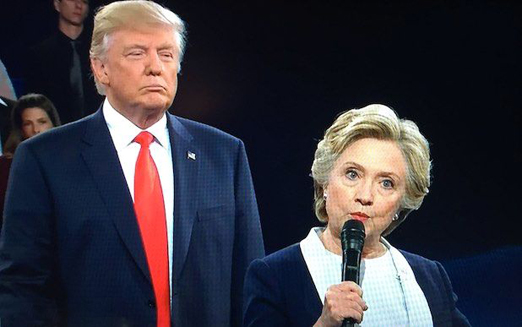
Donald Trump hovering over Hillary Clinton on the debate stage in the 2016 United States election

The 2016 American election was one of the ugliest elections in the history of the United States. Hillary Clinton was continually subject to unwarranted attacks, and daily demonized online. Not a day went by in the lead up to the November 8, 2016 U.S. election when I didn’t find myself outraged at the “sharing” — by a broad range of people on the left with whom I had worked over many years — of Russian bot disinformation, and misogynist commentary about the “war-mongering” U.S. Senator & Secretary of State.
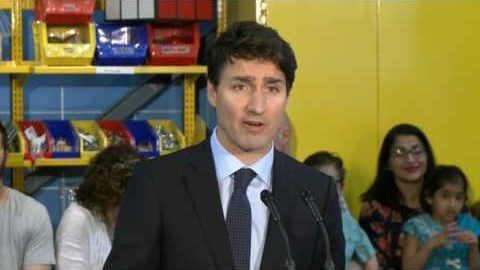
Speaking at a Liberal fundraiser in Toronto last October, Prime Minister Justin Trudeau told those who were gathered at the Danforth Music Hall the upcoming federal election would be the ugliest election in Canadian history.

“We are now looking at perhaps what will be the most divisive and negative and nasty political campaign in Canada’s history,” Trudeau said. “I can tell you, we will do the same thing we did in 2015: No personal attacks, strong differentiation on issues of policy. I will not engage in personal attacks and none of our team will either.

A positive, compelling message that brings people together, that refuses the politics of personal attacks, that refuses the politics of division of scare tactics — whether it’s snitch lines or hijab attacks — that kind of approach that Stephen Harper tried does not work.

Once you’ve gone and divided and angered people in order to get elected it becomes very difficult afterward to pull them together in a way that actually allows us to solve the challenges that we need to solve. To run on division and fear and easy populism makes it harder to do the good things that must be the central purpose of why we run for office.”

Make no mistake, with $65 million in corporate funds already in the kitty for the federal Conservative party to wage their 2019 electoral campaign, with a lesser $41 million available to the Trudeau Liberals, and a paltry $5 million and $3 million, respectively, for Jagmeet Singh’s New Democratic Party of Canada and Elizabeth May’s Green Party of Canada, Andrew Scheer’s far right-of-centre social Conservative party is ready to wage that nasty, ugly campaign Justin Trudeau has talked about to crowds across Canada who have gathered to hear our Prime Minister.

Fight to Defeat Coarseness, Social Contagion, Disinhibition & Isolation
As Canadians, we can do our part by keeping our online discourse respectful, sticking to the facts, not sharing or retweeting the disinformation that will surely be provided by the Russian bots invading our social media, by joining the Greens, the New Democrats or the federal Liberal party, to donate time and money, to work on the campaigns of the socially progressive candidates we support, to staff the candidates’ offices, to go door knocking, gather with others in burmashaves in neighbourhoods, across our city and in Metro Vancouver — and make a difference, fight for inclusion & have a positive impact on the outcome of the election, in order that diversity, climate action, transit, infrastructure, affordable housing, continued subsidy funding of housing co-ops, preservation of our coasts, and preservation of the Canada Child Benefit introduced by the Trudeau government in 2016 that has served to reduce child poverty in Canada by 40%, or 300,000 children, since its introduction only three short years ago, will remain atop the political agenda in Canadian federal governance.