In two days, the eight-seven new, and in most cases returning, members of the British Columbia legislature will be sworn into office for the next term.
The newly-elected British Columbia New Democratic Party caucus is comprised of a record 29 distaff members, which means that more than half of the NDP’s 57 member caucus are women — good on the BC NDP, and a hearty congratulations to all new female members of the NDP caucus.
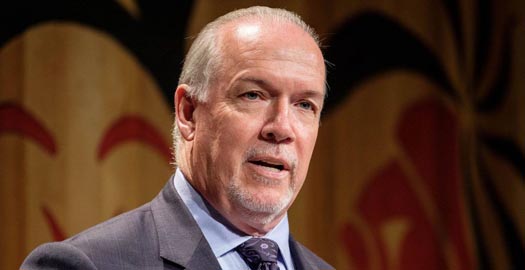
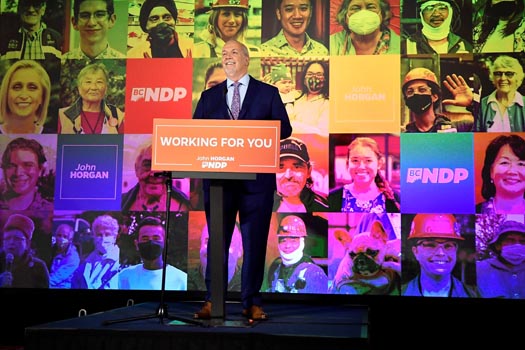
John Horgan has made various announcements leading up to Wednesday …
Cabinet, part 1. The new Cabinet, as was the case with the NDP’s most recent Cabinet, will be comprised of 50% women and 50% men — for which we have Prime Minister Justin Trudeau and his trusted advisors, Gerald Butts and his continuing Chief of Staff, Katie Telford to thank.
Cabinet, part 2. The new BC NDP Cabinet will be sworn in on Thursday. Here’s what we know for sure as of this writing. Contrary to VanRamblings speculation last month that David Eby would become the new Minister of Housing — well, that’s off the table, given that Premier Horgan let it slip that Selina Robinson will maintain her dual role as Minister of Municipal Affairs and Minister Responsible for Housing. Now, we know for sure that David Eby will not continue as Attorney General and Minister of Justice, given that Mr. Horgan let it slip that newly-elected NDP MLA for Oak Bay-Gordon Head would take on that role. Where does that leave the NDP caucus’ beloved David Eby? We’ll know on Thursday.
Meanwhile, though, this morning, the hapless B.C. Liberal party will be leaderless, given that Andrew Wilkinson stepped down from that role over the weekend. Update: Shirley Bond was selected as the Interim leader of the B.C. Liberals in a vote of the 28 Liberal caucus, early afternoon Monday.
Let’s use successful example of 2015 Tories post-Harper, who successfully appointed #RonaAmbrose as interim leader.
1. Leader must be a woman 2. Must command respect of the caucus 3. Clear experience in Legislature 4. Likable, media savvy & resilient
As for the Greens, the party didn’t achieve their much-desired first seat on the Lower Mainland, with the Green candidate for West Vancouver Sea-to-Sky going down to defeat to incumbent B.C. Liberal, Jordan Sturdy, in a close race, confirmed in a recount. Still, there’s good news for B.C. Green Party leader Sonia Furstenau, and her Green Party colleague, Adam Olsen — John Horgan has agreed to afford the Green Party official party status in the B.C. Legislature, which means millions of dollars in funding to the party.
How Elections Are Won | Some Reasons for NDP Success
Nominated candidates in all 87 electoral districts.
Created more than 2,000 online ads (in 9 languages).
Earned more than 47,000,000 views on their digital ads.
Sent more than 300,000 text messages to British Columbians.
Trained 750 volunteers to call people all over B.C. and got out the vote during 2,479 volunteer-driven shifts!
Distributed more than 10,000 lawn signs.
Printed more than 150,000 leaflets.
Ran 5 television ads non-stop for a month.
A great deal of work goes into mounting a successful political campaign.
Now onto the stuff you really care about: the $1,000 for couples, and the $500 for individuals that Mr. Horgan had promised during the recent election campaign. Good news? The money is on its way. When the Legislature is called back into session on December 7th, the first order of business will be to enable the government to shovel that money out the door. In the spring, the BC NDP government gave most British Columbians $180 in a non-taxable Climate Action grant to households with a combined of under $125,000, money that was either deposited directly into your bank account, or mailed to you. The expectation is that monies will be deposited into your bank account on Christmas Eve (and, no, we’re not kidding), or will arrive by January 5th by snail mail — happy, happy days!
Today on VanRamblings four easy to access, and readily available podcasts I listen to regularly and religiously, two weekly and two daily, must-not-miss podcasts that offer a thought-provoking reflection on the times in which we live, produced and hosted by welcoming and informed voices.
Something to listen to while driving in your car, or while you’re on the bus, doing a wash or ironing, tidying up, or when you’re out for a walk or run.
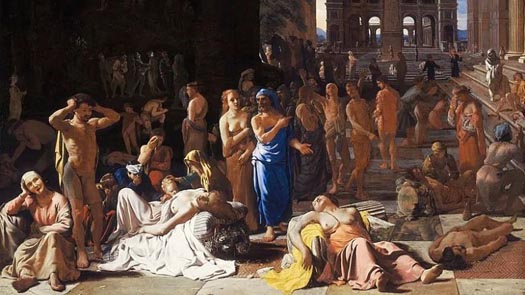
Easy to listen to, even if the subject matter is sometimes emotionally challenging — the content of the 4 podcasts below are always intellectually challenging, tho, which serves to keep your mind active, and you engaged. CBC Ideas | ‘Civilization is a very thin veneer’: What the plague of Athens can teach us about dealing with COVID-19
The painting by artist Michael Sweerts, circa 1652, represents the plague of Athens. The plague struck Athens in 430 BC, killing by some estimates up to half its population. Thucydides was on hand to document the grim events and aftermath.
Back in 430 BC, a plague gripped Athens, killing by some estimates up to half the Greek city’s population. The chronicler Thucydides meticulously recorded the physical symptoms of the gruesome disease in a few pages of his tome about the Peloponnesian War fought in ancient Greece between Athens and Sparta. His vivid account holds enduring lessons for those of us living through the coronavirus pandemic today. More, in the podcast below.
NY Times’ The Daily | When the Pandemic Came to Rural Wisconsin
As the coronavirus spread unchecked throughout the mid-western state of Wisconsin, and most particularly in the rural areas of the state, Patty Schachtner, a nurse and until recently an elected state official, tried her best to remain several steps ahead of the spread of COVID-19, preparing for the worst — an approach which was met with resistance from many of those who live in the conservative community where her family resides.
Now the worst-case scenario has arrived — cases and deaths are on the rise across the state, and most particularly in the state’s rural areas. Over the course of the pandemic, Patty spoke with The New York Times, who charted her journey over the months since March, and what happened when the pandemic reached her family.
Political Gabfest | Making Sense of What’s Going on in the U.S. Slate’s Political Gabfest, where sharp political analysis meets informal and irreverent discussion. Co-hosted by David Plotz, CEO of City Cast, Emily Bazelon, a staff writer at the New York Times Magazine, and author of Charged and Sticks and Stones, and John Dickerson, a 60 Minutes correspondent, host of the Whistlestop podcast, and author of On Her Trail. Plus, there’s a special treat at the end of this week’s podcast, a must-hear interview with journalist & author, the incomparable Ta-Nehisi Paul Coates.
IndieWire’s Screen Talk | The State of the Pandemic Oscar Race
To end on a lighter note …
For months, it has been clear that Oscar season would take an unusual shape. While most of the big contenders are qualifying before the end of the year, the season will continue through the first two months of 2021 — which means there’s a ways to go before films or performances solidify as true frontrunners. In the meantime, the international and documentary contenders are starting to take shape, and in some cases, overlap.
In Episode 310 of IndieWire’s Screen Talk, chief film critic Eric Kohn and film writing’s eminence gris, Anne Thompson weigh in on Oscar season.
In 65 days from today, the monstrous narcissist that is Donald Trump will no longer be President of the United States, a position he never should have ascended to in the first place, and despite the 73 million wrong-headed, Mussolini-lovin’, cult-like votes he managed to secure earlier this month from the American electorate, Donald Trump remains a blight on the social and political landscape of the U.S., and everywhere across the globe.
No one, ten years from now, will ever admit to having voted for this sociopathic, hate-filled traitor — any support for him will have long been repudiated by the vast majority of Republicans, and the U.S. electorate.
In the meantime, Donald Trump refuses to concede, to conduct himself as a responsible citizen, and to co-operate with an orderly transition of power — thereby causing the United States, and all of us, to find ourselves in a precarious state of a lack of security to fight those who would do us harm. No surprise there, of course — it’s just par for the course for Donald Trump, apt phraseology given Trump’s love for spending time on the golf course.
For months before the election, political analysts and worried members of the public wondered what would happen if Donald Trump refused to concede after losing to Joe Biden. With Trump’s fetish for autocratic power, inability to accept negative consequences, and lack of apparent tether to democratic norms, the prospect of his outright ignoring an election defeat seemed all but certain. No one who’s been watching Trump in horror for the past four years should be surprised by his unhinged obfuscatory tactics.
While it’s true that no modern U.S. presidential candidate has refused to concede, and while American history’s most contentious presidential races have also ended in admissions of defeat, if not an expressed concession outright, and there are no legal consequences should Trump continue to refuse to concede, the transition team President-elect Joseph R. Biden has put in place has already addressed the matter of concession, issuing a statement that reads, in part, “the U.S. government is perfectly capable of escorting trespassers out of the White House, if such becomes necessary.”
John R. Vile, dean of political science at Middle Tennessee State University, who has written about the history of concession speeches, argues that it matters for presidential candidates to concede even if it doesn’t have legal consequences, because words matter.
“Adherence to established electoral norms has helped shore up U.S. democracy even in the midst of its most chaotic and divisive elections,” Vile has written. “When it comes down to it, it’s not the Army or the Navy that keeps the United States together. It’s the notion that we are bound together by certain great principles and that our similarities are more binding than our differences are.”
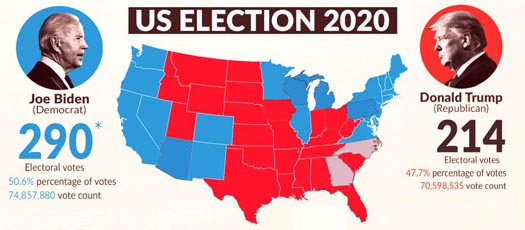
On Monday, December 14th, the U.S. College of Electors will meet to acknowledge that having won 306 electoral college votes, Joseph R. Biden will become the 46th President of the United States, a fact that will be further amplified by a meeting of the U.S. Congress on Wednesday, January 6th, creating the conditions for the Inauguration of President-elect Joseph R. Biden and Vice President-elect Kamala Harris to be sworn into office, and officially become the President and Vice President of the United States.
In an article in Politico, David A. Bell, a professor of history at Princeton University and author, most recently, of Men on Horseback: The Power of Charisma in the Age of Revolution argues that whether or not Trump concedes, come January 20, he will be looking for a new job.
“Trump is undoubtedly tempted to remain as much as possible in the public eye, rage-tweeting against the Biden administration,” Bell writes, “and possibly starting up a new cable TV network. But he also has to worry about criminal investigations, and about defaulting on his considerable debt now that he can no longer use the presidency to drive business to his hotels and resort properties.”
Which is to say, Trump’s post-presidency will hardly be a bed of roses.
VanRamblings would argue that unless, as has been rumoured, tough guy New York Governor Andrew Cuomo becomes the next U.S. Attorney General and orders the prosecutors in the southern district of New York state to cease all investigatory work pertaining to Trump, the 24 credible cases of sexual assault that have been lodged against Trump will move forward through the courts, in all probability leading to a conviction on most, if not all, of the allegations — leaving Donald Trump to experience a penury not dissimilar to that of Harvey Weinstein, and a multiple year prison sentence.
And that’s not all. Trump faces incoming fire from three different directions in his native New York, his odds of escaping unscathed long indeed. New York Attorney General Letitia James has filed motions revealing that her office too is on Trump’s trail, arising from a long-standing civil investigation into whether the Trump Organization improperly inflated its assets to get loans and obtain tax benefits, a practice that former Trump attorney Michael Cohen told Congress was routine. The release of Trump’s eight years of unreleased tax records could very well trigger action by Manhattan District Attorney Cyrus Vance Jr. to file criminal charges.
If Trump were to issue himself a pardon, or resign his office in January and have a lame duck Mike Pence as president for 10 days issue a pardon of Trump, such a pardon would preempt federal prosecution, but it would not stand in the way of state-initiated action by James and Vance in New York.
Slate Political Gabest co-hosts David Plotz, Emily Bazelon & John Dickerson weigh in on Trump’s failure to concede, transition planning by the incoming Biden administration, and the upcoming U.S. Supreme Court decision on the Affordable Care Act aka Obamacare.
Trump has proved himself a prolific escape artist during his presidency, using delay, subterfuge and political muscle to push back against any number of potentially mortal lies, gaffes and legal threats. But his very success in doing so has inspired many powerful actors in the legal profession to want to hold him, finally, to account after he leaves office.
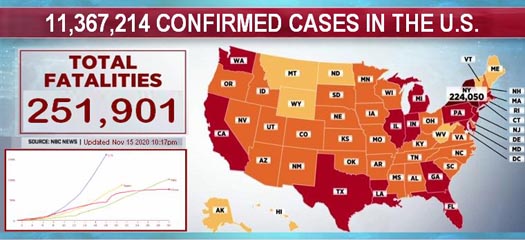
As VanRamblings writes this, more than 251 million Americans have lost their lives to COVID-19. As is the case in Canada, many American children have lost months of school. Soon, a huge part of America will lose any semblance of Thanksgiving, the most important of American holidays.
Because of the Trump administration’s barbaric family separation policy, 545 children may be lost to their parents forever. America has lost its status as a leading democracy. More people have lost their jobs under Trump than under any president since World War II.
A perpetual state of emergency proved so unhealthy for many Americans, and so unsustainable that a record 78,764,266 Democratic voters made it to the polls, even amidst a pandemic, to reclaim their country and end the tenure of the panic-inducing Trump administration that blocked out the sun and all but eradicated hope in a United States that became near unrecognizable to many citizens of conscience living across our Earth.
But soon, a new day will dawn. Only when Donald Trump has gone will all of us come to see how much we’ve been missing these past four years. Bill Maher | Farewell to the Douchebags in the Trump Administration
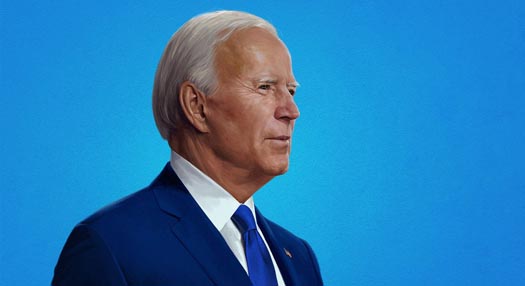
Joseph Robinette Biden Jr. | 2020 | President-elect | United States of America
Final vote count still to come, from Arizona and Georgia, that will take Joe Biden to 306.
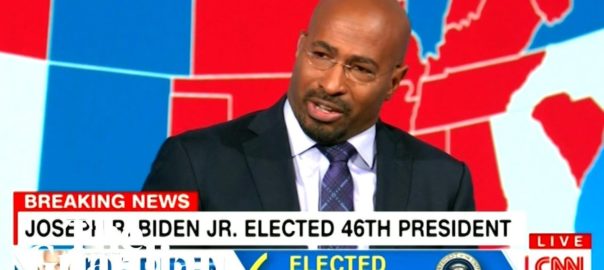
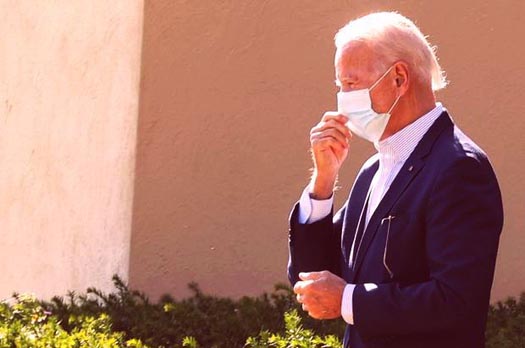
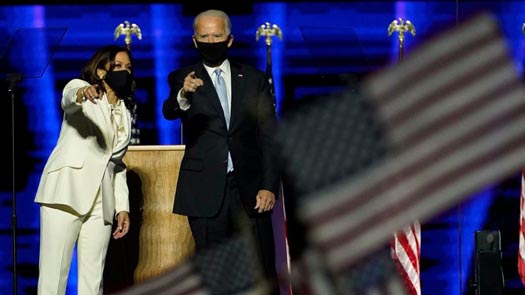
On Saturday afternoon, November 7th, 2020, Joseph R. Biden — a former two-term vice president under Barack Obama, and 36-year veteran of the U.S. Senate — became the 46th president of the United States. His running mate, California Sen. Kamala Harris, will become the first woman, first African American, and first Indian American to serve as vice president.
The transition process — already planned for months, and underway in earnest today — is too important to be left to Trump’s whims. Fortunately, this isn’t the President-elect’s first rodeo. Having been an essential part of the incoming Obama administration team that collaborated with George W. Bush’s administration in 2008, Biden knows how a presidential transition is supposed to work. Unfortunately, the U.S. has never had a departing president like Donald J. Trump, who has yet to accept reality, and concede.
Nonetheless, President-elect Joe Biden signalled on Sunday he plans to move quickly to build out his government, focusing first on the raging pandemic that will likely dominate the early days of his administration, naming former surgeon general, Dr. Vivek Murthy and former Food and Drug Administration commissioner, David Kessler, as co-chairs of a coronavirus working group set to get started; the remaining members of the Transition COVID-19 Advisory Board may be found here.
“People want the country to move forward,” said Kate Bedingfield, Biden deputy campaign manager, in an interview on NBC’s Meet the Press, “and see President-elect Biden & Vice-President-elect Kamala Harris be provided the opportunity to do the work necessary to get the virus under control, and build our economy back to protect the interests of all Americans.”
Joe Biden’s victory has come as a massive relief to many Americans, after four maddening years of a high-octane, anxiety-ridden Trump White House.
For Biden and Harris, their victory marks the end of an unusually low-key, pandemic campaign — but the beginning of a daunting challenge. Biden, who enters the White House as both the chief executive with the most experience in public service in U.S. history and the oldest man to assume the presidency, will take on his duties amid an historic crisis, a pandemic that has already claimed more American lives than World War I, the Korean War, and Vietnam War combined, producing the highest U.S. jobless rates since the brutal, agonizing years of the Great Depression of the 1930s.
VanRamblings will continue to provide coverage of the Biden-Harris transition — and events as they unfold, through the transition period — up until Inauguration Day, on Wednesday, January 20th, 2021.
In this first of many wrap-up columns on the 2020 U.S. election, we’ll leave you with the following peripheral coverage of the Biden-Harris win, and information on the successful and unsuccessful ballot initiatives — but will begin first with coverage of Congress and Senate.
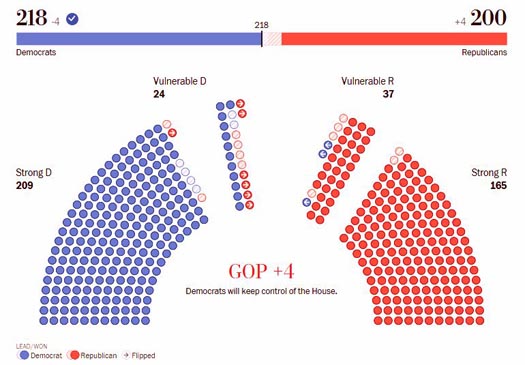
The Democratic Party lost seats in The House on election night, creating tension in the party between centrist Democrats representing conservative districts, and the more progressive congressional representatives from inner city urban districts.
Although Democrats will maintain the majority they won in the blue wave congressional election of 2018 — widely considered to be a repudiation of the policies and the egregious, uncivilized conduct of Donald Trump — the Democrats lost Congressional seats in last week’s U.S. election, as Republican candidates defeated incumbents in conservative-leaning districts in South Carolina, Iowa and New Mexico. Longtime Republicans also held on in Missouri, Michigan and Ohio. The results will mean that House Speaker Nancy Pelosi (D-Calif.) will have the smallest majority in 18 years.
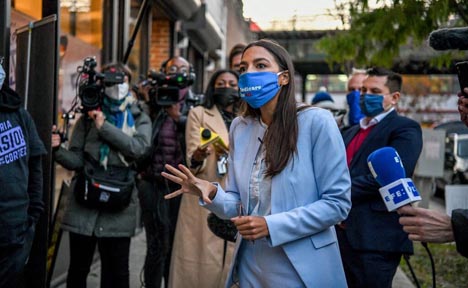
As more centrist members of Congress lashed out at progressive members of Congress, in a post-election interview with the New York Times, Rep. Alexandria Ocasio-Cortez indicated she might quit politics, depending on the hostility of the Democratic Party towards progressive causes.
“I don’t even know if I want to be in politics,” Ocasio-Cortez told The Times. She said the Democratic party has been hostile to progressive causes, like Medicare for All and the Movement for Black Lives.
“I don’t even know if I want to be in politics. You know, for real, in the first six months of my term, I didn’t even know if I was going to run for re-election this year.”
“It’s the incoming. It’s the stress. It’s the violence. It’s the lack of support from your own party. It’s your own party thinking you’re the enemy. When your own colleagues talk anonymously in the press and then turn around and say you’re bad because you actually append your name to your opinion.”
“I chose to run for re-election because I felt like I had to prove that this is real. That this movement was real. That I wasn’t a fluke. That people really want guaranteed health care and that people really want the Democratic Party to fight for them.”
“But I’m serious when I tell people the odds of me running for higher office and the odds of me just going off trying to start a homestead somewhere — they’re probably the same.”
The interview occurred Saturday, shortly after major news networks called the election for President-elect Joe Biden, and after some Democrats blamed progressive messaging for party losses down-ticket.
John Briggs of Black Hawk, Colo., drops off his presidential ballot, and his negative response to a Colorado ballot initiative, as he rejected a 22-week abortion ban.
In U.S. politics, the process of initiatives and referendums allow citizens of many U.S. states to place new legislation on a popular ballot, or to place legislation that has recently been passed by a legislature on a ballot for a popular vote, a signature reform of the Progressive Era.
New York Times’ indispensable The Daily, on how Americans are absorbing the election
Initiatives and referendums, along with recall elections and popular primary elections, are signature reforms of the Progressive Era; they are written into several state constitutions, particularly in the West.
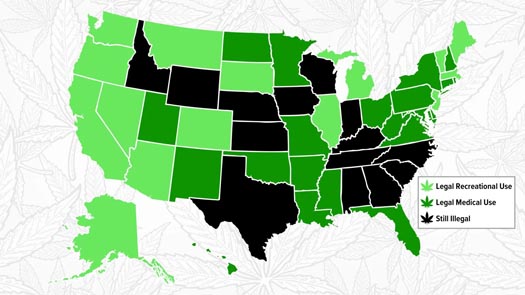
Arising from successful ballot initiatives, marijuana is legal in 36 states across the U.S.
Even as Americans grow more divided politically, marjuana continues to gain ground with every election cycle — 5 states legalized weed in 2020, for recreational use, including Arizona, Mississippi, Montana, New Jersey and South Dakota. The number of states where recreational use is now permitted:15; cannabis (as opposed to THC-free CBD) is still wholly illegal in 14 states. Every other state falls somewhere in-between.
In Florida, a state that voted for Donald Trump 51.2% to Joe Biden’s 47.8%, in a surprising — although, perhaps, not so surprising — development, Floridians approved a ballot initiative to raise the minimum wage to $15. The current minimum wage in Florida is $8.56. The minimum wage in Florida will be raised to $15 an hour over the next six years.
In California, the state’s citizens voted on 12 expensive and important ballot propositions …
Proposition 17, which will give people who are on parole for felony convictions the right to vote, passed, and Proposition 20, which would have increased penalties for some kinds of misdemeanors, failed;
Although homelessness and housing instability were dominant issues facing the state even before the pandemic made them worse, voters soundly rejected Proposition 21, which would have expanded cities’ ability to implement rent control.
Initiatives supported by Governor Gavin Newsom and the state’s Democratic Party, Proposition 19 would give Californians 55 or older a big property tax break when buying a new home. To fund that new tax break, it would curtail a separate tax break Californians may receive on homes inherited from parents and grandparents; and Proposition 15, the complicated, seemingly mundane, but ultimately very consequential measure on Californians’ ballots, if it passes would be one of the biggest tax increases in state history, so that alone is a big deal.
Otherwise, Colorado voters struck down Proposition 115, a measure that sought to ban abortions after 22 weeks of pregnancy. About 60% of state residents voted against the measure. Meanwhile, in a regressive move, more than 62% of Louisiana voters supported an amendment to the state constitution that would limit abortion protections.
Voters in California sided with companies such as Uber and Lyft to prevent the state from enacting a local labour law that would have forced companies to provide basic benefits — such as health insurance, minimum wage, overtime and reimbursement for expenses — to independent contractors. Fifty-eight percent of voters approved Proposition 22.
Voters in Mississippi approved the design of a new state flag, which will include an image of a magnolia, the state flower, and the phrase “In God We Trust.” The previous state flag featured the Confederate Battle Cross. It was retired in June as protests against racial injustice were held nationwide. A majority of voters opted to keep the flag in 2001.
VanRamblings will be back later in the week with more on the U.S. election: Donald Trump’s refusal to concede; that Democrat battle to win the two Georgia Senate seats now up for grabs; and answers (or not) on whether Melania is leaving the Orange One, how long it may be before Drumpf is behind bars; whether the Trumpster will resign his office in December, with a newly-installed Prez Pence pardoning ‘The Beast’ for all past wrongdoings (‘cept, that won’t protect him from New York state prosecutors); and which country will offer Trump asylum when the judicial hammer comes down.
Don’t you just love politics? No? See you back here later this week.
First, though, we’ll leave you with a story, and the accompanying video:
Last month, Academy award-winner and everyone’s best friend, Jennifer Lawrence — now a proud Democrat — revealed Trump made her reconsider political views, admitting she was formerly “a little Republican” and voted for John McCain in her first election. “I grew up Republican. My first time voting, I voted for John McCain. I was a little Republican,” she said during an appearance on Dear Media’s Absolutely Not podcast. But soon, she “changed her politics” after Donald Trump was elected president.
“This is an impeached president who’s broken many laws and has refused to condemn white supremacy, and it feels like there has been a line drawn in the sand. I don’t think it’s right,” she said. “It just changes things for me. I don’t want to support a president who supports white supremacists.”
Following the Democratic convention in August, Lawrence publicly endorsed Joe Biden and Kamala Harris, explaining her reasoning thusly …
“I’m voting for Joe Biden and Kamala Harris this year because Donald Trump has and will continue to put himself before the safety and well-being of America. He does not represent my values as an American, and most importantly as a human being.”
Here’s Ms. Lawrence outside her home, running through the streets in her pyjamas, screaming and dancing around, celebrating the Biden-Harris win.