Category Archives: Politics

Decision 2021 | Day 1 | Canadian Federal Election | Sept. 20th

The Curse of Politics podcast will cover the 2021 Canadian federal election dailyDavid Herle, Scott Reid & Jenni Byrne will provide daily coverage of Decision 2021

As of this morning, Sunday, August 15th, following on the visit of Prime Minister Justin Trudeau to the residence of the recently-installed Governor General, Mary Simon, to request that she dissolve Parliament — a request to which she acceded — Canadians now find themselves in the chaotic midst of the 44th Canadian federal election since Confederation, in 1867.
Thirty-six days from now, Canadians will elect a new government — whether that is a status quo Liberal minority government or a majority Liberal government, as Mr. Trudeau might wish (quite simply, there are no reasonable and foreseeable other options on the table) we’ll know come the evening of Monday, September 20th, E-Day in every region across Canada — or within 10 days afterwards, as election returning officers conduct a hand count, post E-Day, of the more than five million ballots that are expected to be cast by mail during the latter two weeks of the writ period.
We oughta know whether it’ll be a minority or majority Liberal government Canadians have elected somewhere around Friday, October 1st.
VanRamblings will provide our usual in-depth daily coverage of the federal election each week, Monday through Thursday, over the course of the 36-day election period, providing insight, publishing polls, exploring the issues raised by each of the parties, and in the final days of the election period postulating as to the specific probable outcome of the federal election.
For the 4% of you out there who give a good goddamn about Canadian federal politics — which, in some measure, brings you to VanRamblings today — there is no more important activity to which you might turn your attention than the current federal election, which will serve to determine what kind of country we will become over the course of the next four years, and what values will be reflected in the legislation brought before government by the governing party. Make no mistake: your vote counts!
As always, elections are a crapshoot: in the early going, you just can’t predict the outcome.
In 2015, Justin Trudeau and his federal Liberal party began the election with only 23% support among Canadians, while Tom Mulcair and the NDP were rock steady at 35% popularity in the polls, in all regions of Canada, with Prime Minister Stephen Harper following closely behind with 31% support in each of the 10 provinces and three Canadian territories.
Following an unprecedented 78-day election period, on Monday, October 19, 2015 Canadians elected a majority Liberal government to Parliament, and a new Prime Minister. At election outset, no one could possibly have imagined that outcome, so entrenched was the Harper government, and so popular was the New Democratic Party under the leadership of Mr. Mulcair.

star.jpg star.jpg star.jpg

At the top of the page of today’s post, you’ll see a graphic of the relatively new Curse of Politics podcast, created to provide daily, informed coverage of the 2021 Canadian federal election.
David Herle is a Canadian political consultant and Principal Partner at leading polling and research firm, The Gandalf Group, and a regular CBC political commentator. Scott Reid is a political analyst and commentator currently working for CTV News, and a columnist and contributor to the Ottawa Citizen, CBC.ca and Macleans, among other publications.
As is the case with his colleague David Herle, Mr. Reid has acted as a political advisor to a number of Canadian politicians, having served as Advisor and Director of Communications in the Prime Minister’s Office of Canadian Prime Minister Paul Martin. Along with Macleans columnist Scott Feschuk, Reid owns and operates Feschuk.Reid, a strategic communications and speechwriting consultancy.
Jenni Byrne is a political advisor, political commentator, and government relations expert. A member of the Conservative Party of Canada and the Progressive Conservative Party of Ontario, she is a former senior advisor to Prime Minister Stephen Harper and former Principal Secretary to Doug Ford. Once referred to as “the most powerful woman in Ottawa,” she currently operates her own consulting firm, Jenni Byrne + Associates.
Messrs. Herle and Reid and Ms. Byrne will cover the 44th Canadian federal election with greater, and more informed insight than you’ll find anywhere else in the media during the election period. Each of them has been inside the rooms where decisions have been taken by government, over the course of the past 40 years in the case of Messrs. Herle and Reid, and more than a quarter century, in the case of Jenni Byrne. As the three opined recently, “You know that you haven’t made it in politics as a senior political advisor until the Prime Minister has told you to fuck off,” a signal event which each of the three hold proudly & closely to their bosoms to this day.

The Curse of Politics podcast will be available on (just click on the links) …

VanRamblings looks forward to seeing you back here tomorrow. In the meantime, enjoy the début episode of the Curse of Politics podcast, above.
Update. Here’s the kick off to the election Curse of Politics podcast …

David Herle, Scott Reid and Jenni Byrne weigh in on the kick-off to the 44th Canadian federal election, in a podcast published mid-afternoon on Sunday, August 15th.


40th annual Vancouver International Film FestivalThe 40th annual Vancouver International Film Festival will run from Friday, October 1st thru Thanksgiving Monday, October 11th, screening 100 features & 100 shorts this year.

After a seven and a half month break, today’s VanRamblings column — our first in 2021 — marks the beginning of 516 consecutive days of publishing.
Over the coming months, we’ll cover the current federal election, followed by coverage of the 40th annual Vancouver International Film Festival, and begin coverage of the 2022 Vancouver municipal election. Of course, each Monday through Thursday, we’ll cover much much more of a political nature, as you will come to see in the days, weeks and months ahead.
As per usual on VanRamblings, Fridays will be given over to arts coverage (mostly, but not just, film) on Arts Friday, Saturdays to our must-read and indispensable Stories of a Life feature, and Sundays to the Music we love.
Hope to see you back here often. We promise you, it’s gonna be a ride!

#BC Poli | BC Recovery Benefit Application Day | How to Apply

BC Recovery Benefit eligibility, the application process

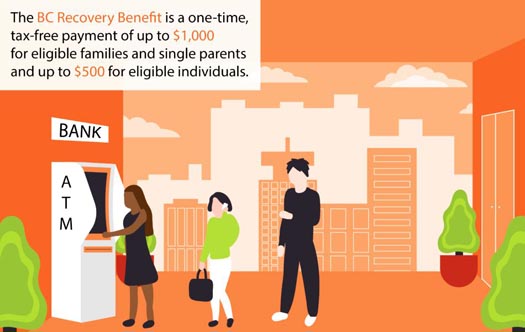
The application for the BC Recovery Benefit that will be made available as a one-time direct deposit payment for eligible families, single parents or individuals opens today. You’ll want to take advantage of this benefit.
The key aspect to be aware of: You must apply to receive the benefit.
Now, the John Horgan could very easily have foregone what will turn out for many to be an arduous application process, if they’re even aware there is a benefit for which they are eligible, and could have held off payment until January 5th, 2021, when they very easily might have included the $500 for eligible individuals, and the $1000 for couples and single parents — as they did in April, when they combined the then Climate Action Credit of $330 — with the issuance of GST cheques to households across the province.
No fuss, no muss, no application process — just a tidy sum of money deposited in every eligible adult’s bank account on the first Tuesday of 2021 — not a bad way to start the new year, don’t you think?

BC Recovery Benefit eligibility, the application process

But in a blunder of immense proportion, not to mention a disingenuous way to commence Mr. Horgan’s first real mandate, our B.C. New Democratic Party provincial government has decided that not only will eligible British Columbians have to jump through the hoops of an online application process, eligibility for the BC Recovery Benefit is dependent on what you earned in the 2019 calendar year — before COVID-19 was on anyone’s radar, before businesses shut down due to the pandemic, causing the loss of hundreds of thousands of jobs across our province — disallowing the full $500 recovery benefit to individuals who in 2019 earned more than $62,500 (with a sliding scale up to a cutoff of $87,500), with households with lower than a $125,000 combined income eligible for the full $1000 recovery benefit, decreasing that amount up to a cutoff point of $175,000.
If you lost you job or your business in 2020, and your income has plunged into the abyss in this very troubling year, you’ll be out of luck when it comes applying for the BC Recovery Benefit.

BC Recovery Benefit eligibility, the application process, covid-19, be grateful

What is that you’re saying? “Don’t look a gift horse in the mouth?”
For those who are unfamiliar with VanRamblings’ modus operandi, well … even with Hanukkah ending yesterday, we nonetheless just love to kvetch.
Okay, enough of this foofaraw, let’s get on with acquiring tax free moolah.

BC Recovery Benefit eligibility, the application process

First off, you going to have to click on this link to be taken to the British Columbia government’s BC Recovery Benefit application website.
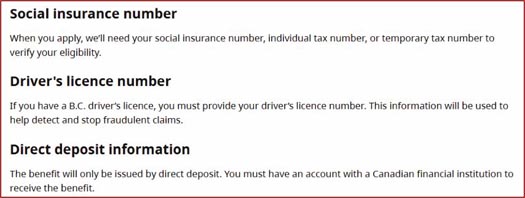
Next, you’re going to have to get all your ducks in a row, and make sure you have the following information and documentation available in order to complete the application process …

BC Recovery Benefit eligibility, the application process

Note should be made: persons who are in receipt of the provincial Persons with Disabilities benefits are eligible to apply. The benefit will not be clawed back from existing benefits, as the recovery benefit is non-taxable.

BC Recovery Benefit eligibility, the application process, COVID-19

On Tuesday, December 8th, the BC government introduced legislation to secure funding for the BC Recovery Benefit, projected to help around 3.7 million British Columbians.

BC Recovery Benefit eligibility, the application process, covid-19, students can apply

Charlotte Aiden, a writer for The Ubyssey has written this story on student eligibility for the BC Recovery Benefit.

Students who are at least 19 years old and reside in British Columbia on December 18, filed a valid 2019 Canadian personal income tax return and have a social insurance, individual tax or temporary tax number are eligible to apply.

Unlike the Canada Emergency Student Benefit, international students are included in this benefit, given they meet the eligibility requirements.

You’ll need four things to apply on the government website: your net income from your 2019 tax return; your social insurance, individual tax or temporary tax number; your driver’s licence number if you have a BC driver’s licence (but this isn’t necessary); and your direct deposit information.

Unlike past benefits, this benefit will only be issued through direct deposit, so those who apply must have an account with a Canadian financial institution.

BC Recovery Benefit eligibility, the application process, COVID-19, telephone support

Toll free telephone support is available by phone starting Monday, December 21st, 2020.

  • Call 1-833-882-0020 (within North America);

  • Monday to Friday, 7:30 am to 5:00 pm, excluding statutory holidays;
  • You have until June 30, 2021 to apply.

The COVID-19 BC Recovery Benefit will cost as much as $1.7 billion, up from an estimate of $1.4 billion announced during the election.

#COVID19 | As The Pandemic Wends Its Glorious Way to A Close

COVID-19 vaccines are on their way, hopefully bringing to an end our current pandemic

Hope for an expeditious end to our current pandemic circumstance appears to be relatively close, with vaccines from at least four — and more probably, six — companies appear well on their way to receiving approval in the next short while, with the two-injection Pfizer vaccine appearing set for approval by Health Canada as early as this Thursday, December 10th, with Moderna, AstraZenica and Johnson & Johnson not far behind in the pipeline. Update: Health Canada approved the Pfizer/BioNTech on December 9th.

A number of announcements have been made in recent days involving the roll-out of the vaccines that will, eventually, keep us all safe …

On November 27th, Prime Minister Justin Trudeau announced the appointment of former NATO commander Maj.-Gen. Dany Fortin to lead the national vaccine distribution effort, with a target of immunizing half of all Canadians — that’s 19 million of us — or more, by September, 2021;

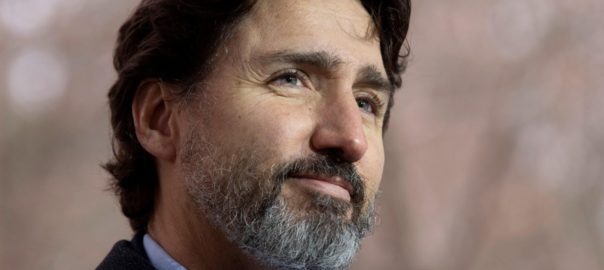
Just yesterday, the Prime Minister told Canadians that Canada has secured an agreement to receive its first batch of Pfizer’s coronavirus vaccine before the end of the year — up to 249,000 doses. Pending Health Canada approval, “Canadians will be getting vaccinated starting next week,” Trudeau said at a news conference in Ottawa. Shipments will continue to arrive in 2021; the second batch will be reserved for the same people vaccinated in the first batch — which is to say, the elderly in long term care facilities across Canada. “We’re facing the largest immunization in the history of our country,” Trudeau said.

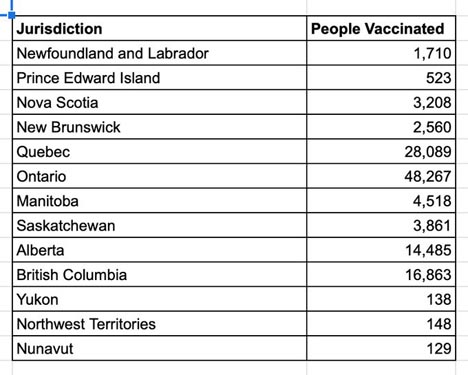
Canada’s National Advisory Committee on Immunization (NACI) this past Friday released its final directive addressing the prioritization of who should receive the vaccines first, and which groups would be next, right through until the late spring. By the end of March, NACI scientists said they expect 3 million Canadians will have been vaccinated with one of the three (soon to be four, or more) approved COVID-19 vaccines, that number doubling by late June, and doubling yet again by early to mid-autumn of 2021.

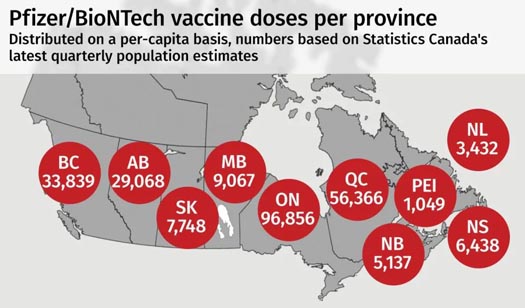
Pfizer/BioNTech roll-out of their COVID-19 vaccine to Canadian provincesThe initial batch of Pfizer/BioNTech vaccines will roll out to 249,000, or more, Canadians

NACI scientists advise the roll-out of vaccines will occur, as follows …

  • (a) Long-term care and assisted living facility residents, as well as residents in retirement homes and chronic care hospitals, who face “severe outcomes” and a much greater chance of dying from the disease than the population as a whole;

  • (b) NACI scientists said the next priority group would be “adults 80 years of age and older;”
    Initial Pfizer/BioNTech vaccine roll-out in early 2021. Expected number of people in each province to be vaccinated.Number of Canadians, by province, expected to receive the initial batch of Pfizer/BioNTech vaccine in the early part of 2021, beginning in January.

    (c) NACI scientists expressed concern about Indigenous adults living in communities “where infection can have disproportionate consequences, such as those living in remote or isolated areas.” Indigenous persons will be the third group of Canadians to be vaccinated;

    Initial Pfizer/BioNTech vaccine roll-out in early 2021. Expected number of people in each province to be vaccinated.

  • (d) Adults aged 75 – 79 would be next to receive vaccinations, followed by adults aged 70 – 74 years of age.

These four groups — long-term care residents and staff, the elderly, front line health care workers and some Indigenous adults — are expected to consume all of the six million doses (the Pfizer vaccine requires two doses) to be delivered in the first three months of 2021.

Nurse holding a small bottle containing a COVID-19 vaccine

In the second phase of the vaccine roll-out, which would begin in April 2021, as more supply comes online, other essential workers will have access. The NACI advisory committee said first responders — such as police officers, firefighters and health care workers not included in the initial rollout — would be next in line, followed by residents and staff in other “congregate settings” — such as migrant workers, prisoners in correctional facilities and people in homeless shelters.
At the end of the day, though, it is the provincial Premiers, their Health Ministers and Public Health Officers who will determine prioritization of vaccine roll-out in their jurisdictions. By late summer / early autumn, Prime Minister Trudeau has said he expects half of all Canadians would be vaccinated — that’s 19 million Canadians.
The vaccine roll-out will continue through the end of 2021, and beyond.

#ParkBoard | The Politics Never End Within Our Civic Bodies

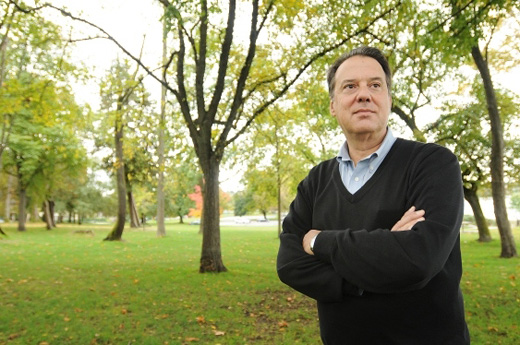
John Coupar - current Vancouver Park Board CommissionerJohn Coupar, Non Partisan Association Park Board Commissioner | Standing in opposition to an anti-democratic motion coming to the Vancouver Park Board | Photo: Dan Toulgoet

In civic governance as practiced within the City of Vancouver, politics — you know, the kind of politics that have our electeds sniping at, belittling, attempting to one up, disliking verging on hatred, while actively engaged in disrespecting one another — remains the order of the day, less so at Vancouver School Board, but ever present at Council (or, now, during their safe socially distanced Webex online meetings), and around the Park Board table nestled within the Vancouver Park Board offices, or is now the case during our pandemic times, online using the city’s Webex online platform.
In the new year, VanRamblings will dedicate the early months of the year to writing about Vancouver civic governance (suffice to say, we’re not happy), and had intended to enjoy the season and leave for another day what will in all likelihood be an evisceration (such a nasty word) of governance in the city of Vancouver, as it is currently practiced, until the following arose …

Vancouver Park Board Procedural Motion, December 7 2020

Vancouver Park Board staff will bring the above recommendation to the Park Board table next Monday, December 7th, first in an in-camera online meeting not available to the public, and then at 6:30pm when the final online meeting of Park Board Commissioners — before the holiday break — will take place. The next Park Board meeting is set for January 18th, 2021.
According to a 31-page Vancouver Park Board staff report [PDF] …

The Vancouver Board of Parks and Recreation Procedure By-law (Park Board Procedure By-law) guides how the business of the Park Board Commissioners is handled and applies to all meetings of the Board and its committees. While the current by-law underwent a comprehensive review in 2018 before being enacted by the Board January 2019, it is best practice to undertake regular administrative reviews to ensure procedures remain relevant.

The revisions outlined in this report, and attached as Appendix A, are proposed to reflect current practices, address gaps, and clarify procedures that may have led to some ambiguity or confusion. Additionally, recommendations have been included to provide Commissioners options to follow-up on the “Future Considerations noted in the last by-law update report regarding electronic and special meetings.

The net impact of the recommendation, when it becomes a motion before the Board this next Monday, as it surely will, would be to deny a minority contingent of duly elected Park Board members to call a Special Meeting of the Board to seek public input on issues of concern to the general populace.
In these parts, we call that bullying, rule of the majority, arrogant decision-making by elected officials, and - let’s face it - downright anti-democratic.

Vancouver Park Board Commissioners, 2018 - 2022Vancouver Park Board Commissioners, l-r: Tricia Barker, John Coupar (NPA); Gwen Giesbrecht, John Irwin (COPE); Stuart Mackinnon, Camil Dumont, Dave Demers (Greens)

Apparently, the genesis for the staff recommendation arises from a Special Meeting of the Board that two Commissioners, John Coupar and Tricia Barker, called this past summer to discuss transportation issues within Stanley Park, with which members of the public had expressed concern.
As a general rule — be it at Council, School Board or Park Board — senior staff are reluctant, at best, to meet with the public to discuss issues of public concern, cuz it’s messy and democratic, and diminishes their power as the professionals who, in actuality, “run” city governance — not to mention which, these time consuming meetings can go on for days, and it takes them away from the familial comfort of their homey and cozy offices.
Park Board staff were none-too-pleased with the calling of the June 18, 2020 Special Meeting — thus, their recommendation to Commissioners. And, if truth be told, neither were COPE Commissioners Gwen Giesbrecht — who viscerally dislikes the rather lovable John Coupar — and John Irwin, and Green Party of Vancouver Park Board Commissioners, current Chairperson, Camil Dumont (also not much of a fan of his NPA Park Board colleagues, ditto his fellow Greens) — Dave Demers & Stuart Mackinnon.
Yes, it’s civic governance as a particularly bad high school experience.

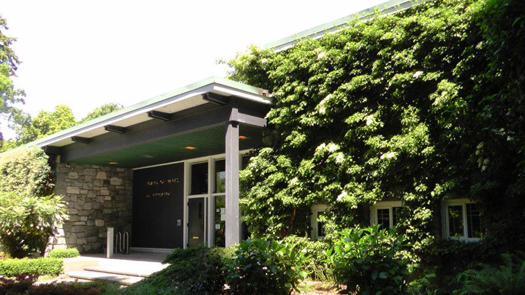
Vancouver Park Board office, on Beach Avenue north-west of English Bay

Now, should the staff “recommendation” be accepted by a majority of the Board at this upcoming final 2020 meeting of Park Board, here’s what the net effect the passage of the motion would mean for governance at the Board, as well as the process to realize the intention of Park Board staff …

1. Going forward only the Park Board Chairperson, or a majority of Board members could call for a Special Meeting of the Board — a derivation of Board practice dating back to its inception more than a century ago;

2. Although there is a provision in the by-law and Park Board governance provisions that would allow a minority contingent of Park Board Commissioners to call a Special Meeting, to address urgent issues of concern to the public, such a motion could (and probably would) be tabled by the majority of the Board Commissioners, effectively making moot the urgent concern provisions of Park Board governance;

3. Assuming the “motion” passes, it would then be forwarded to Vancouver City Council for passage before Council (where such provisions as staff are recommending at Park Board are already in place). How would Council likely respond to the entreaty of Park Board to make application to the provincial government for a change to the Vancouver Charter to accommodate the expressed wishes of the current Park Board? VanRamblings believes the answer would be, contentiously not well;

4. For the sake of argument, let’s say Council says, “Okay you buckos at Park Board, we’ll grant you your Christmas wish, and post your recommended Charter change to our mistresses and masters in Victoria.” La-di-dah. How would British Columbia’s new Minister Responsible for Municipal Affairs, former Tofino Mayor, Josie Osborne, receive the entreaty of Council and Park Board for a change to the Vancouver Charter?

Uuummmm, not well?

One would think that our currently elected Park Board Commissioners would have many better things to do with their time than to seek to diminish democratic governance around the Park Board table, and diminish input from the public into decision-making by our elected Commissioners.
Apparently not.

Vancouver Park Board Commissioner John Coupar on his opposition to a motion to be presented at Park Board on December 7 2020 that would limit public input into decision-making at the Park Board table, and prevent minority members of the Board from calling for a Special Meeting of the Board when issues of public concern arise.

Note should be made that Park Board Chair Dumont determines what items find their way onto the Park Board agenda — as it happens, the Park Board Chair is all powerful. Nothing gets onto the agenda if he doesn’t want it to. So, apparently, Mr. Dumont is possessed of a strong desire to see this staff recommendation become a motion at the Park Board table, a motion he would vigorously support and urge his fellow Commissioners to support.

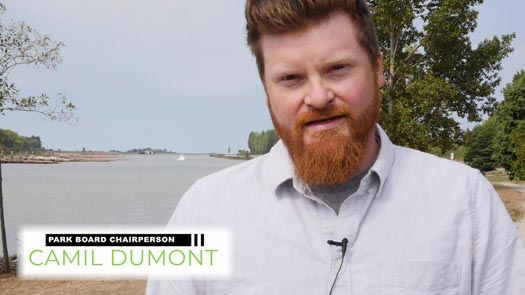
Green Party of Vancouver Park Board Chairperson, Camil Dumont

‘Ceptin one thing: at some point, it’s possible that Mr. Dumont and Mr. Demers would comprise a minority contingent of Green Party of Vancouver Park Board Commissioners on the elected Vancouver Park Board, the values of the remaining Park Board Commissioners in diametric opposition to that for which Mr. Dumont and Mr. Demers steadfastly stand.
Note to Park Board Chairperson Camil Dumont, and his fellow COPE and Green Party of Vancouver Park Board Commissioners: turn the the staff governance report into a motion of Park Board at next Monday’s meeting, and risk that at some point down the road, your very own power as a duly elected Park Board Commissioner will be much diminished.
A risky venture for our elected Park Board Commissioners, anti-democratic in design and intention, and very much contrary to the public interest.