Category Archives: Politics

Decision 2021 | Day 3 | Erin O’Toole | Conservatives on the Ropes

Erin O'Toole, the beleaguered leader of the Conservative Party of CanadaErin O’Toole, the beleaguered leader of the Trumpian-right Conservative Party of Canada

Poor Conservative Party of Canada leader Erin O’Toole. After winning the leadership of his party at the convention held on August 23rd, 2020, almost exactly one year ago, it’s been downhill for Mr. O’Toole ever since.
In order to secure leadership of the Tory party, and beat out rival, former Progressive Conservative Party leader & Conservative Party Cabinet Minister, Peter Mackay, O’Toole made a deal with the devil, in the form of far-right-of-centre leadership hopeful, anti-vaxxer & strident pro lifer, Ontario Conservative MP Derek Sloan, promising Mr. Sloan a prominent seat at the table of an Erin O’Toole-led Conservative Party of Canada.
When Mr. Sloan dropped off the ballot, he encouraged his supporters to cast their ballot for Erin O’Toole, in the process securing victory for Mr. O’Toole over Mr. Mackay.
Less than four months later, on Wednesday, January 20th, 2021, Mr. O’Toole ejected the controversial Ontario MP from the Conservative caucus, due to what he termed Mr. Sloan’s “pattern of destructive behaviour,” including the revelation that Mr. Sloan had accepted a donation in 2020 from a known white nationalist, causing Mr. O’Toole to declare that “there’s no room in (the Conservative Party) for far-right extremism or racism.”
During his 15 months as a Conservative Party Member of Parliament, Mr. Sloan had faced accusations that he was racist and had drawn condemnation for his views on LGBTQ rights and for his strident anti-abortion stance, all leading to repeated calls that Mr. Sloan be tossed from the party’s benches.

“I’ve worked well with many social conservatives in our party over the years. They are welcome in our party, but Derek Sloan’s behaviour is not,” wrote former Conservative cabinet minister John Baird on social media in the lead up to Mr. Sloan’s ouster.

Following on Mr. Sloan’s ejection from the Conservative Party, an as yet unhealed and destructive rift in the Conservative Party occurred.
Most recently, 62 of the 119 elected Conservative Party MPs and former Conservative MP turned Independent Derek Sloan drew outrage from Canadians across Canada, when they voted against legislation brought in by the Trudeau government that would ban “conversion therapy”, the widely condemned practice of trying to change someone’s LGBTQ identity to heterosexual. The final vote was 263-63 in favour of the Liberals’ Bill C-6, passage of the bill banning conversion therapy, include talk therapy, hypnosis, fasting and the use of electric shocks.
The Conservative Party had outed itself as a federal political party largely comprised of homophobes and transphobes, regressives in the manner of Donald Trump and his many hateful acolytes. VanRamblings will expand on this story and theme in a post to be published next month.

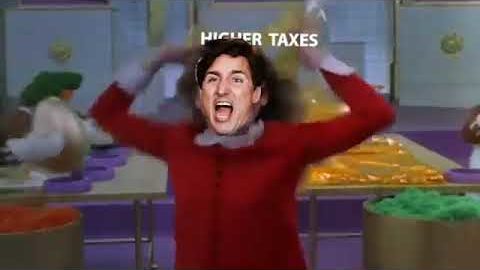
Tasteless, sexist, misognynist, objectionable Conservative Party ad attacking Justin Trudeau.

At campaign outset, the Conservative Party and Mr. O’Toole came under fire from their own members over a ‘tasteless’ Trudeau ad. Todd Doherty, a British Columbia Conservative MP wrote on Twitter that he expected the Conservative Party to be better: “This is embarrassing,” wrote Mr. Doherty.
On Sunday, the day the writ was dropped, Conservative Party leader Erin O’Toole came out against the implementation of a vaccine passport, told the press that unlike the other major political parties, he would not mandate that his MPs or Conservative Party candidates be vaccinated, and if elected to government would revoke the Liberal party’s edict requiring all federal employees to be vaccinated against COVID-19.
The deadline for full vaccination for employees in the federally regulated rail, air and marine sector would have to be completed by the end of October, according to Intergovernmental Affairs Minister Dominic LeBlanc, who said that all public servants and employees in federally regulated sectors must comply with the vaccine mandate or risk losing their jobs.
The measure will also apply to all commercial train, air, and cruise ship passengers. Upwards of 500,000 people work directly for the federal government, the military, RCMP or a Crown corporation. Nearly a million more work in federally regulated industries, such as airlines and banks.

“Being vaccinated makes the workplace and travel safer for everybody,” federal Transport Minister Omar Alghabra announced last Friday, August 13th. “We will work closely with key stakeholders, operators, and bargaining agents, in particular, to develop a measured and practical approach to requiring vaccines in these sectors as quickly as possible.”

Eighty-two per cent of Canadians 12 year of age and older have had at least one dose of vaccine, while 70+ per cent have been fully vaccinated.
The vaccine requirement for federal and federally regulated employees, however, would not be implemented by Conservative leader Erin O’Toole, despite garnering the support of public sector unions & 82% of Canadians.
To dig the hole even deeper for the prospect of Mr. O’Toole and the Conservative Party forming the next government of Canada, on Monday, despite the widely popular and economically sound initiative of the federal Liberal government to implement $10-a-day childcare across Canada — the first national, universal social programme to be implemented since 1964, when the Liberal government of Prime Minister Lester B. Pearson mandated universal medicare, and successfully moved legislation that brought the Canada Pension Plan into existence — and despite the fact that eight provinces and terrritories have enthusiastically signed onto the universal child care programme (including provinces led by Conservative governments), Mr. O’Toole went on record to state a Conservative Party would not implement any sort of national child care programme, but would instead create a tax credit for the parents of young children.
Make no mistake, the Conservative Party of Canada under Erin O’Toole is not your parent’s Progressive Conservative party, not the progressive party of Robert Stanfield, Joe Clark or Brian Mulroney.
Rather, the current Conservative Party of Canada under Erin O’Toole has become a far right, Trumpian party that ill represents the values of Canadians across our land, and as such have not a hope in hell of either being elected to national government, or even holding onto a goodly portion of the 119 seats held by the Conservative Party at dissolution.
Tomorrow’s VanRamblings column will explore in some detail, why it is that Erin O’Toole and the Conservatives have almost an insurmountable uphill battle to hold onto their seats in northern British Columbia, across Alberta and Saskatchewan, in Ontario — particularly in the 905 Metro Toronto region — in Québec, and across the Maritimes.
A dire situation, indeed, for Erin O’Toole and Canada’s Conservative Party.

Canada 2021

Once again, the Curse of Politics panel — David Herle, Scott Reid and Jenni Byrne — weigh in on Elxn44, reviewing the release of the Conservative Party platform, among a raft of other issues that have come to the fore in Day Three of the current federal election.

Day 3 | The Curse of Politics panel weigh in on #Elxn44, and Charlie Brown … er, Erin O’Toole.
Decision 2021 | Day 2 | Public Polling | Entertainment Value Only

2021 Canadian federal election | Nanos Research Poll | August 13, 2021

Over the course of the next five weeks, when you turn on your TV to watch the evening news — be it the national news, or a local broadcast — or you go online to read The Globe and Mail or one of the local newspapers, almost inevitably you’ll be presented with a graphic, such as the one above, presenting the latest election “polling results” from one of Canada’s nationally recognized polling companies — EKOS Research, Ipsos-Reid, Forum Research, Quitto Maggi’s Mainstreet Research or, as above, Nanos Research, and you’ll read about or hear intoned the weight and the meaning of the latest election polling results.
VanRamblings is here to tell you don’t for a minute believe any of the results from these national pollsters. Why not? Because, the meaning of that polling serves a number of functions, none of which contribute to your understanding of where the parties stand at any point during the current 36-day election period. Rather the poll results serve as “earned media” for the polling companies (more often than not, the pollsters supply the polling information for free, as “advertising” for the work they do outside of election periods), or more simply as “entertainment” for the viewer, contributing to the notion that there is not an election of import going on addressing issues of concern to the electorate, but rather the election is little more than a horse race, a form of political amusement or diversion.
In a story published in The Globe and Mail over the weekend, the paper’s Ottawa bureau chief, Robert Fife, wrote …

“The Liberal Party appears to be losing its momentum and now faces the prospect of eking out another minority government … The poll by Nanos Research, completed Friday, shows the Liberals with only 33.4% voter support, a drop of 5.9 percentage points from four weeks ago when the party appeared headed for a majority government.

“They are not in majority territory any more — and based on our internal seat projections — the hot election speculation has turned off enough voters for the Liberals to go from a majority to putting 40 Liberal [potential] wins at risk,” said Nik Nanos, the polling firm’s founder.”

If you believe that palaver, VanRamblings has a bridge we’d like to sell you.

star.jpg star.jpg star.jpg

Public polling has fallen out of favour in recent years, with pollsters in Canada and the United States wildly wrong in their predictions as to the outcome of various elections. Why?
Polling respondents, more often than not, lie to pollsters — who also fail to survey a broad cross-section of the public. Pollsters fail to compensate or adjust their figures factoring in that those members of the electorate under the age of 45 are significantly less likely to turn up at the polling booth, or mail in their ballot, than voters over the age of 45 — but pollsters give these “younger” respondents equal weight in calculating their polling results. As a consequence of their continued failure to accurately account for the intention of the potential electorate, pollsters face an existential crisis, and a disaster for the polling industry and for media outlets and analysts that package and interpret the polls for public consumption.
The polling that counts, and the polling the general public never gets to see is the polling conducted for the two leading parties, in Canada, the Liberals and the Conservatives, each of whom dedicate between five and eleven million dollars of their campaign budgets to paying private internal pollsters who, unlike the 1,000 respondents contacted for the Nanos Research poll above, conduct daily polling in the two hundred or so ridings the two mainstream political parties believe they have chance of winning, contacting between 300 and 500 respondents in each riding every day, as well as conducting in-person demographically diverse research groups in these ridings, among those members of the electorate who are engaged and likely, or almost certain, to vote in the current federal election.
The following “story” illustrates the meaning behind what you read above.

Premier Christy Clark and her B.C. Liberal party secure a majority government in 2013.

Approximately six months before Premier Christy Clark went to the polls in 2013, B.C. Liberal party campaign manager Mike Macdonald engaged the services of longtime Stephen Harper pollster, Maple Leaf Strategies’ Dimitri Pantazopoulos, one of Canada’s leading strategists and public opinion researchers, with more than 25 years of experience and practical knowledge in providing strategic advice to right and centre-right political parties and their leaders, and renowned for his dogged, thorough and in-depth, and almost invariably accurate, public opinion research studies.
Following in-depth polling in all, then, 84 ridings across British Columbia, approximately one week before the provincial writ was dropped in 2013, Mr. Pantazopoulos advised Ms. Clark and Mr. Macdonald that despite the public polling that had the B.C. Liberal party popularity languishing between 33% & 36% in the “public” polls, with NDP leader Adrian Dix polling in the range of 47% to 51% — and assured of an overwhelming victory and majority government in the coming provincial election5 — in fact, he believed Ms. Clark could secure a majority government, advising Mr. Macdonald to “write off” 34 “unwinnable seats”, and focus on the 50 “winnable” ridings that could secure a victory for Ms. Clark and her B.C. Liberal party.
Although many in the B.C. Liberal party were aghast at the advice Mr. Pantazopoulos provided to Ms. Clark and Mr. Macdonald, both chose to take his advice. Mr. Pantazopoulos and his team conducted in-depth polling nightly in each of the “winnable” 50 ridings, and crafted a message for the candidates in each of those ridings to present to the electorate the next day to address the specific concerns of the electorate in those specific ridings. Long story short, despite the public polling that had the B.C. Liberal party and Ms. Clark going down to flaming defeat, come election night, the B.C. Liberal party secured victory in every one of the fifty ridings that Mr. Pantazopoulos had identified, as Ms. Clark and the B.C. Liberal party went on to form their much cherished majority government.

Canada's Governor General Mary Simon signs the Writ that will see Canadians going to the polls

According to information provided to VanRamblings by informed sources within both the federal Liberal and Conservative parties, pre-election internal polling has the Liberal Party on track to win 200+ seats come the end of the current federal election, with the federal Conservative party hoping to hold onto 99 of their current 121 seats — the details of which VanRamblings will provide in the coming days.
Over the course of the next 35 days, both mainstream federal political parties will conduct daily and nightly polling in the ridings they’ve identified for victory, and craft both a national and a local message for the electorate to respond to concerns that have been identified by internal party pollsters, many of whom will be out door knocking in ridings across Canada.
Of course, there’s still five weeks to go until election day and anything could happen, but despite the $63.5 million the Conservative party has in its kitty to “secure victory” s, as VanRamblings will explain tomorrow, it’s going to be an uphill battle for Conservative party leader Erin O’Toole to hold onto a good portion of their current seats in the House of Commons.


As always, VanRamblings will publish the daily Curse of Politics podcast …

Day One | August 16, 2021 | David Herle, Scott Reid and Jenni Byrne weigh in on Day 1 of the 44th Canadian federal election, joined by Politico Canada’s Nick Taylor-Vaisey.


David Herle, pollster, and founder of the Air Quotes Media podcast conglomerateDavid Herle, pollster, and founder of the Air Quotes Media podcast conglomerate.

In addition to the daily Curse of Politics podcast, David Herle has also created the new Through the Looking Glass podcast, today’s début episode presenting ‘swing voters’, where rather than focusing, as per usual, on interviewing political figures or insiders, instead the Through the Looking Glass podcast takes viewers through the looking glass of a focus group boardroom, done virtually, and into the minds of everyday people.
Through the Looking Glass: Swing Voters 2021 will meet with a group of swing voters from the greater Vancouver and greater Toronto areas as they form opinions about the federal election. Both of these Canadian metropolitan areas have a surfeit of seats up for grabs, and are home to some of the most competitive ridings in the country.
Through the Looking Glass will check in with this group of swing voters once a week throughout the campaign period to hear what they’re thinking and feeling about the issues that have come to the fore, the leaders of the four main political parties, the party platforms, the debates (upcoming, in English Canada, on Thursday, September 9th), party ads, and ultimately, how they intend to vote as we head into Election Day.
Here’s the début episode of the Through the Looking Glass podcast …

Episode One | August 16, 2021 | The new Air Quotes Media Through the Looking Glass podcast.

Decision 2021 | Day 1 | Canadian Federal Election | Sept. 20th

The Curse of Politics podcast will cover the 2021 Canadian federal election dailyDavid Herle, Scott Reid & Jenni Byrne will provide daily coverage of Decision 2021

As of this morning, Sunday, August 15th, following on the visit of Prime Minister Justin Trudeau to the residence of the recently-installed Governor General, Mary Simon, to request that she dissolve Parliament — a request to which she acceded — Canadians now find themselves in the chaotic midst of the 44th Canadian federal election since Confederation, in 1867.
Thirty-six days from now, Canadians will elect a new government — whether that is a status quo Liberal minority government or a majority Liberal government, as Mr. Trudeau might wish (quite simply, there are no reasonable and foreseeable other options on the table) we’ll know come the evening of Monday, September 20th, E-Day in every region across Canada — or within 10 days afterwards, as election returning officers conduct a hand count, post E-Day, of the more than five million ballots that are expected to be cast by mail during the latter two weeks of the writ period.
We oughta know whether it’ll be a minority or majority Liberal government Canadians have elected somewhere around Friday, October 1st.
VanRamblings will provide our usual in-depth daily coverage of the federal election each week, Monday through Thursday, over the course of the 36-day election period, providing insight, publishing polls, exploring the issues raised by each of the parties, and in the final days of the election period postulating as to the specific probable outcome of the federal election.
For the 4% of you out there who give a good goddamn about Canadian federal politics — which, in some measure, brings you to VanRamblings today — there is no more important activity to which you might turn your attention than the current federal election, which will serve to determine what kind of country we will become over the course of the next four years, and what values will be reflected in the legislation brought before government by the governing party. Make no mistake: your vote counts!
As always, elections are a crapshoot: in the early going, you just can’t predict the outcome.
In 2015, Justin Trudeau and his federal Liberal party began the election with only 23% support among Canadians, while Tom Mulcair and the NDP were rock steady at 35% popularity in the polls, in all regions of Canada, with Prime Minister Stephen Harper following closely behind with 31% support in each of the 10 provinces and three Canadian territories.
Following an unprecedented 78-day election period, on Monday, October 19, 2015 Canadians elected a majority Liberal government to Parliament, and a new Prime Minister. At election outset, no one could possibly have imagined that outcome, so entrenched was the Harper government, and so popular was the New Democratic Party under the leadership of Mr. Mulcair.

star.jpg star.jpg star.jpg

At the top of the page of today’s post, you’ll see a graphic of the relatively new Curse of Politics podcast, created to provide daily, informed coverage of the 2021 Canadian federal election.
David Herle is a Canadian political consultant and Principal Partner at leading polling and research firm, The Gandalf Group, and a regular CBC political commentator. Scott Reid is a political analyst and commentator currently working for CTV News, and a columnist and contributor to the Ottawa Citizen, CBC.ca and Macleans, among other publications.
As is the case with his colleague David Herle, Mr. Reid has acted as a political advisor to a number of Canadian politicians, having served as Advisor and Director of Communications in the Prime Minister’s Office of Canadian Prime Minister Paul Martin. Along with Macleans columnist Scott Feschuk, Reid owns and operates Feschuk.Reid, a strategic communications and speechwriting consultancy.
Jenni Byrne is a political advisor, political commentator, and government relations expert. A member of the Conservative Party of Canada and the Progressive Conservative Party of Ontario, she is a former senior advisor to Prime Minister Stephen Harper and former Principal Secretary to Doug Ford. Once referred to as “the most powerful woman in Ottawa,” she currently operates her own consulting firm, Jenni Byrne + Associates.
Messrs. Herle and Reid and Ms. Byrne will cover the 44th Canadian federal election with greater, and more informed insight than you’ll find anywhere else in the media during the election period. Each of them has been inside the rooms where decisions have been taken by government, over the course of the past 40 years in the case of Messrs. Herle and Reid, and more than a quarter century, in the case of Jenni Byrne. As the three opined recently, “You know that you haven’t made it in politics as a senior political advisor until the Prime Minister has told you to fuck off,” a signal event which each of the three hold proudly & closely to their bosoms to this day.

The Curse of Politics podcast will be available on (just click on the links) …

VanRamblings looks forward to seeing you back here tomorrow. In the meantime, enjoy the début episode of the Curse of Politics podcast, above.
Update. Here’s the kick off to the election Curse of Politics podcast …

David Herle, Scott Reid and Jenni Byrne weigh in on the kick-off to the 44th Canadian federal election, in a podcast published mid-afternoon on Sunday, August 15th.


40th annual Vancouver International Film FestivalThe 40th annual Vancouver International Film Festival will run from Friday, October 1st thru Thanksgiving Monday, October 11th, screening 100 features & 100 shorts this year.

After a seven and a half month break, today’s VanRamblings column — our first in 2021 — marks the beginning of 516 consecutive days of publishing.
Over the coming months, we’ll cover the current federal election, followed by coverage of the 40th annual Vancouver International Film Festival, and begin coverage of the 2022 Vancouver municipal election. Of course, each Monday through Thursday, we’ll cover much much more of a political nature, as you will come to see in the days, weeks and months ahead.
As per usual on VanRamblings, Fridays will be given over to arts coverage (mostly, but not just, film) on Arts Friday, Saturdays to our must-read and indispensable Stories of a Life feature, and Sundays to the Music we love.
Hope to see you back here often. We promise you, it’s gonna be a ride!

#BC Poli | BC Recovery Benefit Application Day | How to Apply

BC Recovery Benefit eligibility, the application process

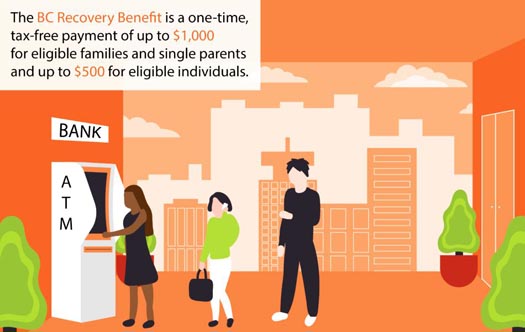
The application for the BC Recovery Benefit that will be made available as a one-time direct deposit payment for eligible families, single parents or individuals opens today. You’ll want to take advantage of this benefit.
The key aspect to be aware of: You must apply to receive the benefit.
Now, the John Horgan could very easily have foregone what will turn out for many to be an arduous application process, if they’re even aware there is a benefit for which they are eligible, and could have held off payment until January 5th, 2021, when they very easily might have included the $500 for eligible individuals, and the $1000 for couples and single parents — as they did in April, when they combined the then Climate Action Credit of $330 — with the issuance of GST cheques to households across the province.
No fuss, no muss, no application process — just a tidy sum of money deposited in every eligible adult’s bank account on the first Tuesday of 2021 — not a bad way to start the new year, don’t you think?

BC Recovery Benefit eligibility, the application process

But in a blunder of immense proportion, not to mention a disingenuous way to commence Mr. Horgan’s first real mandate, our B.C. New Democratic Party provincial government has decided that not only will eligible British Columbians have to jump through the hoops of an online application process, eligibility for the BC Recovery Benefit is dependent on what you earned in the 2019 calendar year — before COVID-19 was on anyone’s radar, before businesses shut down due to the pandemic, causing the loss of hundreds of thousands of jobs across our province — disallowing the full $500 recovery benefit to individuals who in 2019 earned more than $62,500 (with a sliding scale up to a cutoff of $87,500), with households with lower than a $125,000 combined income eligible for the full $1000 recovery benefit, decreasing that amount up to a cutoff point of $175,000.
If you lost you job or your business in 2020, and your income has plunged into the abyss in this very troubling year, you’ll be out of luck when it comes applying for the BC Recovery Benefit.

BC Recovery Benefit eligibility, the application process, covid-19, be grateful

What is that you’re saying? “Don’t look a gift horse in the mouth?”
For those who are unfamiliar with VanRamblings’ modus operandi, well … even with Hanukkah ending yesterday, we nonetheless just love to kvetch.
Okay, enough of this foofaraw, let’s get on with acquiring tax free moolah.

BC Recovery Benefit eligibility, the application process

First off, you going to have to click on this link to be taken to the British Columbia government’s BC Recovery Benefit application website.
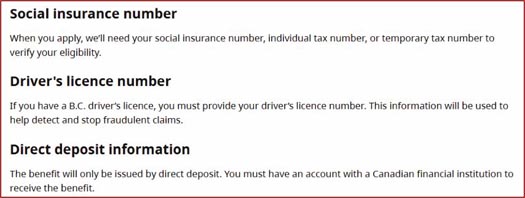
Next, you’re going to have to get all your ducks in a row, and make sure you have the following information and documentation available in order to complete the application process …

BC Recovery Benefit eligibility, the application process

Note should be made: persons who are in receipt of the provincial Persons with Disabilities benefits are eligible to apply. The benefit will not be clawed back from existing benefits, as the recovery benefit is non-taxable.

BC Recovery Benefit eligibility, the application process, COVID-19

On Tuesday, December 8th, the BC government introduced legislation to secure funding for the BC Recovery Benefit, projected to help around 3.7 million British Columbians.

BC Recovery Benefit eligibility, the application process, covid-19, students can apply

Charlotte Aiden, a writer for The Ubyssey has written this story on student eligibility for the BC Recovery Benefit.

Students who are at least 19 years old and reside in British Columbia on December 18, filed a valid 2019 Canadian personal income tax return and have a social insurance, individual tax or temporary tax number are eligible to apply.

Unlike the Canada Emergency Student Benefit, international students are included in this benefit, given they meet the eligibility requirements.

You’ll need four things to apply on the government website: your net income from your 2019 tax return; your social insurance, individual tax or temporary tax number; your driver’s licence number if you have a BC driver’s licence (but this isn’t necessary); and your direct deposit information.

Unlike past benefits, this benefit will only be issued through direct deposit, so those who apply must have an account with a Canadian financial institution.

BC Recovery Benefit eligibility, the application process, COVID-19, telephone support

Toll free telephone support is available by phone starting Monday, December 21st, 2020.

  • Call 1-833-882-0020 (within North America);

  • Monday to Friday, 7:30 am to 5:00 pm, excluding statutory holidays;
  • You have until June 30, 2021 to apply.

The COVID-19 BC Recovery Benefit will cost as much as $1.7 billion, up from an estimate of $1.4 billion announced during the election.