 |
Category Archives: Politics
Jib Jab: This Land Was Made For You and Me
Young Male Prisoners Sodomized at Abu Ghraib Prison
 Seymour Hersh |
In a report published in the British newspaper, The Independent, the paper reports that Seymour Hersh — whose essay on the torture of Iraqi prisoners appeared in New Yorker magazine in May — told a meeting (RealPlayer required) of the American Civil Liberties Union of the continued abuse and torture of teen male Iraqi prisoners. Hersh said …
“The boys were sodomized with the cameras rolling, and the worst part is the soundtrack, of the boys shrieking. And this is your government at war.”
Hersh accused the U.S. administration, President George W. Bush and Vice-President Dick Cheney of complicity in covering up what he called ‘war crimes’. A full transcript of the Hersh speech is available here.
An Associated Press story reports that two young male detainees were bound naked, and were raped in front of 30 other detainees. Further gross sexual abuse and humiliation is sited in the AP story.
The stories above follow on the heels of a May 22nd published report in The Guardian, detailing the rape of a teen Iraqi boy by an army translator.
To date, the U.S. administration has not responded to any of the stories alleging rape of young male prisoners at Abu Ghraib, nor have such stories appeared in newspapers or magazines published in the United States.
Amnesty International: Living in a Dangerous and Divided World
 |
Major challenges continue to confront the international human rights movement.
In the past two years, the United Nations has faced a crisis of legitimacy and credibility resulting from the U.S.-led war on Iraq. Amnesty International, and other human rights organizations (the International Red Cross, Doctors Without Borders, Madre), ever more distressingly find themselves unable to hold states to account for the most egregious violations of basic of human rights.
Across the globe, international human rights standards continue to be flouted in the name of the “war on terror”, resulting in thousands of women and men suffering unlawful detention, unfair trial and torture — often solely because of their ethnic or religious background. Around the world, more than a billion people’s lives have been ruined by extreme poverty and social injustice, while governments continue to spend horrendous amounts of money on the build-up of armaments.
The just-released Amnesty International Report reflects the challenges outlined above. The report documents the human rights situation in 155 countries and territories, summarizing regional trends. The report also addresses areas of work being prioritized and developed by Amnesty International — such as violence against women; economic, social and cultural rights; and justice for refugees and migrants – and celebrates the achievements of activists in these and other areas.
“Looking back over the past twelve months, what I see is a war on global values,” says Amnesty International’s Secretary General, Irene Khan (RealPlayer required). “A war that is being fought on the one hand by armed groups that are ready to go to any extreme of inhumanity to attack ordinary people.”
“On the other side we see governments, which have shown an equal zeal in attacking human rights and global principles. And in-between are ordinary people, (who) are paying a heavy price in terms of their human rights, and in terms of their lives.”
We live in a dangerous and divided world. It is more important than ever that the global human rights movement remains strong, relevant and vibrant, and that each and every one of us remain committed to revitalizing the vision of human rights as a powerful tool for achieving social justice.
Sweatshops and Subsistence Wages: The Gap Learns To Mind Itself
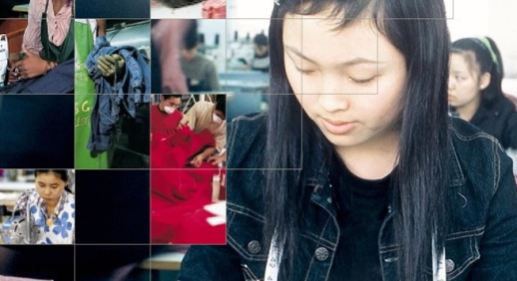
America’s fashion giant for teens and children — The Gap — has just released a candid report detailing the industry’s squalid working conditions.
According to Mark Engler, writing for In These Times, “The report has earned Gap genuine, if measured, praise from a variety of leading anti-sweatshop organizations.” The Gap’s name has been closely tied with the growth of the anti-sweatshop movement over the past 10 years.
“When I decided to join Gap Inc. in the fall of 2002,” writes Paul Presser, president and CEO of the clothing giant behind the Gap, Old Navy and Banana Republic brands, “one of the first things my teenage daughter asked was, ‘Doesn’t Gap use sweatshops?’ ”
An aggressive global movement for workers’ rights has effectively pushed this question into consumer consciousness, and it has haunted Gap for nearly a decade. In May, the company released its first Social Responsibility Report, providing a window into how far that movement has come.
 |
“We’ve had our differences with Gap in the past, and we may in the future,” says Bruce Raynor, president of UNITE, the textiles and needletrades union. But he cites the report as a move to “create positive change for workers.”
A 1995 U.S. National Labour Committee (NLC) campaign against union-busting at a Salvadoran Gap contractor called Mandarin International was among the first drives to illustrate consumer awareness of corporate globalization via clothing labels. As a result, those workers who had been fired while engaged in organizing workers at Mandarin were rehired, and an independent monitoring organization was created.
Just a few years later, The Gap was one of 18 manufacturers charged in a 1999 lawsuit with human rights abuses in the U.S. territory of Saipan. After years of litigation, the company entered into a settlement creating a $20 million fund to compensate workers and establish independent monitoring.
“Companies wouldn’t be doing a thing if it weren’t for the pressure that they felt and continue to feel,” says the NLC’s Charlie Kernighan. “The progress we’ve seen is a testament to all those students, religious people, and union people who were out in front of the Gap back in 1995.”