Category Archives: Politics

Youth Criminal Justice: A Unique Diversion Programme


TEEN-PROSTITUTES


In 2002, a group of angry girls between the ages of twelve and seventeen blew a fuse, initiating a vicious attack on a woman who they perceived to be a hooker.
The woman was walking down the street at around midnight, dazed, shoes in hand. One member of the group of girls hanging out decided to punch the woman and knock her to the ground. Gang mentality led to more of the girls becoming involved, and the woman was kicked to the ground, at one point one of the girls even dancing on her face.
The innocent woman was, in fact, the dazed victim of a recent sexual assault. But had she been a prostitute, the actions of the girls would hardly have mitigated the crime. So how should the girls’ crime be addressed?
The three primary offenders, all under the age of sixteen, were handed a unique sentence, which the victim of their crime had a hand in determining. Through the Youth Restorative Action Project (YRAP), the consequence was constructed to foster a little empathy for the prostitutes whom the girls claimed to hate.
YRAP is a justice committee unique to Edmonton, the inspiration of Yasmina Semanac, a teenaged Serbian / Canadian who managed to escape her war-ravaged country. The YRAP panel is comprised of a group of youth who work with the courts to determine sentences for young people involved in “hate crimes and crimes of significant social issues.”
In this case, the panel called on Mark Cherrington, a youth worker involved in YRAP and Youth Menace, a radio show on the University of Alberta’s CJSR, a weekly programme hosted and produced by young offenders who’ve had contact with the criminal justice system. The programme exists to give voice to the young offender population, a group often invisible to the mainstream population.
Programmes often involve Cherrington transferring young offenders directly from the Law Courts to CJSR, where they are given the opportunity to discuss their situations, unedited and live on the air. “Somebody described [the show] as either brilliantly wonderful or a wonderful disaster depending on what show you turn on,” laughs Cherrington.
Youth Menace and YRAP are partners in crime fighting, a collaboration that allows for the opportunity for youth peer justice, which is to say justice outcomes developed and delivered by youth. The only requirement to be a panel member is that s/he is 25 years or younger and that they affirm a belief in the declaration of universal human rights.
In the case of the young women convicted of assaulting the woman on an Edmonton street, the young female offenders involved were instructed to make a two-hour radio documentary about child prostitution in their own backyards. The award-winning documentary, Children and Prostitution: Victims, All of Us, is as honest and provocative a document of child prostitution as you’re likely ever to hear, akin to the work of writer Harmony Korine, a youth himself, on Larry Clark’s film Kids, though here there is not an ounce of fiction or conjecture in the radio documentary.
The voices represented in Victims are all children and all girls. The documentary introduces a 16-year-old pimp who chews unendingly on candy because she’s trying to get off crystal meth; and a child prostitute who met her pimp by naively waving at him across the street from the public library because she thought he was cute. Two days later, she found herself working the streets for drug money.
“This piece is the first piece from the perspective of the child,” says Cherrington. “It’s not a ministerial statement, it’s not mid- to low-level bureaucrats talking about ‘we need to’ or ‘we should’ or ‘this is adequate or inadequate.’”
Peppered with original urban music, explicit songs all written by street kids from ihuman, an inner city arts studio, Children and Prostitution: Victims, All of Us is well-executed, although the voices of the girls couldn’t be more raw and unvarnished.
“It’s a testament, not a message,” says Cherrington. “At the end it goes back to the philosophy of Youth Menace: you may agree or disagree with what’s being said, but the bottom line is that you certainly have to respect it, and it needs to be listened to.”
Reporting by Tash Fryzuk in the May issue of See magazine.
A Holiday For Us All: Where Labour Day Came From
© The Vancouver Sun 2004, with additional linked material


WINNIPEG-GENERAL-STRIKE


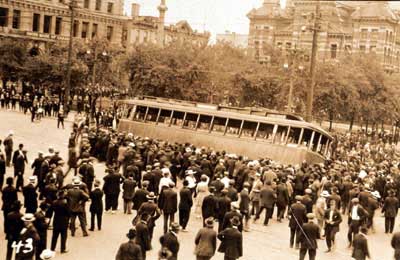
A part of Canadian history: the Winnipeg General Strike of 1919

According to many history books, Labour Day began in the United States when the Knights of Labor organized a parade on Sept. 5, 1882 in New York City.
As is often the case, the history books got one thing right and another wrong. The Knights did hold a parade in 1882, but the history of Labour Day began 10 years earlier, and in a place much closer to home.
On April 15, 1872, when Canada was just five years old, the Toronto Trades Assembly organized a “workingman’s demonstration” to call for the freedom of 24 imprisoned leaders of the Toronto Typographical Union.
The demonstration, which was attended by 10,000 people, included a parade and speeches that called for the repeal of a law criminalizing membership in trade unions.
Buoyed by the success of the demonstration, members of seven Ottawa trade unions organized a mile-long parade on Sept. 3, 1872, once again to protest laws that made union membership illegal.
But this wasn’t your average parade — marchers stopped at the home of then prime minister John A. Macdonald, literally picked up the PM, and took him to Ottawa City Hall by torchlight.
The prime minister was well aware of workers’ discontent with the law, and on the steps of the city hall, he promised marchers that his party would “sweep away all such barbarous laws from the statue books.”
Later that year, Mr. Macdonald and his party made good on his promise, and for the next decade, trade unions continued to hold annual parades and demonstrations.
On July 22, 1882, the Toronto Trades and Labour council decided to invite New Yorker Peter J. McGuire, the general secretary of the United Brotherhood of Carpenters and co-founder of the American Federation of Labour, to speak at the demonstration.
McGuire was duly impressed with the event, and, when he returned home, he proposed that America celebrate a day in honour of workers. Sure enough, the Americans celebrated their first unofficial Labour Day on Sept. 5, 1882, and McGuire became known as the “father of Labour Day.”
Over the next decade, individual states enacted legislation making the first Monday in September Labour Day, and on June 28, 1894, the U.S. Congress passed a federal law enshrining the holiday.
Just four weeks later, the Canadian Parliament enacted a similar law, and now the first Monday in September is celebrated as Labour Day throughout North America. Many other countries, including Australia, New Zealand and the Netherlands, also recognize Labour Day, but have chosen different dates on which the holiday is observed.
And still other countries recognize Labour Day’s spinoff — May Day — on May 1. But regardless of what it’s called, when it’s celebrated or who first made it official, Labour Day was clearly introduced to the world by Canada.
As with many holidays, the roots of Labour Day are often forgotten. Many people now see Labour Day simply as one more much needed holiday, one more much appreciated long weekend, one more much valued opportunity to spend time with the family, or to work around the house, or to sit back and relax.
And you know what? That’s okay. The history of Labour Day is important of course, but the holiday means most when it provides working people with a well-deserved breather from their usual work routines.
So this Labour Day, feel free to do whatever strikes your fancy. After all, this is a holiday that celebrates the contributions of Canadian workers, and a holiday we can truly call our own.

© The Vancouver Sun 2004, with additional linked material.

Amnesty International: Stop Child Executions
Ending The Death Penalty For Child Offenders


CHILD-EXECUTIONS


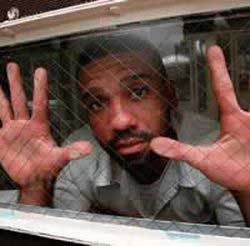
Napoleon Beazley was executed in
2002 in Texas for a murder committed
8 years earlier when he was 17 years old.
At the trial the white prosecutor described
him as an ‘animal’ to an all-white jury.
Trial witnesses cited his potential for
rehabilitation. He was a model prisoner.

Amnesty International and medical experts from seven countries have sent an open letter to the heads of government in China, Pakistan, the Democratic Republic of Congo, the Philippines, Iran, Sudan and the USA urging
them to stop using the death penalty against children.
The letter has been signed by 17 medical experts with outstanding credentials in the field of child and adolescent psychology, psychiatry and social development.
International standards prohibit the execution of child offenders — people who were under 18 years old at the time of the crime. These standards include the International Covenant on Civil and Political Rights, the Convention on the Rights of the Child, the American Convention on Human Rights and the African Charter on the Rights and Welfare of the Child. The relevant standards are respected by the overwhelming majority of the 80 countries which still retain and use the death penalty.

“Although adolescents generally know the difference between right and wrong, they can suffer from diminished capacities to reason logically, to control their impulses, to think through the future consequences of their actions, and to resist the negative influences and persuasion of others,” says the letter.
“They should face punishment for criminal actions, but the sanctions which can be imposed on mentally competent adolescent offenders should not be the same as those faced by adults found guilty of the same offences.”


Since 1990, Amnesty International has documented 38 executions of child offenders in eight countries: China, the Democratic Republic of Congo, Iran, Nigeria, Pakistan, Saudi Arabia, the USA and Yemen.
Endorsing the call of the world community to abolish child executions, Irene Khan, Secretary General of Amnesty International, said, “Child offenders should not be punished as if they were adults. Governments must amend their laws and practices to conform with international human rights standards and end the death penalty for offenders under the age of 18.”

American Election Campaign 2004: You’re The Campaign Manager


CAMPAIGN-TRAIL-2004


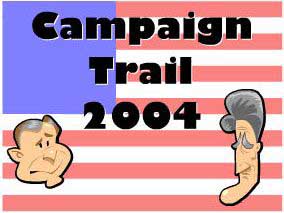
By clicking on the picture above, you’ll be taken to a flash website which will effectively place you “in the shoes of a campaign manager in the 2004 [American] presidential election” for the candidate of your choice.
Yes, employing clever strategy, you can determine the outcome of the election to the south. Four more years of George W. Bush or a new President, John Forbes Kerry? The decision rests on your shoulders.