Category Archives: Park Board

#VanPoli | Vancouver 2050 | The City of the Future

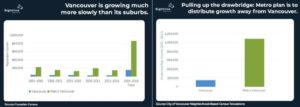
A draft 30-year plan calls for limiting growth in Vancouver, and pushing new residents to the suburbs

All development decisions within the City of Vancouver that are currently being made by senior staff employed within the city’s Planning Department — currently slated to add more than 100,000 new residents to Vancouver, over the course of the next 30 years — is predicated on a rate of population growth that many commentators, and the most recent figures published by Statistics Canada, don’t jibe with population growth projections that are being made at Vancouver City Hall.

In an article published in The Vancouver Sun this past weekend, reporter Douglas Todd writes …

“In recent years about 12,000 more people have been annually moving out of Metro Vancouver for other parts of B.C. than have been moving into the metropolis. The vast majority of new arrivals into Metro Vancouver are foreign-born immigrants.”

Todd goes on to quote former provincial NDP MLA and current two-term Nanaimo Mayor, Leonard Krog.

“We have had lots of people from Alberta and the East cashing out and moving to Nanaimo — to get away from the crush and the smoke,” says Krog. “People are also fleeing Vancouver, and the Lower Mainland. Now it’s more common for people to ask why would you stay in the Lower Mainland when you can cash out on your $2-million house on a crowded Burnaby street, or $3 million Vancouver home and get a great $1 million home in Nanaimo?”

Krog says newcomers are pouring into Nanaimo for several reasons — affordable housing, less density, and a higher-quality lifestyle. “The strong overall shift of residents from other provinces, and from Vancouver or Metro Vancouver, to smaller B.C. cities, which have more young adults, is unsurprising,” writes Douglas Todd.

“Nanaimo’s rapid growth of two per cent a year”, Krog says, “is a result of a ‘perfect storm’ of conditions, including the attractiveness of the region’s oceanfront, university, airport, nearby ski mountains, climate and a lower cost of living.”

“It has all been amplified by the pandemic,” he said. “COVID-19 is helping many across Canada and in other parts of B.C. realize they might be able to permanently work out of their homes. So why not do it in a place that is pleasant and somewhat more affordable?”

If as lawyer, writer, and and community organizer Daniel Oleksiuk writes on the Sightline Institute website that population growth in Metro Vancouver will occur in the Metro Vancouver suburbs, and not in Vancouver, and if Nanaimo Mayor Leonard Krog is correct in his assertion that rather than remain in Vancouver, families are instead opting to move to smaller, more affordable cities such as Nanaimo, how can the Vancouver Planning Department justify a growth strategy, population growth projections, and the consequent tower-driven densification projects they are currently presenting to the members of Vancouver City Council for approval?

At Issue: Form of Development, and the Livability of Vancouver
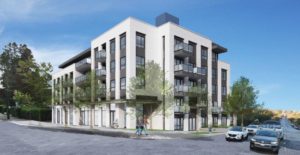
Artistic rendering of the Esso gas station site at 3205 Arbutus, redeveloped into a mixed-use building

A deep issue of concern that has arisen for many, as Vancouver’s  Planning Department presents their plans to City Council, is “form of development”.

For the most part, if you take a look at many of the projects VanRamblings wrote about yesterday, they adhere to the ‘development at all cost’ ethos of the now discredited former Vision Vancouver civic administration, who were roundly and wholly turfed from office in the 2018 Vancouver municipal election: a plethora of greenhouse gas-emitting podium and tower-driven developments — whether they be in the northeast “forest of condos” False Creek neighbourhood, the newly-reimagined Oakridge Centre or nearby Heather Lands development, or in the southern sector of the Grandview Woodland neighbourhood’s ‘Safeway site’.

The question must be asked: whatever happened to the notion of ‘gentle density’?

Why is it that rather than construct high-rise condominum towers all along the Broadway Corridor, from Clark Drive all the way out to UBC, could we not opt instead for the kind of low-rise building illustrated directly above, in the proposed, neighbourhood friendly project located at West 16th Avenue and Arbutus Street?
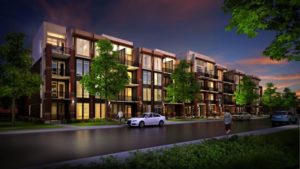
Artistic rendering of a planned, environmentally-friendly wood construction building

Perhaps of even more importance to the stewards of our environment who sit on Vancouver City Council, why not mandate that future home construction be built employing sustainable, carbon-storing cross-laminated timber —  glued at perpendicular angles to make thick beams, and clearly visible in columns, beams, walls and ceilings? Wood construction has proven popular across a broad section of our developer, architect and contractor communities, who see building with wood as a way to increase density at a lower cost, while reducing environmental impact.

Now, that would be an innovation for our Vancouver City Council to truly consider.
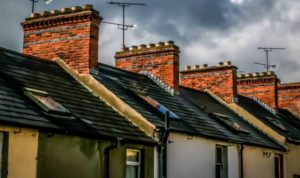
Rowhouses such as the ones above are common in many cities around the world, but not in Vancouver

And what of fee-simple row housing , which architect Michael Geller argues for in an interview conducted by Carlito Pablo, in the October 6, 2021 issue of The Straight?

“In a fee-simple rowhouse or townhouse, there’s nothing owned by the association. The owners own their roof, their windows, the land under and around their townhouse. That means the individual owners are responsible for taking care of any lawn, painting the outside, fixing leaks in the roof, and shoveling the snow.”

Whatever happened to the notion of human-scale, gentle density townhouse construction, all the rage 40 & 50 years ago? Why, in recent years, has townhouse construction fallen so out of favour, as podium and high-rise tower-driven plinth construction has become the greenhouse gas-emitting building forme de la journée?
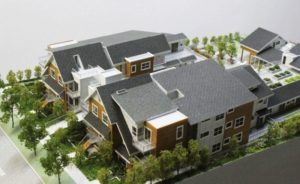
Vancouver Co-Housing, located on 33rd Avenue between Victoria Drive and Knight Street

And what about co-housing in Vancouver, housing that is family-supportive, senior-friendly and energy-efficient? For instance, Vancouver Co-Housing consists of 29 privately owned, fully equipped homes plus 2 rental units, in addition to a large and beautiful common house and outdoor common areas. This vibrant community is located on East 33rd Avenue between Victoria Drive and Knight Street.

The homes range from studios to one-, two-, three- and four-bedroom units – all with their own kitchens. The common house has an area of 6,500 sq ft. and includes a community kitchen, dining room, and lounge; activity rooms for children and teens; office areas; two guest rooms; a yoga studio; and rooftop gardens. As well, there are ground-level gardens, workshops, plus a courtyard and play area that encourage year-round social contact. All parking is underground.

By working together, Vancouver Co-Housing members are able to share amenities common to a traditional home and reduce the size of their private dwelling.


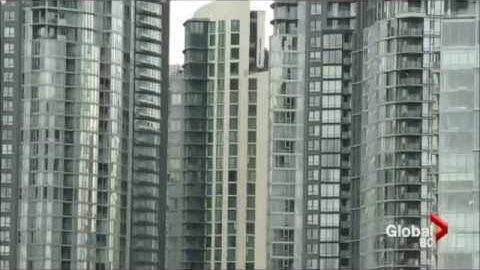
A 2014 Global BC video, identifying Vancouver as one of the high-rise capitals of the world

On July 24, 2014, during the lead up to the Vancouver civic election that year, VanRamblings published a column titled At Issue: Form of Development, and the Livability of Vancouver, which quoted a 2012 study conducted by University of British Columbia Chair of Urban Design and Landscape Architecture, Patrick Condon, addressing the question of how Vancouver might reasonably approach the reduction of energy use and consequent greenhouse gas production in the city by at least 80 per cent by 2050, and how that goal might be accomplished.

The answer: the construction of compact, low-rise structures across the city, along its arterials and throughout its neighbourhoods, as a greener, more workable, more energy-efficient alternative to the present form of high-rise development that so captured the imagination of Vision Vancouver, as seems to be the case with our present Council. That 2014 VanRamblings column is well worth reading.
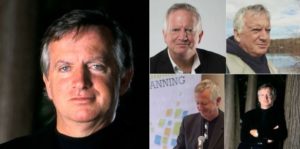
The indefatigable Patrick Condon, future — and absolutely necessary — Vancouver City Councillor

Again today, VanRamblings will leave you with the words of Patrick Condon …

“While it is true that high-rises, when combined in large numbers, create GHG-efficient districts, the buildings themselves are not as efficient as mid-rise buildings.

“High-rises are subject to the effects of too much sun and too much wind on their all-glass skins. And all-glass skins are, despite many improvements to the technology, inherently inefficient. Glass is simply not very good at keeping excessive heat out, or desirable heat in. High-rises, according to BC Hydro data, use almost twice as much energy per square metre as mid-rise structures.”

“High-rise buildings built largely of steel and concrete are less sustainable than low-rise and mid-rise buildings built largely of wood; steel and concrete produce a lot of GHG. Wood traps it. Concrete is 10 times more GHG-intensive than wood.”

Patrick Condon argued with heart and with purpose in 2014, as he does through until today, for the construction of thousands of primarily mid-rise wood frame mixed use commercial / residential buildings on Vancouver’s arterial streets.

And, most importantly, Patrick Condon argues for the retention of existing neighbourhood quality, and the supply of sufficient units to house the burgeoning wave of our elderly population, housing for young families, housing equity, and neighbourhood preservation, through the gentle infill of existing residential streets.

#ParkBoard | The Politics Never End Within Our Civic Bodies

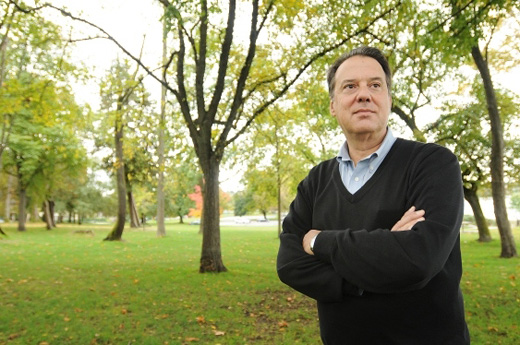
John Coupar - current Vancouver Park Board CommissionerJohn Coupar, Non Partisan Association Park Board Commissioner | Standing in opposition to an anti-democratic motion coming to the Vancouver Park Board | Photo: Dan Toulgoet

In civic governance as practiced within the City of Vancouver, politics — you know, the kind of politics that have our electeds sniping at, belittling, attempting to one up, disliking verging on hatred, while actively engaged in disrespecting one another — remains the order of the day, less so at Vancouver School Board, but ever present at Council (or, now, during their safe socially distanced Webex online meetings), and around the Park Board table nestled within the Vancouver Park Board offices, or is now the case during our pandemic times, online using the city’s Webex online platform.
In the new year, VanRamblings will dedicate the early months of the year to writing about Vancouver civic governance (suffice to say, we’re not happy), and had intended to enjoy the season and leave for another day what will in all likelihood be an evisceration (such a nasty word) of governance in the city of Vancouver, as it is currently practiced, until the following arose …

Vancouver Park Board Procedural Motion, December 7 2020

Vancouver Park Board staff will bring the above recommendation to the Park Board table next Monday, December 7th, first in an in-camera online meeting not available to the public, and then at 6:30pm when the final online meeting of Park Board Commissioners — before the holiday break — will take place. The next Park Board meeting is set for January 18th, 2021.
According to a 31-page Vancouver Park Board staff report [PDF] …

The Vancouver Board of Parks and Recreation Procedure By-law (Park Board Procedure By-law) guides how the business of the Park Board Commissioners is handled and applies to all meetings of the Board and its committees. While the current by-law underwent a comprehensive review in 2018 before being enacted by the Board January 2019, it is best practice to undertake regular administrative reviews to ensure procedures remain relevant.

The revisions outlined in this report, and attached as Appendix A, are proposed to reflect current practices, address gaps, and clarify procedures that may have led to some ambiguity or confusion. Additionally, recommendations have been included to provide Commissioners options to follow-up on the “Future Considerations noted in the last by-law update report regarding electronic and special meetings.

The net impact of the recommendation, when it becomes a motion before the Board this next Monday, as it surely will, would be to deny a minority contingent of duly elected Park Board members to call a Special Meeting of the Board to seek public input on issues of concern to the general populace.
In these parts, we call that bullying, rule of the majority, arrogant decision-making by elected officials, and - let’s face it - downright anti-democratic.

Vancouver Park Board Commissioners, 2018 - 2022Vancouver Park Board Commissioners, l-r: Tricia Barker, John Coupar (NPA); Gwen Giesbrecht, John Irwin (COPE); Stuart Mackinnon, Camil Dumont, Dave Demers (Greens)

Apparently, the genesis for the staff recommendation arises from a Special Meeting of the Board that two Commissioners, John Coupar and Tricia Barker, called this past summer to discuss transportation issues within Stanley Park, with which members of the public had expressed concern.
As a general rule — be it at Council, School Board or Park Board — senior staff are reluctant, at best, to meet with the public to discuss issues of public concern, cuz it’s messy and democratic, and diminishes their power as the professionals who, in actuality, “run” city governance — not to mention which, these time consuming meetings can go on for days, and it takes them away from the familial comfort of their homey and cozy offices.
Park Board staff were none-too-pleased with the calling of the June 18, 2020 Special Meeting — thus, their recommendation to Commissioners. And, if truth be told, neither were COPE Commissioners Gwen Giesbrecht — who viscerally dislikes the rather lovable John Coupar — and John Irwin, and Green Party of Vancouver Park Board Commissioners, current Chairperson, Camil Dumont (also not much of a fan of his NPA Park Board colleagues, ditto his fellow Greens) — Dave Demers & Stuart Mackinnon.
Yes, it’s civic governance as a particularly bad high school experience.

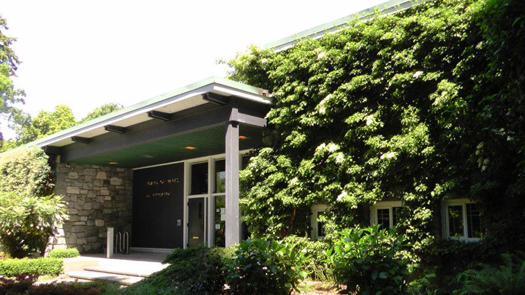
Vancouver Park Board office, on Beach Avenue north-west of English Bay

Now, should the staff “recommendation” be accepted by a majority of the Board at this upcoming final 2020 meeting of Park Board, here’s what the net effect the passage of the motion would mean for governance at the Board, as well as the process to realize the intention of Park Board staff …

1. Going forward only the Park Board Chairperson, or a majority of Board members could call for a Special Meeting of the Board — a derivation of Board practice dating back to its inception more than a century ago;

2. Although there is a provision in the by-law and Park Board governance provisions that would allow a minority contingent of Park Board Commissioners to call a Special Meeting, to address urgent issues of concern to the public, such a motion could (and probably would) be tabled by the majority of the Board Commissioners, effectively making moot the urgent concern provisions of Park Board governance;

3. Assuming the “motion” passes, it would then be forwarded to Vancouver City Council for passage before Council (where such provisions as staff are recommending at Park Board are already in place). How would Council likely respond to the entreaty of Park Board to make application to the provincial government for a change to the Vancouver Charter to accommodate the expressed wishes of the current Park Board? VanRamblings believes the answer would be, contentiously not well;

4. For the sake of argument, let’s say Council says, “Okay you buckos at Park Board, we’ll grant you your Christmas wish, and post your recommended Charter change to our mistresses and masters in Victoria.” La-di-dah. How would British Columbia’s new Minister Responsible for Municipal Affairs, former Tofino Mayor, Josie Osborne, receive the entreaty of Council and Park Board for a change to the Vancouver Charter?

Uuummmm, not well?

One would think that our currently elected Park Board Commissioners would have many better things to do with their time than to seek to diminish democratic governance around the Park Board table, and diminish input from the public into decision-making by our elected Commissioners.
Apparently not.

Vancouver Park Board Commissioner John Coupar on his opposition to a motion to be presented at Park Board on December 7 2020 that would limit public input into decision-making at the Park Board table, and prevent minority members of the Board from calling for a Special Meeting of the Board when issues of public concern arise.

Note should be made that Park Board Chair Dumont determines what items find their way onto the Park Board agenda — as it happens, the Park Board Chair is all powerful. Nothing gets onto the agenda if he doesn’t want it to. So, apparently, Mr. Dumont is possessed of a strong desire to see this staff recommendation become a motion at the Park Board table, a motion he would vigorously support and urge his fellow Commissioners to support.

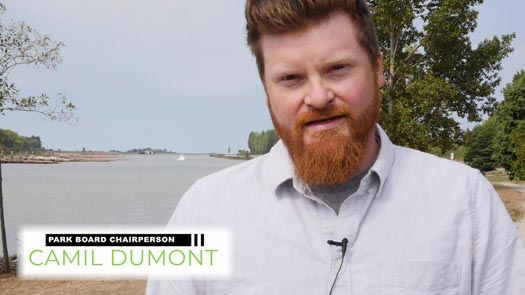
Green Party of Vancouver Park Board Chairperson, Camil Dumont

‘Ceptin one thing: at some point, it’s possible that Mr. Dumont and Mr. Demers would comprise a minority contingent of Green Party of Vancouver Park Board Commissioners on the elected Vancouver Park Board, the values of the remaining Park Board Commissioners in diametric opposition to that for which Mr. Dumont and Mr. Demers steadfastly stand.
Note to Park Board Chairperson Camil Dumont, and his fellow COPE and Green Party of Vancouver Park Board Commissioners: turn the the staff governance report into a motion of Park Board at next Monday’s meeting, and risk that at some point down the road, your very own power as a duly elected Park Board Commissioner will be much diminished.
A risky venture for our elected Park Board Commissioners, anti-democratic in design and intention, and very much contrary to the public interest.

#VanPoli Civic Politics | Faith Groups + Affordable Housing | Part 4

City of Vancouver affordable housing graphic

Joming Lau, a City of Vancouver Planning Analyst and member of Vancouver city’s Community Serving Spaces Team, and his colleague James O’Neill, a Cultural Planner with the city, working in the Cultural Spaces and Infrastructure Division of the Planning Department — and also a member the city’s Community Serving Spaces Team — have been kind in posting to VanRamblings the core document informing the conduct of the Tuesday, May 7th, 2019 affordable housing forum held at CityLab, at Cambie and West Broadway, the document in question, the Community Serving Spaces Place of Worship [pdf] presentation paper on the development of affordable housing and community service spaces on the sites of places of worship.

In an April 1, 2019 article in the Vancouver Sun / Province / PostMedia, migration, diversity and religion writer Douglas Todd asked the question, “Can Metro Vancouver churches plug the dire housing gap?”, going on to ask a second, related question, “How big a dent will re-developing scores of places of worship into housing make in a metropolis that ranks as one of the most unaffordable in the world?”, quoting Andy Yan, director of Simon Fraser University’s city programme as saying …

“Hopefully, the redevelopment (of places of worship) is one of the steps of creating a stairway to housing nirvana in Metro Vancouver. But the scale of trying to house those on local incomes affordably is almost biblical.”

Mr. Todd goes on to report that Christian and Jewish religious groups are together adding hundreds of units each year to the region’s rental and housing market, their annual contribution sometimes exceeding 1,000 new homes, a relatively small portion of the roughly 20,000 to 28,000 homes being constructed each year across Metro Vancouver, but still an invaluable contribution of low cost, affordable housing across our region.

BOSA affordable housing development at 1155 Thurlow Street, with 45 social housing and 168 secure rental units
Approved by Vancouver City Council in 2014, completed in 2018, a partnership between Central Presbyterian Church and Bosa Properties.

In collaboration with the city, Bosa Properties and Central Presbyterian Church, at 1155 Thurlow in downtown Vancouver, set about to provide 45 social housing homes that would be owned by the church, allowing Bosa Properties to build 168 secured rental homes that would be owned by Bosa, the project including the construction of a new church (and child care centre) built for the church by Bosa — at no expense to the church — and still owned by the church, the very much needed social housing homes and the child care centre creating an ongoing revenue stream for the Central Presbyterian Church. A win-win for all concerned: city, developer & church.


Don't Miss Any of VanRamblings Must-Read Content. Click On This Graphic for More

The role of the city? To collaborate with the places of worship to secure funding — from private sources, from the federal or provincial governments through their affordable housing programmes, or in some cases through access to the city’s Community Amenity Contribution programme, which secures in-kind or cash contributions from property developers in exchange for re-zoning of the property — which pays for the entire cost of construction, the city liaising with the place of worship to establish a relationship with a non-profit or for-profit property developer / builder.

Further, the city expedites the development permit process.

From first contact with a place of worship to final completion & occupancy, an average of three years transpire, with the end result: the creation of affordable rental housing, low cost social housing, and much needed community serving spaces, such as the aforementioned child care centre.

Catalyst Community Development Society, Vancouver

The most common phrase enunciated at the Community Serving Spaces for Places of Worship forum last week was, “Robert Brown can’t do it all.”


Don't Miss Any of VanRamblings Must-Read Content. Click On This Graphic for More

Mr. Brown, the founder of the Catalyst Housing Development Society is the President of our province’s largest non-profit real estate developer, he and his team responsible for the development of more affordable rental homes on the Lower Mainland and across our province than any other British Columbia developer, allowing faith groups to unlock the value of their real estate assets, while reinvesting that value back into communities for the benefit of families, and a revenue creation stream for places of worship.


Don't Miss Any of VanRamblings Must-Read Content. Click On This Graphic for More

A key piece of altruistic advice Mr. Brown provided to faith groups at last week’s affordable housing forum: retain ownership of your property.

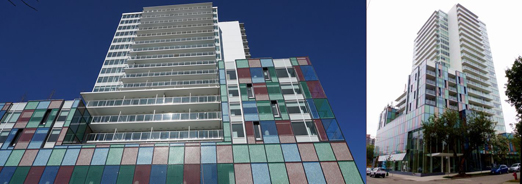
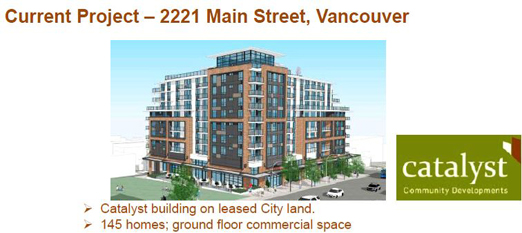
Catalyst Community Development located at 2221 Main Street, in the city of Vancouver

Here’s the bottom line: there are 364 land rich, cash poor places of worship across the Vancouver landscape. The City of Vancouver, as part of the city’s Healthy City Strategy, has set about to work with faith groups to create the conditions necessary that would result in the construction of much needed low cost, affordable housing on the under developed properties owned by faith group congregations, providing a no cost renovation or reconstruction of the aging church, synagogue or other place of worship infrastructure, while also creating a revenue stream for the faith group membership, to ensure that our city’s places of worship will continue to thrive, while serving the social and community interests of neighbourhoods across our city.

Music Sundays | Ani DiFranco | Vancouver Folk Music Festival

Ani DiFranco first played the Vancouver Folk Music Festival in 1992, a 22-year-old up-and-coming singer-songwriter who drove herself from concert to concert across the North American continent, billing herself as the “Little Folksinger” (Ms. DiFranco is 5’2″ tall), in the process creating her own record label, Righteous Babe, allowing her significant creative freedom.
Through the Righteous Babe Foundation Ms. DiFranco, long a political and cultural activist, has backed grassroots cultural and political organizations supporting causes including reproductive rights, gay, lesbian and women’s issues, in 2004 touring Thai and Burmese refugee camps to learn about the Burmese resistance movement and the country’s fight for democracy, in recent years lending her voice and presence to the Women’s Lives Marches in Washington, DC, tangibly demonstrating her belief that the personal is, now and forever, political.

2019 Vancouver Folk Music Festival

When she first appeared on the various Vancouver Folk Music Festival stages, she immediately connected with the rapturous festival audiences, and that grassroots connection has endured here and far beyond.
Over the years, Vancouver’s Folk Music Festival stages have also been gay-friendly: in addition to Ani DiFranco, Canada’s own k.d. lang, the Indigo Girls, Nanci Griffith, Holly Near, Janis Ian, Tret Fure, Melissa Ferrick, Toshi Reagon, Jill Sobule, Cheryl Wheeler, Patty Larkin (and dozens more) have graced festival stages, and delighted and moved audiences.

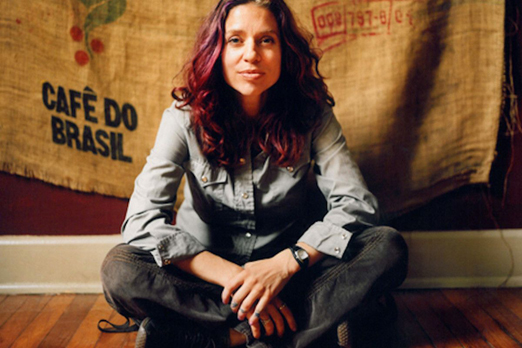
Ani DiFranco, 2015

When she first emerged in 1990, Ani DiFranco had an immediate appeal to misfits. After débuting her eponymous solo album that year, she followed it up with six more in rapid succession, taking only a brief one-year breather in between 1996’s Dilate and 1998’s best-selling Little Plastic Castle.
Ms. DiFranco’s folk-punk aesthetic (complete with staccato finger pickings and spoken word spun into song) was especially exciting to queer women, who rarely had the opportunity to sing along with inclusive lyrics like Ms. DiFranco’s. Not only was she a poetic lyricist, she had a handful of songs that were explicitly about other women, using female pronouns.
Success has been somewhat bittersweet, though, for the folk-punk feminist and rabble-rousing storyteller.
Early on, Ms. DiFranco was open about her bisexuality (she’s married to producer Mike Napolitano, with whom she has two children), but in 2015, she told the LGBT blog GoPride.com she’s “not so queer anymore, but definitely a woman-centered woman and just a human rights-centered artist.” This didn’t sit too well with the lesbian and otherwise queer fanbase she’d drawn from the beginning.

Ani DiFranco - No Walls and the Recurring Dream

Ani DiFranco is set to release a memoir entitled No Walls and the Recurring Dream, recounting her early life from a place of hard-won wisdom, combining personal expression, the power of music, feminism, political activism, storytelling and philanthropy, while chronicling her rise to fame with an engaging candor, a frank, honest, passionate, touching and humorous tale of one woman’s eventful coming of age story and radical journey, defined by her ever-present ethos of fierce independence.
Viking Press will release Ms. DiFranco’s book next month, on Tuesday, May 7th, a week from this coming Tuesday.