Category Archives: Music

The Music of One’s Life | Tom Waits | Closing Time +

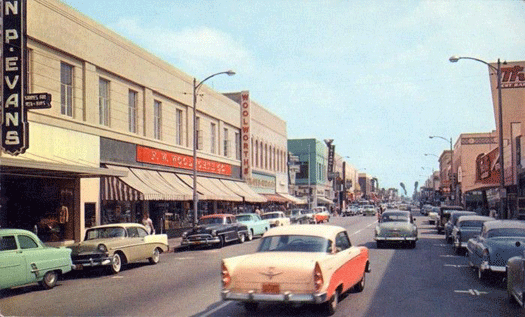
Pomona, California, 1950s, birthplace of singer-songwriter Tom WaitsPomona, California, Los Angeles county, 1950s, birthplace of songwriter Tom Waits

Thomas Alan Waits was born on the 7th of December in 1949, in Pomona, California, a little town located between the Inland Empire and the San Gabriel Valley, situated within Los Angeles County. His father, Jesse Frank Waits — about whom Waits would later say … “he was a tough one, always an outsider” — taught Spanish at a local school and was an alcoholic, while his mother Alma was a housewife and regular church-goer.
Waits was the second of three siblings, having both an older and younger sister, raised (as he’s often said) in a middle-class household, his “a pretty normal childhood”. He attended Jordan Elementary and later on Hilltop High School, where he was bullied. It was at Hilltop, though, where he learned to play the bugle and the guitar, while his father had earlier taught him to play the ukulele. Summers, more often than not, he visited maternal relatives in Gridley or Marysville, both small towns about 50 miles north of Sacramento, in northern California. Waits recalls that it was an uncle’s raspy, gravelly voice that inspired the manner in which he later sang.
In 1959, Waits’ parents separated and his father moved away from the family home; it was a traumatic experience for the 10-year-old boy. Alma took her children and relocated to Chula Vista, a middle-class suburb of San Diego. In Chula Vista, he fronted a rhythm and blues school band, The Systems, where he developed a love of soul singers like Ray Charles, James Brown, and Wilson Pickett, as well as country music and Roy Orbison. Later on, Bob Dylan became a catalytic influence, with Waits placing transcriptions of Dylan’s lyrics on his bedroom walls.
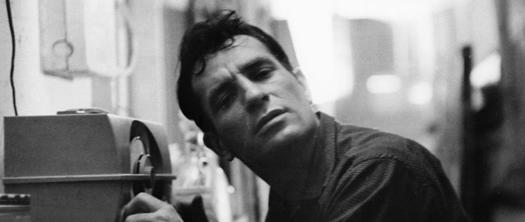
Novelist Jack Kerouac, listening to the beat of a new generationNovelist Jack Kerouac listening to the beat of a new generation, where as he wrote, “The only people for me are the mad ones, the ones who are mad to live, mad to talk, mad to be saved, desirous of everything at the same time, the ones who never yawn or say a commonplace thing, but burn, burn, burn, like fabulous yellow roman candles exploding like spiders across the stars.” Excerpted from Kerouac’s 1956 novel, On The Road.

In high school, Waits was a self-described “amateur juvenile delinquent”, interested in “malicious mischief” and breaking the law, a “rebel against the rebels”, as he eschewed the hippie subculture then growing in popularity, inspired instead by the 1950s Beat generation, with a great love for the work of Beat writers like Jack Kerouac, Allen Ginsberg, and William S. Burroughs. In 1968, at age 18, he dropped out of high school.

The Howl, Allen Ginsburg, September 1956

I saw the best minds of my generation destroyed by madness, starving hysterical naked, dragging themselves through the negro streets at dawn looking for an angry fix, angelheaded hipsters burning for the ancient heavenly connection to the starry dynamo in the machinery of night, who poverty and tatters and hollow-eyed and high sat up smoking in the supernatural darkness of cold-water flats floating across the tops of cities contemplating jazz, who bared their brains to Heaven under the El and saw Mohammedan angels staggering on tenement roofs illuminated, who passed through universities with radiant cool eyes hallucinating …

Waits spent much of the next three years traveling, picking up odd jobs here and there, taking college classes in photography, while all the while pursuing his musical interests, including learning the piano, all of which led to gigs along California’s coast, opening for acts like Tim Buckley, and Sonny Terry and Brownie McGhee.

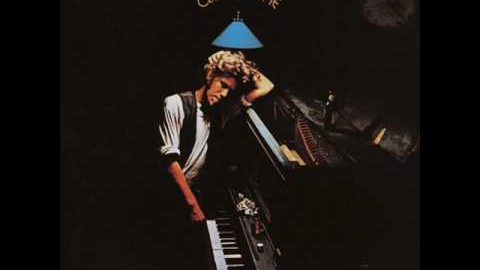
Tom Waits, debut album, Closing Time, March 1973

Early in 1972, Tom Waits landed a gig at the Troubadour in West Hollywood, where he came to the attention of Herb Cohen, a music impresario, record company executive, music publisher, and personal manager for Linda Ronstadt, Frank Zappa, Buckley, and Odetta, among other artists. Cohen signed Waits to a publishing contract with Troubador Records — it was at Troubador that Waits came to the attention of David Geffen, who gave Waits a recording contract with his Asylum Records, the recording sessions taking place in Hollywood’s Sunset Sound studios, the resulting album titled Closing Time, released in March 1973. The rest, as they say, is history.

In a down period of my life, living in a tiny apartment in Coquitlam, teaching school, my Master’s programme falling apart, and the state of my marriage — if such a thing even existed anymore — undecided at best, I took solace with music from Waits’ 1980 album Blue Valentine, most particularly his version of Leonard Bernstein’s Somewhere, from West Side Story (which, for me, is the definitive version of the song). As you can hear, by this point in his career, Tom Waits had developed his signature raspy and heartrending voice. Both songs remain among my favourites to this day.

The Music & The Stories of One’s Life | A Horse With No Name

Nogales, Sonora Mexico, circa 1972

When Cathy and I left for Mexico in February 1972, we crossed the border at Tijuana, and took a bus to Mexicali, where we boarded a train for Guadalajara. On the way home, though, we crossed the border at Nogales, Mexico, approximately 600 kilometres east of Mexicali — which meant that when we entered into the United States, we landed in Nogales, Arizona rather than San Ysidro, California.
Whatever the case, we were happy to be heading home.

Rollies Diner in Nogales, Arizona

Once in Nogales, Arizona, we stopped in at a popular local diner for breakfast (it was approximately 8 a.m.), after which we headed over to the highway, where we stuck our thumbs out, hoping for an 85-mile ride to Tuscon, Arizona, all dusty and laden with backpacks, of course.
A kind young man picked Cathy and I up just outside of Nogales, and as luck would have it, he was on his way to Tuscon. Once we’d loaded our backpacks into the back seat, and were comfortably ensconced in his late model Ford sedan, as we barrelled down the I-91 highway heading north, he turned the radio on. After two months away, the song that follows just below is the first song we heard on American radio, a song that would soon rise to #1 on the charts, and which Cathy and I remember to this day as signalling the first jaunt of our journey home, to Los Angeles initially, and then to our home atop Burnaby Mountain, at SFU’s Louis Riel House.

Somehow a song about the desert as we trundled our way through southern Arizona on a warm, breezy, dusty sun dappled Tuesday morning seemed entirely fitting — Cathy and I just looked at one another & smiled.
Once in Tuscon, we once again put our thumbs out at the side of the highway, and soon found ourselves on the second, 113-mile leg of our journey home, this time to Phoenix, and afterwards on the last leg of our route back to our friend’s home in East LA, a 372-mile ride to from Phoenix to Los Angeles. We made it back to Los Angeles around 8:30 p.m.
In fact, we arrived in the Westwood neighbourhood of Los Angeles, where our friend Bachi (Manuel Vittorio Esquivel) was kind enough take the 22-minute drive from East L.A. to pick us up, and bring us back to his home. We stayed a couple of days, and then jumped into our Datsun 510 — a wedding present, as it happens, and a vehicle that Bachi had serviced in our absence, all in prep for our 1277-mile leisurely sojourn to Vancouver.

Holiday Season | VanRamblings Will Reduce Posting This Month

The 2018 holiday season, and VanRamblings reduces our incidence of posting

The holiday season is upon us. For VanRamblings that means spending time with friends and family (as I suspect is the case with most of us), and a level of busyness that is unusual for us — given that much of our life is given over to the creative endeavour of writing on VanRamblings, which entails a dozen hours or more each day sitting in front of our computer composing the posts that you read from time to time, on this blog of ours.
From April 20th on of this year — six months out from the 2018 Vancouver municipal election —&#32there was a raison d’être for VanRamblings: to introduce you to the candidates we felt were worthy and deserving of your vote. To that end, we wrote as many as 2500 words each day about the 2018 Vancouver municipal election, the issues we felt were important for candidates to address, and who we felt best were most capable of creating the city we need, a fairer and more just city for all.
While it remains our intention to continue our coverage of Vancouver City Council, School Board and Park Board, we are not quite so obsessed with civic governance and all that occurs each day with the process of decision-making that will lead to creating a city for all of us. In Vancouver, we’ve elected our Mayor, Kennedy Stewart, and a pretty darn fine group of City Councillors, School Board trustees and Park Board Commissioners — we’re prepared to let them get on with the job sans the obsessive coverage that has come to define VanRamblings these past almost eight months.

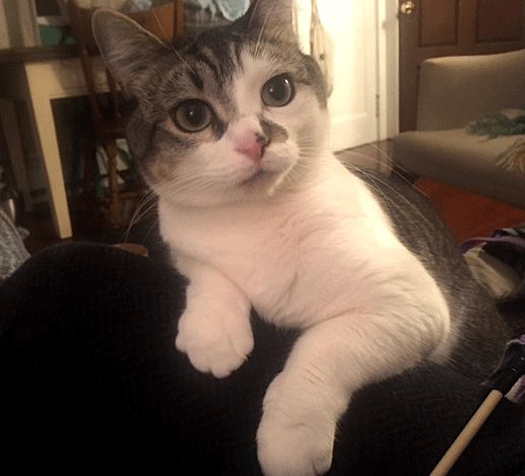
Damara, our new kittyamara-new-kitty.gifDamara, our new 3-year-old kitty, soon to be our companion as we write each day.

Here’s our plan for VanRamblings, then, going forward, which, of course, is subject to change — we’re planning on writing about politics once or twice a week this month. We have a column on Janet Fraser, Chairperson of the Vancouver School Board, that we’re intending to write, with likely publication this upcoming week (for the record, we consider Dr. Fraser to be a transformative political figure, and believe we should all be grateful for the gift of her presence on Vancouver’s political scene). We’ve also got a column on Vancouver International Film Festival programmer Tom Charity’s Best of 2018, which it is our current intention to publish next Friday.
In fact, VanRamblings will publish a great many columns on film this month — because we love film, considering it to be the art of our age, and during the April through October period we forfeited our love of film in favour of covering the election — where the majority of candidates we endorsed were elected to office, as well as a few we failed to endorse, but should have.
As far as is possible, in addition to our once or twice a week political coverage, we’ll keep up our Arts Friday coverage — which will be given over to film for the foreseeable future, but within which we plan to expand our coverage into other facets of Vancouver’s arts scene. We’ll continue our Stories of a Life feature — no such posting this week, or last, but next week we promise — and our Music Sunday feature, which tomorrow oughta emerge as a sort of Story of a Life when, and if, it actually comes to fruition. Tuesdays and Thursdays may be fallow days, or given over to tech coverage — we have a column for Apple iPhone SE, 6, 6 Plus, 6s, 6s Plus, 7, 7 Plus, 8, 8 Plus, and X users we’ll publish this upcoming Tuesday.
In the new year, VanRamblings will finally write about our cancer journey — which “story” will begin 10 months prior to our official cancer diagnosis. We’ll introduce you to those who made a difference in our life, and who are — we believe — the reason we are here today, enabling you to read those words on the screen in front of you (there’ll be a great many political folks who will find their way into our reporting out, as our “life savers”).
Thank you for hanging in with us.
Going forward, it is our intention to remain relentlessly positive about pretty much darn near everyone and everything, while focusing on change for the better, and a better life for everyone in all aspects of our lives.

The Music of One’s Life | Kasey Chambers | The Captain

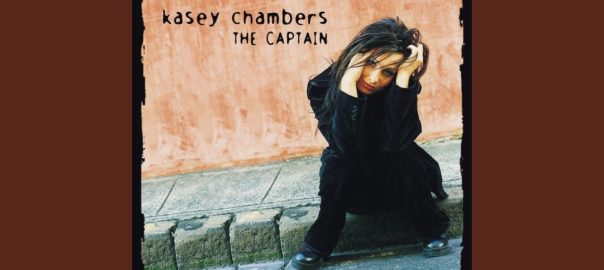
Kasey Chambers, The Captain

As the year draws to a close, the thoughts of music lovers everywhere is the anticipation of the discovery of new music made extant through the publication of the various year-end lists by respected music critics of the best new, under-the-radar music releases of the previous 11 months.
Such was the case during the holiday season in 2000, when the then not-discredited Charlie Rose had on the then not-discredited longtime New Yorker music critic Sasha Frere-Jones on his show to discuss the best albums of 2000. Mr. Frere-Jones found himself able to talk about one artist and one artist alone: Kasey Chambers, a then 23-year-old woman raised in the southern Australian outback who, he insisted, had released the best album of the year, the best country album he’d heard in years. Mr. Frere-Jones could not help himself from extolling Ms. Chambers’ many virtues as a singer-songwriter, going on to insist that Mr. Rose, and his other guests around the table that evening — and everyone tuned into PBS’ The Charlie Rose Show first thing the next morning repair to their local record store to secure, or order, Kasey Chambers’ début album release, The Captain.
Enthusiasm exhibited by a usually taciturn critic is a rare commodity at the best of times — critics being a cynical lot, by nature — leaving the viewer of that evening’s episode of The Charlie Rose Show no option other than to purchase The Captain first thing the next day — which, of course, I did.
Kasey Chambers’ music is timeless, as is the case with every song on The Captain. If you’ve not heard The Captain prior to this, you can listen to each of the songs on the album through YouTube, after which I assure you, you’ll want to download the entire album, and make it a part of your music library, and the soundtrack of your life, going forward. Important, really.

Click or tap on this link to listen to & savour Kasey Chambers’ The Captain in its entirety

Kasey Chambers was born in Mount Gambier, the second most populated city in South Australia (urban population: 28,684) early on the Friday afternoon of June 4th, 1976, the younger sister of brother Nash, who was born in 1974. Kasey’s parents, Diane and Bill, were musicians, itinerant farmers and hunters, who wanted nothing to do with big city life.

Mount Gambier's Blue Lake, in southern Australia

Mount Gambier’s crystalline Blue Lake

As money was often tight, on the few occasions when the family came to town, given that all members of the family were fine, well-respected musicians, arrangements were made for the family to play a series of concerts, the monies earned enough to pay for supplies until the next time the Chambers family came to town. By 1986, when Kasey was only 10, the family had formed a band called the Dead Ringer Band, so-named because Nash and Kasey looked like younger versions of their parents.
From the outset, it was clear to anyone that heard Kasey Chambers that she was a preternatural talent, Kasey Jo Chambers providing vocals and writing songs for a series of albums released by her parents between 1987 and 1993. When interviewed by the press — word of Kasey’s talent spread quickly across Australia, almost from the outset — she often cited Emmylou Harris as one of her primary influences, recalling that Harris’ music was frequently played by her parents, ever since she was a child.
Kasey Chambers recorded her début solo album, The Captain in July and August of 1998, with her brother Nash producing, and her father Bill on guitar (her parents were in the throes of divorce, so mother Diane played no role in the recording of the album). Joining the family on the recording were American country musicians, Buddy Miller and Julie Miller, who added guitars and vocals to four tracks. The Captain was released in Australia in May 1999, and worldwide, in June 2000 by Asylum Records.
And, as is often said, the rest is transcendent & salutary musical history.
Cry Like a Baby went on to win the country music Song of the Year award in 2000, The Captain winning the same award the following year. The next year, Kasey Chambers toured across the globe as the supporting and opening act for Lucinda Williams, who was touring to support her breakthrough, multi-award winning album, Car Wheels on a Gravel Road.
At my insistence, my friend J.B. Shayne (not a fan of country music) and I attended the Lucinda Williams concert at The Vogue in late 2001 — a three-hour concert that blew the roof of the venue — J.B. commenting to me afterwards, “That was like attending a Doors concert. I don’t think I’ve ever heard better musicianship. Lucinda Williams and her band (two drummers / percussionists, two lead guitarists, a rhythm guitarist, a slide guitarist, an organist, and a pianist) are probably the finest band I’ve heard in years. It’s maybe the most stoned concert I’ve ever attended.” And so it was.
Kasey Chambers, of course, was the opening act — and proved to be everything and more that I’d promised J.B. Within minutes, she had the audience in the palm of her hand, clapping, cheering, shouting, and head over heels in love with this Aussie girl who just knocked their socks off, not only performing most of the songs off The Captain, but previewing songs from her new album, Barricades & Brickwalls, produced by her brother Nash, the song Not Pretty Enough going on to win CMA Song of the Year.