
Category Archives: Jude and Megan

Stories of a Life | Megan, Jude & Me and Movies | 80s and 90s

Cinema | Megan and Jude Tomlin, and their dad, love cinema, love the movies, stories of a life

Film has always been a central, organizing force in my relationship with both my daughter, Megan, and my son, Jude.
Our collective love of the cinema, attending film festivals and discussing what we saw following the various screenings we attended (usually at the Fresgo Inn on Davie, which was alive no matter the time of night or early morning) was, over the years, a central feature of our relationship — the relationship between son and daughter, and dad — that allowed us to delve deep into discussions of the meaning of life, and our collective responsibility to work towards creating a fairer and more just world for everyone.
Heart and deep caring for humanity was at the centre of our love of film, and at the centre of our loving familial relationship, informing the choices we made about how we would conduct ourselves in the world, and the projects and causes to which we would devote our time and our energies.

In the 1980s, when Cathy and I were going through a rancorous divorce, film brought us together. When in Seattle — which we visited frequently, always staying on the non-smoking 33rd floor of the Weston twin towers — in 1984, we took in a screening of Garry Marshall’s The Flamingo Kid — the story of a working class boy (Matt Dillon) who takes a summer job at a beach resort and learns valuable life lessons. Megan was seven years of age, and Jude 9 — both were uncertain about the efficacy of our trip south (without their mother’s permission — we called her upon arriving at our hotel), but the screening alleviated and, finally, repaired any of their concerns, and all went well that weekend. Fortuitously, too, upon our return, the divorce proceedings inexplicably moved forward into a more reasonable and thoughtful direction, reflective of all our collective concerns.
Whenever there was “trouble” in our relationship — generated, most usually, by their mother — film served to salve the wounds of dysfunction, allowing us to find our collective centre while healing the wounds that rent all of our lives during a decade-long, million dollar custody dispute.
Film spoke to us, made us better, took us out of the drudgery of our too often protean daily and, more often, troubled lives, and engaged us while putting our lives into a broader and more human scale perspective. Never once was there a film that we saw together when we didn’t come out of the screening feeling more whole, and more at one with ourselves & the world.

Such was true, at the screenings of Glenn Close and John Malkovich’s Dangerous Liaisons over the holiday period in 1988, or months later at the screening of Kevin Costner’s Field of Dreams, which we took in at the Oakridge Theatre, a favourite and comforting cinema haunt of ours.
When Megan wanted some “alone time” with me, it almost always revolved around watching a film together, although as Megan matured (and as her love for film matured), Megan made it plain that she was present in the theatre to watch the film, not “share time” with me, choosing always to sit in a whole other section of the theatre (it drove her crazy in the times that we were sitting together in a theatre that I would check in occasionally with her, looking at her to determine how she felt about the film — talking during a film was an unforgivable sin, so that was never going to happen).
Some days, Megan would call and say, “Dad, take me to a film.” And because I was a film critic at the time, and had a pass to attend at any cinema in North America, off the two of us would traipse to see Kathy Bates’ Fried Green Tomatoes (1991) or Johnny Depp’s Benny & Joon (1993) at the old 12-theatre complex downstairs in the Royal Centre mall.
Other times, post dinner and after Megan had finished her homework, I’d say to Megan out of the blue, “I’m heading out to attend a screening of a film. Do you want to come along with me?” Megan would ponder my question for a moment before asking, “Which film?”
In 1991, one very long film screening we attended was Kevin Costner’s directorial début, Dances With Wolves, about which we knew nothing other than it starred one of our favourite actors, and off the two of us went.

At screening’s end (Megan and I actually sat together at this particular screening, which took place in the huge Granville 7 Cinema 7, cuz the preview theatre screening room was just packed), Megan turned to me, and said, “Dad, I knew this was going to be a great film.” And it was. “And, you know what else? It’s going to pick up a raft of Oscars this year, too, and be considered one of the, if not the best, films of the year.”
Jude and Megan also attended film festival screenings with me.
Almost inevitably, Vancouver International Film Festival founder, and co-owner of Festival Cinemas Leonard Schein was present with his wife Barbara, and at a screening’s end, Megan would make her way over to wherever Leonard and Barbara were sitting to enquire of him whether or not he intended to book the film into either the Varsity, Park or Starlight.

Following screenings of Neil Jordan’s 1992 putative multiple Oscar award winner, The Crying Game or, that same year, Baz Luhrmann’s Strictly Ballroom, Megan marched right over to Leonard, and asked him boldfacedly, “Well, what did you think?” When Leonard indicated that he thought the films were not quite his cup of tea, that both films would have difficulty finding an audience, and that it was unlikely he’d be booking either film into one of his cinemas, Megan lit into Leonard with a passion and an anger that I had rarely observed as coming from her, saying, “Are you out of your mind? Strictly Ballroom (or, The Crying Game) is a wonderful film, and just the sort of film that not only should you book, but that you MUST book — these are both groundbreaking films that will only serve to reinforce your reputation as an arts cinema impresario, but will also make you a tonne of money, and we all know that you’re all about the money. Either you book these films into The Varsity, or believe me when I tell you that there’ll be hell to pay when you see me next.”
And with that, Megan marched off.

At the 1990 Vancouver International Film Festival, I’d caught a screening of Whit Stillman’s directorial début, Metropolitan, in preview, and knew that this would be a film that Megan would just love (and be astounded by, at the revelation of one of the characters, mid-film). I made arrangements to pick Megan up from University Hill Secondary at 3pm sharp on the day of the festival screening, we drove downtown, found a parking spot, and rushed over to The Studio Cinema on Granville to catch the 4pm screening of Metropolitan — which as I had predicted, Megan just loved.
In early December 1993, on a particularly chilly and overcast day, at 10am in Cinema 2 at the Granville 7 theatre complex, I caught a screening of Jonathan Demme’s groundbreaking new film, Philadelphia — a film about which I knew little, and a film that knocked me out (along with the handful of film critics in attendance at the theatre for the screening). Emerging from the theatre just after noon, making my way onto Granville, I looked for the nearest telephone in order that I might call Megan at school.
I called the office at University Hill Secondary, and asked them to find Megan and bring her to the phone. When Megan asked, “Dad, is everything all right?”, I told her about the film I had just seen, and that when it opened in January, I wanted to take her and Jude to a screening at the Granville 7. We talked about the film for a few minutes, with her saying about 10 minutes in, “I’m holding up the school phone, and calls coming in. Let’s get together after school. Come and pick me up, and we can continue our conversation. I’ll see you then, Dad. I love you.”
There are gifts we give our children. From my parents, it was what would emerge as a lifelong love for country music. For Jude and Megan, my gift was a love of music, a love of the ballet, and an abiding love for film.

Saving the Environment | Fast Fashion vs the ‘Thrift’ Economy

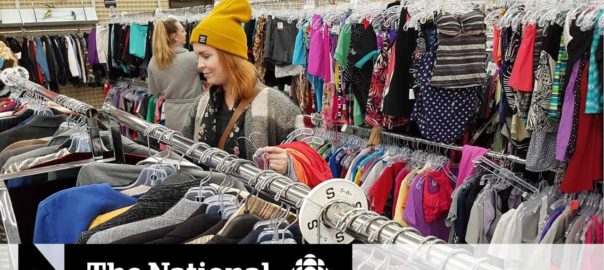
Consignment clothes shopping as a thrifty means to save the environment

Fashion is today the second most polluting industry in the world, following only the oil business.
For altruistic and ecological reasons, the shopping attitude of Canadians towards second-hand clothes has been changing, and consignment stores are bustling with their newfound clientele, and consequent increased sales.
What was once a $12 billion North American market only a few short years ago is now a thriving $24 billion consignment clothing market, with the marketplace expected to top $50 billion by the middle of the next decade.
In other words, the ‘second hand economy’ is thriving.

A consignment clothing shop

Consignment stores are not what they used to be, offering quality like never before, carefully curated collections, and an elevated shopping experience for their burgeoning customer base.
A recent published study shows that in 2018, 64% of women and men were willing to buy pre-owned consignment store clothing — clothing which often has never been worn, and acquired from businesses which have gone bankrupt — up from 45% in 2016. The clothing retail industry believes that by 2028, up to half of the clothes in women’s and men’s wardrobes are likely to be ‘secondhand’. Fashion circularity, a new term referring to the recycled life of a garment, as indicated above is projected to reach $51 billion in five years, up from the current $24 billion.
In discussion with consignment store operators across Vancouver, proprietors told VanRamblings that where there was once “a stigma attached” to purchasing consignment store clothing — conjuring images of the yellow sweat patches, clothes strewn casually and confusingly hung (if at all) and emotional baggage people often associate with used clothing …
“Now, thankfully, purchasing clothing from consignment stores is not just acceptable — it’s cool and has completely captured the fashion zeitgeist,” one consignment clothing proprietor recently told us.
A recent study published by the Raymond James Financial Centre reports that 56% of women and men aged 18-29 prefer the consignment second hand market over conventional retailers of new clothing. Shopping in a thrifty manner guarantees shoppers the uniqueness of their own style. Most of the pieces in a consignment clothing shop are one of a kind, and allow endless possibilities of matching and styling in a creative and unique way.
All of which is to say, no longer is there a taboo about consignment clothes shopping. The rise of the sharing economy has also helped — it’s taken the stigma out of resale and removed the need to own something forever.

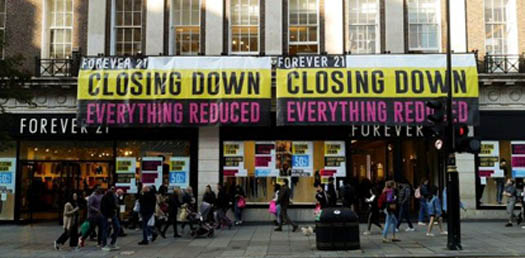
Forever 21 fashion retailer closes its doors

In September, fast fashion chain Forever 21 announced it was closing all its international locations, including 44 stores in Canada, amid flagging sales.
According to a recent interview conducted with the CBC finance guru Diane Buckner, British Columbia retail consultant Bruce Winder told her fast fashion’s target market — young, style-conscious shoppers on a budget — are also among those most concerned about the health of the planet.

“The younger millennial specifically, along with Gen Z, are incredibly environmentally conscious,” he said. “And they look at every brand and every product in terms of what is the impact on society, but also what is the impact on the employees and the environment.”

Not only do consignment stores benefit from the fact that the city’s stylish set are clearing out their closets like never before, a return to quality over quantity in the minds of most shoppers means visits to consignment stores for quality designer goods that will last (i.e. not end up in a landfill) and not break the bank will only continue to rise.

One third of millennials do the vast majority of the clothes shopping at thrift and consignment shops

How does consignment clothing store shopping save the environment while also saving you money? Thrift shopping at consignment stores offers a viable solution for anyone looking to help out the environment.

  • Saving Money. Thrifted clothing is far more affordable than new clothes of comparable quality.

  • Smarter Buys. You tend to spend more time looking over each item instead of buying it outright.
  • Unique Finds. It’s highly unlikely that anyone else is walking around in the same clothes as you.
  • Creative Potential. You might be inspired to try new combinations, or even some DIY reconstruction!

If that isn’t enough incentive, as promised above, here are seven ways Erich Lawson writes thrifting helps the environment …

1. Consignment clothing shopping lowers your carbon footprint. A great deal of energy goes into clothing manufacture, right from the transportation of raw materials to the production process. Then, there’s the energy required to transport clothing to stores, and dispose of unwanted pieces. When shoppers buy from consignment stores, we prevent wastage of energy & resources on production of new clothes.

2. Aiding in Water Preservation. In addition to energy, water consumption is extremely high at every stage of clothing production. For instance, growing one kilogram of cotton requires 5,300 gallons of water, while wet processing and printing use 18 and 21.6 gallons respectively, per pound of cotton. Manufacturing, packaging and transportation processes add to this cost as well.

3. Reducing Chemical Pollution. The production of cotton is highly pesticide-intensive, causing soil acidification and water contamination. Textile manufacturing processes also involve the use of harmful dyes, caustic soda and crude oil by-products. These chemicals are generally dumped into areas around manufacturing units, contaminating surface and ground water through soil runoff.

4. North Americans throw out anywhere from 60 to over 80 pounds of textile waste annually, and only about 10% of this makes it to consignment stores. If more people start shopping for consignment clothes, less fabric ends up being dumped in landfills. That’s not all. Packaging material is also reduced, keeping plastic, paper and metal out of the waste stream.

5. Inspiring Green Living. Thrifting is an essential part of green living, in more ways than one. When you buy consignment clothing, you keep them from being sent to a landfill and reduce manufacturing demand as well. Also, by donating consigning clothes you no longer wish to wear, you encourage others simply by giving them something they can use.

6. Boosting Community Development. Shopping at consignment stores means support for local business instead of multinational corporations. Consignment stores provide employment in retail outlets, creating more jobs and boosting the local economy. Many hire disabled workers and support local community programming projects as well.

7. Encourages Recycling. Did you know that recycled cotton clothing uses less than 3% of the energy that would have gone into producing new clothes? When you reuse or recycle clothes, you’re decreasing the demand for production & encouraging sustainabity. It may not seem like much, but every item that doesn’t end up in a landfill counts as a win!

In the 1990s, when VanRamblings was charged with training Statistics Canada employees on how to conduct the annual Survey of Household Spending, during the role play portion of the training exercise, in answer to the question as to how much we spent on clothing and shoes each year, we responded with: $500. Senior staff at Statistics Canada guffawed loudly when VanRamblings offered this bit of information, saying to us at days’ end, “Raymond, suggesting that you spend only $500 a year on clothing and shoes is the funniest thing I think I’ll ever hear. How clever of you. Good for you. It brought lightness to the day’s proceedings.”

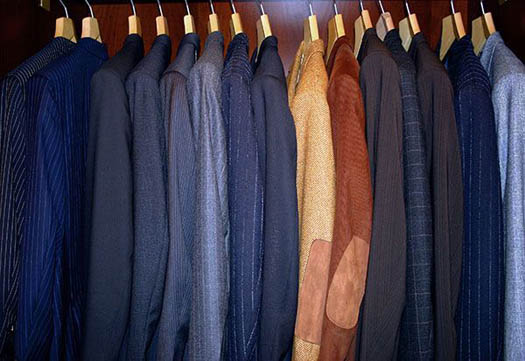
Men's jackets to be found at a consignment clothing shop

Little did senior staff know that, in fact, VanRamblings was acquiring most of our clothing from Arthur’s for Men on West 1st Avenue just west of Burrard Street, where fashionable wool sweaters could be had for $15, shirts and pants for $10, and jackets and shoes for $25, or less.
VanRamblings’ children had long encouraged shopping at consignment stores.

“Dad, not only are you colour blind, you have no fashion sense. In the past, you’ve bought your clothing at The Bay, and you’ve tended to shop for the store brands. You are much better off shopping for name label clothing at a consignment store: those clothing items are priced less expensively than what you’re buying now, the clothes are of invariably better quality — and will hold their nap in a way your current shirts, sweaters and pants will never do, meaning the clothing will last longer.”

“Buying name label consignment clothing assures quality, assures — at least in most cases — proper colour and design that will match the remaining items in your wardrobe, and as long as you shop at Arthur’s for Men, the owners will know what clothing items you have in your wardrobe at home, because they have a list of what you’ve purchased, so will be able to recommend complementary items.”

And now to the present.
Recently, we purchased an Italian suede jacket we’d seen at a neighbourhood Italian clothing boutique that had now gone out of business.
The jacket was retailing for $380.
When Turnabout (our consignment clothing shop of choice, these days) purchased almost the entire stock of the bankrupt Italian clothing boutique, that $380 suede jacket was put on sale for $40!

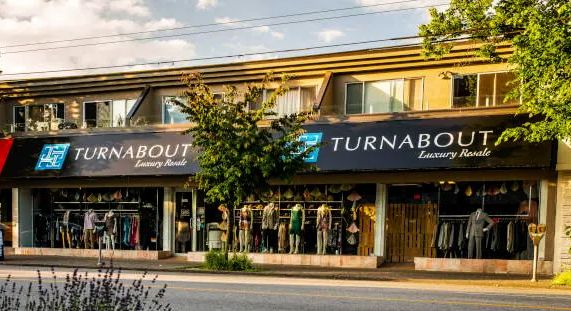
Turnabout Luxury Clothes Consignment Shop on West Broadway in Vancouve

When walking into the store the morning the jacket was put on sale, staff approached me to say, “Mr. Tomlin, we’ve just put a jacket out on the floor that we think you’ll love,” directing me to the suede jacket. “You’d better buy it now, or it’ll be gone by noon.”
So, we did — and enjoy wearing it today!

One third of millennials do the vast majority of the clothes shopping at thrift and consignment shops

Now, it may be a lark that our former employers at Statistics Canada thought our voiced annual clothing expenditure to be a laugh, but in our current scarce and uncertain economy, if sales at the consignment store we most often attend is any indication — where only a decade ago, we could wait for an item to drop 80% in price were we to wait six to eight weeks — when an item we like now appears in the shop, we purchase it immediately, because if we don’t, it’s almost a certainty that it’ll be gone the next day.

Stories of a Life | 1989 – 90 | The Balloon Story

Stories of a Life | VanRamblings | The Balloon Story, 1989 - 90

Christmas of 1989, Cathy asked me if she might have the children on Christmas Day, as her mother would be in town and very much wanted to spend Christmas Day with her two grandchildren, Jude and Megan.
Now, just the previous year Cathy and I had come to the bitter end of an arduous and discomfiting 10 year, million dollar separation and divorce journey that had near bankrupted me. Although I had sole custody of the children from 1978 through 1981, because Myrtle (Cathy’s mother) hated having to go through me to see her grandchildren, she financed what turned out to be a brutal seven year campaign to wrest sole custody away from me in favour of Cathy having the children year round, in the court proceedings setting about to deny me access to my two loving children.
In order to pay for the legal fees necessary to put my position forward in the Supreme Court (and to preserve my access to Jude and Megan), I worked three jobs simultaneously, teaching, working as a social worker, as well as a corrections officer, taking an inheritance from my aunt, as well, to fund legal fees from 1981 through 1988 — going so far in the late eighties as to cash in my teacher’s pension to pay off the last of my legal bills — all but living in the Supreme Court throughout the 1980s, until one fine day, Supreme Court Justice Patrick Dohm seized himself of our divorce and custody matter (which meant that all future proceedings would be directed to his court), with Justice Dohm finally deciding in 1988 that “enough was enough”, scolding Cathy, instructing her to “behave”, and then awarding the two of us joint custody, which gave me 183 days of access to the children each year, Wednesday evenings, Friday evenings through Sunday evenings, half of each of the Easter and Christmas holidays, as well as all summers, from the beginning of July through the end of August.

Note of reflection: I will say this, had I to do it all over again, I would not have fought what was for me a half million dollar custody battle with Cathy throughout the 1980s. Some people are meant to be parents — Cathy is not one of those people. Had I not fought with her, gone to court half a dozen or more times each year for seven years, because Cathy is who she is, I likely would have spent just as much time, perhaps even more time, with Jude and Megan throughout the 1980s than I did by fighting with her in court to maintain my access to the children — and would most probably have a better relationship with my children than is the case today.

In 1988, as per the Supreme Court ruling of Justice Dohm, in the first year of the Court mandated agreement I was given the latter half of the Christmas holidays as access, which meant that in 1989, I would have the two children from the last day of school through Boxing Day morning. But as Myrtle was in Vancouver during Christmas 1989, Cathy asked if she might have the children from the end of the school term in December through Boxing Day morning.

“Raymond, you know you want to spend time with the children. School gets out for the holidays on Friday, December 22nd and Boxing Day is only four days later, which would give you very little time with Jude and Megan. If you take them for the second half of the holidays, you would have the children from Boxing Day through the late evening of Sunday, January 7th — which would give you the children for thirteen full days, more than three times the number of days you would get if you just had them through Boxing Day, which I’m sure would make you happy.”

The more time I got to spend with the children the better, I had long thought, so I agreed to take the children from Boxing Day through their return to school on the 8th of January, agreeing to forfeit spending Christmas Day with the children in favour of a longer period with the children over the holiday season, granting Myrtle her Christmas wish.
Now, given the previous seven year history of our rancorous divorce, I should have known something was up, but being the good-hearted, naïve fellow I was then (and remain today), I readily — if stupidly — agreed to Cathy’s plan. And thus the conditions are set for part one of today’s story.

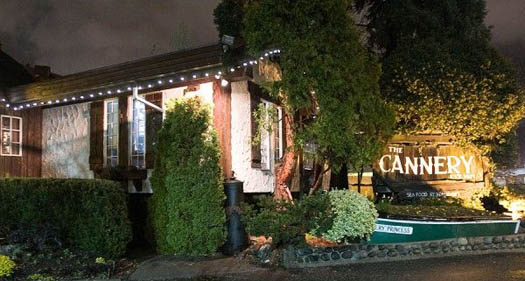
The Cannery Restaurant, along Vancouver's waterfront, in its glory days

A bit of background as to why I should’ve been wary of Cathy’s intentions:

On my birthday on August 11th 1989, Cathy drove over to my home to drop the kids off, as Jude, Megan and I prepared to spend my birthday afternoon together, after which we would attend at The Cannery Restaurant for my much-looked-forward-to birthday dinner.

Cathy drove up in her late model Jetta, parked illegally across the street, leaving Jude and Megan (who were all dressed up) in the car, approaching me as I stood on the front lawn of my home. Cathy said, in an angry tone, “I want to talk with you.” “Something contentious?” I asked. “Yes,” she said, to which I replied, “Could we put off having that discussion until tomorrow? I’d very much like to speak with you, and I’m sure we could work out to your satisfaction whatever it is that you feel needs doing — it’s my birthday, though, and as you well know from having been married to me, I like to steer clear of any sort of contention on my birthday.”

Before I knew what was happening, Cathy balled up her fist, and moving her arm back and then towards my face hit me squarely on my left cheek, with such force that it knocked me to the ground. With me now lying sprawled out on the ground, Cathy stomped back across the street, got back into her car, and drove off, the children looking at me piteously through the rear window of their mother’s car as she speedily drove off.

Cathy could have her moods, and that is an example of one of them.

Robin Williams in the movie Good Morning Vietnam

Boxing Day 1989: the Beginning of a Three Month Interregnum
As pre-arranged and agreed upon, Cathy dropped the children off to my place in the late morning of Boxing Day 1989. Upon alighting from their mother’s car, both children approached me to say that they wanted to go shopping for clothes, the first stop on our buying spree to be Aritzia at Oakridge where Megan had scoped out exactly what she wanted to acquire, with Jude asking afterwards that we drive downtown to Robson Street to a shop where he wanted to acquire a pair of jeans he’d had his eye on, and were on sale on Boxing Day. The three of us spent that day after Christmas day bopping around town, shopping, walking along crowded streets, stopping off for lunch, driving around Stanley Park and out to Horseshoe Bay — the children loved to be driven across the landscape of our region, soaking in the sights, listening to the radio and spending time together — before heading home for dinner, and a night in together watching a video.
Jude and Megan had chosen Good Morning Vietnam as the video, and after cleaning up the kitchen post dinner, set about to create the warming conditions to watch the Robin Williams movie, the three of us all snuggly & toasty warm in our pj’s and housecoats, sitting on the sofa hot chocolate in hand, and snacking on an array of chocolates and shortbread cookies.

Vancouver police officers

At 11:30pm, the front door buzzer in my apartment sounded, with me thinking, “Who could that be at this time of night?” In fact, it was two Vancouver police officers, who asked to be let in, who told me that one of them would be knocking on my apartment door within the next minute. When the officer arrived at my door, I greeted him, the officer looking into my apartment to see Jude and Megan on the sofa staring out at him, the officer asking, “Are you two alright?” “Yep, we’re fine,” they said. The officer asked me to step out into the hallway of my apartment, which I did.
The officer explained to me that a frantic Cathy was in the foyer of my apartment building, court order in hand, exclaiming that I had not returned the children to her earlier in the day, as per the court order (a court order which she had re-proclaimed for this evening event). Cathy contended, the officer said, that I had not returned the children to her, so she called the police to enforce the court order — which he and his fellow officer were now compelled to do. I set about to explain the circumstance, but the officer was clear that the court order trumped whatever exclamation of events I was presenting to him. The officer asked me to return to my apartment to instruct the children to get dressed, and prepare to return to their mother’s home — which I solemnly and reluctantly set about to do.
Within 15 minutes, Jude and Megan were in the custody of the officer, after which they took the elevator to the main floor, reuniting with their mother.
I had no contact with the children for the next three months. Despite the fact that I was earning good money, I had no desire to spend even more money taking Cathy back into court, before Justice Dohm — who, no matter what he ruled, would at the end of the day, as had been the case in the past, have little effect on Cathy’s arbitrary and injudicious conduct.

University Hill Secondary School in the 1980s

Megan was born on March 26th, 1977. March 26th, 1990 would not only mark her 13 birthday, but her entrance into teenage hood. There was no likelihood that I was not going to move the sun, the moon, the stars to become a part of the celebration of the young woman I had raised, despite the fact that we’d had no contact with one another for three months.
So, I did what any good father would do: I arranged to have a large bouquet of birthday helium balloons delivered to the offices of University Hill Secondary, addressed to the young woman, Megan Jessica Tomlin.
That afternoon, I received a telephone call from Megan asking me to pick her up from school, which I did. Megan told me how disconcerting and embarrassing she found my outré birthday gift to be, but that her friends prevailed upon her that afternoon, saying what a wonderful gesture it was, that she couldn’t possibly not see how loving the gift was, and that she must, must, must get in touch with me as soon as was practicable.
For the next nine years, Megan’s and my relationship was steady and as close as it had always been, with no breaks away from one another throughout that entire time period, trusting confidants and friends with one another, lovers of baseball both, father and daughter, advocate and advocatee, Megan in charge (Megan always had to be in charge, then and to this very day), decided and loving, independent, feminist and caring.

Megan Jessica Tomlin, age 13, in Vancouver

Music Sundays | Angus and Julia Stone | Sibling Folk

The Australian folk duo, Angus and Julia Stone

Julia Natasha Stone was born on the 13th of April 1984 in Sydney Australia.
Julia’s parents, Kim and John Stone, were both well-regarded Australian folk musicians who played locally. Two years later, on April 27th 1986, her brother Angus was born. At family gatherings, it was not uncommon to see the two siblings perform — all was well until, in 2000, their parents split.
After finishing secondary school and while on a holiday with her brother in South America, Julia was impressed by her brother’s musical talent, “Angus was writing amazing songs … he had shown me how to play guitar when we were traveling in Bolivia, and those songs had gotten me through that year (Julia had, earlier that year separated from her boyfriend, from all reports a turbulent relationship, which left Julia emotionally devastated)”.
Within a year, in 2004, Julia began writing her own songs.
By 2005, and back in Sydney, Angus and Julia began to play gigs at open mic nights, with Angus performing backing vocals for Julia, as in time Julia did for Angus, on the songs he wrote. Finally, in 2006, the two formed a duo, Angus and Julia Stone. In March of that year the pair recorded their début extended play, Chocolates and Cigarettes, a remarkably chill amalgam of songs written and recorded live at home.
The EP, released in August, went on to win the ARIA (Australian Recording Industry Association) 2006 Best Album award, with Angus and Julia also taking home the Best New Group prize. The rest, as they say, is history.

Chocolates & Cigarettes directed by Angus and Julia Stone — from their 2006 début EP.

Angus and Julia Stone’s second album, Down the Way (March 2010), débuted at number one on the ARIA Albums Chart and was certified 3x platinum in 2011, It was the highest-selling album by an Australian artist for 2010. At the 2010 ARIA Music Awards the duo won ARIA Album of the Year for Down the Way and ARIA Single of the Year for Big Jet Plane, attaining the number-one position in the Triple J Hottest 100 in 2011, as voted on by radio station listeners across Australia.

Angus and Julia Stone last played in Vancouver on November 28th 2017, to a sold-out audience of 1280 fans at The Vogue.