Category Archives: Jude and Megan

Stories of a Life | Raymond’s Ongoing Battle of the Bulge

Raymond and Joy, April 1970. Photo taken by Cathy McLean, at her house near Edmonton UofA.Joy, one of Cathy’s University of Alberta roommates & Raymond. Photo taken April 1970.

For much of my life, I have a fought an unsuccessful campaign with my weight, with the exception of the period from 1969 to 1975, where early on I was preparing “meals” for myself (and hardly eating), and in the period after marrying Cathy in 1970, when my weight hovered around 135 pounds, as you can see in the picture above, taken by Cathy at a house she shared with fellow University of Alberta students, just off the campus on Edmonton’s southside. A happy go lucky person without a care in the world.
Following graduation from SFU in 1975, after settling into jobs in the Interior, with Cathy taking on a job as a Financial Aid worker cum social worker, and me at the beginning of my teaching career, Cathy and I settled down to life as working nine to five citizens, a quick and hardly nutritious breakfast in the morning, a bagged lunch, and at the end of the work day — given that by 1975 Cathy had developed into a gourmet cook (a story for another day), a sumptuous meal and homemade dessert. Mmmm, good.
Although Cathy and I jogged, went cross-country skiing in the winter, with me taking judo classes while Cathy attended Okanagan College two evenings a week, somehow during my teaching tenure in the Interior in the mid-to-late 1970s, the pounds started to pile on for me. Cathy — an athlete always, throughout her life has run 5 miles each day seven days a week, plays volleyball & basketball in the evening, and tends to walk everywhere, while Cathy stayed fit and trim, alas such was not the case with me.
I have never been profoundly obese (the most I’ve ever weighed was 225, while 195 – 200 is my usual weight). In middle age, through my forties, fifties and early sixties, if I thought about it, worked out and was careful about what I ate, I often managed for a year or two to settle in at a weight of 175 pounds. A comfy and healthy weight for me, I think.
Weight has always ceased to be an issue when I’m head-over-heels in love, which fortunately has occurred relatively frequently over the years: with Cathy 2 (the woman I lived with when working on my Master’s, when it became clear that Cathy, my wife, and I were finis), in the late 1980s and early 90s when I was head-over-heels in love with Lori (who I consider to be the love of my life, although I am given — despite the ugliness of many of the post years of my marriage to Cathy — to thinking that Cathy, too, is one of the great loves of my life), with Anne in the mid-90s, and with Janaya in the late 90s. Oh there were a great many other women in my life over the years, but I would say that Cathy, Cathy 2, Lori, Anne and Janaya stand out as the women who, when I was in love (and I would have to say, too, lust) with them, the pounds just melted away, as during my entire time with each of them, my weight always hovered around 145 – 150 pounds.
While raising my children, I often continued the battle with my weight, in the periods between significant relationships with women I loved.
As I have written before, my relationship with my children growing up was honest and forthright. Jude was a happy-go-lucky kid, while Megan tended to the more pensive, take charge and opinionated (as she is to this day).
One late spring weekend, around 1986, when I had decided that it was time for me to once again begin a workout regimen to help me lose the pounds, the kids and I walked on over to the spiffy new Sportif on West 4th Avenue, where I proceeded to try on a variety of shirts and shorts.

Megan Tomlin, age 9, in 1986Megan Jessica Tomlin, age 9, spring of 1986. Kitsilano neighbourhood of Vancouver.

One particular outfit consisted of a mesh acrylic top, and matching billowy blue shorts (which were exactly that). Upon exiting the dressing room and presenting myself to Jude (who really couldn’t have cared less) and Megan, my loving daughter looked at me with a wary eye, from head to toe, at the outfit I’d chosen, and with a serious expression on her face said to me …
“Dad, you look like a beached whale,” then burst into a fit of giggles.

The Music of One’s Life | Rhianna, and the ReMixes

Rihanna remixes

My musical tastes run the gamut: progressive and old-timey country, folk, Americana, lounge, progressive dance, klezmer, world beat, Celtic folk, Japanese pop, trip-hop, orchestral, urban pop, hip hop soul, rhythm and blues, acoustic, dirty bass south, avant-garde, europop, gospel, house music, dream pop, trance, ambient and downtempo, acid jazz, rock ballads, post-Britpop — and with all that, I’m only scratching the surface of the types, styles and genres of music I love which constitute the soundtrack of my life, the various genres of music which you’ll come to hear through this screen in the days, weeks, months and years to come.
Where I am a listener and an appreciator of music, with some background in piano and guitar — long forgotten, alas — my son Jude, a recording engineer and D.J. creates his own complex, layered, multi-dimensional music, electronica for wont of a better word. Jude records under the name Dj Nameless, as has been the case for well more than a decade now.

I love well-produced, textured music, and remixes, of which you’ll be hearing a great deal more in the time to come. Today, a remix by New York-based D.J. Branchez of Rihanna’s 2012 chart topper, Stay. When this song pops up on my iTunes playlist, through my bluetooth headphones, when I’m heading downtown to a movie, the bus crowded, rain pelting down on the bus, the wetness of the day permeating not just the clothing but the very souls of the people around me, the Branchez bootleg remix of Stay simply raises my mood — see if it does the same thing for you.

Stories of a Life | Another Megan Story | Kibune Sushi, 1982

Megan, age 10, photo taken on a camping trip to Tofino in 1987Megan, my great daughter, age 11 (in 1988), am just putting the picture up cuz I like it …

In the 1970s, when I was “co-ordinating” the Tillicum Food Co-operative — honestly, a big deal, a multi-million dollar grassroots endeavour that not only changed eating habits across Metro Vancouver, British Columbia, and beyond, but put power into the hands of activists and working people — as Tillicum’s produce, and some other, suppliers were located in the area just north of Powell Street, and east of Main, Cathy and I would frequently stop in for lunch at the then one and only existing sushi restaurant in Vancouver, The Japanese Deli, I think it was called, or perhaps some other name.
As time passed, as Cathy and I moved into the Interior for me to take a job as a teacher, and she as a Financial Aid worker with the Ministry of Human Resources, and as I moved on from my responsibilities with the Tillicum and Fed-Up Food Co-operatives — although Cathy and I re-invigorated the Shuswap / North Okanagan food co-operative movement in our years in the Interior — we got out of the habit of eating Japanese cuisine.
I recall in the early 1980s attending a garden party at the University of British Columbia, accompanied by my friends Scott Parker and the late Daryl Adams — with whom I worked on the Galindo Madrid Defense Committee, in concert with Gary Cristall and the Committee for the Defense of Human Rights in Latin America, and Svend Robinson — the food on offer at the sunny, mid-spring afternoon political event, fresh sushi, the first time in years I’d had sushi, although I had long ago mastered the use of chopsticks (which took me four arduous months — one cannot honestly call me the most co-ordinated person in the world, but once I get it, it’s got!).

Kibune Sushi, in Vancouver's Kitsilano neighbourhood, on Yew Street, just up from Kits Beach

A couple of summers later, in the summer of 1982, when Megan was a whole five years old, I asked her one summer’s day where she’d like to go for dinner, to which she replied, “Kibune Sushi — it’s my favourite.” So, off Jude, Megan and I went to Kibune Sushi on Yew Street, just up from Kitsilano Beach. Once we’d seated ourselves in the tatami room, after a couple of minutes, the waitperson came by with tea and to take our order. Being the adult present, I set about to order — but, really, what did I know about ordering sushi? Not much I can tell you.
After about 30 seconds of my fumbling around with the menu, Megan looked over at the waitperson and said, pointing in my direction, “He doesn’t know much about Japanese food,” and then turning to me, she said, “Dad, I’ll take over the ordering. You just sit back — we’ll be good.”

Megan, aged 5 years of age, in the autumn of 1980

Megan, age 5, a ‘take charge’ kind of person, always

At which point, Megan set about to order …

“Well, given that my dad doesn’t know much about Japanese food, I think we should start him off with chicken yakatori, because that’s really BBQ chicken, and I’m sure he’s familiar with that. An order of chicken yakatori, then. Next, a California roll will hit the spot, I think — I know my dad likes avocado, and my brother and I do, as well. So, an order of one California roll. I like the yam roll, and I think my dad wouldn’t find that too confrontational — so, we’ll have a yam roll, as well.

(looking at me, Megan said) “Now, sooner or later, dad, you’re going to have to get used to eating sashimi. To complete our order, because all three of us are hungry, I’m going to place an order for an assorted sashimi platter,” which the waitperson dutifully wrote down.

So, that’s Megan: in control always, and I do mean always. Honestly, in the entirety of my life, I’ve never seen anything quite like it: Megan sets her mind to do something, and it’s done — almost like magic. Megan is stubborn, she knows her own mind, she knows what she wants, and she always gets her way — it’s simply unprecedented in my experience.
Oh, and did I say that Megan is a lovely, lovely person — tough, but wonderful, possessed of a social conscience, capable of much good, and one of the brightest, most able people I’ve ever met. And I’m not saying that because Megan is my daughter — she is simply a gift of our landscape.

Stories of a Life | How Can You Locomote Yourself from A to B?

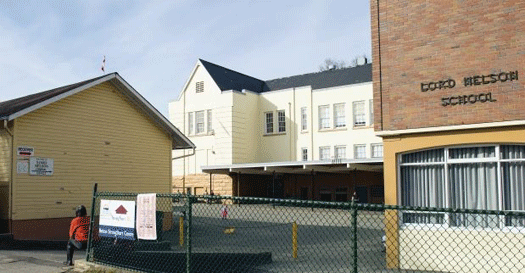
Lord Nelson Elementary School in Vancouver

Lord Nelson Elementary School, on Vancouver’s eastside, where I attended Grades 1 thru 3. The portable on the left is where I experienced a happy and rewarding Grade 2, in Mrs. Goloff’s class (I liked her, I thought there was a solid goodness about her and a genuine affection, as well as a deep respect, for students) from September 1957 thru June 1958.

In the summer of 1959, after I’d completed Grade 3 at Lord Nelson Elementary School in Vancouver (my memory of Grade 3 only slight), in August of ’59, my parents moved from Vancouver to Edmonton to be closer to family — on both my mother’s and father’s sides of the family.
In Alberta at the time, the provincial government had adopted what they called an “Enterprise Programme,” a focused academic programme meant to engage students intellectually while providing them with the tools they would require to compete successfully at post-secondary university. While all other Canadian provinces had adopted a two stream programme, one academic (university bound), the other vocational (meant to prepare students to work in the trades), Alberta was having none of that — educational achievement at the highest possible level was Alberta’s goal, the curriculum requirements rigorous, demanding and challenging, and consistently above grade level. The Enterprise Programme was defined by competition and the striving to become the best possible student — failure was never an option, doing your best was expected and required, academically and socially. Future leaders were being trained in Alberta.

“The provincial government meant to produce the best and the brightest, informed by a progressive educational ideology that Alberta was the first Canadian province to adopt in the 1950s, an educational philosophy that was child-centred, subject-integrated, with an activity-based approach, known in Alberta as the Enterprise Programme, focused on content centered courses in History, Geography, and Civics integrated into a new course: Social Studies, which was taught across all grade levels, this new subject emphasizing the development of democratic, co-operative behaviour, and inquisitiveness through experiential learning.”

Lynn Speer Lemisko & Kurt W. Clausen, Connections, Contrarities and Convolutions: Curriculum and Pedagogic Reform in Alberta; Faculty of Education, SFU, March 1, 2017

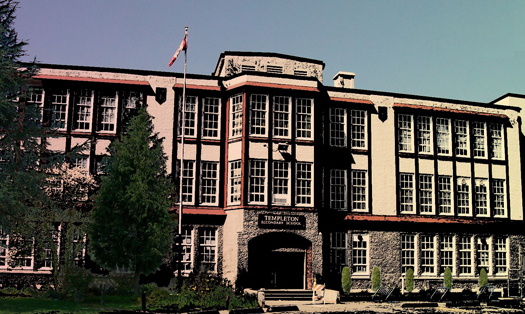
In the summer of 1962, my parents made the decision to return to Vancouver — the reasons are unclear to me, but whatever the case, in the summer of 1962, living at 2136 Venables Street, I found myself enrolled at Templeton Secondary School, then the toughest school in Vancouver (that mantle would soon be claimed by VanTech — but in 1962, Templeton was the school where all the toughest “juvenile delinquents” were enrolled, although truth to tell, many of the tougher students found themselves behind lock and key at the Brannen Lake Juvenile Correctional Facility).

Templeton Secondary School in Vancouver circa 1963

From Grades 7 through Grade 12, I attended Templeton Secondary. Based on my experience in Alberta, I was enrolled in the academic programme at Templeton, whereas every person I’d attended Grades 1 thru 3 with at Lord Nelson found themselves enrolled in the vocational stream. Odd, I thought to myself at the time. Another odd thing I found: from the spring of 1963 on, my grades never soared about a C-average — whereas in Alberta, I’d been a straight A student. Unlike most others enrolled in the academic programme, I was required to take vocational classes — and from Grade 8, I was enrolled in typing and secretarial classes, unlike any other student in the academic stream. Although a typing speed of 160wpm would serve me well later in life, I still found it odd, and just a bit concerning, that I was required to take three clerical classes each year through to graduation.
From Grade 8 on, I was also concerned that when I submitted an essay in Social Studies or one of my English classes, it either came back to me with a C, a D or a fail — with a comment from my teacher that someone other than me had written the essay, or I had either plagiarized or copied directly the work of someone else. By the time I reached Grade 12, where I had achieved an A- average in French, was taking the lead in the school plays, and editing the student newspaper, I was surprised and disappointed to receive a D in English, and a fail in History and Geography.
I recall one spring afternoon in 1968, the teacher having turned down the lights, with soft music playing in the background, the teacher asking the students in my Grade 12 English class to write a stream of consciousness essay, which I was only too happy to do. When I submitted the essay to the teacher, she took a glance at the essay and tore it up, saying to me, “You didn’t write this. You either copied it from someone else or had the essay prepared in advance (note. there had been no notice of a stream of consciousness essay taking place in class that day). You receive a fail for the essay. I’m disgusted with you.”

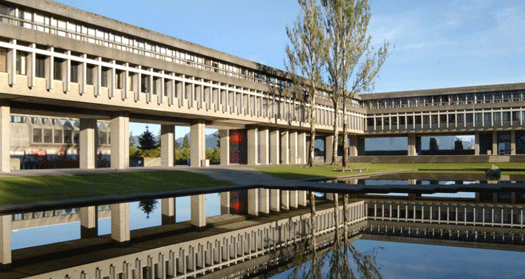
Simon Fraser University, Burnaby Mountain campus

A dozen years later, I was the Assistant Director of Teacher Training, PDP 401-402 at Simon Fraser University (a position I held while working on my Master’s degree). The English teacher referred to above had taken a seconded position as a PDP Faculty Associate — in essence I was her boss. When we first connected, in September, at the outset of the 1980 academic school year, almost the first words out of her mouth were, “I had a student with your name at Templeton Secondary. How odd that you should both have the same name,” at which point I informed her that the Raymond Tomlin she had taught, and the person standing in front of her was one and the same person. She looked aghast, stammering, “But how?”
I told her I had a 3.8 grade point average and two undergraduate degrees, and was currently enrolled in a Master’s programme at the university, letting her in on what I am about to write and record for posterity now …
In June of 1968, when I was about to graduate, as was the case with all of the other graduating students, I met with Ken Waites, the patrician, white-haired Principal at Templeton Secondary School, in his office with the door closed, and this is what he said to me …

“Well, Raymond, even though you’re a couple of courses short of graduation, given your failing grades in History and Geography, I am nonetheless going to graduate you anyway — because any kind of academic future is clearly not in the cards for you. I want to tell you something that we’ve kept from you for the past five years: for each of those years, you were recorded as having the lowest IQ of any student enrolled in the Vancouver school district, not just at Templeton, but city wide. Your teachers and I had often wondered, given your low IQ, how it is that you locomoted yourself from point A to point B. Someone with as low an IQ as you shouldn’t even be able to speak — but here you are.

You’ve probably wondered to yourself, why you were required to take three clerical courses each of the past five years. The answer is easy: you spell well, and it was clear early on that you had an aptitude for secretarial work, your typing speed and accuracy superior. Your guidance counsellor and I determined a long time ago that the best course in life for you would be to enter the clerical field, to be a secretary — because, clearly, you are possessed of no academic skill whatsoever, although you seem to have done well in French.

I have had these meetings with all graduating students, providing what I believe to be sound advice on how each student should proceed with his life following graduation. In your case, your best — and I would say, your only — hope is as a secretary. Thank you for meeting with me this afternoon, Raymond. All the best in your future.”

In 1970, my new wife insisted I enroll at Simon Fraser University, where students with an inferior academic record were being accepted, in order to build the student body. In my first semester at SFU, I achieved 3 C’s and two B’s. In my second semester, 3 B’s and 2 A’s — and every semester after that, straight A’s (not that I ever cared about grades, as did many of my fellow students — I was just hungry for knowledge, and curious about the world, eager to learn as much as I could, at one point early on not leaving SFU’s Burnaby campus over an 18-month period). I loved to read, I loved to write, I loved to learn, I was curious about everything — being at Simon Fraser University and hanging out with and being challenged by the best and the brightest was like a dream come true for me.
My curiosity about life, about all aspects of our existence on Earth remains to this day — I want to read all of the papers of record every day (and I do!), to engage with nation builders and city builders, to work with persons of conscience, to work towards better, fairer, more just. And I am afforded that opportunity each and every day, surrounded (outside of my plangent housing co-op life) by strong-willed persons of conscience who mean to build a better and more just world. As such, my life is near filled with joy!