Category Archives: Cinema

Arts Friday | Vancouver International Film Festival Special Presentations

Here we are, less than two weeks away from the singular cinematic arts event of the autumn season, the much anticipated 41st annual Vancouver International Film Festival.

Next Friday, September 23rd, VanRamblings will publish our annual introductory VIFF column, with all the information you’re going to need — ticket and pass prices, and where to secure these valuable items and how much time you should set aside for lining up, the best cafés, bistro, restaurants and bars nearby Festival venues — including the VIFF 41 films that are, quite simply, must-attends.

Talking about must-attends, have we got a treat for you today: the twelve finely curated, award-winning, future Oscar-contending Special Presentations, the celebrated and critically-acclaimed films that will début in Vancouver over the course of the 11-day running time of the 41st annual Vancouver International Film Festival.


Empire of Light
6pm, Friday, September 30th
The Centre for the Performing Arts


Decision To Leave
9:15pm, Friday, September 30th
9pm, Thursday, October 6th
The Centre for the Performing Arts


The Grizzlie Truth
2pm, Saturday, October 1st
6pm, Wednesday, October 5th


The Son
6pm, Saturday, October 1st
The Centre for the Performing Arts


The Banshees of Inisherin
9:15pm, Saturday, October 1st
The Centre for the Performing Arts


EO
4pm, Sunday, October 2nd
The Vancouver Playhouse

9:30pm, Saturday, October 8th
The Centre for the Performing Arts


One Fine Morning
9pm, Sunday, October 2nd
6pm, Tuesday, October 4th
The Centre for the Performing Arts


Corsage
6pm, Monday, October 3rd
6pm, Thursday, October 6th
The Centre for the Performing Arts


Triangle of Sadness
9pm, Monday, October 3rd
The Centre for the Performing Arts


Stars at Noon
9pm, Monday, October 3rd
The Playhouse

1pm, Saturday, October 8th
The Centre for the Performing Arts


The Whale
5:45pm, Sunday, October 2nd
The Centre for the Performing Arts


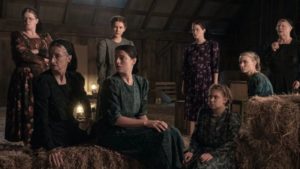
Women Talking
9:15pm, Wednesday, October 5th
The Centre for the Performing Arts

Each of the films titles, italicized and in red, link to the VIFF webpage for the film, which will allow you to read about the film, discover the various awards the films have garnered at Festivals prior to arriving at VIFF, and to purchase tickets, if you’re of a mind to do so — and we hope such is the case.

The VIFF digital Festival Guide is now available; click on the preceding link.

While picking up our Media Pass to VIFF41 on Friday afternoon — at the VIFF Centre on Seymour Street, just north of Davie Street — VanRamblings also secured a hard copy of the 41st annual Vancouver International Film Festival film guide.

Arts Friday | Vancouver International Film Festival | Sept. 29 – Oct. 9th 2022

In Vancouver, and across the province of British Columbia, we may find ourselves in the midst of civic elections in villages, towns and cities in every far flung corner of our province, but as you’re no doubt aware, life goes on.

At the end of September each year for the past 41 years (in the early years, VIFF happened in the spring), come rain or come shine, the good folks long associated with the Vancouver International Film Festival — who have spent the past 12 months curating film submissions from thousands of filmmakers, and visiting almost every film festival screening films in almost every country on our, it seems, ever smaller globe — present the best in world cinema to appreciative British Columbia audiences, cinephiles and cinéastes who love film, and those persons in our city who look forward each year to opening a window on this vast world of ours, to gain insight into how folks who live in every country across the planet live their lives, and how their struggles mirror our struggles.


VIFF’s Director of Programming, Curtis Woloschuk, introduces the depth and breadth of the 41st annual Vancouver International Film Festival. A must watch.

Vancouver International Film Festival: a humanizing experience like no other.

Each Friday in September, VanRamblings will present  you with insight into the 41st annual Vancouver International Film Festival — which films are can’t miss in 2022, and demand to be seen on the big screen (screening at the 1800-seat Centre for the Performing Arts is a Festival must), the tiny gems that are always at the heart of VIFF each year, which films Vancouver is sharing with other film festivals screening simultaneously to Vancouver’s homegrown festival by the ocean, the celebrated award winners, and so very much more.

135+ feature films
102+ shorts
25+ events
11 days

The VIFF 2022 digital guide will be available for download after September 15.

The VIFF printed guide will be available across Metro Vancouver on Sept. 20.

So many films to look forward to, and so many films to move and change you.

Arts Friday | The Undeniably Cinematic Romance of Train Travel

[PROGRAMMING NOTE: VanRamblings won’t publish Saturday, Sept. 3rd thru Monday, Sept. 5. We’ll resume regular posting on Tuesday, Sept. 6th].

As a boy growing up in the 1950s and 60s, a part of each summer was given over to train travel with my mother and sister, to the Calgary Stampede, Edmonton’s Klondike Days, to Saskatoon or Regina, or out to Winnipeg.

There was nothing I cherished more than to arise at sunrise, standing between the trains cars, the summer prairie winds blowing across my face, as I gazed upon mile after mile of blonde fields of bluish green or mustard-yellow flowering and deeply scalloped gently rolling hills of oil-rich rapeseed.

All of which is to say, trains hold much for me in the recall of my life.

Cinema and trains go together like no other form of transport. Equal parts romantic and thrilling, they offer a sense of unequaled escapism.

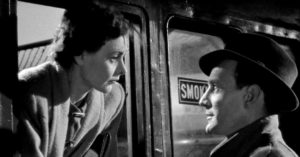
Whether it’s the tearful goodbyes of Casablanca, the secretive affair of Brief Encounter, the epic crash of The Fugitive, the chase scenes of The General, the fateful encounter in Before Sunrise, the comings and goings of trains have been used to give metaphorical dynamism to countless films.

Trains are so popular that entire stories have been set on them.

This is due to the way they are able to keep action moving forward as its characters are forced to occupy the same physical space. From action thrillers to class commentaries to classic whodunnits, here are a few films set on a train that you’ll want to board should you be afforded the opportunity.

The Lady Vanishes (1938)

Perhaps the best of all Alfred Hitchcock’s British films, The Lady Vanishes tells the story of a young woman traveling across Europe who suddenly realizes her elderly traveling companion has disappeared. Containing endless twists as well as a pre-WW2 espionage subplot, The Lady Vanishes offers a delightful concoction that doubles as a study of British mannerisms, and the classic 1930s era of train travel.

The Commuter (2018)

Billed as an actioner, there are surprising depths to Jaume Collet-Serra’s train-based thriller The Commuter, starring Liam Neeson as a former police officer turned insurance agent who has just been laid off from his job, the majority of the film taking place on a Manhattan commute. While the thrills are thrilling and the action sequences accomplished, The Commuter has a socioeconomic depth that makes this Neeson’s most profound action film.

Unstoppable (2010)

As fast, loud, and relentless as the train at the centre of the story, Unstoppable is perfect popcorn entertainment — and proved to be director Tony Scott’s best movie in years, the narrative involving an unmanned runaway train carrying a cargo of toxic chemicals, and an engineer (Denzel Washington) and his conductor (Christ Pine) who find themselves in a race against time.

Murder on the Orient Express (1974)

Director Sidney Lumet’s agent called it “the dumb train movie” but the cast — Albert Finney as Hercule Poirot, and suspects including Lauren Bacall, Sean Connery, Martin Balsam, Jacqueline Bissett, John Gielgud, and Ingrid Bergman, who won the Oscar for Best Supporting Actress — gives this mystery the feel of a luxurious chocolate-box with few toffees. “Stylistically it had to be gay in spirit, even though it was about a murder,” Lumet said of the film.

Source Code (2011)

Finding the human story amidst the action, director Duncan Jones and a charming Jake Gyllenhaal craft a smart, satisfying sci-fi thriller about decorated soldier Captain Colter Stevens, who wakes up in the body of an unknown man on a commuter train, to discover he’s part of a mission to find a bomber.

Europa (1991)

Director Lars von Trier boxed himself into an expressionistic corner with this hyper-stylized thriller set aboard a German train in 1945. For all its visual razzle-dazzle, this tale of a trainee conductor contending with Nazi terrorists and a collaborationist boss is an oppressively claustrophobic ride. No wonder the lo-fi, wildness of the Dogme 95 revolution was just around the corner.

Before Sunrise (1995)

Richard Linklater’s Before movies span 20 years but it all began unassumingly enough onboard a train from Budapest. Jesse (Ethan Hawke) strikes up a conversation with Céline (Julie Delpy), then persuades her to disembark with him in Vienna to while away the evening and early morning before he catches his flight home to the U.S. Had she not fallen for his charms, audiences would have been deprived of one of films most enchanting trilogies.

Runaway Train (1985)

Jon Voight and Eric Roberts were both Oscar-nominated for playing hard-bitten convicts who steal a locomotive after a prison escape. Directed with an air of existential horror by Andrei Konchalovsky, Runaway Train — based on a 1966 screenplay co-written by Akira Kurosawa — emerged as a first rate genre film, and a hard-boiled action thriller that feels a bit like Speed on a train.

Snowpiercer (2013)

Revolution is in the air in Bong Joon-ho’s post-apocalyptic thriller set on a train that endlessly circles  a frozen and inhospitable Earth, carrying the last survivors of humanity — poor folk crammed into squalor at the back, rich ones whooping it up in first class with their own nightclub in front. There was enough fuel in the furnace to keep the idea burning through a Netflix series.

Strangers on a Train (1951)

The murderous “crisscross” trade-off proposed by Robert Walker to Farley Granger in Strangers on a Train may be hatched on a train but it’s telling that the actual climax occurs on an out-of-control carousel — the antithesis of the train, and anathema to any screenwriter, since all it does is go pointlessly round and round.

The General (1926)

Cinema has been coupled to train travel ever since the Lumière brothers screened their 45-second film from 1895 of a train arriving at La Ciotat station. Incredible to think that it was only 30 years later that Buster Keaton set to work on his staggeringly sophisticated silent Civil War action comedy, the story about a doleful train engineer who goes all out to save two objects of his affection — his engine and his sweetheart (Marion Mack).

https://youtu.be/4nj0vEO4Q6s

The Lumière brothers had it right — there is something undeniably cinematic about the locomotive. When it comes to train travel, you never know who might be onboard, and therein lies both its mystery and its thrill.

Arts Friday | 2022’s Film Festival Season | An Oscar Season in Preview

With cooling weather finally having taken hold, and the heat of the summer season soon to be but a fond memory, today VanRamblings will set about to preview the always provocative cinematic season of serious import,  the fall film festival season

As we discover each September, autumn is the season for all of our senses.

The feel of cooler temperatures after a long summer. A warm, visually pleasing palate of reds, oranges and browns. The taste of pumpkin spice in everything.

The sound of crunching leaves underfoot.

The smell of woodsmoke.

Like spring, autumn is a season of transition, a reminder of the value of change, in this case from a bright, buzzing, verdant summer of picnics in the park, towards the darker, quieter, more redolent calm of autumn and winter. It’s a journey inward; first experiential, then intellectual, delving into the collective unconscious.

“Autumn light is the loveliest light there is,” wrote author Margaret Renkl. “Soft, forgiving, it makes all the world an illuminated dream.”

In a cinephile’s world, dreams come to the fore in the fall through the release of films which will take on Oscar importance in the winter season to come.

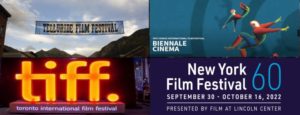
Telluride, Venice, Toronto, New York each early autumn introduce the films which will fill our film consciousness over the many months yet to come.

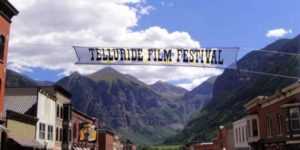
The first of the important later summer film festivals occurs amidst the mountain landscape of Telluride, Colorado, which locale will be overrun with cinéastes over September’s Labour Day weekend, where prestige filmmakers ranging from Canada’s Sarah Polley (Women Talking), Luca Guadagnino (Bones and All), Sam Mendes (Empire of Light), Alejandro G. Inarritu (Bardo), Todd Field (TÁR), Sebastian Leilo (The Wonder), and Scott Cooper (The Pale Blue Eye) are set to garner the most buzz among the film cognoscenti, each of these filmmakers recipients of much past Oscar glory, each film highly anticipated, each film Oscar bound.

Overlapping the Telluride Film Festival is the 79th annual Venice International Film Festival, the Biennale Cinema, which will run from Wednesday, August 31 thru Saturday, September 10, where many of the films débuting at Telluride stateside will also feature in the star-studded Venice locale.

The big buzz film in Venice this year is White Noise, Noah Baumbach’s first film since Marriage Story. White Noise is a zany adaptation of Don DeLillo’s seminal novel about a Hitler Studies professor (Adam Driver) and his beleaguered wife (Greta Gerwig) whose lives are threatened by a toxic event.

Also at Venice: Andrew Dominik’s evocative drama Blonde, starring Ana de Armas as Marilyn Monroe, who disappears into the role as she struggles to cope under the glare of the spotlight. Add Bobby Cannavale as her second husband, Joe DiMaggio; Adrien Brody as her third husband, Arthur Miller; meticulous production design & luminous cinematography, and you have a potential awards-season juggernaut, streaming on Netflix Sept. 28th.

Olivia Wilde’s psychological chiller, Don’t Worry Darling, sees Florence Pugh and Harry Styles embody a picture-perfect ’50s couple whose unbridled passion for one another turns to suspicion when the former begins to fear that something sinister lurks beneath their carefree existence. Prepare for jump scares, glorious interiors, and Chris Pine as the film’s menacing mastermind.


A TIFF programme screen capture of Steven Spielberg’s autobiographical film, The Fabelmans

As the Telluride and Venice festivals wrap, the film festival season focus will turn to a renewed Toronto International Film Festival (TIFF), now in its 47th season, running from Thursday, September 8th through Sunday, September 18th, as TIFF marks a return to its pre-pandemic days of in-person screenings, after two scaled-down editions spent in hybrid mode the past couple of years.

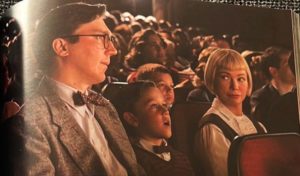
The big buzz film débuting in Toronto this year is Steven Spielberg’s The Fabelmans, which will have its world première at this fall’s TIFF, with the iconic Oscar-winning director attending TIFF for the first time ever.

A long-in-the-works semi-autobiographical film, The Fabelmans is described by producers as a “deeply personal portrait of 20th-century American childhood,” which focuses on a family based in post-Second World War-era Arizona, the film following the young Spielberg facsimile Sammy Fabelman (played by Gabriel LaBelle) as he grows up with his father (Paul Dano), mother (Michelle Williams) and uncle (Seth Rogen). After discovering a “shattering family secret,” Sammy dives into the wonder of cinema to cope and find a path forward.

With a screenplay by regular Spielberg collaborator Tony Kushner (Munich, Lincoln, and last year’s West Side Story), The Fabelmans is Spielberg’s latest shot at awards-season glory. The film’s première represents a huge coup for TIFF.

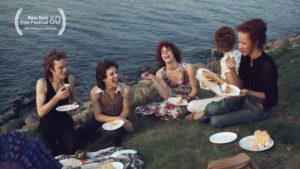
The New York Film Festival  has lined up titles from Kelly Reichardt, Claire Denis, Alice Diop, Joanna Hogg, and more for its Main Slate this year. Women directed or co-directed 13 of the 32 Main Slate films, amounting to about 41%.

The NYFF has returned to the city that never sleeps for its 60th year at the Lincoln Centre, which recently announced Laura Poitras’ new documentary, All the Beauty and the Bloodshed, to serve as the festival’s Centerpiece film. A story about art, politics, addiction, and David v. Goliath battles, the documentary chronicles the life of photographer Nan Goldin and her fight to hold the Sackler family accountable for their role in the opioid epidemic.

Mia Hansen-Løve’s latest, the Léa Seydoux-starring romantic drama One Fine Morning, is also part of the Main Slate, as are Claire Denis’ Stars at Noon; Kelly Reichardt’s Showing Up; Joanna Hogg’s The Eternal Daughter; Alice Diop’s Saint Omer; Charlotte Wells’ Aftersun; and Marie Kreutzer’s Corsage.

Another Oscar bound film? Clemency director Chinonye Chukwu’s Till, a biopic about the lynching of Emmett Till, and his mother’s pursuit of justice.

As has been the case since it’s inception 41 years ago, the NYFF runs in tandem with the Vancouver International Film Festival, our somewhat truncated festival set to run from from Thursday, September 29th through Sunday, October 9th.

The importance of festivals to culture and society cannot be underestimated, as they set about to provide empathetic insight into our often confusing world. Film festivals also provide the opportunity to switch off your everyday life, to become enmeshed in the lives of people from across the globe.