Category Archives: Cinema

VIFF2012: An Odd But Rewarding Festival Draws to a Close

Vancouver International Film Festival

In the films we see at VIFF, as is the case with film we screen during the remaining 11½ months of the year, we demand cinema possessed of insight, wit and intelligence, poetry and craft, honest reflections on the human condition, fidelity of intent and purpose for the characters we see on screen, and that they be moving with a melancholy subtext (even if it’s a comedy). We want to see films on the human condition.
We feel much the same about the people we let into our life. We demand the very best from our children, Jude and Megan, and have never sanctioned anything other than complete emotional honesty. Of course, we demand fidelity from our friends and family. We demand of our friends that they are loyal to a fault, have our best interests at heart, that they never ever engage in passive aggressive behaviour so as undermine our fragile heart. Our friends must be possessed of a keen insight into themselves, as well as us, and into the human condition, in general.
Of course, we demand of our friends that they possess a keen wit and and an enquiring and overweening intelligence, that they possess a consuming interest in the political realm — here at home, in the province, federally and beyond (we expect quite a sophisticated analysis, as well) — and in respect of politics we don’t care whether someone’s a Liberal, an NDPer, supports the Green party, or … well, we’d include the Conservative party in the above delineation, but honestly, we’d be misleading you if we indicated a support for Stephen Harper’s Tories. We do have many friends in the Progressive Conservative parties resident in provinces across Canada — we appreciate their moral take on the issues and their commitment to community and social justice, and have found generally their approach to politics to be humane, and when you get right down to it, to the left of most of our so-called left friends (we’ve moved in left circles for 50 years).
Oops, getting off topic. Patricia won’t like the digression above, she demands writing about film, and scolds us if we disappoint her. And as Patricia is our muse for these nightly, reflective essays on VanRamblings, we might as well get on with things. So to placate Patricia, and because we actually like to write, and because we saw a life raft of terrific films on Tuesday, we’ll provide you with some insight into …
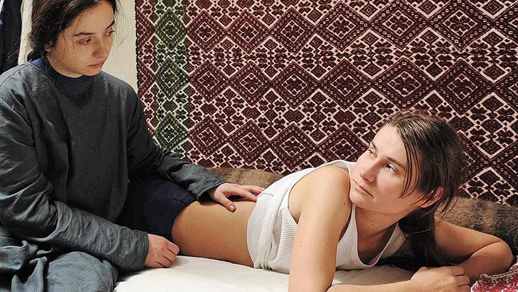
Beyond the Hills

Beyond the Hills (Grade: A): After dealing with the psychodrama that began our day in line outside the Granville 7 (sheesh, I mean, really?), we settled down to the 153-minute screening of Cristian Mingui’s fictionalization of a 2005 incident involving a novice who died after being subjected to an exorcism in Romania’s Tanacu monastery: an irrational horror at the heart of 21st-century Europe. We hadn’t really done our homework on the film prior to Tuesday’s screening, and kept saying to ourselves during the film’s first two-thirds, “Cristian Mungiu is turning out a film in support of those who seal themselves away in rural monasteries, to a life of … what? Really, that’s Mungiu’s follow-up to 4 Months, 3 Weeks and 2 Days?” And then, and then, at the two-thirds point in the film, the honesty and fidelity, intelligence and insight, and honest reflection on the human condition emerged (beginning with a spectacular “speech” by a resident doctor in the Romanian hospital, where the monastic novice has been transported).
Migawd, did the doctor set things straight. A little passionate honesty goes a long, long way, in our books. We felt so emboldened after the screening that we engaged one of the senior VIFF staff to address and resolve an outstanding issue of concern, but were disappointed to find only a passive-aggressive response to those expressed concerns, and an utter and absolute lack of fidelity in our contact. Still, a common response when one is feeling under attack, although such was not our intention, and we hope against hope, our demeanour (we strive to be respectful at all times). Hey, we recognize that we’ve been a pain in the ass at this Festival for some people (although we find we are considered to be charming by others, according to the feedback we’ve been receiving); but that comes from demanding the best from all of us, and settling for no less. Be honest and sincere, think about the things you say, be prepared to take action where necessary and be responsible for yourself and for all of your utterances. Both of us will be be a better off for the experience, when a little humanity, a modicum of humour, kindness and wit is brought to our engagement.
Good thing, then, that Festival Director Alan Franey never, ever, ever disappoints. We could write that Alan Franey is the best arts administrator in the City, but that would only be the partial truth. Alan Franey is probably not only the hardest working, but the most sophisticated, intelligent, insightful, organized, humane, caring, warm, and dedicated (we could go on for quite a bit longer) arts administrator in the country. Alan Franey ranks as one of the finest corporate leaders it has been our privilege to interview and engage, at any point in our 40+ years as a working journalist.
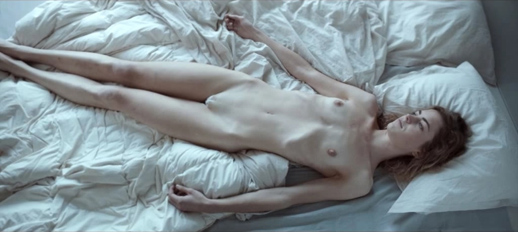
Hannah Hoekstra, starring in Sacha Polak's debut film, Hemel

Hemel (Grade: A): Arriving at VIFF2012 with immense buzz, after winning the Critics’ FIPRESCI Prize at Berlin this year, at Tuesday morning’s screening, Hemel was everything, and more, that had been promised. A chilly, chilly film emotionally, the lack of emotion onscreen was more than made up for by the promised and delivered outré sex, general kinkiness and nudity (here’s some video), mostly involving Hemel (“Heaven” in Dutch). A character study delving into Hemel’s experience of life, uneasy resolution is reached by movie’s end. How did Hemel become who we see onscreen? With its insinuating trance score offering aural landscape to all we see before us, this movie about a wild and out-of-control, verging on dangerous, woman leaves us to ponder whether her sexual acting out is a product of, or a response to, rape in late adolescence or her early teens years, or derives from her involvement in street, child prostitution, again in late adolescence or her early teen years — the time when a sense of a child’s sexuality begins to emerge and cohere — or is the product of a very early, and sustaining, sexual relationship with an adult, sometimes an uncle or a neighbour, but more generally the father. That the answer to the film’s puzzle revolves around bodily fluids and function, takes the whole issue of resolution to a new and disturbing conclusion. Sacha Polak’s provocative character study of a beautiful Dutch twentysomething enables Hannah Hoekstra to shine in this year’s most stunning, star-making performance.
A couple of quick notes: we loved, loved, loved Come As You Are, and find ourselves grateful beyond words for the recommendation to see the film, from many, many of our VIFF cinephile friends. We also took in a second screening of When The Night, early last evening, and we liked the film much more during a second viewing — that’s going some when you take into account that we loved When The Night when we first saw it in preview three weeks ago. We didn’t think it possible to love the film any more than we already did; we were wrong. We loved When The Night’s cinematography, performances, narrative, insinuating score, as well as it’s evocative setting.

VIFF2012: As The Film Festival Begins To Wind Down

Vancouver International Film Festival

VanRamblings is concerned about the fragility of our emotional state.
Since taking in an early Saturday morning screening of Álex de la Iglesia’s treatise, As Luck Would Have It, we have felt emotionally wrung out, fragile, and have in the days since wondered if we will make it through til Festival’s end, on Friday. That As Luck Would Have It addresses a core belief we have long held respecting the dynamic of women’s impact on the lives of men, and that VanRamblings had never seen this core philosophy expressed on screen before was for us, overwhelming & profound, the truest expression, and capturing, of love that VanRamblings has ever seen on film.
On Monday afternoon, still recovering from As Luck Would Have It, not to mention Monday morning’s screening of certain Best Picture Oscar nominee, The Angels’ Share in Theatre 7, as we were thanking her for her kindness to us throughout the Festival, we broke down and cried. Too many films, too many tears over too many days, too little sleep?
Whatever the circumstance, we will carry on, while remaining grateful for the support of Festival staff, volunteers and patrons — our Festival family.

star.jpg star.jpg star.jpg

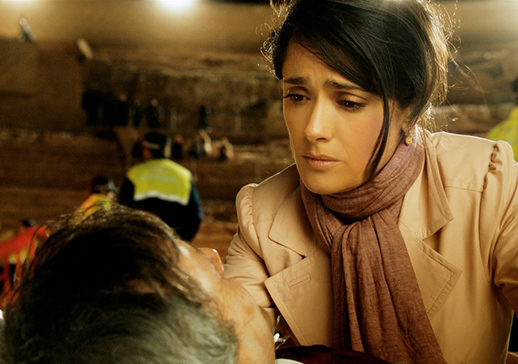
Selma Hayek, from the film As Luck Would Have It

As Luck Would Have It (Grade: A+): There is no movie we have found more deeply affecting than Álex de la Iglesia’s at all times wondrous new film. A very dark comedy that simply teems with life, the most well-conceived and executed picture that has played the Festival, the single most heart-wrenching family drama that has played the Festival year, as I wrote to my friend Michael Klassen after Saturday morning’s screening …

This morning, I saw Álex de la Iglesia’s new film, As Luck Would Have It, starring Salma Hayek in a role that provides her with the opportunity to turn in the best performance of her career. A story about economic dislocation, and the love that the husband and wife in the film have for one another and how that love defines their lives and informs all decisions that are made for their family, had me on the floor. Although I’ve seen some very affecting films at VIFF, on Saturday morning at the screening of As Luck Would Have It, about two-thirds of the way through the film, during a conversation Salma Hayek was having with José Mota, who plays her husband, I completely lost it … I sobbed uncontrollably, I had a hard time catching my breath, I thought I was going to have to run from the theatre and collapse in some dark corner … I heaved heavy sobs for 15-minutes before pulling myself together enough to make it through the remainder of the film. That a film can speak to someone, as As Luck Would Have It has resonated with me, simply reinforces for me the power of the image to transform.

Of the more than 80 films VanRamblings has seen to date at VIFF2012, As Luck Would Have It has emerged as our very favourite film.

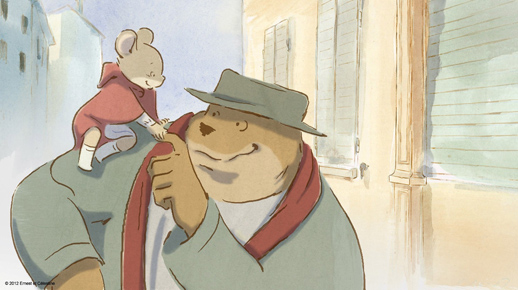
Ernest et Célestine

And more from the same e-mail to Michael, on the VIFF animated film, Ernest and Célestine (Grade: A): …

I also caught a screening of the French animated film, Ernest et Célestine, which also proved both powerful and affecting. You would like this film because of your love for Sophie. In many films at VIFF this year, relations between children and their parents have resonated deeply with me … Ernest et Célestine is very much a father-daughter story, I believe. I love the way Célestine treats Ernest, just like Megan used to, and still does, as she helps to keep me on the right path … our daughters, just like our wives, always have our best interests at heart, their honesty and their love in their relations with us, as well as their insistence that we always be our best selves, becomes for us in our lives a defining and abiding characteristic of both the love we hold in our hearts for our children and our spouses, and they for us.

We have had a wrenching few days at VIFF, finding the following two films, moving, deeply affecting and humane …

  • Revolution (Grade: A): A recently released United Nations report states that should world powers fail to address the issue of the acidification of our oceans, seas, lakes and other water bodies, by the year 2048, the lack of government action on the matter will result in the extinction of all sea life, vanishing from the earth forever. Employing the most moving, non-didactic, wildly entertaining and humane means possible, filmmaker Rob Stewart has turned in a mighty doc, one that should be seen by everyone. There’s one more screening tomorrow, Wednesday, October 10th at 1:30pm at the Vancity Theatre. Revolution is, quite simply, a must-see documentary.
  • Rose (Grade: B+): Wojtek Smarzowski’s new film offers a searing indictment of rape as a victor’s reparation of war, and an indictment of post WWII Russian soldiers as a monstrous force of evil. Set in Masuria, a lake region bordering East Prussia and Poland that after WWII was turned over to the Soviet Union, Rose offers a story of place, time, people and history in an epic tale of an historic tragedy. Another must-see. Screens for a final time, Wed., Oct. 10, 7pm, Gr7.

Tuesday’s must-see VIFF films include: First thing in the morning, there’s Beyond the Hills, Romanian director Cristian Mungiu’s follow-up to his award-winning “race-against-the-calendar abortion thriller 4 Months, 3 Weeks & 2 Days; next, Hemel offers a twisted story about love, lust and erotic fixation, Sacha Polak’s weirdly beautiful, graphic and tender début feature both compulsive and transgressive. Hemel was one of the buzz films coming into VIFF2012. Screens for the first time today, Oct 9, 2pm, Gr2, and again on Thursday, 11am, at the Vancity Theatre, on Seymour.
The other must-see VIFF films on this Tuesday are: VanRamblings favourite romance, the at all times wonderful When The Night, a film we love and about which we have heard only praise from those who’ve attended screenings of When The Night, earlier in the Festival. And, finally, on Tuesday, Bay of All Saints, by far our very favourite documentary film at VIFF2012, screens for a final time today, at 3:30pm, Gr6.
As we wrote yesterday, based on buzz and the insistence by VIFF patrons that VanRamblings must attend, tonight we’ll be taking in a screening of what has become Week 2’s buzziest film, Come As You Are.

VIFF2012: A Transcendent, Lovely, Moving, Successful Fest

Vancouver International Film Festival

Ran into Festival Director Alan Franey following a mid-afternoon screening of the Christopher Kenneally / Keanu Reeves documentary, Side by Side: The Science, Art and Impact of Digital Cinema, and spent a few minutes catching up with Alan (who looked great on Sunday in his cream coloured suit), touching on a range of Festival-related subjects.
Alan expressed a concern that, in VIFF’s final year at the Empire Granville 7, the patron experience has not been everything that he might have hoped it would be, that he would have liked to “go out on a higher, better note.” We both agreed, though, with the changes Alan implemented on Friday that the ship had been righted, that following a review at the end of the first week arising from the ongoing consultation / seeking of feedback from staff, volunteers and festival-goers, the patron experience had improved measurably, to patron satisfaction, over the course of the past 72 hours.
VanRamblings suggested that where it mattered most, VIFF is experiencing an exceptionally rewarding year: the films. From The Hunt, Any Day Now, When The Night, Thursday Till Sunday, The Late Quartet, Bay of All Saints, Egg and Stone, Teddy Bear, Rose, Nuala — well, the list could go on and on, couldn’t it? — VIFF is experiencing an exceptional year. The films we see at VIFF don’t arrive as if by magic, they’re curated by Alan, PoChu AuYeung, Mark Peranson, Terry McEvoy, Stephanie Damgaard, Shelly Kraicer, Tony Rayns and Sandy Gow, as well as being juried by a dedicated, hard-working group of cinephiles. This year, the VIFF programmers have outdone themselves, as the Vancouver International Film Festival grows from strength to strength to strength.
Of course, we touched on the issues which Alan must address respecting the re-locating of VIFF in 2013 to a new site(s). Alan indicated that he doesn’t want to rush into anything, or react precipitously, that he and his team will take some time to review the options available to VIFF. For now, though, following a hard-fought year of working to bring to Vancouver the best curated and juried film festival in North America, Alan will take a brief, well-deserved break, before settling down to the tasks at hand.
Then VanRamblings rushed off to the Empire Granville 7 for an early evening screening of Lucy Mulloy’s wondrously delightful, heart in your throat Cuban narrative, Una Noche where we arrived late to meet COPE Executive Director, Sean Antrim, our companion for the screening. Sean had to rush off to a late Thanksgiving dinner (VanRamblings sets aside all prosaic concerns during the Festival, so no turkey dinner for us on Sunday, as we took in five powerfully affecting VIFF screenings).

star.jpg star.jpg star.jpg

A few notes to complete VanRamblings’ shorter than usual VIFF post …

Our Children: VIFF has secured a pristine DCP print of Belgium’s Best Foreign Language Film Oscar nominee, following the almost week-long psychodrama that occurred following last Monday’s screening of Our Children at the VanCity. The film’s producers had supplied a degraded production screener with a time code running across the top, with a critical two minutes of the film missing (VIFF didn’t know that a portion of the film was missing). We’re looking forward to attending today’s 3:45pm screening at the Empire Granville 7. Given that Our Children looks to be a solid Oscar contender (Amour would appear to be its only serious competition), and given that the word VanRamblings heard from friends who actually stayed for the entirety of the Our Children screening last week, who told us they felt the film to be among the strongest of the films they had seen at VIFF in 2012, well .. given that most of these friends/VIFF patrons are not given to engaging in the kind of hyperbole that defines our ‘review’ approach (we either love a film, or really don’t care for it, there’s ain’t no in between with us), the comments of these friends would have to be considered high praise, indeed. Bottom line: Our Children is one of today’s must-see films.

Come As You Are: As patrons were exiting Cinema Three late Sunday morning, we were approached by several VIFF regulars, who told us, “Raymond, I don’t know what you’ve got scheduled for the late show on Tuesday, but whatever it is, cancel it. You absolutely have to see the 9:30pm screening of Come As You Are on Tuesday night.” So that’s where we’ll be. Ahhhh, how wonderful to be taken care of by the VIFF family.
Any Day Now: Talking about films that are can’t miss, the final screening of Any Day Now occurs at 9:30pm this evening, in the Empire Granville 7. There are very few films which we will guarantee any VIFF patron and cinéaste will love, but let us tell you: Any Day Now is amongst the best American independents of the year. You really oughta do youself a favour and take in a screening of this powerfully affecting period drama.
Monday’s screenings represents one of the potentially strongest VIFF days, thus far, film wise. Must-sees on Monday include: Ernest et Célestine, The Sessions, The Angels’ Share, Amour, Our Children, No Job for a Woman: The Women Who Fought to Report WWII, All in Good Time, Kinshasa Kids, Revolution, The Flat and Any Day Now.
And, finally for this post: we were told by VIFF staff that a screening of The Hunt had to be cancelled on Sunday, for technical reasons. Apparently, there’ll be an additional screening announced today. Given that The Hunt is probably the most well-crafted and accessible film at VIFF in 2012, The Hunt would have to be considered yet another must-see.

VIFF2012: Worshipping at the Church of Cinema


VANCOUVER INTERNATIONAL FILM FESTIVAL, the Church of Cinema

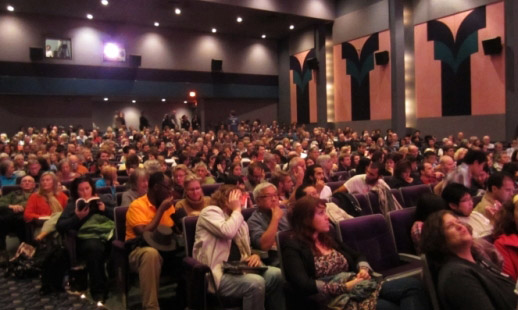
Imagine yourself on a Sunday morning at the 31st annual Vancouver International Film Festival. You’ve just walked into the Empire Granville 7, where you’ve been greeted by one of the volunteers, and are then ushered into a dark room with seats all facing forward. You feel reverent.
You are about to worship at the ‘church of cinema‘.
One hundred years on, global cinema has arrived as a form of transcendence, for many replacing the once venerated position held by the institutional church. Think about the similarities: churches and the cinema are both large buildings built in the public space. Both have signage out front indicating what is about to occur inside.
As physical structures, the church and the cinema create a sense of sacred space with their high ceilings, long aisles running the length of the darkened rooms inside, the use of dim lighting, the sweeping curvature of the walls, and the use of curtains to enhance the sacredness of the experience.
In the church of the cinema we take communion not with bread and wine, but with the ritualistic consumption of our favourite snack.
Consider if you will, the memorable moment when you enter the auditorium to find your perfect viewing angle, allowing you to sit back, relax and enjoy. Although you may not receive absolution at the cinema, there is the two-hour reprieve from the burden of your daily life.
As the lights are dimmed, the service begins: The seating, and the opening introduction constitute a liturgy for one and all, not dissimilar to the welcoming ritual that occurs in a church service prior to the sermon. If you are like most people, you obey an unwritten rule that requires you to be in place in time for either the singing (if you’re in church) or the introduction of a film by a Vancouver Film Festival theatre manager. And, you remain silent while in the theatre, focused on all that unfolds before you.
There is, too, the notion that as the film limns your unconscious mind you are being transported, elevated in some meaningful way, left in awe in the presence of a work of film art.
What we want from church is often, these days, more of what we receive from the cinema on offer at the Vancouver International Film Festival: the vague, unshakable notion that the eternal and invisible world is all around us, transporting us as we sit in rapt attention. We experience the progress and acceleration of time, as we see life begin, progress, and find redemption. All within two hours. The films at the Vancouver International Film Festival constitute much more than entertainment; each film is a thoughtful meditation on our place in society and our purpose in life.
As a film draws to a close, just as is the case following a sermon we might hear in church, our desire is to set about to discuss with friends that which we have just experienced. Phrases and moments, transcending current frustrations with a new resolve, all in response to a line of dialogue or an image on the screen that we have now incorporated into how we will lead our life going forward.
In the holy trinity of meaning, cinema reigns supreme, the personal altar of our home theatres placing a distant second place, the city providing the physical proof of the reality the other two point to, oriented towards the satisfaction of the devout cinemagoer’s theology.
Throughout the centuries we have sought to find meaning through manifest ritual and symbolism. If, as in the scene from American Beauty, a plastic bag sailing in the breeze is an intimation of immortality then there is, perhaps, something for us to consider respecting the difference between art as diversion and art in our lives as a symbolic representation of an awakened mindfulness, allowing us to transcend the troubles of our lives.
For those who attend the Vancouver International Film Festival, cinema has emerged as that place where we might experience life in the form of parable, within a safe and welcoming environment, that place where we are able to become vulnerable and open, hungry to make sense of our lives. Cinema delivers for many of us access to the new spiritualism, the place where we experience not merely film, but language, memory, art, love, death and, perhaps even, spiritual transcendence.