Category Archives: Cinema

Boyhood: The Movie of the Summer of 2014. A Must-See Film.

The indie movie of the summer, destined for significant attention come Oscar time, a groundbreaking winner of multiple awards at film festivals across the globe, an utterly original film work by director Richard Linklater, Boyhood opens in Vancouver next Friday, July 25th.
In a summer that is full of blowed-em-up-real-good special effects films, and a steady diet of overblown, mediocre sequels and merchandising tie-ins, any one who loves cinema — the art form of our age — keeps their eye out for the joyously human-scale independently-financed film.
In 2014, there was joy to be had in the patient, elliptical comic movements of small, independent films like Jon Favreau’s Chef, in the black-and-white landscapes of Pawel Pawlikowski’s Ida, or the artfulness of Jillian Schlesinger’s Maidentrip, a home movie that transforms into a personal documentary of immense force, not to mention the improbable collision of styles (mystery and realism, both magic and kitchen sink) that propels Jeremy Saulnier’s $37,000-budgeted wonderment of a film, Blue Ruin.
Now we have Richard Linklater’s 12-years-in-the-making Boyhood, the one must-see picture this summer that has broken all sorts of box office records in limited release. As we did last week, VanRamblings will present a series of capsule reviews, linking to the full reviews of a range of critics. For the record, you should know that Boyhood is sitting at an impossible 99% on Metacritic as, improbably, is the case on Rotten Tomatoes. We’re talking 136 out 138 reviews are over-the-moon for Boyhood.
Those who love cinema will want take note.
Andrew O’Hehir, Salon
You may be better off seeing Richard Linklater’s Boyhood without much advance preparation, the way I did at Sundance last January. But given that this 12-year mini-epic of family life has been widely pronounced as the independent film of the year, I think the cat’s out of the bag. There’s always considerable danger in proclaiming the greatness of a work that presents as modestly as this one does.
Boyhood wants to sneak up on you and steal your heart … there isn’t anything else quite like Boyhood in the history of cinema.
One of the precedents, I suppose, is the love-and-marriage trilogy beginning with Before Sunrise that Linklater has made with Ethan Hawke and Julie Delpy across 18 years, although those tell discrete stories separated by many years. Boyhood is something else again, almost a combination of Michael Apted’s Up documentaries, Ingmar Bergman’s Fanny and Alexander and Orson Welles’ The Magnificent Ambersons, but translated into Linklater’s Texas-Zen aesthetic and the world of the 21st-century American family. In its own quiet way, it’s a world of marvels.
Manohla Dargis, NY Times
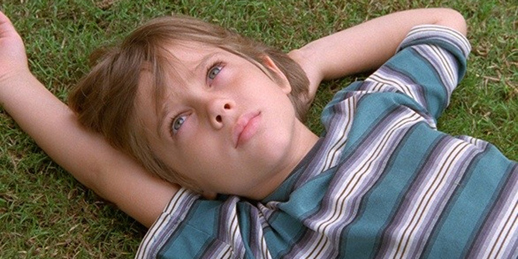
The first shot in Boyhood, Richard Linklater’s tender, profound film, is of a cloudy sky. The second is of a boy staring up at that sky, one arm bent under his head, the other flung out straight on the ground. He’s a pretty child with calm eyes, a snub nose and a full mouth. It’s a face that you get to know and love because, even as this child is watching the world, you’re watching him grow. From scene to scene, you see the curve of his jaw change, notice his thickening brows and witness his slender arms opening to embrace the world and its clear and darkening skies.
Filmed over 12 consecutive years, Boyhood centres on Mason (Ellar Coltrane), who’s 6 when the story opens and 18 when it ends. In between, he goes to school; argues with his sister, Samantha (Lorelei Linklater, the director’s daughter); and watches his mother, Olivia (Patricia Arquette), struggle with work and men while paying the bills, moving from home to home and earning several degrees. Every so often, her ex-husband, Mason Sr. (Ethan Hawke), roars into the children’s lives …
The film’s visual style is precise, unassuming to the point of seeming invisibility and in the service of the characters, with compositions that remain unfussy and uncluttered, even when the rooms are busy. When Mr. Linklater films a landscape, your eye locks not on the camerawork but on the beauty of these spaces and the people in them — the enveloping greenness of the neighborhood in which Mason first rides a bike, and the tranquillity of the watering hole that he swims in with his dad.
Radical in its conceit, familiar in its everyday details, Boyhood exists at the juncture of classical cinema and the modern art film, a model of cinematic realism, its pleasures obvious yet mysterious. in Boyhood, Mr. Linklater’s masterpiece, he both captures moments in time and relinquishes them as he moves from year to year. He isn’t fighting time but embracing it in all its glorious and agonizingly fleeting beauty.

star.jpg star.jpg star.jpg

And, finally, my favourite review of Boyhood, the best non-review review you’ll read all year, the most soul-baringly evocative writing you’ll read anywhere, anytime in 2014. Make sure you click on the Hitfix link below.
Drew McWeeny, Hitfix
I am nine years old. I am lying in the back of the 1977 Plymouth van my parents are driving. It is the middle of the night, and we are leaving Dunedin on the first leg of our move to Texas. I am crying. My best friend Oli Watt, my next-door neighbor, said goodbye to me earlier in the day, and we’ve made promises to write and call on the phone, but I know that I am leaving behind the life that I’ve enjoyed up to that point and that whatever comes next, it will be different, and I am afraid, and I am sad, and I am sure that nothing will ever be this good again.
I am sixteen years old. I am lying in the back of the car driven by my nineteen year old girlfriend. It is the middle of the night, and while I’m supposed to be at school in the morning, I don’t care at all. I am stoned and drunk and happy. My parents hate this girl that comes to pick me up in the middle of the night, who always knows where there’s a party, who has way more sexual experience than me, and they’ve tried to stop me from seeing her, but I am desperate for what I see as necessary sensual memory, fodder for the writing that I want to make a career of, and I know that it’s destroying the relationship I have with my parents who I adore for adopting me, but I have to do this, I have to live like this, and it is amazing and it is dizzying and I am sure that nothing will ever be this good again.
I am twenty-six years old. I am sitting on the bed in the room I share with the woman I am about to marry, and she has just told me that she is leaving. I am yelling at her, but I can’t hear myself. I’m thinking about all the plans, all the conversations, all the promises, and I am thinking about the child we almost had, the choice that was made, the horrible space it left between us that nothing has worked to fill. I am crippled by both the love I have for her and the yawning suspicion that I really am a terrible person, not worth the love she’s wasted on me, and I know that if she leaves, I’m done, there’s no way I ever find anyone else, and I am sure that nothing will ever be this good again … read on

Ellar Coltrane, six years of age, in Richard Linklater's Boyhood

Life Itself: A Cinematic In Memoriam to Roger Ebert

Life Itself, now playing on 4 evenings only — July 13, 14, 15, 17, at 7pm — at the Rio Theatre


The most popular film reviewer of his time, who became the first journalist to win a Pulitzer Prize for movie criticism and, on his long-running TV programme, wielded cinema’s most influential thumb, following a lengthy and debilitating illness, Roger Ebert died on April 4, 2013. He was 70.
Based on Mr. Ebert’s own memoir, titled Life Itself, as is the Steve James documentary now playing in Vancouver in exclusive engagement at the Rio Theatre, James’ film tracks the life of Roger Ebert — who, as we say above, was the most famous and affectionately regarded of American movie critics, a Pulitzer Prize-winning reviewer for The Chicago Sun-Times who, in company with Gene Siskel, improbably became a globally known television star, and whose encroaching mortality made him appreciate life all the more — Life Itself is this summer’s must-see, award-winning documentary.
Don’t take just our word for such assertion. Have a look at these reviews:
Owen Gleiberman, Entertainment Weekly
Life Itself, a deeply enthralling documentary about the late film critic who changed film criticism, Roger Ebert was such a compelling writer, thinker, talker, and human being, it didn’t matter whether you agreed with him — he had a way of putting things that was pithy and practical and philosophical all at the same time. Over the last few years, when Ebert struggled, heroically, against the cancer of the jaw that resulted in his drastic facial surgery and the loss of his voice, his life became more public than ever, largely because Ebert chose to make it public (on his blog, and in his memoir).
Steve James, the documentary master who made Hoop Dreams, uses Ebert’s final months as a prism to put the pieces of Ebert’s life together — the sweater-wearing, thumb-wielding TV icon who turned his weekly on-air battles with Gene Siskel into a take-no-prisoners conversation that defined what criticism was for a new generation — all that and more is explored in James’ extraordinary, wondrously fascinating and implacable cinematic vision of film criticism’s most dazzlingly brilliant and insatiable writer.
Geoffrey O’Brien, New York Times
Life Itself, Steve James’s (Hoop Dreams) documentary on the life of Roger Ebert, is in many ways like a wake at which intimate acquaintances warmly recall their departed friend in all his aspects, foibles and quirks along with his talents and triumphs. Deep currents of love and sorrow flow under the succession of often funny recollections of a busy life. But it is a wake where the departed is still present.
This is not only a film about Roger Ebert but also a film very much with and by Roger Ebert, who refused to be laid low by the medical catastrophes of his last years. A friend describes him as having been, early on, “not just the chief character and star of the movie that was his life, he was also the director.” Life Itself is indeed broadly shaped by Ebert’s own interpretation of his life and clearly marked by his sense of what kind of film it should be.
In the film, Ebert’s words are joined by those of many others: filmmaker friends like Martin Scorsese and Werner Herzog, and old acquaintances whose deep fondness is apparent but who don’t gloss over his complications and confusions, from his outwardly rowdy days hanging out at O’Rourke’s in Chicago (he stopped drinking in the late ’70s) to the defensive petulance sometimes provoked by Siskel during their on-air critical brawls. (“He is a nice guy,” one friend smilingly comments, “but he’s not that nice.) There is a rich aura of journalistic camaraderie and Chicago solidarity. When The Washington Post’s editors tried to lure him away with a big-money offer, Ebert told them, “I’m not gonna learn new streets.”
Life Itself is a work of deftness and delicacy, by turns a film about illness and death, about writing, about cinema and, finally, and very movingly a film about love. In Life Itself, we are at last unavoidably caught up face to face with the absence that even the liveliest of wakes must finally acknowledge.

Best of 2013: Music, Spanning Genre and Critical Recognition

Best of 2013

VanRamblings’ two favourite times of year occur from mid-July through the end of August, a six-week celebration revolving around the anniversary of our coming to this Earth (at least in this incarnation, in this time and place and history of life on our planet), and the period beginning in mid-
November through until December 31st. We have long been a romantic about most aspects of life, and love the idea of simply taking a bit of time off from the hurly burly of our everyday, and often too busy, life to reflect on the conditions of our existence, a deep and abiding reflection, a process in which we seek to provide meaning, context and, perhaps, resolution.
Within that contextual framework is contained our love for the arts — dance (we love the ballet), music (mostly of the pop culture variety, although we love progressive country), film, anything tech-related, literature, television, and the art of politics, which is to say, the political maelstrom that is public engagement early in this new millennium.

star.jpg star.jpg star.jpg

In this first of five columns on the Best of 2013, we’ll survey a cross-section of critical opinion on the best music of the year, much of which art you may have been utterly unaware of prior to the writing that’ll appear below. As a means by which to introduce new music into your life, there is no more salutary event than that which occurs at year’s end, as you (and I) become aware of the music of our age, through a survey of informed critical opinion — always a life-enhancing event offering steadfast insight, in the most propitious, enlightening and expedient manner possible. Yippee!

Best Music of 2013

There was a time, in recent years, when we turned to Salon (in its heyday, in the late 90s through 2005), Rolling Stone, the now defunct and the much-missed Blender magazine, but since 2009, Popmatters has been the go-to place for insight into the Best Music of the Year. Yes, we know there’s NME and Paste (now available online only), Q, Pitchfork, Mojo and more, but we’ll stick with Popmatters, at year’s end, for our annual hit of unexpected and oh-so salutary musical insight.
Here’s Popmatters ‘best of music’ home page, detailing the 75 Best Albums of the Year, Best Canadian, Country, Metal, Indie-Pop, and more …


Popmatters' 75 Best Albums of 2013


Making Popmatters’ 75 Best Albums of 2013 list, at 72. The Boards of Canada; at 63. the ever-present Lorde; at 47. David Bowie’s The Next Day; 42. Julia Holter (a favourite of our friend, J.B. Shayne); 38. Rhye, to whom we introduced you earlier in the year; 27. Queens of the Stone Age; 24. Our very own Tegan and Sara; at 9 and 8, the breakout bands of the year, Haim and CHVRCHES, and at number one … well, who else would you expect? But you’ll have to read through to be sure you guessed right.
One of our favourite discoveries is a duo out of England, with whom our son Nathan has long been familiar, but is new to us this year: 4. Disclosure, who represent the very best danceable British garage house music of 2013.

Now, make no mistake, there’s more, a great deal more …

And, of course, much, much more.
In the The Best Country Music of 2013 category, we discovered a couple of artists with whom we were not previously familiar, Brandy Clark, and our favourite roots, working class, progressive country find of the year, Kacey Musgraves, who’s making a whole tonne of Best Of lists in 2013.

star.jpg star.jpg star.jpg

We leave you, dear and constant reader, with a survey list of the Best Music of 2013, critical reception from some of our favourite publications …

Lots to listen to, lots to grok. Good luck. Enjoy. Merry Christmas!

Salmon Confidential: Dying Salmon, Destruction of an Ecosystem

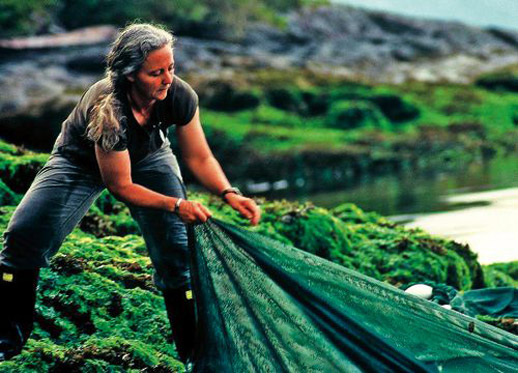
About two-thirds of the way through Twyla Roscovich’s maddeningly compelling documentary, activist marine biologist Alexandra Morton and a few cohorts with whom she works on the study of the impact of salmon farming on Canadian wild salmon, enter the Real Canadian Superstore at Rupert Street and Grandview Highway, in Vancouver.
The scientific foray into the community involves purchasing all the salmon available at the store, in order that their purchase might be shipped to a laboratory in Europe, and another on the east coast, to test for the infectious salmon anemia (ISA) virus, and other pathogens.
The result? Suffice to say that anyone who watches that particular sequence in Roscovich’s provocative documentary film — available above in today’s VanRamblings post — will never eat farmed salmon ever again.
Here’s Ian Bailey’s Globe and Mail review of Salmon Confidential

This feisty and provocative film is spoiling-for-a-fight cinema. Someday there will be a new feature-length documentary reconciling both sides of the debate over the environmental costs of farming salmon in B.C. For now, there’s this compelling work which tilts sharply towards the wild-salmon side. Director Twyla Roscovich’s visually alluring film spotlights activist biologist Alexandra Morton as she finds B.C. salmon in the wild showing European viruses that Ms. Morton links to fish farms on the coast. Federal and industry representatives declined to sit for interviews, Ms. Roscovich has said. Still, the film serves as a forceful primer on an ongoing debate that some viewers, especially those in urban areas, may now just be catching up on. Let the debate begin after the end credits.

Hey, it’s The Globe and Mail — you expected an evisceration of the role of both the provincial and federal governments for their failure to act to protect wild salmon, or the health of Canadians? Not the world we live in.

Alexander Morton, in a scene from Twyla Roscovich's Salmon Confidential

Greg Ursic, in The Ubyssey, says about the film “Salmon Confidential is thoroughly researched, informative and so infuriating that you’ll want to throw something at the screen.” Jason Coleman, at Star Pulse, agrees with VanRamblings, when he writes …

You will never eat farmed fish for the rest of your life after viewing this. A must-see, especially for British Columbians known for world-renowned Sockeye, Salmon Confidential is a corker of a doc. It’s staggering and eye-opening to see how the business of B.C.’s natural resources and food has been tainted by government and how puppet scientists have given up their objectivity simply to kowtow to (corrupt) governments. This is the GMO monster in a different form and here the monster kills by passing on poisons and infection that are a recipe for extinction of a foundational salmon species. An important film right on par with The Cove impact-wise, Salmon Confidential is an important don’t miss it experience for all who care to listen. — 5/5 stars

Meanwhile, while our intransigent senior governments take a do nothing approach to the destruction of B.C.’s wild salmon industry, Norwegian authorities have recently ordered that some two million sea-lice infested farmed salmon in the Vikna district of Nord Trondelag be slaughtered with immediate effect after becoming resistant to chemical treatments against the sea-lice parasite. Actor Ted Danson and Andrew Sharpless, CEO at Oceana, the largest international conservation organization fully dedicated to protecting the oceans, have published a paper stating, and backing up, their contention that “farmed salmon are not a sustainable alternative.”
Enough? Whether you’re concerned for your health, wish to gain more insight into the “controversy” involving farmed salmon, or are simply interested in watching a provocative, compelling, and incredibly well-made and watchable documentary film, we would encourage you to screen Salmon Confidential — take our word for it, you won’t be sorry you did.