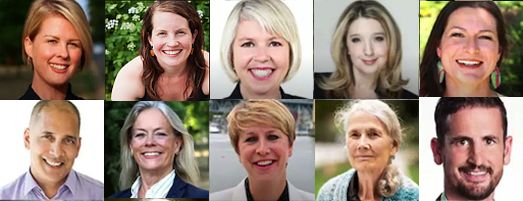
From a diehard VanRamblings reader (and friend and associate, who holds VanRamblings to account), a former Park Board Commissioner, longtime politico, keen observer of Vancouver’s civic political scene, a well-respected local architect and designer, a city-builder, world traveler, husband and father, and sometimes, just sometimes, a bit of a curmudgeon…
“Not sure why you think these Councillors are doing such a great job!
In addition to being overly swayed by staff, these novice Councillors continue to sit back and leave the Vision Vancouver agenda intact, an agenda which got Vision un-elected, decimated, and an agenda that has resulted in so much damage to our City. As well, in each of your examples in your series this week on our City Councillors, the initiatives you think are so wonderful are contradicted by other decisions they have made.
In particular, Councillor Boyle’s energy shift sounds great if it is meant only to be read. But, think about how each of these ideas can be realized. She wants all neighbourhoods to be walk / bike / transit-friendly, and to use wood frame construction, and yet she voted to support the Skytrain SUBway, and it’s greenhouse gas-spewing green glass concrete towers, unfriendly to neighbourhoods, our seniors’ population and young families.
If Councillor Christine Boyle was really as good a listener as you suggest she is, as a first term Councillor she could have taken advice from knowledgeable people (think: Patrick Condon) that the two approaches are not compatible. Only Councillors Colleen Hardwick and Jean Swanson seem to have their heads screwed on straight on the transit file.
I am surprised (and disappointed), as well, to learn that Councillor Adriane Carr continues to support bonus density policies that have long proven to be and are destructive to neighbourhoods. Meanwhile, her Green seatmate on Council, Pete Fry, is trying to get everybody to drive no faster than 30kph when the most energy efficient speed is 38-40kph. While that gets him media coverage, is that sensible Green policy?
Perhaps a better sum up of Council’s performance to date is a ‘hmmm‘”.
- Bill McCreery, architect, VanRamblings reader, politico, keen city observer.
Much of what Bill McCreery writes in indisputable; he, like many across our city, is frustrated at the slow pace of change at City Hall and the cumbersome nature of decision-making, not to mention an unbecoming naïveté and acquiescence to staff, masked as the defining, seemingly newfound ethos at City Hall, now guided by “being respectful of others.”
There’s a lot of that going on at Vancouver School Board, as well - which not only makes for dull politics, it makes for unproductive, unfocused politics, politics too often in the sway of an entrenched bureaucracy, with the decision-making that takes place not for the people, but rather at the expense of the interests of the very people who elected our city officials into office, responding to a campaign of hope for better, when all we’re getting now is the same ol’ same ol, an utterly unacceptable status quo.
The lack of action thus far in civic governance is frustrating, maddening.
Swept into office on a wave of optimism and the belief that change, change for us, for parents & for children, for seniors & for renters, for the disenfranchised, for the struggling single mother and all the struggling families across our city was possible, and as assiduously as our electeds apply themselves to their work at City Hall, day-by-day, and week after frustrating week, the hope the electorate felt emboldened by last October fades into the miasma of an “I’m alright, Jack” ethos that has set our well-heeled civic officials apart from the “hoi polloi” who thrust them into office.
 Sadhu Aufochs Johnston, the City Manager of Vancouver, British Columbia, the CEO.
When Mayor Gregor Robertson and his majority Vision Vancouver Council assumed office at City Hall in December 2008, the first order of business for the fledgling party was to appoint a new City Manager to carry out the programme the party had announced, run on and committed itself to during the course of their thirty-day (and night) winning campaign for office.
From 1999 until 2008, when she was unceremoniously turfed from City Hall, Judy Rogers was the city manager for the City of Vancouver, our city’s first female city manager. At the time of her dismissal by the new Council, Ms. Rogers had worked for the city of Vancouver for 25 years, spending 10 years in the role of city manager, after having become assistant city manager in 1994, and deputy city manager in 1996. She started her new employment as Vancouver City Manager on New Year’s Day in 1999.
In 2008, within one week of Vancouver Mayor Gregor Robertson taking office, Rogers was fired by Robertson to be replaced by Dr. Penny Ballem — who had only recently voluntarily left her role as Deputy Minister in the province’s Ministry of Health — as the new head of Vancouver’s civic administration, to provide a “fresh start” for Robertson’s and Vision Vancouver’s agenda. Ms. Rogers received $572,000 severance pay.
The catchphrase around Vancouver City Hall from late 2008 until September 15, 2015, when Mayor Robertson announced that Dr. Ballem’s service had “concluded” and Sadhu Aufochs Johnston would be her replacement was “get ‘er done.”
Dr. Ballem well understood her role: fulfill Vision Vancouver’s agenda, don’t second guess the decision-making of the new Vision Vancouver Councillors and Mayor, pave the way for substantive change and remove any impediments to change, and under no circumstance, ever, ever, ever use the word “no” when addressing Vision Vancouver Councillors, and the Mayor, during Council meetings, or when Council was in session at City Hall.
Finally, though, the people of Vancouver (and the Vision Vancouver Council) had had enough of Dr. Ballem’s strong-armed tactics, as the years went by her loyalty to her “masters” proving increasingly counterproductive to the carrying out of the Vision Vancouver agenda. Mayor Gregor Robertson all but promised the electorate during his 2014 campaign for office that he’d get rid of the cantankerous, and to many off-putting, Dr. Ballem — and after a 10-month delay, on Sept. 15, 2015 he proved true to his word.
Dr. Ballem received $556,595 in a severance package when she left Vancouver City Hall.
On September 1st, 2009 Dr. Penny Ballem announced that Sadhu Johnston would be hired as Deputy City Manager to lead the city’s environmental efforts. Note should be made that Mr. Johnston’s hiring was not that of Dr. Ballem, but of Mayor Gregor Robertson and the Vision Vancouver braintrust, who had come to know and like Sadhu Aufochs Johnston through their mutual association at Cortes Island’s Hollyhock “Lifelong Learning Centre”, which a few reporters have inferred is a “cult”, as Georgia Straight reporter Shannon Rupp wrote in an article published in The Straight on March 28th, 1996, with Rupp writing that the …
“… artificial feeling of love & acceptance is what people are paying for, but I have to admit I find these get-togethers oppressive. Perhaps the most annoying aspect of Hollyhock is its culture of conformity — Goddess forbid anyone should question anything. After five days here, I’ve found Hollyhock is really two places: the site itself is delightful, but the half-baked spiritual and psychological concepts it peddles make me uneasy.”
Over the course of the past six months as the new Mayor and eight novice Councillors have settled into their term of office and their newfound responsibilities at City Hall, as VanRamblings has attended or watched City Council and committee meetings, we have observed city manager Sadhu Johnston consistently, egregiously and unremittingly turning into “Dr. No.”
When Vision Vancouver were in power, telling the Mayor and Vision Vancouver Councillors that they couldn’t do something they had their minds set on, or even implying that there was a “no” in his address to Vision Vancouver electeds would have been tantamount to a tendering of his resignation — Sadhu Johnston was kept on at City Hall after the dismissal of Dr. Penny Ballem, to carry out Vision’s agenda, which he does these days every time he speaks at Council, and every time he scolds a Councillor with a near denunciation of their naïveté, that his is “the way things are done.”
 Malcolm Bromley, General Manager of Vancouver Park Board since July 2010
The time is nearing for our current City Council to put their stamp on civic governance in the city of Vancouver.
More than one Councillor — and dozens of VanRamblings’ readers — has expressed a concern about how, as Bill McCreery puts it at the outset of today’s post, that some Councillors have been “overly swayed by staff” and that a change of city staff will be required in order that our new Council might fulfill their campaign commitments to the people of Vancouver.
“There are those of us who’d like to see a change at the top,” various Councillors have told VanRamblings, “but having to pay more than $550,000 in severance pay to the city manager, or the $1.2 million Vision Vancouver paid out in severance money to 11 employees in 2016 is just not palatable, to Councillors or the public.”
VanRamblings is not suggesting that Sadhu Johnston be fired or dismissed, rather that the accomplished Mr. Johnston be transitioned into another position of authority at City Hall, while maintaining his current salary.
Vancouver’s Mayor and Council need a leader at the top of the City Hall bureaucracy who will carry out their agenda, and not the defeated Vision Vancouver agenda. Who would that person be to replace Sadhu Johnston?
Take a look at the photo above — that is Malcolm Bromley, the current General Manager of the Vancouver Park Board, who is one of the most passionate persons with whom VanRamblings is acquainted about city-building. Most of the members of Council are familiar with the many accomplishments of Mr. Bromley, his commitment to democratic engagement, and finding a path that will enable the electeds to carry out their commitment to the citizens who elected them to office.
Councillors Melissa De Genova, Sarah Kirby-Yung and Michael Wiebe sat on Park Board when Mr. Bromley was GM. In 2014-15, when Sarah Kirby-Yung was Park Board Chairperson, Malcolm Bromley was instrumental in helping Ms. Kirby-Yung fulfill her commitment (and it was her commitment to the people of Vancouver, and not to her Non-Partisan Association party) to ban cetaceans (whales and dolphins) in captivity in Stanley Park.
VanRamblings has written previously that UBC’s Patrick Condon, Park Board’s Malcolm Bromley, and the Green Party of Vancouver City Councillor Pete Fry are the finest minds in our city on the topic of city-building, the three seasoned urban geographers familiar and admiring of the work of each member of the triumvirate VanRamblings has identified above.
Fiscal responsibility is always a concern in governance. Transitioning Malcolm Bromley from Park Board General Manager to the role of city manager, while maintaining his current salary (although he’s due for a raise), perhaps transitioning Sadhu Johnston into the role of GM of Environmental Innovation, while maintaining his salary, downsizing City Hall’s bloated communications department, would mean savings in staffing costs — and a better run city, with a bureaucratic governance in place that will facilitate the agenda of Mayor & Council, rather than appear to impede.
As we say above, “the time is nearing for our City Council to put their stamp on civic governance in the city of Vancouver,” to let the public know that they’re in charge and ready to get to work on the people’s business.

“The Death of Cynicism,” the name VanRamblings has assigned to this week’s series?
As VanRamblings has suggested throughout the week, the electorate of Vancouver displayed their unerring wisdom on Oct. 20 2018 in electing the finest group of change makers ever to sit around our city’s Council table.
Last year, when writing about the incoming Council, we wrote that it would take a year and half for our new Councillors to “find the bathrooms,” a metaphor for how long it would take new Councillors to begin to implement their agenda. And so it is, and is proving to be. Only by shaking up the bureaucracy at Vancouver City Hall, putting their own senior staff in place to carry out the new Council’s agenda, will this Vancouver City Council achieve their goal of creating a healthier, fairer and more just city for all.
VanRamblings remains confident that our new Council will usher in generational change, and that by 2022 the vast majority of the electorate will come to view governance in our city differently, knowing that the Mayor and all 10 Councillors are on their side, working for them, while achieving and putting into practice the change that will serve us all, each and every one of us, on the road to the death of political cynicism and the renewal of hope in our city, in every neighbourhood, across every diverse community.
 |
 |
 |