Category Archives: BC Politics

2019: The Year of Living Ferociously | Fight Back!

2019: The Year of Living Ferociously | Change is on Its Way

ferocious
Definition:
a raging of the soul, living with fierceness, determination, gravity, deliberate intention and intensity.

And so it will be in 2019, a year of progressive change unlike any other in a generation, across Canada, in British Columbia, in our little burgh by the sea, in the United States, across Europe and across the globe.
Make no mistake, though, necessary progressive change for the better will not come should we fail to band together to fight the forces of regression.

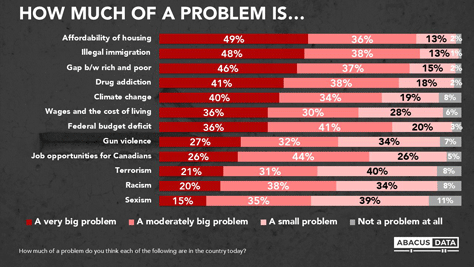
Abacus poll. Top issue in the 2019 Canadian federal election

  • Justin Trudeau has said that the 2019 federal election will be the ugliest in Canadian history. Make no mistake, Conservative Party leader Andrew Scheer will make it so — aided by Maxime Bernier, the leader of the so-called People’s Party of Canada, who will force the Conservatives further to the right — focusing as former Prime Minister Stephen Harper did on “fear of the other”, as Trump has done in the United States, demonizing the Muslim population and “illegal immigrants”. According to a recent Angus Reid poll, two-thirds of Canadians believe the influx of asylum seekers into Canada is a “crisis”, with 84% of Canadians who voted for the Conservative Party of Canada of the belief that “there are too many people claiming asylum and that Canada is ‘too generous’ toward them;”

  • In British Columbia, voting in the Nanaimo by-election to replace former BC NDP MLA Leonard Krog (who was elected Mayor of Nanaimo this past November) starts today. In late January, it’s a neck-and-neck race, with B.C Liberal candidate Tony Harris focusing on the botched roll-out of the government’s Speculation and Vacancy Tax, which forces every British Columbia homeowner to register their home with the government — failure to do so could result in a payout of thousands of dollars for unsuspecting, unregistered homeowners. If Harris wins, we’re looking at a late winter / early spring B.C. election, which bodes ill for any progressively-minded British Columbian & a return to the bad old days;
  • In Vancouver, we’re sitting pretty, with a largely progressive City Council (notice the number of unanimous or near-unanimous progressive votes — on transit, affordable housing, 58 West Hastings, a renter’s office, our current climate emergency, and much, much more). The success of our City Council, though, is almost wholly dependent on a federal Liberal government, complemented by a provincial NDP government — which, for instance, have set aside $52 billion dollars on the affordable housing file alone, monies which would most assuredly be withdrawn by a right-of-centre / “the market is always right” do-nothing Conservative government, and their B.C. kin, Andrew Wilkinson and the B.C. Liberals.

Closer to home for me will be the fight in which I engage throughout 2019 against the forces of repression, intolerance, despotism, racism, homo-and-transphobia and hatred of “the other” that has defined that portion of my life, resident in the housing co-operative where I have dwelled for 35 years.
2019 is the year to fight back, to demand better, to organize, to recognize that — as is evident in the time of Trump across the United States, and across Europe — that in 2019 all of us are in for the fight of our lives.

#VanPoli | Planning | How Did We Get Ourselves into This Pickle?

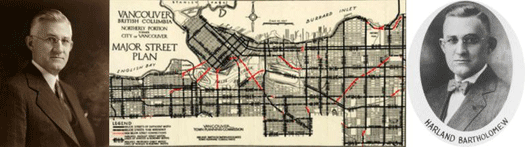
Harland Bartholomew, author of the 1930 Vancouver Plan

Harland Bartholomew (September 14, 1889 – December 2, 1989) was an American urban planner. Although a civil engineer by training & disposition, from 1911 through until the mid-1950s, Mr. Bartholomew emerged as the most influential urban planner of the first half of the 20th century, his considerable influence now thought to have had a profoundly negative impact on city development, administrative evil masked as “moral good”.
During the course of his lifetime, Mr. Bartholomew created comprehensive city plans for urban centres across North America, including …

  • 1911-1915 Newark, New Jersey;

  • 1916-1920 St.Louis, Missouri;
  • 1920 Memphis, Tennessee;
  • 1920-1921 Lansing, Michigan;
  • 1921-1922 Wichita, Kansas;
  • 1926-1930 Vancouver, BC;
  • 1930 San Antonio, Texas;
  • 1930-1934 St.Louis, Missouri;
  • 1932 Louisville, Kentucky The Negro Housing Problem;
  • 1953-1959 Washington, DC.

Before, during and after WWII, Mr. Bartholomew was appointed to the United States’ Federal Planning Committee by three Presidents, Herbert Hoover, Franklin D. Roosevelt and Dwight D. Eisenhower. In 1952, President Eisenhower appointed Mr. Bartholomew chairman of the National Capital Planning Commission, a position he held for seven years.
Mr. Bartholomew was an early advocate of slum clearance & city planning, serving on the U.S. Slum Clearance Advisory Committee. His ideas helped shape the Housing Act of 1937 & the Housing Act of 1949, and had a profound effect on the segregation of city neighbourhoods, ensuring that immigrants and the urban poor would be designated to one blighted city neighbourhood — including in Vancouver, skid row (now called the Downtown Eastside), the urban planning handiwork of Mr. Bartholomew.

Harland Bartholomew, author of A Plan for the City of Vancouver, 1930

In his June 17, 2017 essay on Vancouver’s Abundant Housing website, urbanist Reilly Wood records the following …

“When Bartholomew asked what abuses he should consider in the interim zoning by-law of 1927 he was preparing, the chairman replied that ‘the only serious abuse… is the intrusion of undesirable apartment houses into residential districts'” (Zoning and the Single-Family Landscape, p. 60)

Recently, at the November 13th meeting of Vancouver City Council, newly-elected OneCity Vancouver Councillor Christine Boyle moved an amendment to a motion calling for an updated City Plan that would have included in its mandate “a city for all, such that all neighbourhoods in Vancouver would include all types of housing, rental, co-and-co-op housing, and social housing.” Councillor Boyle’s amendment was supported only by Mayor Kennedy Stewart and COPE City Councillor Jean Swanson.
Old ideas die hard, it would seem, and the legacy of Harland Bartholomew looms large in the planning process within the City of Vancouver.
Nonetheless, VanRamblings believes that as a new, inclusive and neighbourhood sensitive City Plan is developed, the intent of Councillor Boyle’s heartening and necessary amendment will carry the day, with the near unanimous consent of the Mayor & her fellow City Councillors, persons of conscience, grit & integrity to their core, who mean well for our city, not just over the course of the next four years, but for generations to come.
How did Harland Bartholomew’s Ideas Shape Vancouver?

“Few cities possess such a combination of nearby natural resources, a splendid harbour, a terrain ideally suited for urban use, an equable climate and a setting of great natural beauty.

Vancouver is the most important Pacific port of a great country. Here, if anywhere, should develop a great city. Circumstances of such character call for a city plan of substantial scale.”

A Plan for the City of Vancouver, Harland Bartholomew & Associates, 1928, p. 10

From the outset, Harland Bartholomew was clear in stating his preference for single-family homes throughout the city, with Vancouver Town Planning Commission chairman Arthur Smith setting the tone by praising Point Grey’s early bylaw, explicitly segregating Vancouver by class, and noting the retention of single-family homes as a major goal …

“The wise foresight which Point Grey has used in planning at an early stage of its growth should provide Vancouver with one of the most desirable residential districts possessed by any city on the Continent, and those who have to gain their livelihood by manual labor should find in Hastings Townsite, and in a replanned South Vancouver, a place where they can build up modest homes which should differ only in size from that of the more opulent employers. The retention of Vancouver as a city of single family homes has always been close to the heart of those engaged in the preparation of this plan.” (A Plan for the City of Vancouver, p. 26)

Bartholomew further clarified his preference for single-family homes …

“As has been mentioned, Vancouver is largely a city of one-family homes and is surrounded by similar development in the adjoining municipalities. Large areas are now available for such development, though a considerable proportion has yet to be served by utilities. That the one-family dwelling is the desirable unit for happy living is the general concensus (sic) of opinion of all authorities. (A Plan for the City of Vancouver, p. 233-234)

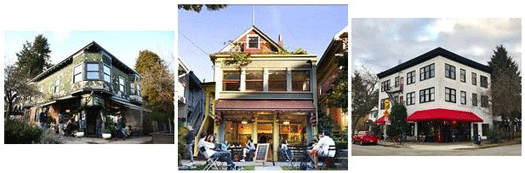
Neighbourhood stores in the City of Vancouver

Bartholomew was keen to keep stores out of residential neighbourhoods …

“The scattering of stores promiscuously throughout residence districts has done considerable damage to the city’s appearance. The nearly universal custom of building stores out to the street line has hurt the appearance of a good many residence streets and at the same time has injured adjoining lots by making them less desirable for living purposes and reducing their saleable value. The zoning by-law will remedy this condition and tend to prevent residence districts from becoming blighted.” (A Plan for the City of Vancouver, p. 247)

As Reilly Wood writes in his Abundant Housing essay …

“The contrast with modern-day Vancouver is remarkable, given that neighbourhood stores built before Bartholomew’s Plan are now many neighbourhoods’ most cherished jewels. Who would prefer the East Side without the Marché St. George, or the West Side without Arbutus Coffee? Bartholomew sought to completely eradicate small-scale retailers and meeting places from residential neighbourhoods, without questioning whether people might want to live near such amenities.”

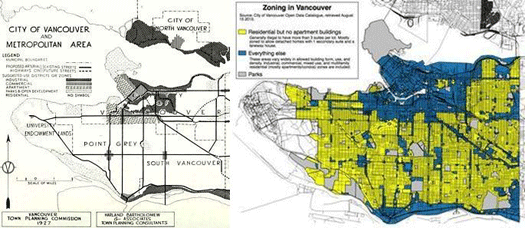
Bartholomew advocated for and succeeded in creating exclusionary neighbourhoods, imposing extravagantly large minimum lot sizes and yards, and as Wood writes could “be more accurately described as a suburban plan, designed by a man with a profoundly anti-urban bias. It would be laughable if we weren’t still living in its shadow.”

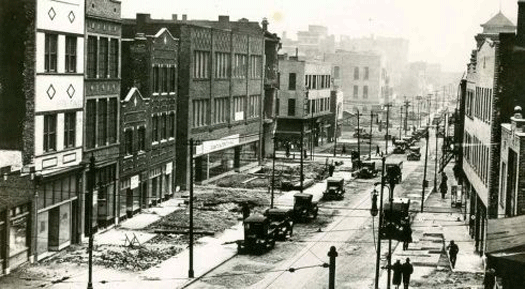
Urban planner Harland Bartholomew's plan for St. Louis, Missouri created a blighted cityFranklin Avenue looking East from 9th, 1928. Landmarks Association of St Louis.

Bartholomew’s urban plan for St. Louis, Missouri, is particularly instructive:

“City planner Harland Bartholomew rose in prominence along with the popularity of scientific city-efficient planning during the early to mid-twentieth century. In the pursuit of solutions to urban problems, Bartholomew concluded that the most efficient way to revitalize St. Louis, Missouri, was through the clearing of slums. In an attempt to solve the city’s economic and demographic problems, slum clearance destroyed and displaced Black neighborhoods whose 70,000 residents were seen as detrimental to the city’s success.”

In fact, as Dan Chapman of The Atlanta Journal-Constitution, writes

“The region’s psychic scars run deeper. St. Louis once was the nation’s fourth most populated city, a manufacturing and transportation colossus. It was the proud Gateway to the West, idealized by the soaring steel Arch along the banks of the Mississippi River.

A century ago, city fathers realized that blight, traffic, poverty, and fragmented government threatened St. Louis’ success. They hired a city planner in 1916 who, a year later, published the “Problems of St. Louis.” The city was at a critical juncture, an inflection point where long-term success might be guaranteed if the right civic decisions were made.

Harland Bartholomew, the planner, hoped that his report would “ultimately result in some action and action is St. Louis’ greatest need.” Action ensued, but not always the right kind.

St. Louis today ranks 27th in population and 45th in job growth among the top 50 metro areas. In hindsight, few imagined that the year 1916 would figure so prominently. Bartholomew’s embrace of urban renewal and highways-to-the-suburbs fueled the exodus from St. Louis as well as the region’s fragmentation and racism.

A residential segregation law passed that year established an ongoing pattern of racial separateness. The law was overturned, but the scars remain. Ferguson, for example, is two-thirds black, yet at the time of the shooting the mayor and five of six council members were white.

Ferguson affirms that we in St. Louis are in the geographic and cultural heart of America with all its issues and foibles,” said the Rev. Starsky Wilson, pastor of St. John’s United Church of Christ in St. Louis. “These are American problems.”

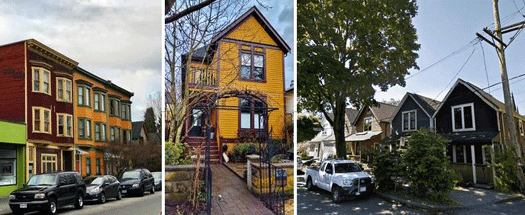
The Strathcona neighbourhood in Vancouver, the only neighbourhood zones for narrow lotsVancouver’s Strathcona neighbourhood was developed with narrow lots before Harland Bartholomew’s ideas were adopted. UBC urban geography professor Patrick Condon wants it known that in the 1960s, consequent of a state-sponsored urban renewal initiative, government sought to declare Strathcona a “slum”. David Gibson wants it known that “Strathcona was saved by the Strathcona Property Owners and Tenants’ Association (SPOTA), The Electors’ Action Movement (T.E.A.M.) Council of the early 1970s, supplemented by federal Opportunities for Youth (OFY) & Local Initiatives Projects (LIP) grants, “such that Strathcona continues to thrive to this day.

Blatantly racist development policy, intolerance, exclusive neighbourhoods where the working poor, persons with disabilities, seniors, those on social assistance, immigrants and refugees are all but forbidden from residence, and a blighted downtown neighbourhood riven with crime, hopelessness and an opioid crisis that is killing our city’s residents by the thousands — these are the critical challenges faced by our new Mayor and City Council.
A good place to start?
Undo and reverse the legacy of Harland Bartholomew, and begin anew.

#VanPoli | Orientation | Happiness | Collegiality | City Council

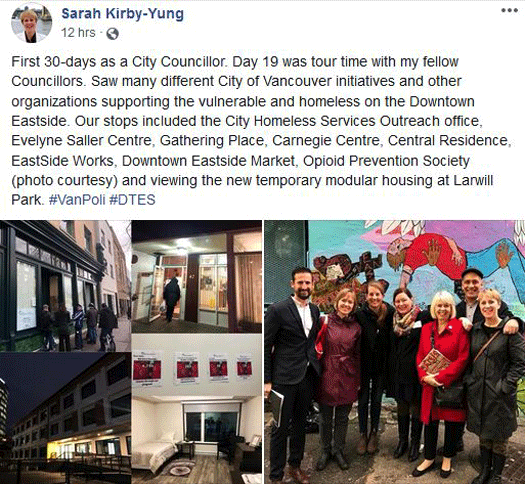
Day 19 of 30: Vancouver Mayor and City Councillor Orientation | Sarah Kirby-Yung

The glorious, thrilling and edifying 30-day orientation for the members of our new Vancouver City Council continues first thing this morning.
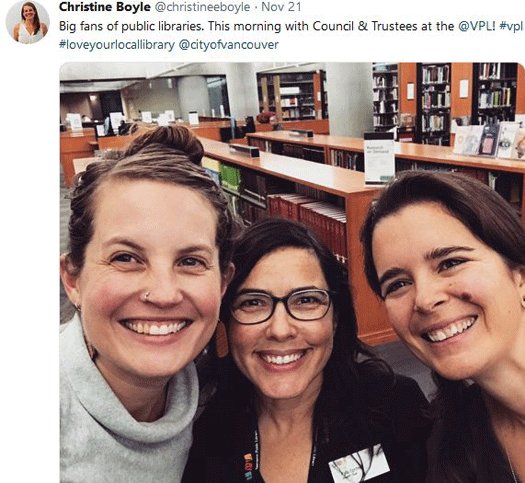
Clearly, Vancouver Non-Partisan Association Councillor Sarah Kirby-Yung and OneCity Vancouver Councillor Christine Boyle have proven to be the best communicators among our new crop of electeds — their social media feeds informative and an absolute delight to follow, with first-rate reportage to the tens of thousands of you who voted them into office. Good on them.

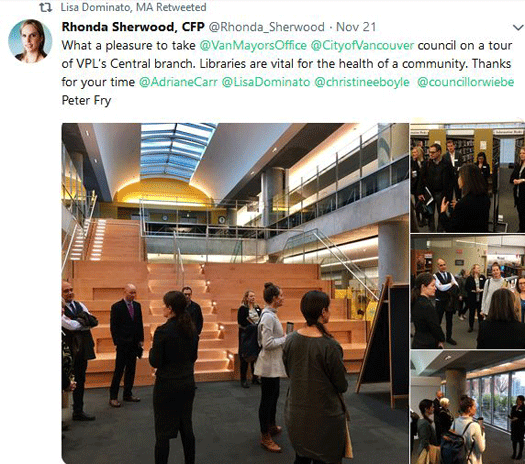
Day 15 of 30: Orientation of new Mayor and Vancouver City Councillors | Library | Christine Boyle

Day 15 of 30: Orientation of new Mayor and Vancouver City Councillors | Library

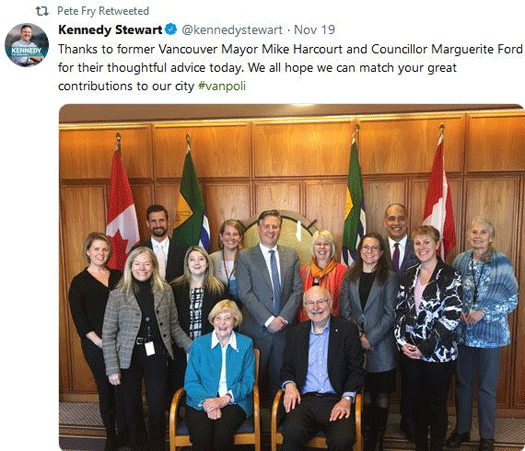
Day 18 of 30: Orientation of new Mayor and Vancouver City Councillors | Mike Harcourt, Marguerite Ford

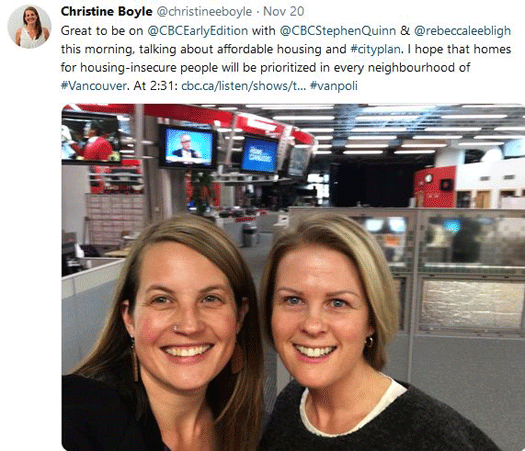
Day 14 of 30: Orientation of new Mayor and Council | CBC | Christine Boyle, Rebecca Bligh

If you’re not already following Councillor Christine Boyle on Twitter, you can do so at @christineboyle, while the incredibly wonderful Sarah Kirby-Yung at @sarahkirby_yung is another must follow — which you ought to do.

#VanPoli | Politics Comes to Park Board | Woe is Us

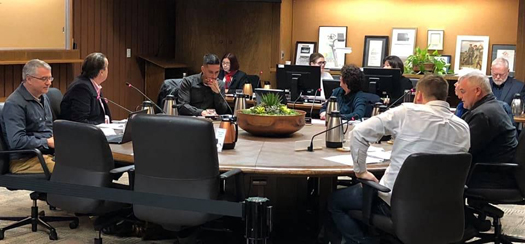
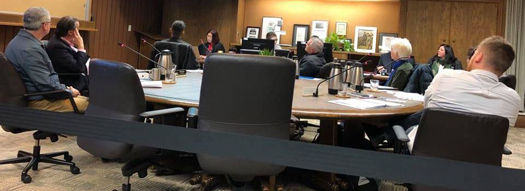
Park Board Commissioners, first business meeting of new term, Monday, November 19 2018Park Board Commissioners, l-r: John Irwin, John Coupar, Dave Demers, Gwen Giesbrecht and Tricia Barker (both obscured), Stuart Mackinnon, and Camil Dumont. On the far right (with a beard), the one, the magnificent Malcolm Bromley, Park Board GM.

VanRamblings has spent much of the month stating to anyone who would listen that there’ll be some politics at City Hall, and a whole bunch of politics at School Board, but the saving grace in municipal politics in Vancouver is our Park Board — where there’d be no politics, just good caring folks who have the best interests of Vancouver’s parks & recreation system at heart. Oh how wrong and naïve we were. Alas and alack.

The same sort of procedural wrangling that infected Council last week visited Park Board last evening.

Once again it was an amendment to amendment hellscape, this time around it was at the Park Board table, though, with a no-nonsense, takes no truck from anyone, by the book Gwen Giesbrecht in the Chair. Before we continue, note should be made we believe Ms. Giesbrecht can do no wrong — we’re so in her corner, we’ve moved in and set up permanent residence.

VanSplash logo

The first item on the agenda: setting up a VanSplash Advisory Committee, to advise Park Board on how to move forward on the VanSplash report.

VanRamblings happens to know that the eminence gris at Park Board (and one of the finest men we know), John Coupar (along with his colleague Tricia Barker) believes that the controversial VanSplash Aquatic Strategy has been talked and consulted to death, and that any reasonable person would know that Park Board should just get on with things, build much-needed community neighbourhood pools, preserve, renovate & update Templeton and Lord Byng pools, and jettison the neighbourhood-intrusive Olympic destination pool the authors of the VanSplash Aquatic Strategy threw their support behind — a plan vehemently opposed by community pool advocates, and the neighbourhood surrounding Connaught Park.

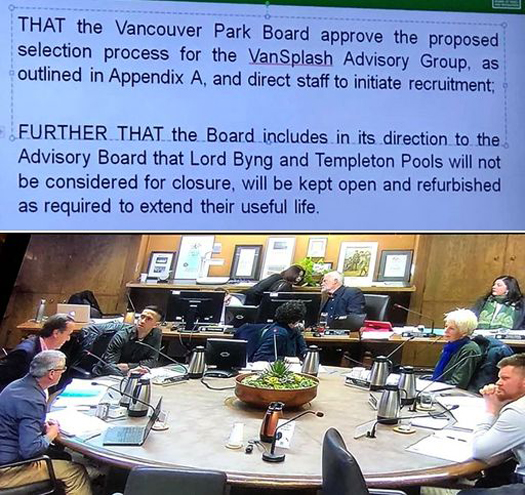
In an effort to play nice (realizing he and his colleague didn’t have the votes to quash the VanSplash Advisory Committee), Commissioner Coupar moved an amendment that would turn the attention of the Advisory Committee to preserving both the Lord Byng and Templeton pools (both recommended for closure in the original iteration of the VanSplash Report).

VanSplash Advisory Committee, amendment to preserve Lord Byng and Templeton pools

But Park Board Committee Chair Gwen Giesbrecht, no fool she, and one of the most well-experienced Board chairs in Park Board history, was having none of that palaver, no siree, Bob.

Not only would the amendment hamstring the new Advisory Committee, the mandate of the Committee had not yet been made clear — the amendment was ultra vires. On the advice of the clerk — with whom Commissioner and Park Board Committee Chair Giesbrecht consulted, and who advised the amendment was not an amendment, but a whole separate motion that would have to be put on notice for a future meeting — causing Ms. Giesbrecht to rule the amendment out of order. Bear with us — the amendment will live on to fight another day, in another form (and pass).

Lulled to sleep, yet? Okay, okay — we’ll leave VanSplash for now.

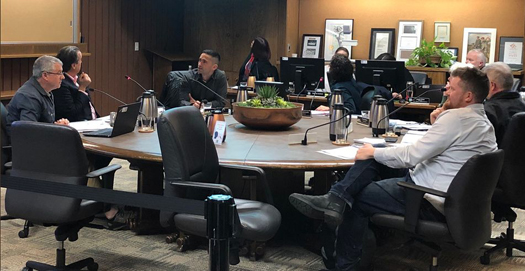
Park Board Commissioners, first business meeting of new term, Monday, November 19 2018

Topic 2: Where the (Ugly) Politics Comes in. 

Chair Giesbrecht called for a 5-minute break after the contentious “debate” on the questionable VanSplash Advisory Committee. Fine & dandy with us!

Given that we’re a snoop, we listened in on a conversation Park Board Chairperson Stuart Mackinnon was having with former Park Board Chair, Anita Romaniuk, where he was exclaiming to her how he’d consulted with all of the Commissioners before assigning them to their Park Board liaison and other responsibilities.

Migawd, it’s been a long time since we’ve heard such codswallop.

Earlier in the day, we had been advised that Chairperson Mackinnon had not assigned John Coupar as the liaison to the Van Dusen Botanical Gardens — perhaps the meanest, most off-putting, partisan act by an elected official in this or any other term. Colour us mightily disgusted.

The Bloedel Conservatory, now inexorably linked to the Van Dusen Botanical Gardens, is entering its 50th year, which it will celebrate next December 9th. John Coupar’s claim to fame in Vancouver politics, as a former member of the Board of Director of the Van Dusen Botanical Gardens, was in convincing the Gardens Board to take over the Bloedel Conservatory at Queen Elizabeth Park, when the previous Vision Vancouver Park Board wanted to shut it down. John fought against the closure, found the funding to keep the Conservatory alive, such that the Conservatory thrives to this day. John Coupar loves the Van Dusen Botanical Gardens and the Conservatory atop Queen Elizabeth Park.

At their worst and their meanest, the Vision Vancouver Park Board Commissioners would never have dreamed of denying John Coupar the job of liaison to the Van Dusen Botanical Gardens and the Queen Elizabeth Park Conservatory / Aboretum. But Stuart Mackinnon has done just that.

And in its 50th anniversary year.

Whose father was the founding curator of the Bloedel Conservatory? Gosh, could it be John Coupar’s father? Hmmm, yep, it was.

And who was present at the opening of the Bloedel Conservatory / Arboretum on December 9th, 1969, standing next to the father he loved, and who passed on to him his love of parks? Gosh, could that boy standing next to his dad at the opening of the Conservatory on that chilly Tuesday morning, December 9, 1969 be John Coupar? Yer darn tootin’ it was …

John Coupar had asked Mr. Mackinnon to be re-appointed as the liaison to the Conservatory in its 50th year, so he might help prepare for the anniversary. But Stuart Mackinnon?

He all but told John Coupar to go to hell.

VanRamblings being VanRamblings, we queried Stuart Mackinnon on his decision to strip John Coupar of his liaison responsibilities to the Conservatory, particularly in its anniversary year, and the Van Dusen Botanical Gardens. His voice dripping with a haughty and indifferent mix of derision and condescension, he simply looked down on us and said, “Thank you for the input, Ray,” and walked away, nose held high in the air.

In Vancouver folks, this is what we call petty politics of the worst kind.

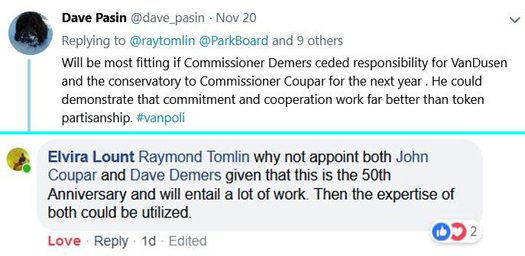
Update: Park Board Chair Sober Second Thought. John Coupar Appointed as Liaison to Van Dusen + Conservatory for 2019

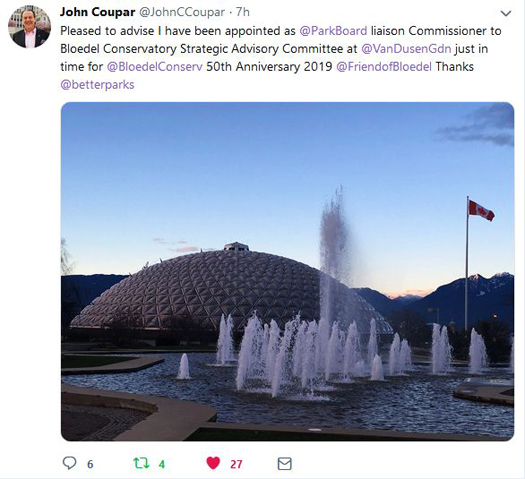
Consistent with everything VanRamblings knows about Park Board Chairperson Stuart Mackinnon — whom we have long known to be a heart-filled person of conscience, and one of the finest men it has been our privilege to come to know — Chairperson Mackinnon, engaging in sober second thought, re-thought his original assignment of responsibility to the Bloedel Conservatory and the Van Dusen Botanical Garden, and less than 18 hours after the publication of today’s VanRamblings column, appointed Commissioner John Coupar as Park Board liaison to the Bloedel Conservatory + Van Dusen Botanical Garden for the 2019 calendar year.

Sober second thought: Park Board Chair Stuart Mackinnon appoints John Coupar as liaison to Bloedel Conservatory + Van Dusen Botanical Garden

VanRamblings would like to thank community members Dave Pasin and Elvira Lount for helping bring the above matter to resolution.

John Coupar appointed liaison to Bloedel Conservatory, as Park Board Chair responds to community

And don’t think that it was Mr. Coupar alone who was made subject to Stuart Mackinnon’s non-consultative decision-making. John Coupar’s good-hearted NPA colleague Tricia Barker had asked Stuart Mackinnon if she might be the liaison to the Seniors Advisory Committee at City Hall — given that Ms. Barker is a certified personal trainer who works with seniors in building a healthier, more productive life, while facing the challenging aspects of aging. Chairperson Mackinnon assigned Ms. Barker as the liaison to City Hall’s Youth Committee instead.
Commissioner Barker asked Stuart Mackinnon if she might be assigned as liaison to the Dunbar and Kerrisdale Community Centres, where she knew and had worked with staff. Instead, Stuart Mackinnon assigned Ms. Barker as the liaison to the Champlain Heights and Killarney Community Centres.

Note. Revised Park Board Liaison appointments by Park Board Chair Stuart Mackinnon have been made, that correspondence to Commissioners dated November 20th, the appointments effective January 1, 2019, or sooner.

Park Board Commissioners, first business meeting of new term, Monday, November 19 2018

Lest you be left with the impression the Park Board Committee meeting room is Dysfunction Junction, let us assure you that is not wholly the case.

Whatever Mr. Mackinnon’s faults — after all, whom among us does not have faults? — he cares desperately about Vancouver’s parks and recreation system, and long has been a staunch advocate for our parks system. The same is true for each of the other electeds at Park Board: truth-teller Camil Dumont, take no guff Gwen Giesbrecht, heart-filled Dave Demers, passionate John Coupar, parks advocate extraordinaire Tricia Barker, the mighty, velvet-gloved and oh-so-bright John Irwin, and just about our favourite person on Earth, Park Board General Manager Malcolm Bromley.

Parks and recreation is in great shape with the above-named persons.

Queer Arts Festival Grant Application to Vancouver Park Board

On to the second to last item in today’s VanRamblings column, as our beloved and persons of conscience Park Board Commissioners unanimously approved a $35,000 grant to the Queer Arts Festival, the motion moved by Commissioner John Coupar, seconded by Tricia Barker, and amended by Gwen Giesbrecht to raise the sum to $35,000 — which motion and amendment passed with, as we say above, unanimous consent.

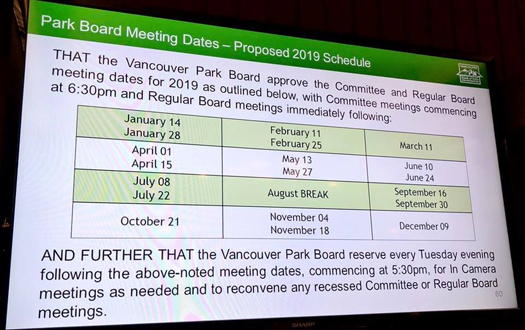
Vancouver Park Board 2019 meeting schedule

In 2019, the Vancouver Park Board will meet 21 times, with a month break in August, and only one meeting in each of March (spring break), October and December. Chances are the Board will meet more often than that, tho.

For instance, although the Park Board Commissioners meet in open session, next, on Monday, December 3rd, Chairperson Mackinnon announced to his fellow Commissioners on Monday night that there’ll be a Budget Committee meeting on the evening of Wednesday, December 5th — chances are, there’ll be more than one budget committee meeting, as there will also likely be community consultative meetings throughout the year.

Compensation
for all their hard work? The Park Board Chair receives $21,346 per year in compensation, whereas our Park Board Commissioners are paid $17,077 for each year of their tenure — for what generally works out to be a 35 – 40 hour week, although most Commissioners put in more hours than that, in their liaison work, and in work in the community.

Little known fact: the Park Board meeting schedule mirrors that of Vancouver City Council, with Park Board meeting on Monday evenings, and Council meeting all day Tuesday, Wednesday and Thursday.